


29 Sep The Ultimate Online Review Platforms Comparison for Smart Businesses
The Ultimate Online Review Platforms Comparison for Smart Businesses
Choose a Review Platform That Matches How Customers Find You
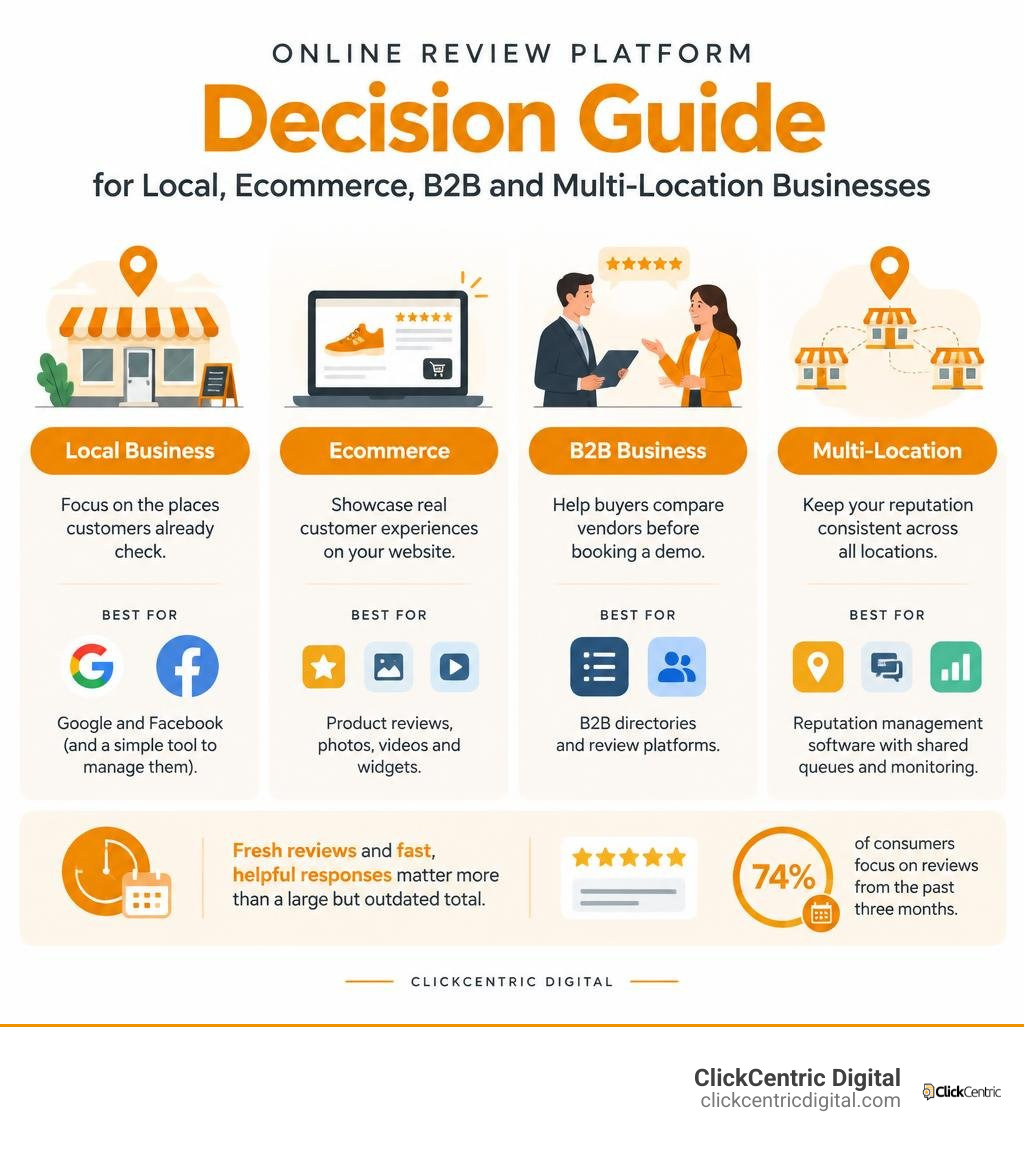
The best online review platform is not always the one with the most features. For a local business, start with the places customers already check – usually Google and Facebook – then choose a tool that makes it easy to request, monitor, and respond to reviews across those channels.
For this online review platforms comparison, use this quick rule:
- Choose public third-party networks when independent credibility and brand-search visibility matter most.
- Choose on-site review tools when you need product reviews, photos, videos, and widgets on your website.
- Choose reputation management software when you manage multiple locations, need shared response queues, or want broad review monitoring.
- Use B2B directories if you sell software and buyers compare vendors before booking a demo.
Star ratings matter, but fresh reviews and fast, helpful responses often matter more. Research cited in this guide suggests that 74% of consumers focus on reviews from the past three months. That means a steady review process can be more valuable than a large but outdated review total.
The rest of this guide breaks down the platforms, workflows, integrations, and pricing details that help smart businesses choose with confidence.
Online review platforms comparison terms to know:
Comprehensive Online Review Platforms Comparison: Core Architecture and Platform Types
Every customer review ecosystem runs on one of three distinct software architectures: B2B marketplaces, B2C e-commerce widgets, or multi-channel local reputation hubs. Choosing the wrong framework creates endless friction. An e-commerce brand that purchases enterprise B2B directory placements will struggle to collect product-level photos, while a regional service provider attempting to deploy standalone e-commerce widgets will lack local map-pack syndication.
To navigate these structural trade-offs, explore our detailed guide to compare review management services before locking your team into long-term contracts.
| Category | Best For | Core Strengths | Common Drawback |
|---|---|---|---|
| B2B Software & Services | SaaS, Professional Services, Enterprise Tech | High buyer-intent data, grid quadrant reports, LinkedIn-verified reviews | High entry pricing for premium lead-gen tiers |
| B2C & E-Commerce | DTC Retailers, Direct Brands, Online Stores | Visual photo/video UGC, SKU mapping, Google Shopping rich snippets | Per-order or per-domain overages at scale |
| Open Trust Networks | Global Brands, FinTech, High-Consideration Services | Third-party credibility, brand-search authority, public trust badges | Rigid annual enterprise contracts, limited widget styling |
| Local & Multi-Location | Dental/Medical Practices, Contractors, Local Franchises | Google Business Profile sync, SMS review invites, triage queues | Limited product-level attribute tagging |
Understanding these categories ensures your software investment aligns with how buyers discover and evaluate your business.
B2B vs B2C Online Review Platforms Comparison
The buying journey in B2B markets diverges dramatically from retail consumer purchases. B2B buyers navigate high-ticket, long-cycle decisions involving multiple stakeholders. On leading B2B software review directories, which house millions of verified reviews backed by established market research authority, social proof serves as deep qualitative validation.
B2B platforms verify reviewer credentials through business email confirmations and LinkedIn profiles. Vendors use these ecosystems for buyer-intent data, tracking when target accounts research specific software categories. In practical evaluations of software review platforms, the leading directories differ in enterprise feature depth and buyer-intent reporting, while others provide accessible cost structures and immediate organic visibility.
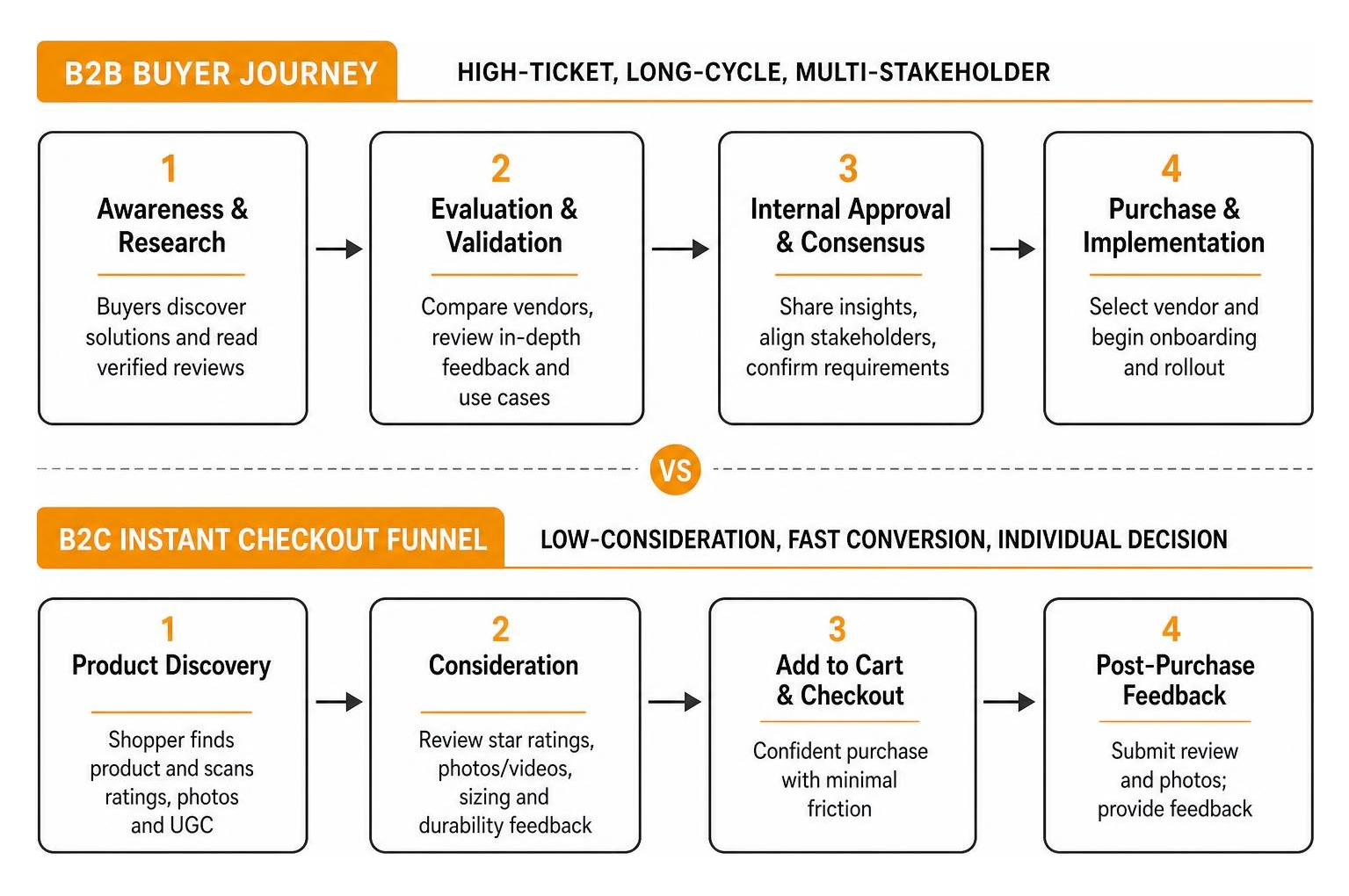
Conversely, B2C review systems focus on rapid conversion optimization at the point of sale. Direct-to-consumer (DTC) shoppers look for authentic photo and video user-generated content (UGC), sizing feedback, and product durability. Direct comparisons show that modern e-commerce brands prioritize lightweight widgets and deep marketing-platform event tracking to capture post-purchase sentiment without degrading checkout speed.
Third-Party Authority Networks vs On-Site Widget Systems
Another fundamental architecture choice separates open third-party trust networks from native on-site review widgets.
Open networks host public-facing brand directories. Every review lives on an independent domain indexed by search engines. This structure offers immense authority for high-consideration purchases; when prospective clients search for your company name, an independent public rating delivers immediate credibility. However, public networks limit layout customization and charge high premiums for enterprise API access.
On-site widget engines embed directly into your website’s Document Object Model (DOM). They give you total aesthetic control, custom review submission forms, and granular schema injection for organic rich snippets.
Pairing on-site review widgets with verified post-purchase invitation links delivers the best balance of on-page conversion lift and product SEO. To ensure your business engages customers across these external and internal touchpoints, review our guide on review platforms for businesses.
Advanced Features: AI Insights, Moderation Workflows, and System Integrations
Collecting reviews is only half the battle; extracting actionable intelligence and managing operational workflows determines your actual return on investment. Review management in 2026 relies heavily on AI-driven text analytics, multi-channel triage queues, and automated data pipelines.

Modern sentiment analysis moves far beyond calculating average star ratings. Natural language processing (NLP) models now evaluate structured and unstructured review text across thousands of monthly entries, identifying subtle friction points like shipping delays, billing errors, or specific product defects. Platforms with specialized NLP engines process hundreds of thousands of customer texts per hour, isolating product-level topics regardless of the star score given.
Multi-Location Governance and Moderation Queues in Online Review Platforms Comparison
For multi-unit enterprises, multi-location dental groups, and regional franchises across Grand Rapids MI, Holland, and West Michigan, centralized governance is vital. Without organized triage, reviews left on Google Maps, Facebook, or niche directories can sit unanswered for weeks.
Leading platforms solve this through structured moderation queues:
- Automated Assignment Rules: Inbound reviews route directly to regional managers or customer support leads based on branch location, sentiment severity, or product SKU.
- Tiered Response Templates: Teams deploy pre-approved brand messaging that local operators can personalize, ensuring consistent brand voice across all touchpoints.
- SLA Tracking: Internal dashboards monitor response times, ensuring negative feedback receives human attention within 24 hours.
- Multi-SKU Product Mapping: For retail operations, automated SKU matching maps verified customer feedback to exact catalog variations, avoiding mismatched product feedback.
Maintaining structured oversight across locations is an essential element of effective reputation management, protecting your local search visibility from regional service inconsistencies. Specialized industry tools, such as the top software solutions for physician and dental reputation management, illustrate how clinical practices maintain compliance while managing location-specific patient sentiment.
API Connectivity, CRM Automation, and Review Velocity
Review volume alone does not determine search visibility; review velocity (the regular pace of incoming reviews) and recency carry heavy weight in modern search algorithms. An enterprise with 1,000 legacy reviews from two years ago frequently ranks below a competitor accumulating 15 verified reviews every week.
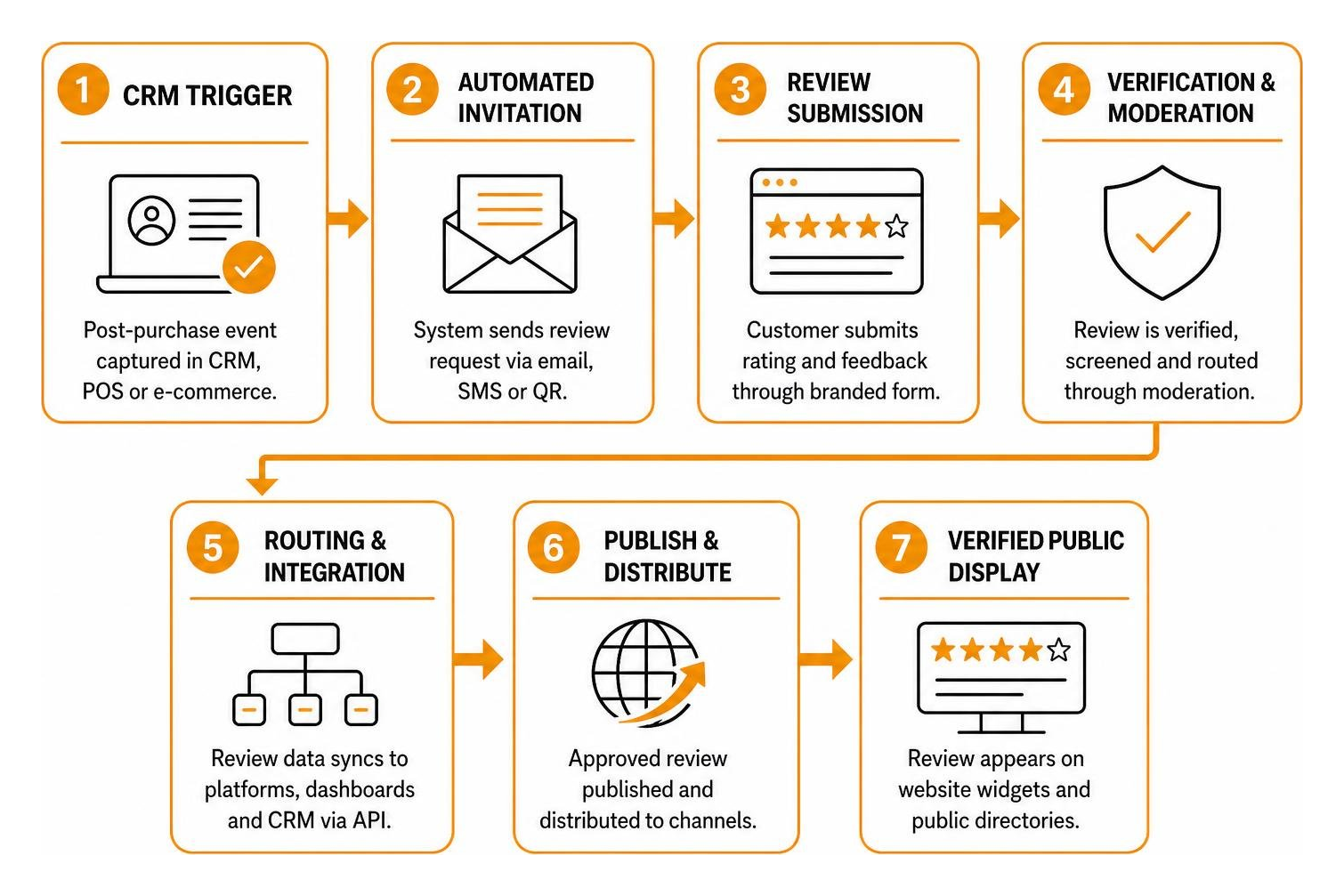
Achieving steady velocity requires programmatic API connectivity. Webhooks linked to your CRM, point-of-sale (POS), or e-commerce platform automatically initiate review requests via SMS, email, or QR prompts immediately following successful service delivery or order fulfillment. According to our detailed breakdown in the ultimate guide to review generation service, integrating automated post-purchase triggers accelerates submission rates while ensuring your public profiles maintain fresh signals.
For specialized platforms, check industry evaluations of the best online customer review software and review management feature comparisons to verify webhook flexibility before committing.
Strategic Decision Framework: Pricing Models, Enterprise Scale, and Common Pitfalls
Evaluating software options requires matching your operational scale to the appropriate commercial model. Hidden fees, strict annual contracts, and per-location add-ons can turn a seemingly affordable tool into a major operational expense.
Evaluating Value for Money Across SMB and Enterprise Tiers
Review platforms use distinct pricing structures depending on their target audience:
- Per-Location SaaS (Local Businesses): Local reputation management platforms charge predictable flat fees ($44 to $99 per location per month), monitoring dozens of local citation directories and Google Business Profiles. This model offers exceptional value for local service contractors and regional practices across Kalamazoo MI, Grand Haven MI, and South Haven MI.
- Tiered Order-Volume SaaS (E-Commerce): E-commerce review tools offer flexible monthly plans based on monthly order counts. Starting at accessible rates ($19 to $99/mo) and scaling with brand growth, they prevent early-stage DTC brands from being locked into enterprise billing.
- Modular Enterprise Bundles: Some larger platforms bundle reviews, loyalty, and SMS marketing. While comprehensive, mid-market brands can face monthly costs between $1,500 and $3,000+, often paying for software modules they do not use.
- Directory Sponsorship & PPC (B2B): Software comparison platforms offer low-cost PPC entries alongside organic listings, while some focus on premium annual tiers ($499+/mo) centered on grid placement licensing and intent data.
When selecting software, explore our recommendations on how to pick a review generation platform for local businesses to ensure your investment fits your operational workflow.
Critical Selection Pitfalls: Review Gating, Migration, and Performance Lag
When deploying review management software, avoid these three common operational traps:
- Illegal Review Gating: Filtering negative feedback by asking customers “Were you happy?” and routing only satisfied users to public review profiles violates Google policies and regulatory standards enforced by the Federal Trade Commission. Legitimate platforms collect open, un-gated feedback across all customer segments while using fast private resolution channels to address customer dissatisfaction.
- Data Migration Lock-In: Moving historical reviews between platforms is technically complex. Ensure any platform you choose supports complete CSV exports with timestamped verification records, photo attachments, and SKU mappings. Losing historical ratings during a platform migration damages organic search rich snippets.
- Widget Latency and Core Web Vitals: Bulky on-site review widgets loaded with heavy JavaScript libraries can degrade Largest Contentful Paint (LCP) by 300+ milliseconds. For online storefronts where mobile traffic dominates, prioritize lightweight, asynchronous widgets that preserve mobile site performance. Consult performance-tested consumer review software guides for options.
To maintain continuous protection over your brand’s digital presence, use the best review monitoring services to detect unauthorized profile changes or unexpected drops in review collection volume across every channel.
Frequently Asked Questions About Online Review Platforms
How does review recency compare to overall star rating in 2026?
Review recency strongly influences modern consumer behavior and local search ranking algorithms. Research indicates that 74% of consumers only consider reviews written within the last three months, while 47% will not consider a business with fewer than 20 total reviews. A 4.8-star rating built entirely on outdated feedback creates trust decay, whereas a consistent flow of fresh, authentic 4.5-star reviews signals operational reliability to prospective buyers and search crawlers alike. For a complete look at search performance, review Google Reviews Everything You Need to Know.
What is the biggest risk when migrating between review software platforms?
The most critical risk during migration is the loss of structured schema markup and historical verification data. If your new provider cannot cleanly import past customer reviews with their original verified purchase timestamps and SKU identifiers, Google may drop your rich snippet star ratings from organic search results. Always verify that your prospective vendor provides full data portability, automated 301 schema redirection, and compliant historical imports before closing legacy accounts.
Can businesses legally gate negative reviews before publishing?
No. Regulators and major search engines prohibit review gating—the practice of pre-screening customers to direct positive feedback to public review sites while capturing negative feedback privately. All customers must receive equal opportunities to leave public feedback. Businesses should focus on delivering outstanding customer service, monitoring feedback feeds in real time, and responding constructively to public criticism within 24 hours to resolve legitimate customer concerns.
Conclusion
Building a dominant market presence requires an active reputation strategy that aligns with your operational model. Whether your organization requires B2B buyer-intent intelligence, fast e-commerce UGC widgets, or multi-location review monitoring, selecting software tailored to your customer journey is the key to sustainable growth.
At ClickCentric Digital, we help businesses throughout Grand Rapids MI, Holland, and West Michigan build enduring authority through targeted local search optimization, review management workflows, and performance advertising. To discover how our customized strategies can elevate your brand’s visibility and conversion rates, explore ClickCentric Digital’s growth solutions today.
Sorry, the comment form is closed at this time.