

27 Aug Top Software Solutions for Physician and Dental Reputation Management
Top Software Solutions for Physician and Dental Reputation Management
Why Healthcare Reputation Management Software Is Essential for Patient Acquisition

Healthcare reputation management software helps medical and dental practices automatically collect, monitor, and respond to patient reviews across platforms like Google, Healthgrades, and Facebook — all from one dashboard.
Here are the top solutions covered in this guide:
| Software | Best For |
|---|---|
| Swell | Multi-location dental and medical groups (DSOs/MSOs) |
| Promptly | Small to mid-size independent practices |
| Press Ganey | Enterprise health systems and HCAHPS benchmarking |
| Kyruus Health | Health systems needing provider data + scheduling integration |
| Reputation | Large multi-location healthcare organizations |
| Yext | Listings management + review monitoring at scale |
The stakes are high. 84% of patients check online reviews before choosing a provider. And 61% say a single negative review can outweigh a personal recommendation from someone they trust.
That means your online reputation isn’t just a marketing concern — it’s a patient acquisition problem.
Patients today shop for doctors the same way they shop for products. They scan star ratings, read recent comments, and compare providers side by side. If your practice has thin, outdated, or scattered reviews, you’re losing patients before they ever contact you.
The right software fixes that. It automates the tedious work of asking for reviews, flags problems before they go public, and gives you a clear picture of how your practice looks online — across every location and every provider.
I’m Fred Dirkse, and in this guide I’ll walk you through the top platforms so you can find the one that fits your practice.
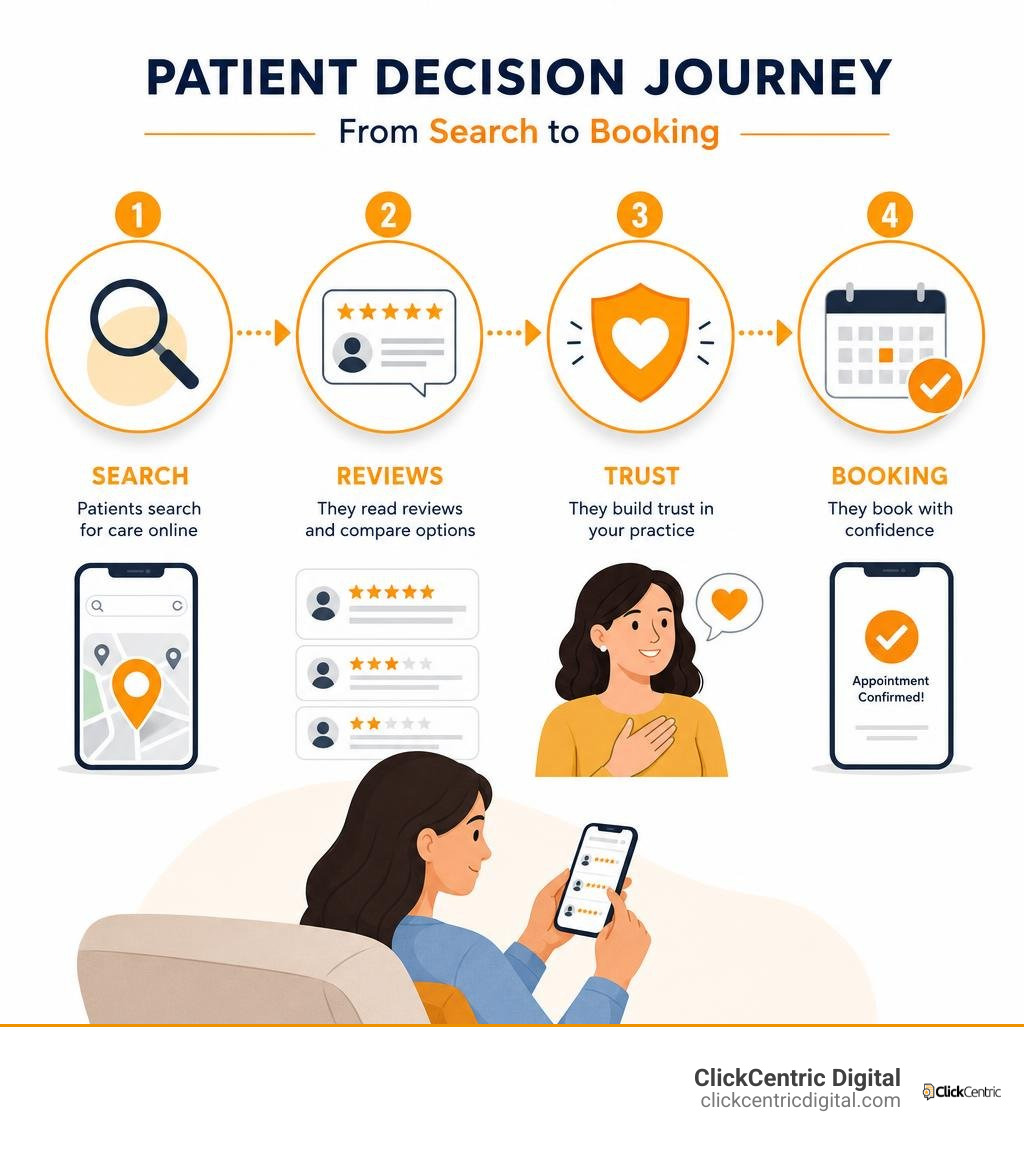
Why Your Practice Needs Healthcare Reputation Management Software
In the medical and dental fields, trust is the ultimate currency. Whether you run an orthopedic clinic in Grand Rapids, a family dental practice in Holland, or a multi-specialty group in Kalamazoo, patients want validation before they book.
Relying on word-of-mouth or legacy marketing is no longer enough. When prospective patients search for local care, Google’s local map pack is often their first stop. If your competitors have hundreds of fresh, five-star reviews and you only have a handful from three years ago, the choice is easy for the patient.
Investing in a dedicated healthcare reputation management software helps you control this narrative by turning patient feedback into your most powerful marketing asset. It solves several critical pain points:
- Accelerates Patient Acquisition: A steady stream of positive feedback acts as powerful social proof, reassuring prospective patients that they will receive excellent care.
- Improves Local Search Visibility: Google’s local search algorithms heavily favor businesses with high volumes of frequent, positive reviews. Strong reviews help your practice climb the rankings in West Michigan search results.
- Saves Administrative Time: Instead of front-desk staff manually asking patients to leave reviews or sending individual emails, the software automates the entire outreach process.
- Protects Your Practice from Negative Publicity: Many platforms offer private feedback loops. If a patient has a poor experience, they can voice their concerns directly to your management team privately, allowing you to resolve the issue before it turns into a damaging public review.
Building a proactive strategy around your digital footprint is essential to growing a modern practice. To understand how this fits into your broader digital marketing goals, explore our comprehensive guide on reputation management.
The Three Critical Factors of Online Patient Reviews
When patients look at your reviews on Google, Healthgrades, or Facebook, they do not just look at your overall star rating. Modern consumers have become highly sophisticated at evaluating online feedback. They look for authenticity, and they weigh their decisions based on three critical factors:
1. Volume: Quantity Creates Credibility
A perfect 5.0 rating looks suspicious if it is only based on three reviews. Patients wonder if those reviews were written by your staff or family members. However, a 4.8 rating backed by 450 reviews builds instant trust. High volume proves that you consistently deliver quality care to a large volume of patients over time.
2. Recency: Fresh Feedback Reflects Current Care
How relevant is a review from 2021 to a patient booking an appointment in July 2026? Not very. In fact, 77% of consumers agree that recent reviews are more important than old reviews. Patients want to know how your practice operates now. If your most recent review is several months old, patients may wonder if your service quality has slipped or if your office is even still open.
3. Coverage: A Complete Picture Across Your Practice
If you run a multi-provider practice or have offices in Grand Haven, South Haven, and Holland, your reviews must reflect that entire footprint. Having 200 reviews for your primary location but zero reviews for your satellite offices or individual associate dentists creates gaps in patient confidence. Complete coverage ensures that every provider and every office has a strong, visible reputation.
For a deeper dive into leveraging these elements to outperform local competitors, check out our guide on Mastering Local Reviews To Win More Customers.
Evaluating the Best Software Categories for Medical Practices
Not all reputation platforms are built the same. While generalist tools like Birdeye or Podium are highly popular in retail and home services, they often fall short when applied to healthcare. Medical and dental practices operate under strict regulatory frameworks and unique operational workflows that require specialized software.
When evaluating your options, look for platforms that integrate directly with your Electronic Health Record (EHR) or Practice Management System (PMS). This integration allows the software to automatically trigger review requests immediately following an appointment, ensuring high conversion rates without adding a single task to your front-desk staff’s daily checklist.
If you are tired of begging patients for feedback at checkout, you can learn more about choosing automated tools in our article on how to Stop Begging For Feedback With This Review Request Software.
Core Features of Healthcare Reputation Management Software
To protect your practice and maximize your return on investment, your selected software must include these non-negotiable features:
- Strict HIPAA Compliance: This is the absolute baseline. The software must secure patient data, sign a Business Associate Agreement (BAA), and ensure that no Protected Health Information (PHI) is exposed during review collection or response workflows.
- Automated Review Generation: The tool must connect to your PMS (such as Dentrix, athenahealth, or eClinicalWorks) to send automated, personalized SMS or email review invitations within hours of a patient’s visit.
- Multi-Platform Monitoring: A centralized dashboard that pulls in reviews from Google, Healthgrades, WebMD, Vitals, and Facebook so you never miss a patient’s feedback.
- AI-Powered Sentiment Analysis: Advanced platforms use Natural Language Processing (NLP) to analyze patient comments. This helps you identify operational trends, such as long waiting room times or issues with billing, across hundreds of reviews.
To understand why these security and monitoring features are so critical for local businesses, read more about our approach to reputation management.
How to Choose Healthcare Reputation Management Software for Multi-Location Groups
If you are managing a Dental Support Organization (DSO) or a Medical Support Organization (MSO) with clinics spread across West Michigan — from Grand Rapids down to Kalamazoo — your scaling needs are entirely different from a single-location practice.
You need a platform that supports complex multi-location hierarchies. This allows regional managers to view roll-up reports for their specific territories, while individual office managers only see data for their local clinics.
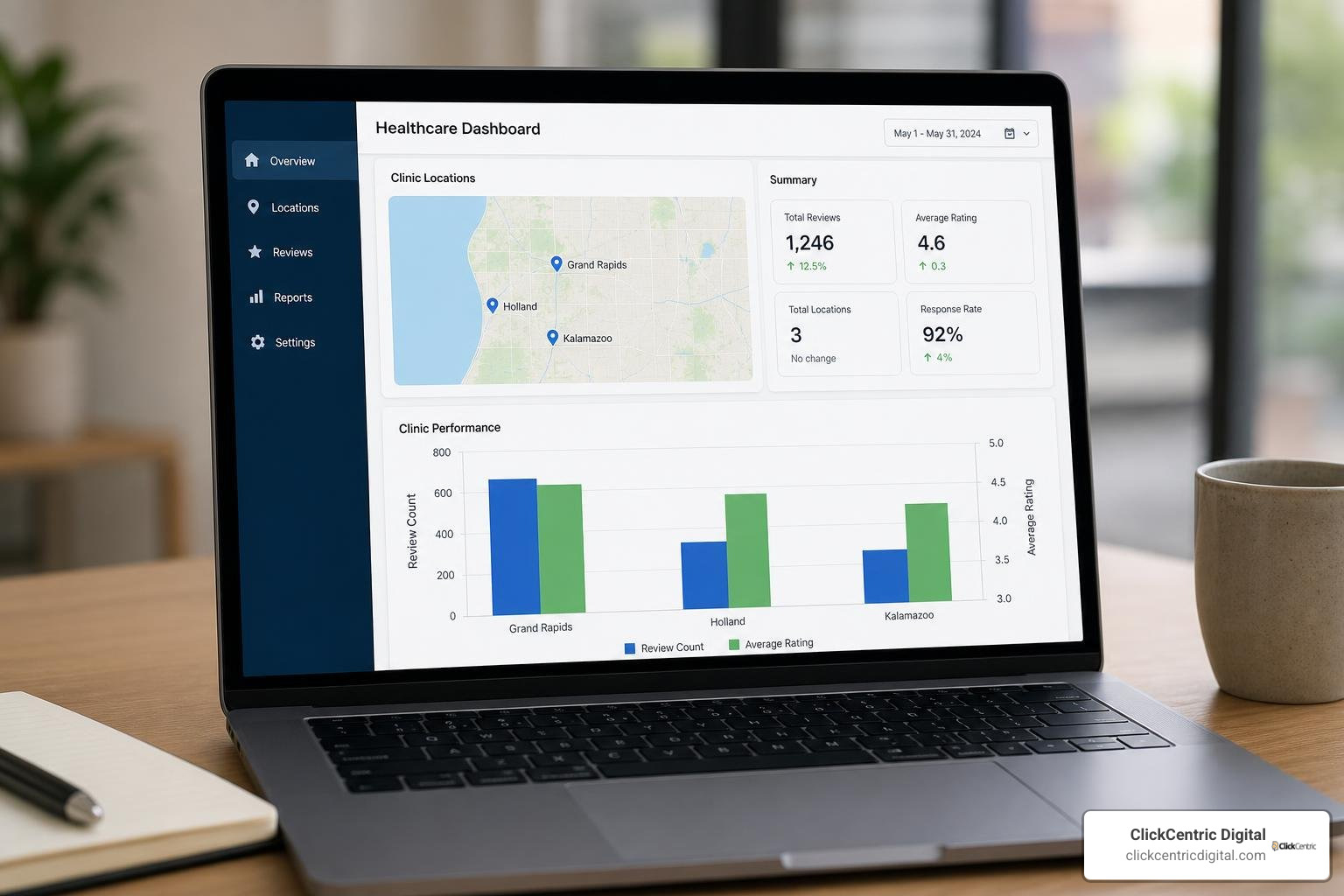
When selecting a platform for a multi-location group, prioritize:
- Native Hierarchies: Avoid “flat” account structures where every user has to log into different accounts to see different locations. You need a single login with customizable permission tiers.
- Location Leaderboards: The ability to compare performance across locations, helping you spot underperforming clinics that need customer service training.
- Unified Listing Management: A tool that keeps your practice names, hours, and addresses perfectly synchronized across Google, Apple Maps, and local search directories to protect your local SEO.
For instance, Healthcare online reputation management software | Swell is built specifically to handle these complex multi-location hierarchies, supporting over 12,000 locations with robust healthcare-specific features.
Automating Review Generation and Response Workflows
The secret to scaling your reputation without burning out your staff is automation. Manual workflows are slow, inconsistent, and prone to human error. With an automated setup, the moment a patient is marked as “checked out” in your PMS, a text message is scheduled to go out.
Text-based review invitations yield significantly higher conversion rates than email. In fact, specialty practices using automated SMS review requests frequently see massive jumps in their monthly review volume. For example, some medical groups have achieved over a 1,300% increase in monthly review volume simply by transitioning from manual email requests to automated, text-based workflows.
To keep your public profiles looking active and engaging, you must also respond to reviews. Using pre-approved, HIPAA-compliant response templates or AI-drafted suggestions allows your office managers to reply to feedback in seconds. For pro tips on handling this, read our guide on how to Manage Your Google Review Responses Like A Pro.
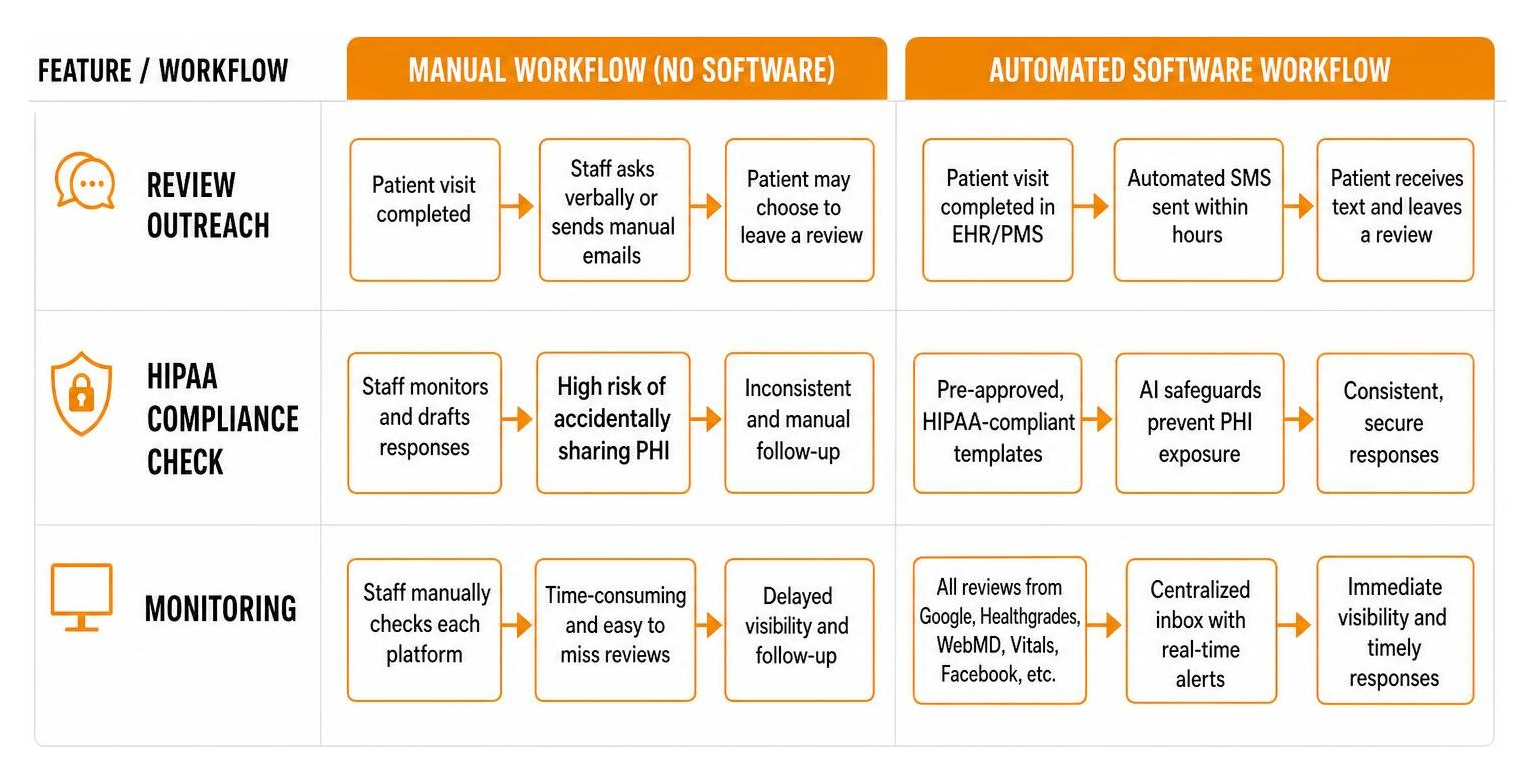
| Feature / Workflow | Manual Workflow (No Software) | Automated Software Workflow |
|---|---|---|
| Review Outreach | Staff asks verbally or sends manual emails | Automated SMS triggered by EHR checkout |
| HIPAA Compliance Check | High risk of accidentally sharing PHI in replies | Pre-approved, secure templates and AI safeguards |
| Monitoring | Manually checking Google, Healthgrades, Facebook | Centralized multi-platform inbox with real-time alerts |
| Negative Feedback | Often discovered only after it is published online | Private feedback loop intercepts complaints early |
| Reporting & Analytics | Manual spreadsheets and guesswork | Real-time dashboards and sentiment analysis |
Frequently Asked Questions about Medical Reputation Management
How do you handle negative patient reviews without violating HIPAA?
Responding to negative reviews is a common pitfall for medical and dental practices. Even if a patient post-identifies themselves and shares details of their treatment online, you cannot confirm they are a patient of your practice in a public response. Doing so violates HIPAA regulations and can result in severe fines.
The best strategy is to use neutral, pre-approved templates that focus on your practice’s policies rather than the specific patient’s experience. A safe response looks like this:
“Thank you for your feedback. At our practice, we strive to provide the highest quality care to all of our patients. We take all feedback seriously. Please contact our practice manager directly at 800-555-0199 so we can discuss and resolve your concerns privately.”
This approach shows prospective patients that you care about service quality while keeping you fully compliant with federal privacy laws. For more guaranteed ways to handle negative feedback, check out our guide on How To Remove Negative Reviews 5 Guaranteed Methods.
Can you remove unfair or fake Google reviews?
You cannot simply delete a Google review because it is negative or because you disagree with the patient’s perspective. However, if a review violates Google’s Terms of Service — such as containing hate speech, harassment, spam, or being posted by a competitor rather than a real patient — you can flag it for removal.
If the review does not violate Google’s policies, your best defense is a strong offense: use your reputation software to generate a high volume of positive reviews from your actual, satisfied patients. This quickly pushes the negative review down the page and minimizes its impact on your overall star rating.
To learn more about navigating this process step-by-step, read our detailed guide: How Do You Get Rid Of Bad Google Reviews A Step By Step Guide.
How does review software integrate with electronic health records (EHR)?
Modern reputation platforms connect directly to your PMS or EHR via secure API integrations. The software monitors your daily appointment schedule in real-time.
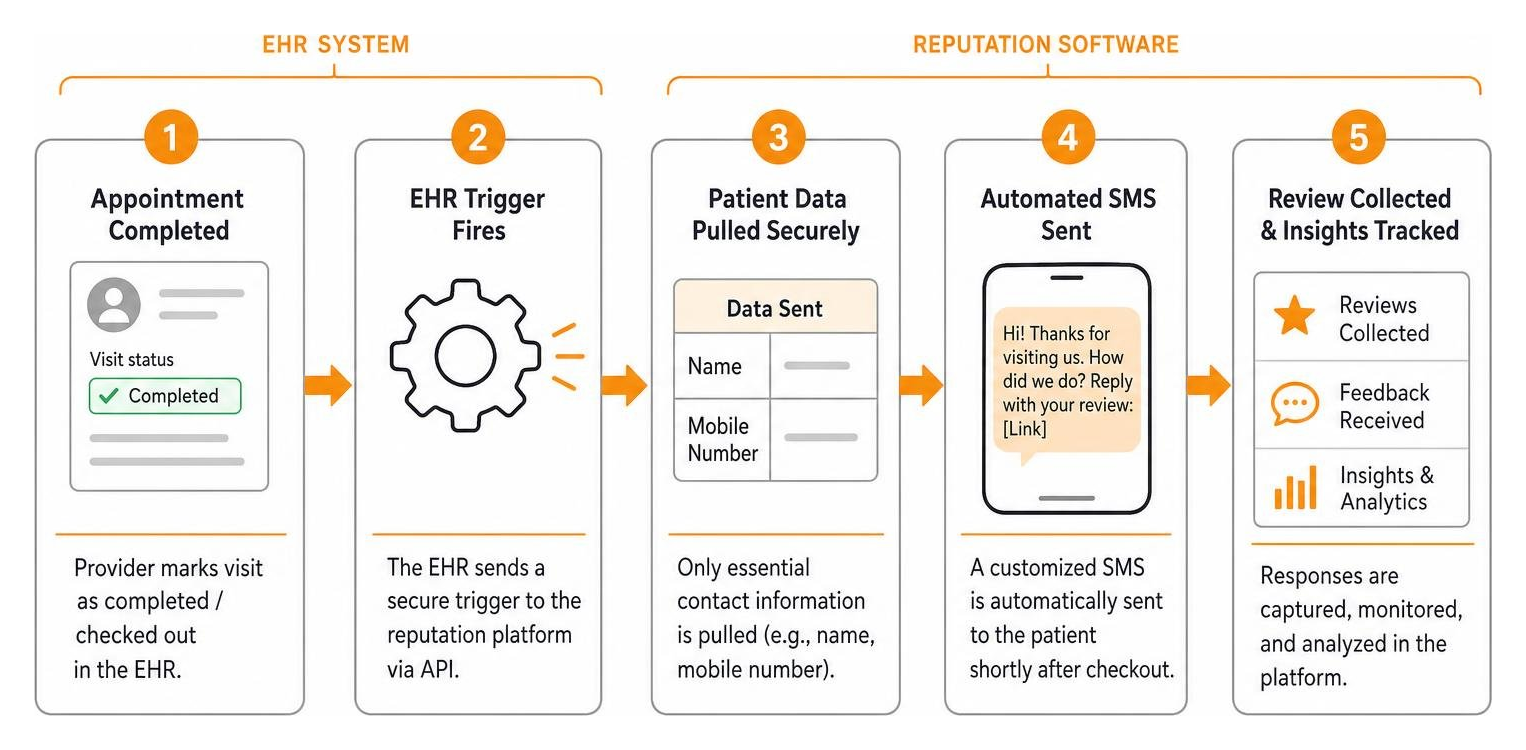
When a provider completes an appointment and marks the patient record as “completed” or “checked out” in the EHR, this action acts as a trigger. The reputation software automatically pulls the patient’s contact information (typically just their name and mobile number) and sends a customized text message asking for feedback. This seamless integration ensures that requests are sent when the visit is still fresh in the patient’s mind, driving maximum engagement.
Conclusion
Your online reputation is often the very first interaction a patient has with your medical or dental practice. In highly competitive West Michigan markets like Grand Rapids, Holland, and Kalamazoo, having a robust, active, and highly rated digital presence is no longer optional — it is the foundation of patient acquisition.
Implementing the right healthcare reputation management software allows you to automate review generation, maintain strict HIPAA compliance, and gain valuable operational insights that help you run a better practice.
At ClickCentric Digital, we specialize in helping local medical and dental practices dominate local search rankings, manage their online reviews, and drive patient acquisition through targeted search and paid traffic strategies. If you want to transform your online reputation into a powerful growth engine, explore our professional reputation management services and let us help you build the five-star brand your practice deserves.
Sorry, the comment form is closed at this time.