
15 May Beginner’s Guide to Small Business SEO
Beginner’s Guide to Small Business SEO
Why Small Business SEO Is Your Most Powerful Growth Tool in 2026
Small business SEO is the process of improving your website and online presence so that customers can find you on Google — without paying for ads. Done right, it drives a steady stream of leads, builds trust, and compounds over time.
Here’s what small business SEO covers at a glance:
| SEO Activity | What It Does | Priority |
|---|---|---|
| Google Business Profile | Gets you found on Google Maps | High |
| On-page optimization | Helps Google understand your pages | High |
| Local citations & NAP | Builds trust and consistency | High |
| Content creation | Attracts searchers and answers questions | Medium |
| Backlink building | Boosts your authority and rankings | Medium |
| Technical SEO | Ensures Google can crawl your site | Medium |
| AEO / GEO / AI search | Gets you cited by AI tools like ChatGPT | Emerging |
The stakes are real. 53.3% of all website traffic comes from organic search. And only 0.63% of Google users ever click to page two. If you’re not showing up on page one, you’re essentially invisible.
For local businesses, the opportunity is even bigger. 46% of all Google searches have local intent — people looking for a nearby plumber, dentist, or coffee shop. And 76% of those people visit a business within a day of searching.
Yet most small business owners either ignore SEO, or try it once and give up before it kicks in. That’s a costly mistake.
SEO isn’t instant. But unlike paid ads that stop the moment you stop spending, SEO compounds over time. Every page you optimize, every review you earn, every backlink you build — it stacks. One SEO agency grew a client from 3,489 to 42,856 monthly impressions in just 8 months through consistent content alone, with zero paid promotion.
This guide walks you through exactly how to make that happen for your business.
What is Small Business SEO and Why It Matters in 2026
In the fast-moving digital landscape of April 2026, small business SEO has evolved. While the core goal remains the same—appearing where your customers are looking—the “where” and “how” have shifted. It is no longer just about ranking #1 on a desktop search result; it’s about being the definitive answer across mobile devices, voice assistants, and AI-driven platforms.
Many people confuse general SEO with Local SEO. While they overlap, understanding the difference is key to allocating your budget effectively.
| Feature | Small Business SEO (Organic) | Local SEO |
|---|---|---|
| Primary Goal | Rank your website pages for relevant keywords. | Rank your business in the “Local Map Pack.” |
| Main Tool | Your website content and technical health. | Your Google Business Profile (GBP). |
| Geographic Focus | Can be national or regional. | Strictly tied to your physical location/service area. |
| Conversion Type | Clicks to website, form fills, downloads. | Phone calls, direction requests, walk-ins. |
| Key Factor | Content depth and backlink authority. | Proximity, reviews, and NAP consistency. |
Why does this matter for a shop in Grand Rapids or a service provider in Kalamazoo? Because Google processes over 9.5 million searches per minute. If you aren’t optimized, you are missing out on the 28% of local searches that result in a purchase within 24 hours. By investing in Grand Rapids SEO services, you aren’t just buying “traffic”—you’re building a digital asset that works 24/7.
The Impact of AEO, GEO, and AIO on Small Business SEO
By 2026, the search world has been turned upside down by three new acronyms: AEO, GEO, and AIO.
- AEO (Answer Engine Optimization): This focuses on providing direct, concise answers to user queries. Think of voice assistants like Alexa or Siri. If someone asks, “Who is the best plumber in Holland MI?” AEO ensures your business is the one named.
- GEO (Generative Engine Optimization): As AI tools like ChatGPT and Perplexity become search engines in their own right, GEO is the practice of making your brand “citeable.” These engines reward brand clarity and authoritative, original data.
- AIO (AI Overviews): Formerly known as SGE, these are the AI-generated summaries at the top of Google. While they can reduce clicks to some websites, they prioritize businesses with strong Google Business Profiles and clear, structured website data.
To win in this era, we must move beyond “keyword stuffing.” AI engines reward expertise and trust. If your content sounds like a robot wrote it, a robot will likely ignore it. We focus on conversational keywords—the way real people in West Michigan actually talk—to ensure you stay relevant in voice and AI search.
Essential On-Page and Technical SEO for Small Businesses
Before you start writing blog posts, your “digital house” needs a solid foundation. This is where technical and on-page SEO come in. Think of technical SEO as the plumbing and wiring of your website—if it doesn’t work, nobody wants to stay there.
The Technical Essentials
Google uses “mobile-first indexing,” meaning it looks at the mobile version of your site to decide your rank. If your site is slow or hard to use on a phone, you’ve already lost.
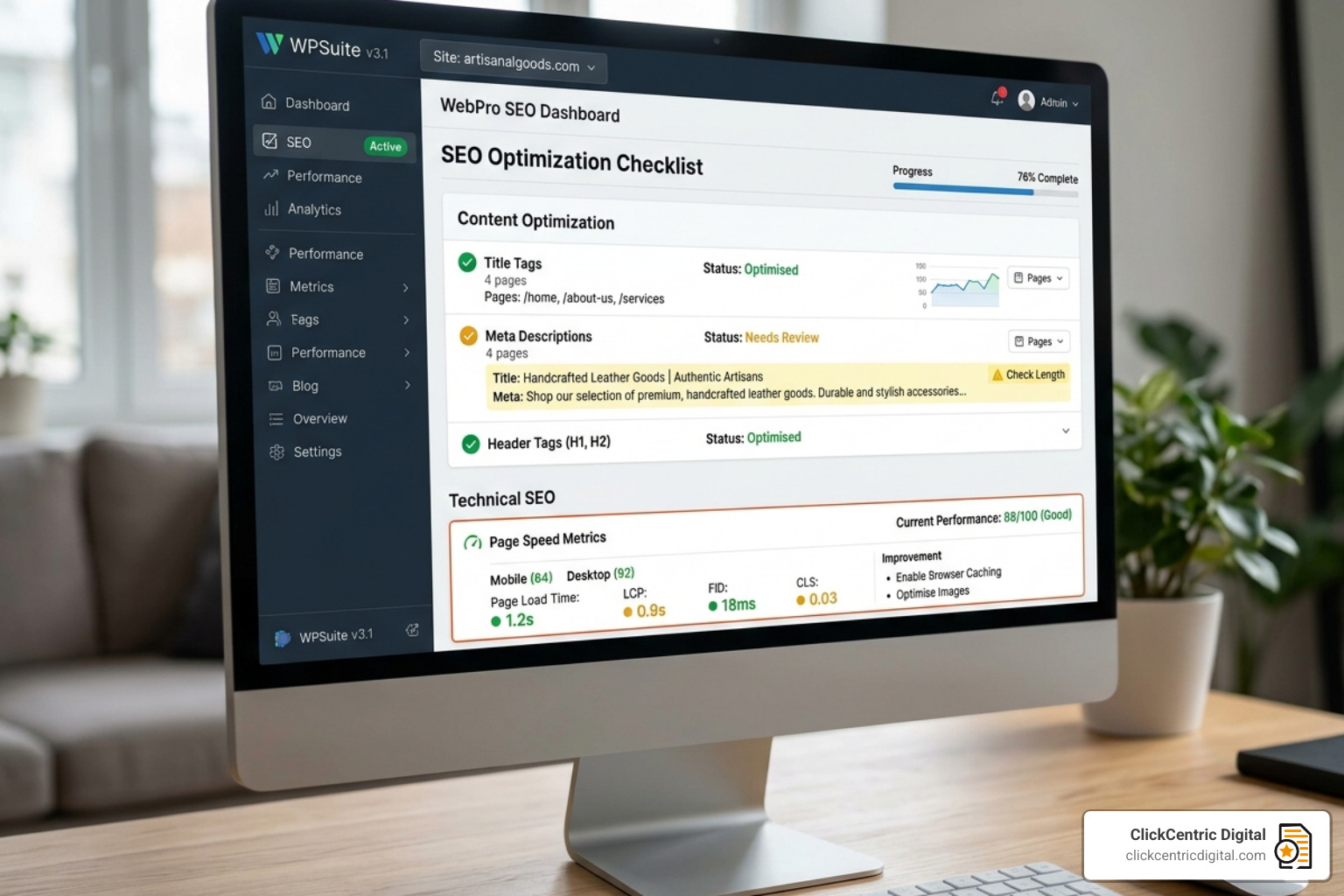
- Page Speed: If your site takes longer than 3 seconds to load, 53% of users will leave. We aim for an LCP (Largest Contentful Paint) of under 2.5 seconds.
- HTTPS: Security is a non-negotiable ranking factor. Ensure your SSL certificate is active.
- Core Web Vitals: These are Google’s metrics for user experience, focusing on loading, interactivity, and visual stability.
On-Page Optimization
On-page SEO is how we tell Google exactly what a specific page is about. Every page on your site should have:
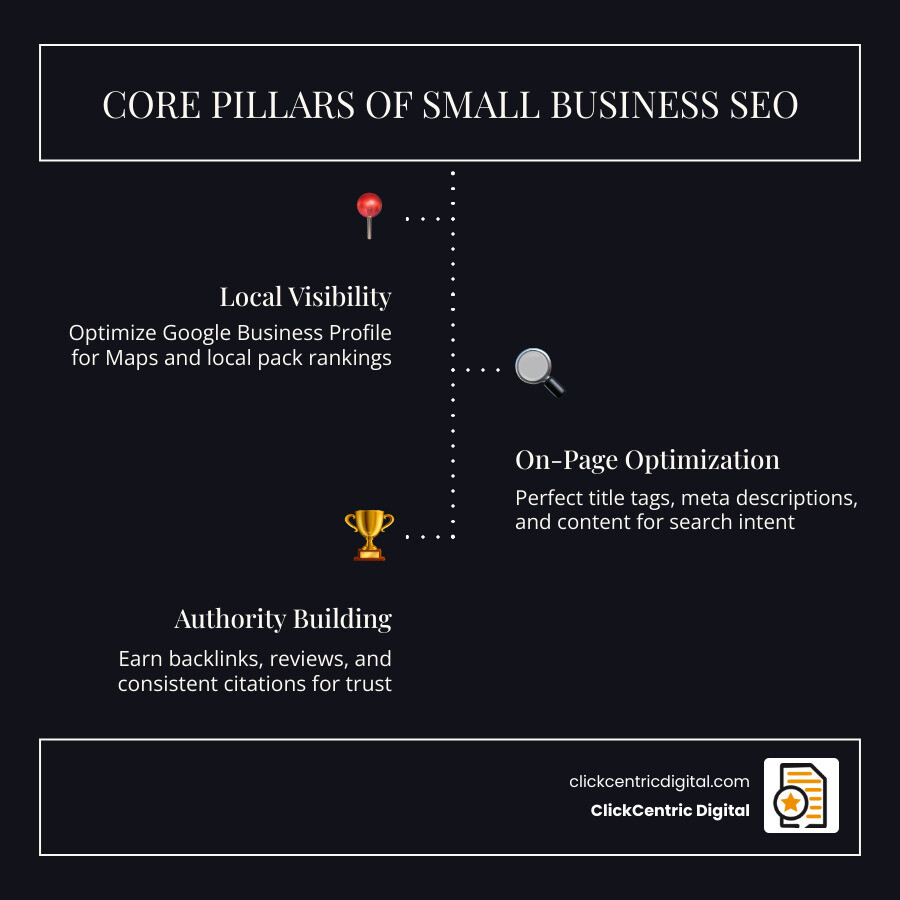
- Unique Title Tags: Keep these under 60 characters. Include your primary keyword and location (e.g., “Emergency Plumber in Grand Haven MI | Fast Service”).
- Meta Descriptions: These don’t directly impact rank, but they act as your “ad copy” in the search results. A compelling description increases your click-through rate.
- Header Tags (H1, H2, H3): Use these to structure your content. Your H1 should contain your main keyword.
- Alt Text: Describe your images for search engines and visually impaired users. Instead of “image1.jpg,” use “interior of Holland MI boutique shop.”
For a deeper dive, check out our guide on how to optimize for local search and dominate your neighborhood.
Creating High-Quality EEAT Content for Small Business SEO
In 2026, “thin” content is a death sentence for rankings. Google prioritizes E-E-A-T: Experience, Expertise, Authoritativeness, and Trustworthiness.
How do we demonstrate this as a small business?
- Experience: Share real-world photos of your work, case studies, and “behind the scenes” videos.
- Expertise: Answer the actual questions your customers ask. If you’re a mechanic in South Haven, write about “How to prep your car for Michigan winters.”
- Authoritativeness: Get cited by local news or industry associations.
- Trustworthiness: This comes down to your reputation. Mastering local reviews to win more customers is the fastest way to build this pillar.
Instead of random blog posts, we use topic clusters. You create one “pillar” page about a main service (e.g., “Residential Roofing”) and then several smaller articles answering related questions (e.g., “How much does a roof replacement cost in Kalamazoo?”). This shows Google you are a complete authority on the subject.
Mastering Google Business Profile and Local Citations
If you do nothing else, optimize your Google Business Profile (GBP). For many small businesses, their GBP generates more leads than their actual website. This is what puts you in the “Map Pack”—the top three results shown with a map.
GBP Optimization Checklist:
- Claim and Verify: Ensure you own the listing.
- Complete Every Field: Hours, services, description, and attributes (e.g., “locally owned,” “wheelchair accessible”).
- Photos are King: Businesses with 100+ photos get 520% more direction requests than those with just one. Add real photos of your team, your office, and your completed projects.
- Google Posts: Treat this like a mini-social media feed. Post updates, offers, and events at least once a week.
- Q&A Seeding: You can ask and answer your own questions! Seed the profile with common FAQs like “Do you offer free estimates?”
NAP Consistency and Citations
NAP stands for Name, Address, and Phone number. To rank well, your NAP must be identical across the web—on your site, your GBP, Yelp, and local directories like the Grand Rapids Chamber of Commerce. Inconsistent info (e.g., “Street” vs “St.”) confuses Google and lowers your trust score.
While we focus on local growth, it’s interesting to see how global standards shift; for context on high-performing markets, you can look at the Best SEO Companies in Netherlands 2026. However, for our West Michigan neighbors, the goal is simple: How to win the local pack in 2026 and beyond.
Building Backlinks and Authority for Small Business SEO
A backlink is a “vote of confidence” from one website to another. In small business seo, local relevance often beats national authority. A link from a local South Haven news site or a Holland community blog is often more valuable than a link from a generic national site.
Effective Link Building Strategies:
- Local Directories: Ensure you are in the “Big Five” (Google, Apple Maps, Bing, Yelp, Facebook) and local niche directories.
- Sponsorships: Sponsoring a Little League team in Kalamazoo or a 5k in Grand Haven often results in a high-quality local backlink.
- Unlinked Mentions: Sometimes people talk about you online but forget to link. We use tools to find these mentions and politely ask for a link.
- Relationship Building: Partner with non-competing local businesses. A wedding planner and a florist can link to each other as “preferred vendors.”
For more on how these links impact your map presence, read about search engine optimization and Google Maps ranking.
Tracking Performance and Avoiding Common SEO Mistakes
You can’t improve what you don’t measure. We use two free, essential tools: Google Analytics 4 (GA4) and Google Search Console.
- GA4: Tells you what people do on your site. Are they calling you? Are they filling out your contact form?
- Search Console: Tells you how people found your site. What keywords are they typing in? Are there any errors preventing Google from seeing your pages?
Common Mistakes to Avoid:
- Keyword Stuffing: Writing “Best plumber Grand Rapids plumber Grand Rapids Michigan” over and over. This will get you penalized. Write for humans, not just bots.
- Buying Links: Never buy “5,000 backlinks for $10” on sites like Fiverr. These are toxic and can get your site removed from Google entirely.
- Duplicate Content: Copying and pasting descriptions from a manufacturer’s website. Google rewards original content.
- Neglecting Reviews: 97% of consumers read reviews. If you aren’t responding to them—both good and bad—you’re leaving money on the table.
Understanding the data is vital. We often help clients dive into the math behind a better local search strategy to ensure every hour spent on SEO is driving actual revenue.
A 30-Day Action Plan to Kickstart Your SEO Journey
SEO is a marathon, but you can make significant strides in just one month. Here is our recommended 30-day “sprint” for small business seo.
Week 1: The Technical Audit
- Install GA4 and Search Console.
- Check your site speed on Google PageSpeed Insights.
- Fix broken links and ensure your site is mobile-friendly.
- Submit your XML sitemap to Search Console.
Week 2: On-Page Optimization
- Identify your top 5-10 keywords (e.g., “HVAC repair Holland MI”).
- Optimize title tags and meta descriptions for your homepage and main service pages.
- Ensure every page has a clear Call to Action (CTA).
Week 3: Local/GBP Setup
- Claim and verify your Google Business Profile.
- Upload 20+ high-quality photos.
- Audit your NAP (Name, Address, Phone) across the web for consistency.
- Reach out to 10 recent happy customers for a Google review.
Week 4: Content and Link Building
- Write your first “Expertise” post (e.g., “5 Things to Ask Before Hiring a Landscaper in Kalamazoo”).
- Claim your listing on 5 local or industry-specific directories.
- Plan your content calendar for the next 3 months.
The goal is to get your business on the map and stay there through consistent, small improvements.
Frequently Asked Questions about Small Business SEO
How long does it take to see results from SEO?
SEO is a long-term play. Typically, you’ll start seeing “movement” (rankings for minor keywords) within 4-8 weeks. Meaningful traffic growth usually takes 3-6 months, and a full ROI—where the revenue generated far outweighs the spend—often hits the 6-12 month mark. Remember: SEO compounds. The work you do today will still be paying off in 2027.
Can I do SEO myself or should I hire an agency?
You can absolutely do the basics yourself! If you have 5-10 hours a week to learn and implement, a DIY approach is a great way to start. However, many business owners find that their time is better spent running their business. You should consider hiring an agency when your market is highly competitive, you’ve hit a “plateau” in your growth, or the technical aspects (like schema markup) feel overwhelming.
Is SEO better than Google Ads for small businesses?
It’s not an “either/or” situation—they work best together. Google Ads (PPC) is like a faucet: you turn it on and get leads immediately, but the leads stop the moment you stop paying. SEO is like planting an orchard: it takes time to grow, but eventually, it provides “fruit” for years with much lower maintenance costs. We often recommend starting with both to get immediate leads while building long-term authority.
Conclusion
In 2026, small business seo is no longer optional—it is the heartbeat of local growth. From the shores of Holland to the bustling streets of Grand Rapids, the businesses that win are the ones that prioritize being helpful, being fast, and being found.
At ClickCentric Digital, we specialize in building integrated marketing systems that don’t just “get clicks,” but drive sustainable revenue. Whether you need to dominate the Local Map Pack, fix your technical foundation, or navigate the new world of AI search, we’re here to help you win.
Ready to stop being invisible? Start winning with ClickCentric Digital and let’s get your business the visibility it deserves.
Sorry, the comment form is closed at this time.