

06 Oct Why Online Reviews Boost Sales and How to Leverage Them
Why Online Reviews Boost Sales and How to Leverage Them
How Online Reviews Boost Sales for Local Businesses
Online reviews boost sales by helping people trust your business before they call, visit, or buy. To put them to work, ask every customer for honest feedback, keep new reviews coming in, and reply to both praise and complaints. Show relevant reviews on the pages where customers decide whether to book or buy.
Start with your Google Business Profile if you rely on local search. Then focus on the platforms your customers use. You do not need a perfect rating: specific, recent reviews give shoppers more to judge than a wall of five-star praise.
I’m Fred Dirkse, and I’ll show you how to turn that steady flow of feedback into more customers.

Online reviews boost sales terms you need:
The Empirical Science: How Online Reviews Boost Sales and Revenue
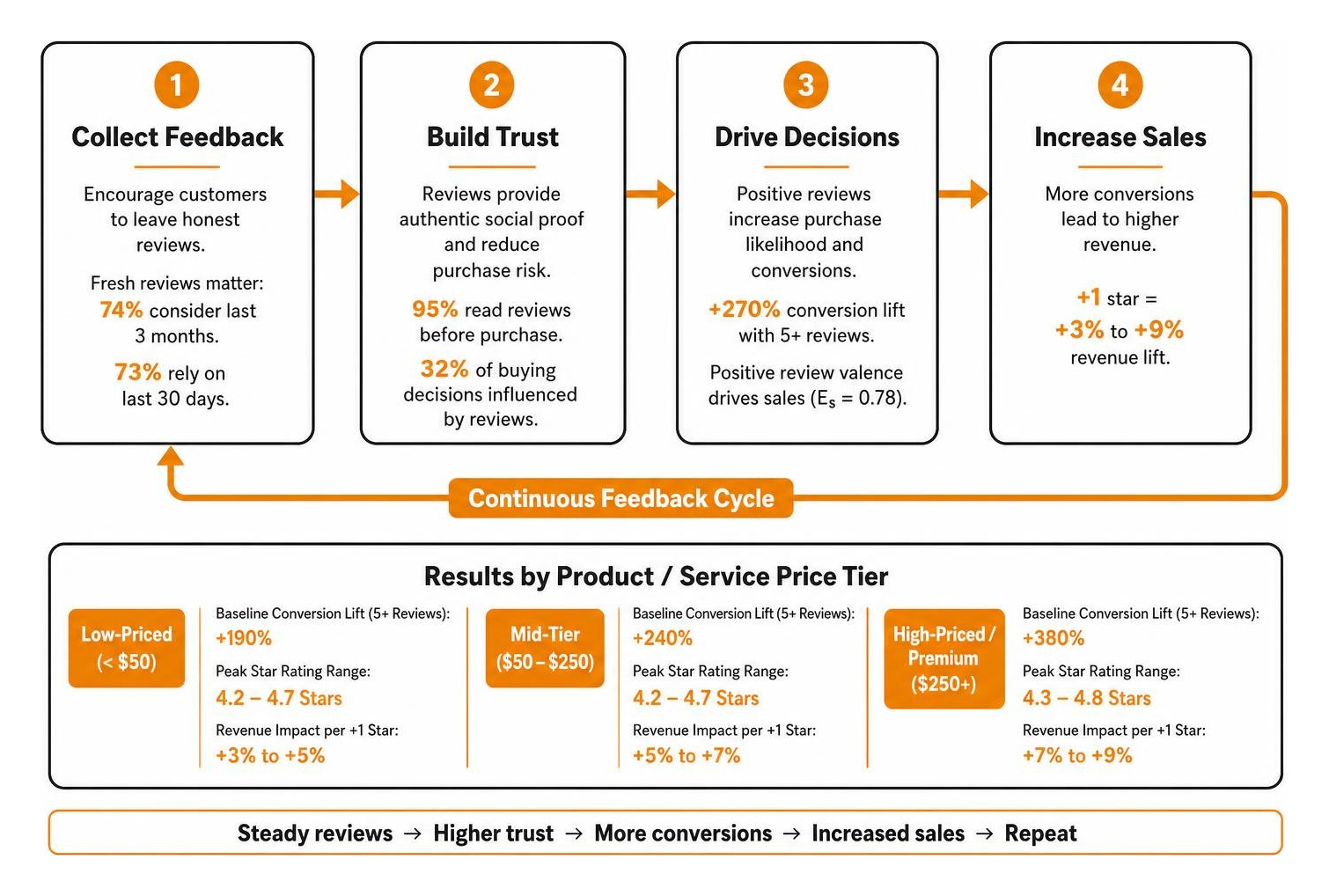
Consumer psychology has fundamentally shifted. In the 2026 digital marketplace, 95% of consumers read online reviews before committing to a purchase. Customer feedback influences 32% of all buying decisions, carrying more weight than promotional discounts or coupons.
Online reviews serve as dynamic trust signals. When prospective clients evaluate your business, third-party feedback provides authentic social proof that mitigates perceived purchase risk.
Extensive academic research confirms this direct relationship between feedback and revenue. As highlighted in research on How Online Product Reviews Affect Retail Sales: A Meta-analysis, positive review valence generates a strong sales elasticity ($E_s = 0.78$), demonstrating that upward shifts in customer sentiment lead directly to measurable sales lift.
Furthermore, data published in the report How Online Reviews Influence Sales reveals that displaying reviews can lift overall site conversion rates by up to 270%, with even more dramatic effects observed for high-consideration offerings.
The Statistical Math: Conversion Lift, Star Ratings, and Price Points
Review volume and star ratings operate within specific mathematical thresholds. A single-star increase in a business’s average Yelp rating correlates with an immediate 5% to 9% increase in revenue. Reaching a baseline threshold of just five reviews increases purchase probability by 270% compared to products or services with zero reviews.
Higher-priced, high-consideration purchases benefit the most from verified customer sentiment. When price tags increase, customer hesitation climbs proportionally. Displaying authentic testimonials reassures buyers, lifting conversion rates significantly higher for premium purchases than for lower-cost impulse items.
| Product / Service Price Tier | Baseline Conversion Lift (5+ Reviews) | Peak Star Rating Range | Revenue Impact per +1 Star Lift |
|---|---|---|---|
| Low-Priced Items (< $50) | +190% | 4.2 – 4.7 Stars | +3% to +5% |
| Mid-Tier Offerings ($50 – $250) | +240% | 4.2 – 4.7 Stars | +5% to +7% |
| High-Priced / Premium ($250+) | +380% | 4.3 – 4.8 Stars | +7% to +9% |
A common misconception is that a flawless 5.0-star score is the ultimate objective. In reality, purchase likelihood peaks between 4.2 and 4.7 stars. Scores hovering at a clean 5.0 often trigger skepticism, as modern shoppers assume pristine profiles have been manipulated. Incorporating strategies from Google review mastery guides helps businesses build an authentic profile that balances praise with natural critique.
Review Recency and Velocity: Why Fresh Feedback Trumps Historic Volume
Accumulating a large archive of reviews is beneficial, but review recency dictates consumer action. According to the Online Reviews Statistics (2026) | Review42 report, 74% of consumers only consider reviews written within the last three months, while 73% rely strictly on feedback posted in the last 30 days.
A business with 300 reviews from two years ago appears inactive compared to a competitor with 40 reviews posted over the past quarter. Maintaining consistent review velocity signals operational stability, consistent service quality, and sustained customer satisfaction.
The Double-Edged Sword of Pseudo-Reviews and Humorous Testimonials
Humorous, exaggerated customer commentary—often called pseudo-reviews—can significantly influence purchase intent. Viral, satirical testimonials entertain readers, driving social shares and brand awareness.
However, excessive humor can elevate buyer uncertainty regarding actual product specifications and performance. To optimize conversion, balance entertaining customer feedback with grounded, detailed testimonials that validate service reliability and product performance.
Platform Dynamics and Local SEO: Dominating High-ROI Channels

Different review channels serve distinct stages of the buyer journey. While niche directories capture targeted traffic, major search engines and local platforms drive the vast majority of commercial discovery. Applying proven approaches to mastering local reviews allows businesses across West Michigan—including Grand Rapids MI, Holland, Grand Haven MI, South Haven MI, and Kalamazoo MI—to capture nearby search volume.
Channel Breakdown: Google, Yelp, TripAdvisor, and Emerging AI Discovery
Google maintains dominance in the discovery space, hosting roughly 71% of all online reviews and serving as the primary engine for local search intent. Yelp holds strong commercial intent for hospitality and home services, with over 330 million cumulative reviews. TripAdvisor leads travel and tourism with more than 1 billion user contributions, while Facebook Recommendations provide peer-to-peer social proof.
Emerging discovery platforms are reshaping local search. Over 45% of consumers now consult conversational AI tools like ChatGPT for local recommendations, and 82% read AI-generated review summaries before booking. Platforms like Apple Maps have also expanded their native review footprint. Reviewing comprehensive online review platform comparisons helps you allocate resources effectively across these channels.
How Active Review Signals and Keywords Fuel Local Search Rankings
Review signals account for roughly 15% to 20% of Google’s local pack ranking factors. When customers write detailed descriptions, they naturally include long-tail keywords, service terms, and geographic references.
Search engine algorithms evaluate these user-generated keywords to match your profile with conversational and voice search queries. Profiles with consistent review velocity earn prominent map placement, earning up to 266% more inbound leads when surpassing 50 total Google reviews. Correctly optimizing Google Business Profiles ensures these active review signals directly strengthen your local rankings.
The Revenue Power of Response Management and Reputation Protection
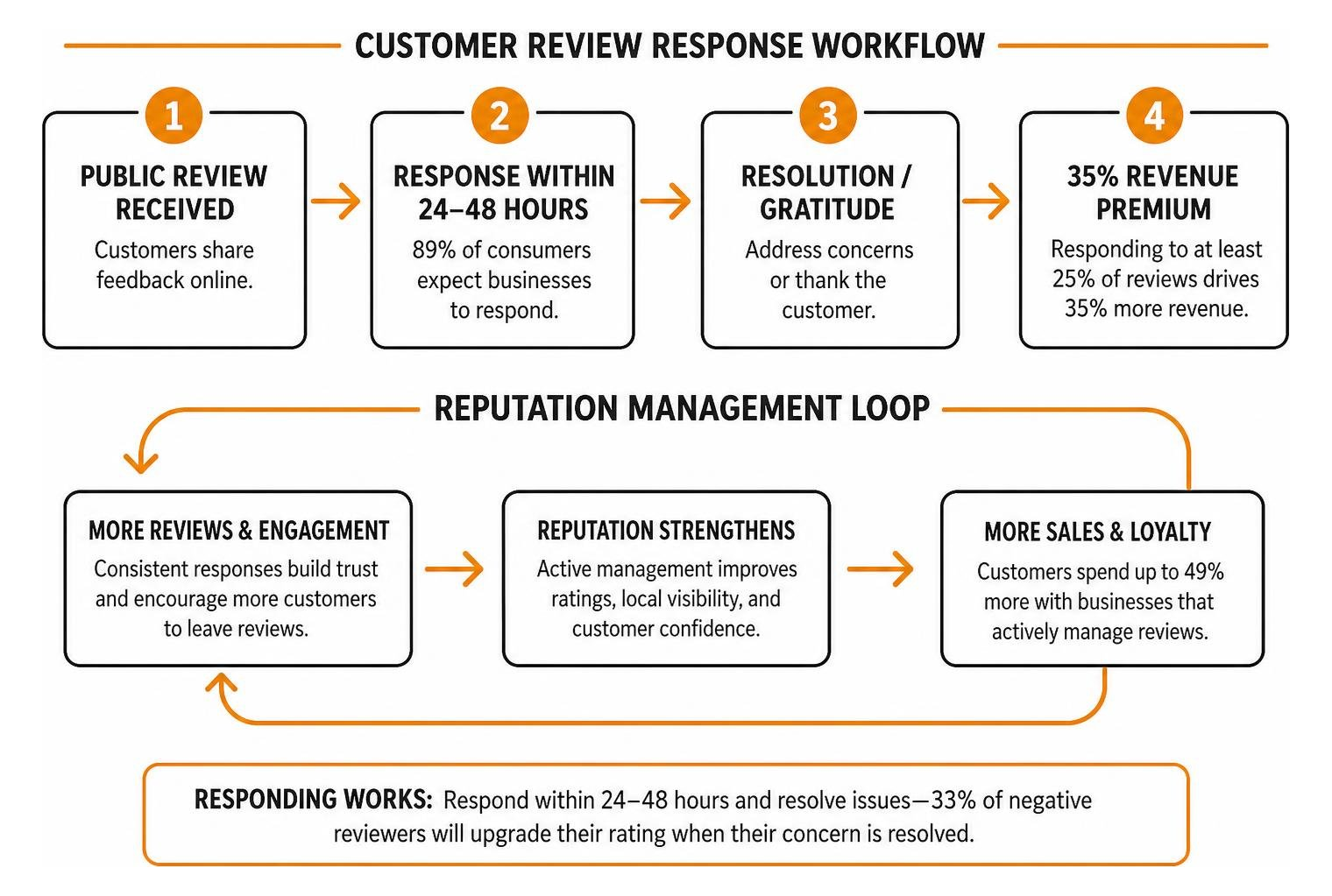
Managing incoming feedback is as critical as generating it. The benchmark data outlined in 35 Social Proof Statistics That Will Change How You Think About Reviews shows that 89% of consumers expect businesses to respond to public feedback.
Engaging with your audience pays off: businesses that respond to at least 25% of their reviews generate an average of 35% more revenue than inactive competitors. Furthermore, customers spend up to 49% more money with companies that actively manage and reply to their reviews. Establishing professional Google review response workflows protects your reputation and drives measurable customer lifetime value.
Why Responding to Every Review Helps Online Reviews Boost Sales
Speed and tone matter when handling public reviews. Responding within 24 to 48 hours demonstrates accountability. When addressing negative feedback, a calm, empathetic, and professional response can de-escalate tension; roughly 33% of negative reviewers will upgrade their rating if the business resolves their complaint promptly.
To maintain consistency without draining staff hours, evaluate automated review response systems that blend automated alerts with personalized, human responses.
Preventing 5-Star Review Deletions and Fighting Fake Feedback
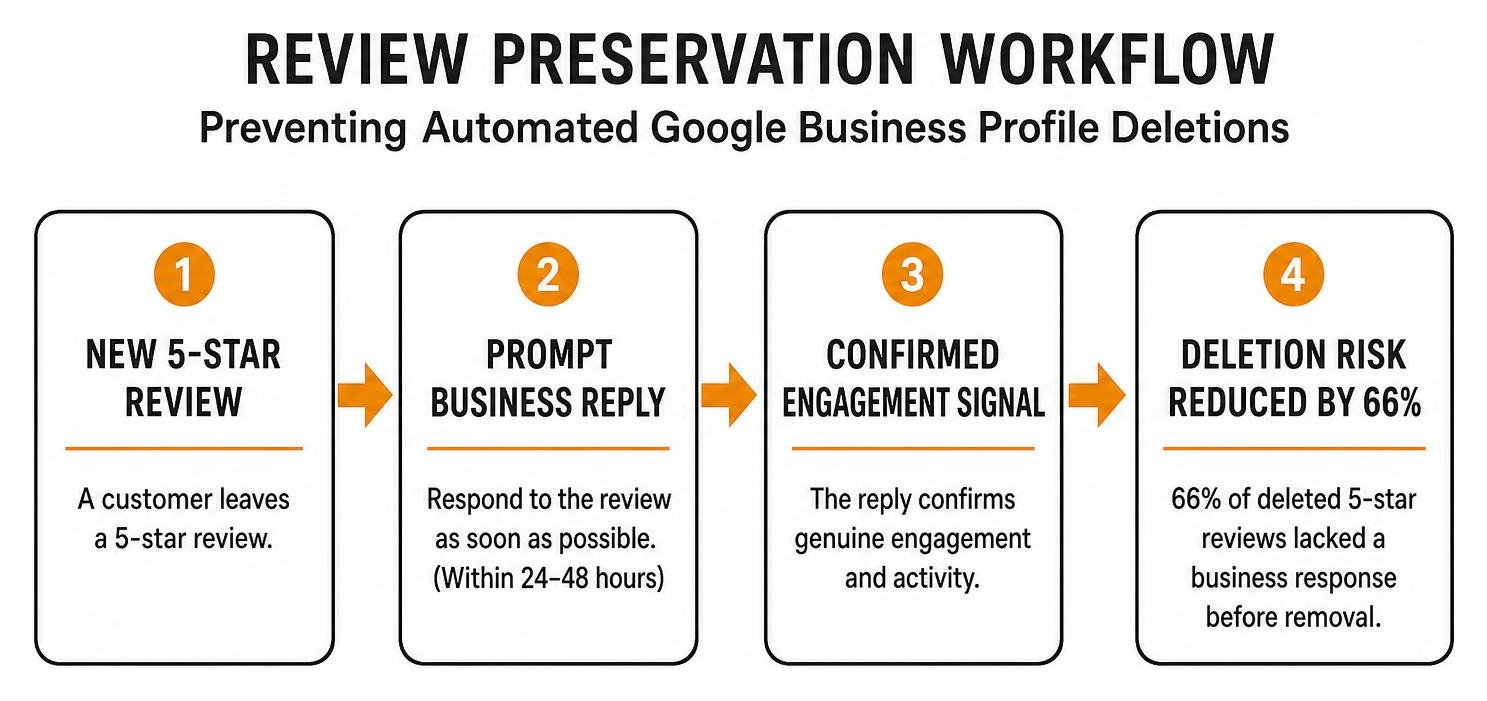
Google’s automated spam-filtering systems actively prune accounts showing abnormal activity patterns. Notably, 66% of deleted 5-star Google reviews lacked a business response before removal. When a 5-star review receives no reply from the business owner, automated algorithms are more likely to flag it as unverified or incentivized feedback.
Simultaneously, fake and malicious reviews represent a multi-billion dollar issue, with roughly 30% of web reviews estimated to be fraudulent. To maintain FTC compliance and protect your listing, learn the process for identifying and deleting fake Google reviews without compromising your brand’s integrity.
Strategic Execution: How to Collect, Manage, and Display Customer Reviews

A successful review strategy requires a continuous, automated process. Rather than relying on sporadic manual outreach, implementing dedicated review generation services ensures steady review velocity across all primary platforms.
Multi-Touch Collection Strategies: SMS, QR Codes, and Automated Triggers
Timing dictates response rates. The most effective window to request customer feedback is immediately following a completed transaction or project milestone while customer enthusiasm is highest.
- Automated SMS Sequences: Deliver direct review links via text message. Because mobile users are typically logged into their Google accounts, SMS workflows deliver higher conversion rates than email alone.
- Point-of-Sale QR Codes: Display scannable cards, receipts, or counter displays. Learn more about generating 5-star ratings with review QR codes at physical checkout counters.
- CRM Milestone Workflows: Trigger automated review solicitations directly from your CRM or invoicing platform upon project sign-off.
On-Site Social Proof: How Embedding Online Reviews Boost Sales at Checkout
Do not restrict your customer reviews to third-party directories. Integrating real-time review widgets directly onto high-intent landing pages, pricing grids, and checkout screens resolves final pre-purchase hesitations, reducing cart abandonment by up to 19%.
Use structured review schema markup (JSON-LD) on your product and service pages. Schema implementation allows search engines to display star ratings directly within organic search results, lifting organic click-through rates.
Frequently Asked Questions About Review Management and Sales Growth
What is the ideal star rating for maximizing conversion rates?
The optimal average rating for maximizing sales conversion sits between 4.2 and 4.7 stars. A perfect 5.0 score often raises suspicion among shoppers, who may perceive it as curated or fake. A balanced profile containing minor constructive feedback builds credibility and converts higher than an unblemished record.
Why does Google delete unresponded 5-star reviews?
Google uses automated spam-detection algorithms to combat review manipulation and paid endorsements. Approximately 66% of deleted 5-star reviews lacked a business reply. When an owner regularly responds to incoming feedback, it signals an active, legitimate business relationship, significantly reducing the likelihood of automated removal.
How many total reviews does a local business need before seeing revenue growth?
Significant conversion gains begin at just five reviews, which increases purchase likelihood by 270%. Consumer trust solidifies once a profile reaches 20 fresh reviews. Businesses that pass the 50-review milestone on Google generate up to 266% more inbound leads than competitors with fewer than 10 reviews.
Conclusion
Building a systematic review acquisition and response engine is one of the most effective strategies for growing a business. Authentic feedback boosts local search rankings, reassures prospective buyers, and increases conversion rates across every marketing channel.
We at ClickCentric Digital help businesses dominate local search, capture high-intent leads, and turn customer feedback into revenue. Contact us today to strengthen your review pipeline and scale your local market presence.
Sorry, the comment form is closed at this time.