

29 Oct Can Companies Actually Remove Bad Google Reviews or Are Star Ratings Permanent?
Can Companies Actually Remove Bad Google Reviews or Are Star Ratings Permanent?
Can Companies Remove Bad Google Reviews?

Can companies remove bad Google reviews? Not directly. Google decides whether to remove a review that breaks its policies or the law. If a review looks fake, abusive, or spammy, save a screenshot and report it through your Google Business Profile. If Google leaves it up, you may be able to file a one-time appeal. An honest negative review usually stays.
That does not mean you are stuck doing nothing. A calm public reply can show future customers how you handle problems, while better service and a steady flow of genuine reviews can reduce one bad rating’s impact.
I’m Fred Dirkse, and I’ll walk you through when to report a review, how to appeal, and what to do if it stays.
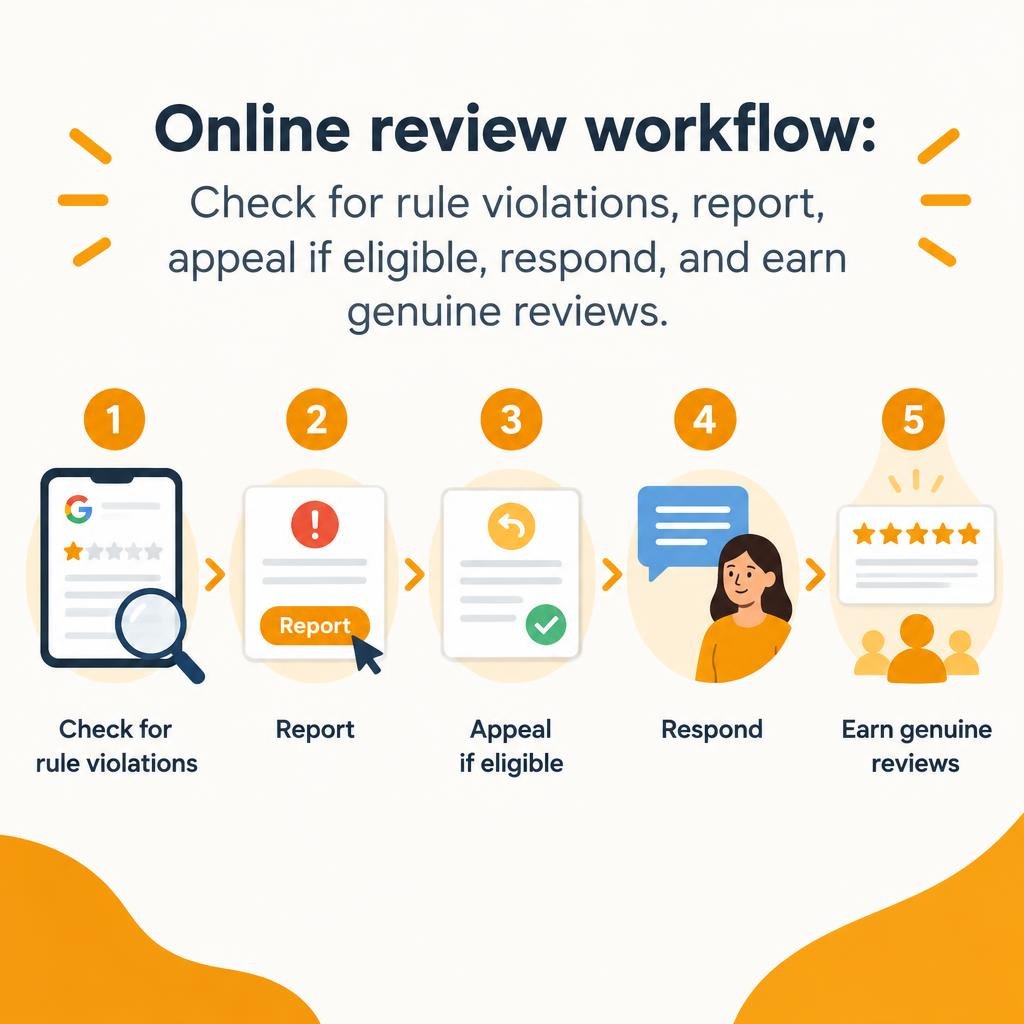
Can companies remove bad google reviews terms to remember:
The Reality: Can Companies Remove Bad Google Reviews Directly?
When a harsh 1-star rating pops up on your screen, your first instinct is naturally to search for a “Delete” button. Every business owner wants absolute control over their public image. However, Google maintains strict platform autonomy. As a business owner, you do not have administrative power to simply erase reviews from your Google Business Profile.

Google builds its platform around consumer transparency. If businesses could scrub away every dissatisfied customer comment with a single click, online reviews would lose all public credibility. Today, 96% of consumers read online reviews before deciding on a local business. Because prospective buyers rely heavily on these star ratings, Google acts as an independent gatekeeper.
Before assuming you are stuck forever, you must understand how Google evaluates bad review removals. You cannot delete a review simply because it is unflattering, unfair, or bad for sales; Google will only intervene if the submission violates its official policies or consumer protection laws.
Why Can Companies Remove Bad Google Reviews Only When Policies Are Breached?
Google draws a sharp line between a poor customer experience and prohibited content. A real customer who disliked your customer service or thought your pricing was too high has posted an authentic opinion. As frustrating as that is, Google will not remove it.
However, Google actively enforces rules against content that undermines platform integrity. Reviews are eligible for removal under specific prohibited categories:
- Fake Engagement and Spam: Reviews generated by bots, paid review rings, or competitors attempting to sabotage your ranking.
- Conflict of Interest: Content posted by current or former employees, business owners reviewing their own listing, or competitors trying to manipulate ratings.
- Harassment and Hate Speech: Content using offensive profanity, personal attacks, slurs, or disclosing private personal information (doxxing).
- Off-Topic Content and Misinformation: Political rants, social commentary, or reviews describing a completely different business or location.
Learning the proper steps for spotting and deleting fake reviews allows you to pinpoint exact policy violations and present a compelling case to Google’s moderation team.
Legal Frameworks and Consumer Protection Across Global Markets
Review moderation is not just guided by platform rules; international consumer protection laws strictly regulate how platforms and businesses handle user feedback. Regulatory bodies penalize deceptive review manipulation heavily.
In the United States, the Federal Trade Commission (FTC) enforces strict guidelines against deceptive review suppression. Under the FTC Consumer Review Rule, suppressing, hiding, or buying the removal of honest negative feedback carries civil penalties of up to $53,088 per violation. Similarly, the European Union’s Digital Services Act (DSA) mandates transparency and requires platforms to provide structured notice-and-action mechanisms for illegal content. In Australia, the Australian Competition and Consumer Commission (ACCC) monitors misleading business conduct, working alongside established guidelines for deleting reviews under Australian law.
| Regulatory Jurisdiction | Primary Consumer Law | Legal Rules on Bad Reviews | Penalties for Deceptive Suppression |
|---|---|---|---|
| United States | FTC Act & Consumer Review Fairness Act | Banning non-disparagement gag clauses; illegal to suppress authentic negative reviews | Fines up to $53,088 per violation |
| European Union | Digital Services Act (DSA) & Omnibus Directive | Prohibits fake reviews; platforms must provide appeal mechanisms for illegal content | Regulatory sanctions and platform-level fines |
| Australia | Australian Consumer Law (ACL / CCA) | Deceptive conduct bans filtering or artificially altering authentic feedback | Substantial statutory fines for misleading conduct |
How to Dispute and Remove Policy-Violating Google Reviews
When you identify a review that genuinely breaks platform rules, you need a methodical approach. Do not submit an emotional complaint. Instead, treat the dispute like an evidence-based claim by disputing Google reviews with documented proof.
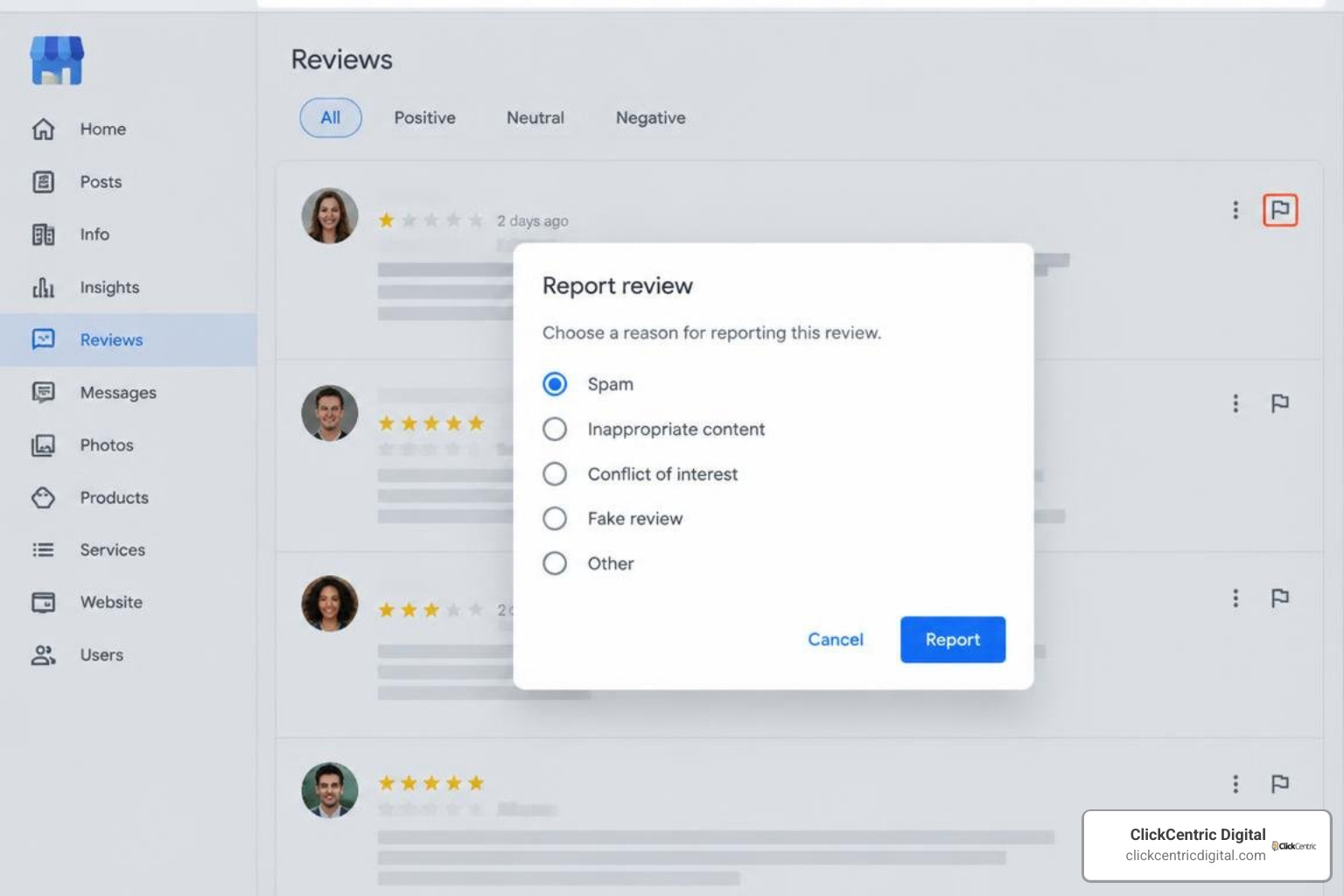
Begin by capturing clear screenshots of the review, the reviewer’s public profile, and any associated timestamps. Check your internal customer database, POS records, or appointment schedules. If the reviewer’s name or incident has zero correlation with your operational records, note that absence of customer contact clearly in your documentation.
Step-by-Step: How Can Companies Remove Bad Google Reviews via Official Google Tools?
To challenge a policy-violating post, use the built-in moderation workflows inside your Google account. You can consult the official Google policy on reporting inappropriate reviews and follow our step-by-step review dispute guide to submit your request:
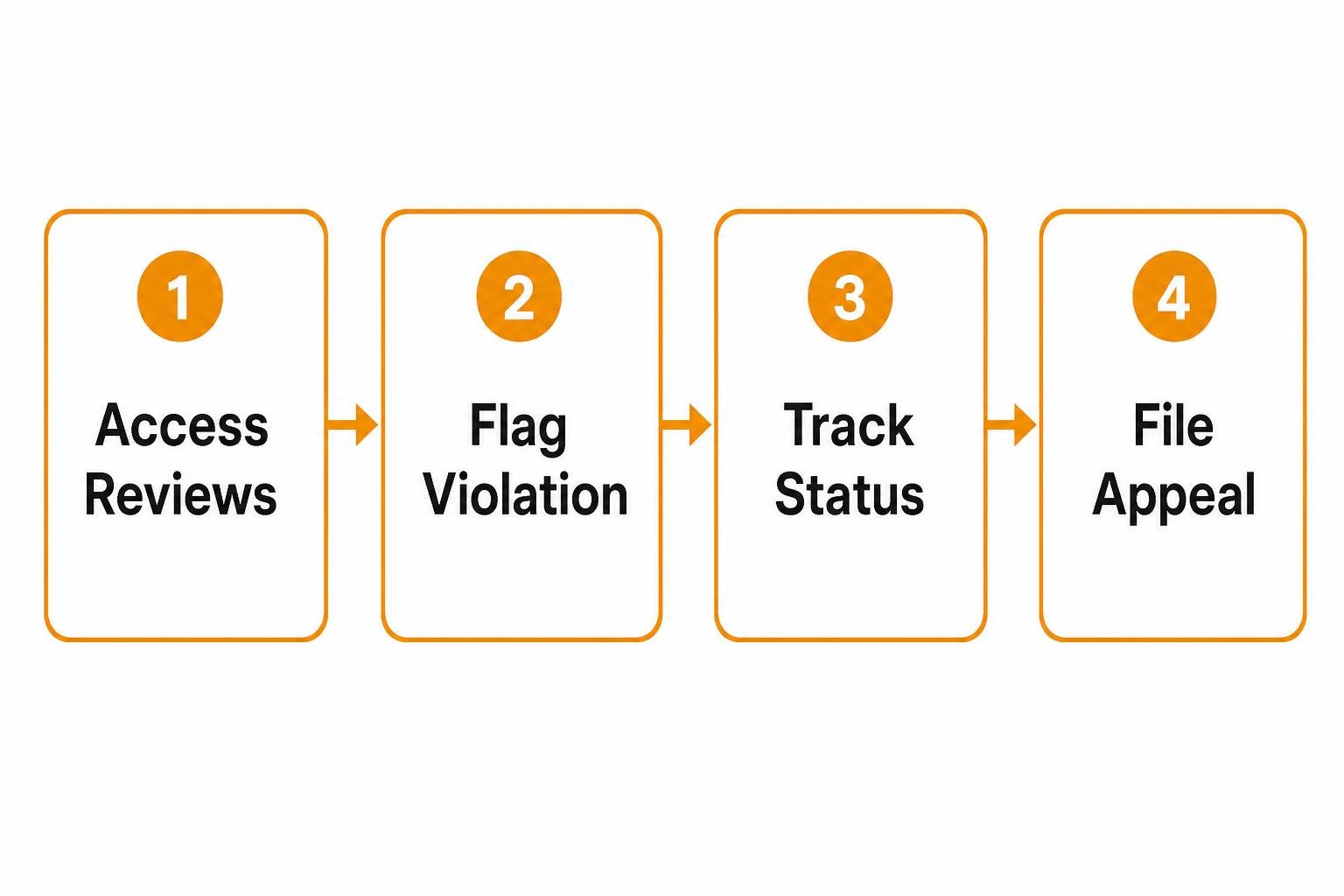
- Log in to Google Business Profile: Open your dashboard on Google Search or Google Maps.
- Locate the Offending Review: Click on Read reviews and scroll to the specific comment.
- Click the Three-Dot Menu: Select the three vertical dots next to the rating and click Report review.
- Choose the Specific Violation Category: Select the precise policy breach (e.g., Spam, Conflict of Interest, Profanity, or Harassment). Do not select a random category; pick the one that accurately matches the text.
- Monitor via the Reviews Management Tool: Access Google’s specialized Workflow Tool to check the real-time status of your reported review.
Navigating the Google One-Time Appeal and Escalation Process
Google’s automated spam detection systems evaluate millions of reviews daily, which means legitimate removal requests can occasionally be denied on the first pass. If Google evaluates your initial flag and decides to leave the review up, do not lose hope.
You are entitled to submit a structured one-time appeal through the Reviews Management Tool. When preparing your appeal:
- Cite Specific Policy Clauses: Quote Google’s exact Prohibited and Restricted Content terms.
- Provide Concise Evidence: Explain clearly why the content is fraudulent, abusive, or off-topic (e.g., “The reviewer explicitly states they were never a customer and are protesting an unrelated political event”).
- Batch Appeals Properly: Google allows businesses to track and appeal up to 10 reviews per submission batch.
- Escalate Damaging Claims: If the review involves severe defamation or explicit harassment, follow our guide on deleting damaging business reviews to contact Google Support directly via help desk tickets.
What to Do When Google Refuses to Remove a Negative Review
What happens when a negative review is completely authentic or Google rejects your appeal? In these situations, the review is permanent. However, an unremovable review does not have to damage your business.
A single negative review is enough to scare off 35% of shoppers before they ever contact you. Fortunately, 88% of consumers are likely to look past a bad review if the business responds professionally. When removal is off the table, managing your Google reviews effectively through thoughtful public communication becomes your most powerful asset.
The 4-Beat Public Response Framework for Defusing Customer Complaints
When prospective buyers read your reviews, they are not just looking at what unhappy customers say—they are watching how you react under pressure. A defensive or hostile reply validates the critic, while a calm, professional response builds immediate trust.
Use this 4-beat public response framework:
- Acknowledge & Thank: Thank the reviewer for their feedback and acknowledge their frustration without admitting legal liability.
- Apologize with Empathy: Deliver a sincere, professional apology for the fact that their experience fell short of your usual standards.
- State Your Standards: Briefly explain your commitment to high-quality service or the standard protocol you follow.
- Take It Offline: Provide a direct name, phone number, or email address so the individual can resolve the matter privately.
Here is how to adapt this framework for different review scenarios:
- For Legitimate Customer Complaints:
“Thank you for bringing this to our attention, [Name]. We pride ourselves on prompt, reliable service, and we are truly sorry that your visit took longer than expected. We would love the chance to make this right. Please contact our general manager directly at [Phone/Email] so we can find a solution for you.” - For Vague or Unverified Drive-By Reviews:
“Hi [Name], we take all customer feedback seriously, but we cannot locate any records matching your name or service details in our system. We strive to provide excellent care to every client we serve. Please reach out to us at [Email] with more details so we can investigate and assist you directly.”
Data shows that 33% of users are open to improving their negative rating after receiving a personalized, constructive reply from the business.
Defamation and Legal Action: When to Involve Legal Counsel
When a review crosses from harsh criticism into outright defamation, slander, or malicious corporate sabotage, legal escalation may be necessary. If a reviewer makes false factual statements that cause demonstrable financial injury—such as falsely accusing a business of criminal conduct or health code violations—you may have legal grounds for action.
Before hiring an attorney, keep these practical points in mind:
- Opinion vs. Fact: Statements like “The food tasted bland” are protected personal opinions. Claims like “The kitchen is infested with rats” are assertions of fact that can be challenged legally if provably false.
- Cease-and-Desist Letters: A formal letter from legal counsel can prompt an identifiable reviewer to retract their statement voluntarily.
- Court Orders: Google complies with valid court orders requiring the removal of proven defamatory content.
- The Streisand Effect: Publicly suing a customer can attract unwanted local media attention, often causing far more reputational damage than the original review itself.
We always recommend completing a realistic review removal assessment before investing substantial financial resources into litigation.
Long-Term Strategies to Dilute Bad Reviews and Protect Your Star Rating
The most sustainable way to protect your business profile is not fighting over every single negative review—it is creating an ongoing influx of authentic 5-star ratings. A single negative review can be diluted until it becomes statistically irrelevant.
By mastering end-to-end Google review management, you build a resilient local search presence that consistently attracts new customers.
The 4.2 to 4.5 Star Sweet Spot and Why Perfection Looks Fake
Many business owners believe they must maintain an immaculate 5.0-star rating. In reality, consumer research from the Medill Spiegel Research Center reveals that purchase likelihood peaks when a business’s average rating is between 4.2 and 4.5 stars.
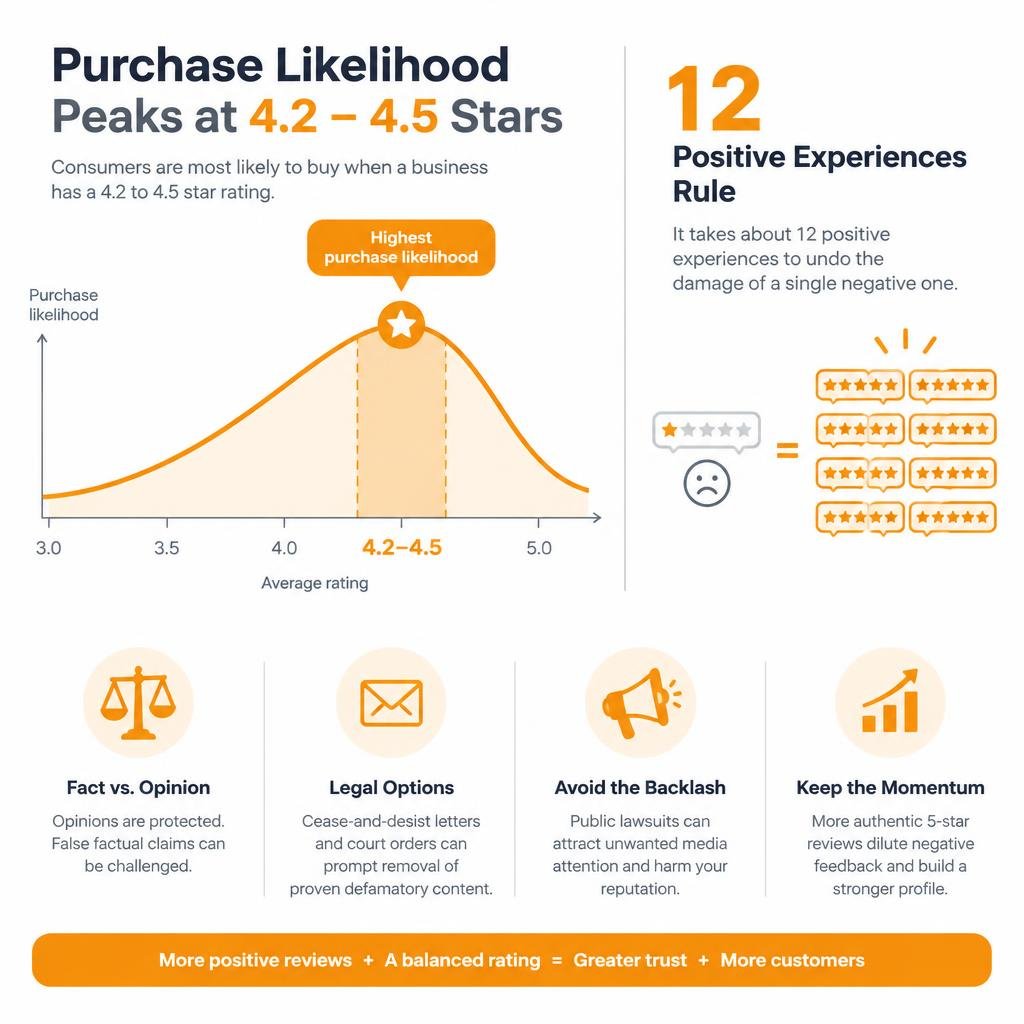
A flawless 5.0 rating across hundreds of reviews often triggers consumer skepticism. Buyers suspect that negative feedback has been artificially scrubbed or that the reviews are manufactured. A balanced profile with a few handled critical reviews demonstrates authenticity.
Research indicates that it takes about 12 positive experiences to undo the reputational damage of a single negative one. By focusing on volume and consistency, an isolated 1-star review will hardly impact your aggregate score.
Proactive Review Generation to Offset Negative Feedback
To build a continuous flow of positive social proof, integrate review requests directly into your standard operating procedures:
- Automated SMS & Email Workflows: Send an automated text message or follow-up email within 2 to 24 hours of completing a job or sale, while the positive experience is fresh.
- Direct Review Shortlinks: Generate your Google Business Profile review shortlink and turn it into scannable QR codes on receipts, invoices, table tents, or business cards.
- Team Training: Train your client-facing staff to ask satisfied customers for feedback at natural high points of customer delight.
- Consistent Velocity: Rather than running a one-time campaign that generates 50 reviews in two days (which can trigger Google’s automated spam filters), aim for a steady pace of authentic reviews week after week.
Frequently Asked Questions About Google Review Removal
Can I pay a third-party company to delete a bad Google review?
No. Any agency claiming they have an “insider backdoor” or a 100% guarantee to permanently delete legitimate Google reviews is operating an unethical scheme. Only Google can remove reviews from its platform. Legitimate reputation management companies simply help you audit, flag policy violations, and run ethical review generation campaigns.
Does deleting my Google Business Profile permanently erase bad reviews?
Deleting your profile removes your access to manage the listing, but it does not erase the underlying location data or public reviews from Google Maps. Unclaimed listings often remain visible, and you will lose all of your local SEO rankings, photo assets, and verified status.
How long does Google take to review a flagged comment?
Google’s automated and manual moderation teams typically evaluate flagged reviews within several business days to three weeks. You can check the current evaluation status at any time using Google’s Reviews Management Tool.
Conclusion
Can companies remove bad Google reviews directly? No—Google strictly controls its platform to protect consumer trust. However, by identifying genuine policy violations, leveraging Google’s reporting and appeal tools, responding constructively to legitimate criticism, and building a proactive review generation strategy, you can protect your brand’s reputation and search visibility.
At ClickCentric Digital, we help businesses improve local search rankings, optimize Google Business Profiles, and implement sustainable review management strategies. Explore our professional online reputation management services today to build a local search presence that drives steady customer acquisition.
Sorry, the comment form is closed at this time.