


28 May The Art of Deleting Bad Amazon Feedback Without Losing Your Mind
The Art of Deleting Bad Amazon Feedback Without Losing Your Mind
When a Bad Amazon Review Is Costing You Sales, Here’s What You Can Actually Do
Amazon negative review removal is possible — but only under specific conditions. Here’s a quick breakdown before we dive in:
Can you remove a negative Amazon review?
- Yes, if the review violates Amazon’s Community Guidelines (fake reviews, profanity, irrelevant content, competitor sabotage, shipping complaints posted as product reviews)
- No, if it’s an honest negative opinion — even if it’s unfair or harsh
- You cannot directly delete a review yourself as a seller
- You can report it via the “Report abuse” link or open a Seller Central support case
- Amazon typically responds within 5–10 business days; complex cases can take up to 90 days
Here’s the uncomfortable truth every Amazon seller eventually faces: you can do everything right — great product, fast shipping, solid listing — and still wake up to a one-star review that tanks your conversion rate overnight.
It stings. And it’s not just emotional. The data backs it up.
93% of customers read reviews before buying. A single bad review can push away roughly 22% of potential customers. And according to research, even a 0.1-point drop in your star rating can cost you 25–50% of your sales lift in the other direction.
As of May 2026, Amazon’s review ecosystem is more scrutinized than ever — both by the platform itself and by regulators. Amazon blocked over 200 million suspected fake reviews in a single recent year. That means the rules are tighter, the stakes are higher, and sellers need a clear, policy-compliant strategy — not guesswork.
This guide walks you through exactly what you can remove, how to request it, and what to do when removal isn’t an option.
Key amazon negative review removal vocabulary:
Customer Reviews vs. Seller Feedback: Know What You’re Trying to Remove
Before we try to remove anything, we need to identify what it actually is. This is where many sellers lose an afternoon and a bit of their sanity.
Amazon has two different systems:
| Type | Appears where | About what | Impacts what |
|---|---|---|---|
| Customer reviews | Product detail page | The product itself | Conversion, star rating, search visibility |
| Seller feedback | Seller profile | The buying experience | Seller metrics, account health, fulfillment reputation |
Customer reviews are product-focused. They help shoppers decide whether the item is worth buying. They can include ratings, text, photos, and the familiar Verified Purchase badge.
Seller feedback is different. It covers the order experience: shipping speed, packaging, communication, cancellation issues, and whether the transaction felt smooth or painful.
That distinction matters because the removal path is not the same.
What customer reviews actually affect
Customer reviews influence far more than feelings. They shape performance.
When a product collects negative reviews, we often see pressure in these areas:
- Conversion rate
- Star rating
- Buyer trust
- Organic visibility in Amazon search
- PPC efficiency
- Perceived relevance in Amazon’s ranking systems
This is why negative reviews feel expensive, because they often are. Research shows 93% of customers read online reviews before purchasing, and 84% trust reviews as much as personal recommendations. If the review section looks rough, shoppers hesitate. Hesitation kills conversion.
Even small shifts matter. A 0.1 improvement in rating can lead to a 25-50% lift in sales. That is not a rounding error. That is real money.

Why seller feedback is a different system
Seller feedback has more to do with operational performance than product perception. If a buyer complains about late delivery, damaged packaging in transit, or service issues, that content may belong in seller feedback rather than a product review.
For third-party sellers, seller feedback can affect account health in a way customer product reviews usually do not. Amazon’s official help pages for seller feedback are separate from product review handling, which is why it is important to use the correct path from the start. You can review Amazon’s official documentation here: Amazon.
In simple terms:
- Product reviews hurt listing performance
- Seller feedback hurts seller reputation and metrics
- Shipping complaints posted as product reviews may be removable
- Product complaints posted as seller feedback may need a different workflow
If you misclassify the issue, your removal request is much more likely to go nowhere.
Amazon Negative Review Removal: What Can Actually Be Removed?
This is the core rule: Amazon does not remove reviews just because they are negative. Amazon removes reviews when they violate policy.
That makes amazon negative review removal less about persuasion and more about evidence.
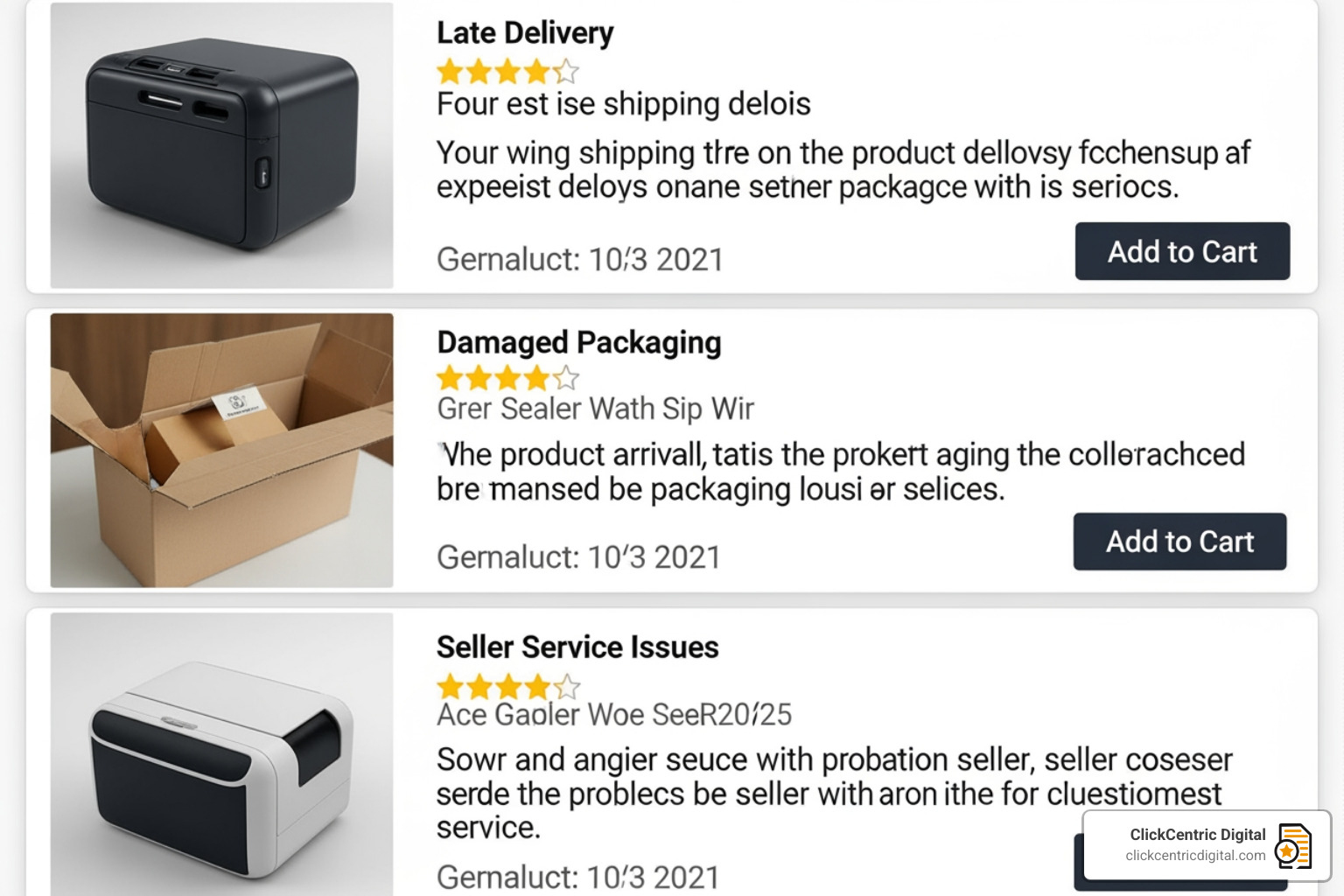
Reviews Amazon may remove under its rules
Based on Amazon guidance and supporting industry research, these are the main categories that may qualify for removal:
- Reviews focused only on seller service instead of the product
- Shipping or delivery complaints posted as product reviews
- Fulfillment by Amazon issues when Amazon handled the logistics
- Obscene, abusive, or profane language
- Personal information such as phone numbers, email addresses, or home addresses
- Promotional content or spam
- Duplicate content
- Conflict-of-interest reviews, including competitor abuse
- Fake or clearly manipulated reviews
- Irrelevant content that does not discuss the product experience
Examples:
“Arrived two weeks late. One star.”
If Amazon handled shipping, this may be removable.“Call me at this number and I’ll explain why this seller is a scam.”
Personal info plus likely abuse issue.“Buy Brand X instead, it’s way better.”
Promotional competitor content.A review repeated across multiple listings with nearly identical wording
Possible spam or coordinated abuse.
Reviews Amazon usually will not remove
Here is the frustrating part: even bad reviews can still be allowed.
Amazon usually will not remove:
- Honest negative opinions
- Low star ratings without policy violations
- Complaints about fit, comfort, color, size, or quality
- “Not worth the price” comments
- Harsh but relevant product criticism
- Reviews that seem unfair but still describe a real product experience
So if a buyer says, “This felt cheap and broke in a week,” Amazon may keep it even if you know the customer used it incorrectly, assembled it upside down, or expected it to make coffee and walk the dog.
Amazon negative review removal myths that get sellers in trouble
There are a few myths that consistently create account risk.
Myth 1: “If I solve the customer’s problem, I can ask them to edit or remove the review.”
Not safely. Amazon is very strict about review manipulation. You can provide support and resolve issues, but you should not pressure a customer to change or delete a review.
Myth 2: “I can offer a refund, gift, or replacement in exchange for removal.”
Absolutely not. That crosses into incentivized review behavior and can create serious account consequences.
Myth 3: “A service can wipe any review if I pay enough.”
No legitimate provider can promise removal of valid reviews. Anyone offering guaranteed deletion of policy-compliant criticism is waving a giant red flag.
If you want a solid outside explanation of the policy-first process, this step-by-step guide covers the general framework well.
How to Request Amazon Negative Review Removal Step by Step
Now for the practical part. If a review appears to violate policy, here is the cleanest way to handle it.
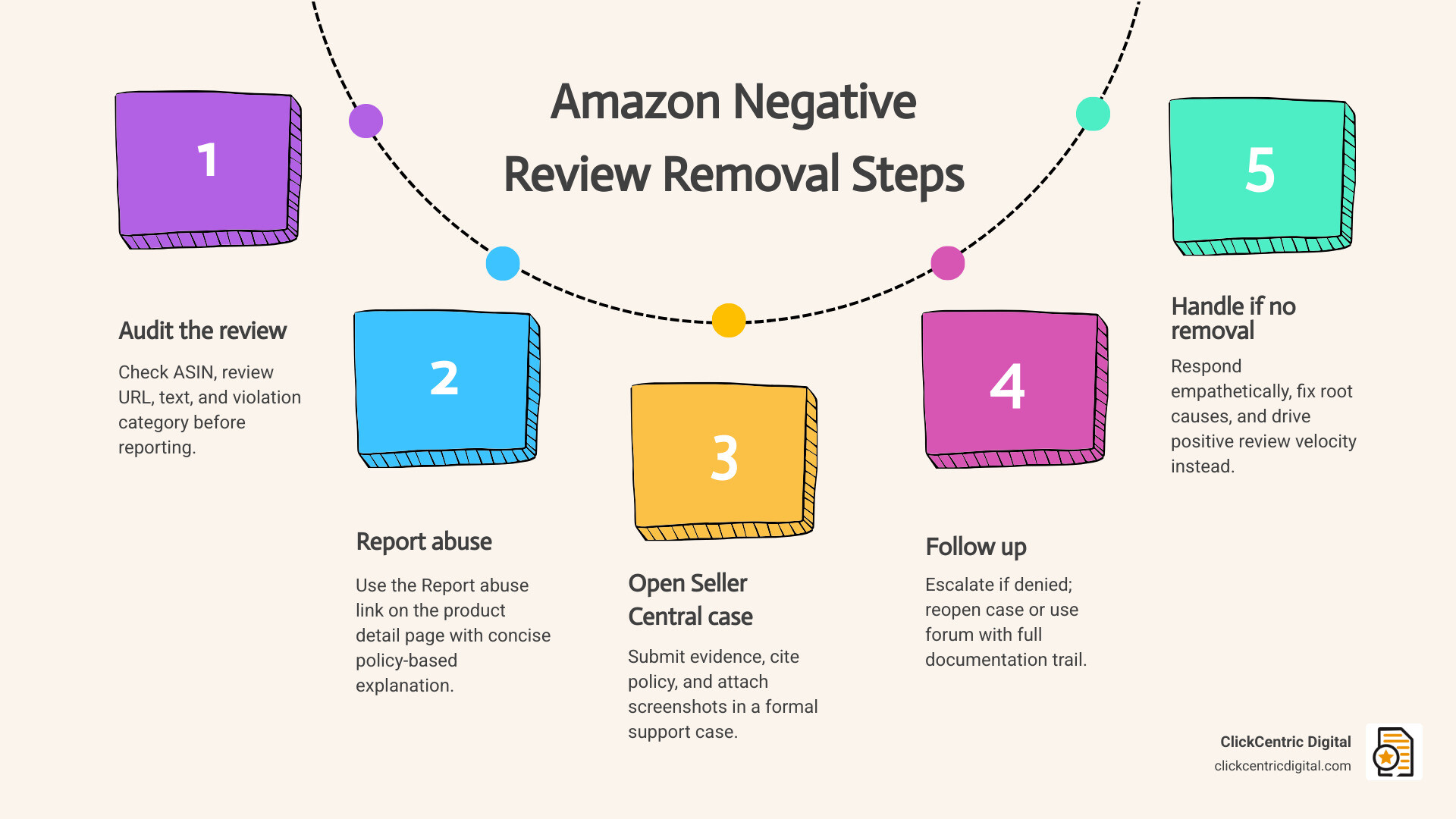
Step 1: Audit the review before you report it
Do not report first and think later.
Gather:
- ASIN
- Product URL
- Direct review URL if available
- Screenshot of the full review
- Reviewer name as displayed
- Date posted
- Exact text of the violation
- The category of policy issue
This matters because vague reports get vague results. “This review is unfair” is weak. “This review discusses shipping delay on an FBA order and does not evaluate the product” is much stronger.
We recommend writing a one-sentence summary like this:
- “This product review appears to violate Amazon guidelines because it addresses delivery performance handled by Amazon fulfillment rather than the product itself.”
That keeps your case factual and easy to review.
Step 2: Use the Report abuse link on the listing
On the product detail page, use the “Report abuse” link attached to the review.
When you submit the flag:
- Be concise
- Stick to the policy issue
- Avoid emotional language
- Do not insult the reviewer
- Explain why the content violates Amazon rules, not why it annoys you
Good example:
- “This review concerns delivery delay and shipping experience, not the product. Amazon fulfillment handled shipping.”
Bad example:
- “This customer is wrong and clearly trying to hurt my business.”
Amazon support teams are much more likely to act when the report is calm, specific, and policy-based.
Step 3: Open a Seller Central support case with evidence
If the review is serious or the abuse report goes nowhere, open a case in Seller Central.
Your case should include:
- ASIN
- Screenshot
- Date of review
- Full review text
- Clear explanation of the violation
- Any fulfillment details that prove Amazon handled shipping
- Reference to the relevant policy category
Best practices for the case:
- Use a factual tone
- Keep the request short
- Focus on one violation per review
- Attach evidence
- Avoid long emotional backstories
A simple structure works well:
- Identify the review.
- State the policy issue.
- Explain the supporting evidence.
- Request review of removal eligibility.
If you are dealing with several violating reviews, submit organized evidence rather than a messy pile of screenshots named things like “final final real final.png.”
Step 4: Follow up and escalate if Amazon says no
A rejection is not always the end. Sometimes the first response is generic, incomplete, or clearly written by a bot having a very average day.
If Amazon says no:
- Reopen the case if possible
- Submit a second case with clearer evidence
- Tighten your wording
- Reference the exact violation again
- Keep a clean documentation trail
If you still hit a wall, Amazon’s own seller community discussions can offer guidance on next steps. This Seller Central discussion is useful for understanding the platform’s stance: So you want to remove a customer review? – Amazon Seller Central
Timeframes vary. Some approved removals happen within hours or a few days. Other investigations can drag on for weeks. Complex cases may take much longer, especially if Amazon needs to review abuse patterns or account links.
What to Do When a Negative Review Can’t Be Removed
Sometimes the answer is no. In that case, the job shifts from removal to mitigation.
That is not as satisfying as seeing a one-star review vanish into the internet void, but it is still valuable.
How to respond without sounding defensive
Amazon no longer offers the same kind of broad public review response options many businesses know from Google, so your main response strategy is operational rather than theatrical.
If you can contact the customer through approved Amazon tools, keep your tone:
- Calm
- Helpful
- Brief
- Non-defensive
- Focused on resolution
The goal is not to win an argument. The goal is to reduce friction, solve the issue, and create the possibility that the customer updates their review on their own.
A smart format is:
- Acknowledge the issue
- Express willingness to help
- Offer a specific next step
- Avoid blame
The same principles apply in other review environments too, which is why our guide on how to manage review responses like a pro is still useful for tone and structure.
Ways to reduce the impact of bad reviews
If a review stays up, we work on dilution and recovery.
That usually means:
- Use Amazon’s Request a Review feature consistently
- Increase review velocity from satisfied customers
- Improve post-purchase support
- Consider programs like Vine where appropriate and compliant
- Monitor recurring complaint themes
- Adjust your listing to reduce confusion before purchase
A stronger stream of legitimate positive reviews can soften the effect of one or two damaging comments. Not by gaming the system, but by making sure happy customers actually leave feedback.
This is also where monitoring matters. If you only notice negative reviews two months later, you lose response time and learning time. Our article on reputation monitoring tools can help you build a process that catches issues earlier.
Turn criticism into operational fixes
The most expensive review is the one that points to a real, repeated problem you ignore.
Look for patterns in negative reviews:
- Confusing sizing
- Missing instructions
- Fragile packaging
- Wrong product expectations
- Slow support
- Compatibility problems
- Inconsistent product quality
Then fix the root cause.
Useful corrective actions include:
- Rewrite bullets and descriptions for clarity
- Add better images
- Add size charts or compatibility notes
- Improve inserts or instructions
- Redesign packaging to reduce damage
- Tighten supplier quality control
- Respond to support inquiries faster
This is where review management becomes operational improvement, not just cleanup. Our guide to how to remove negative reviews: 5 guaranteed methods is platform-agnostic, but the larger lesson applies here too: the best long-term review strategy is to create fewer reasons for bad reviews in the first place.
Should You Hire a Review Removal Service?
Sometimes sellers have too many ASINs, too little time, or too many borderline policy violations to handle everything manually. That is when outside help starts to look tempting.
That can be fine, but only if the approach is clean.
Green flags to look for before you hire anyone
If you consider help with amazon negative review removal, look for these signs:
- Policy-first approach
- No promises to remove valid reviews
- Transparent pricing
- Clear explanation of how cases are documented
- No outreach to reviewers asking for edits
- No incentives, gifts, or side deals
- Limited and appropriate account access only if necessary
- Realistic expectations on timing and outcomes
A legitimate provider should sound boring in the best possible way: compliant, methodical, evidence-driven.
Red flags that signal account risk
Run away from these:
- “Guaranteed deletion” claims
- Offers to bribe or compensate reviewers
- Fake review replacement schemes
- Mass manipulation tactics
- Requests for unsafe login access
- Advice to pressure buyers into changing reviews
- Anything that sounds like a shortcut around Amazon policy
In 2026, shortcuts are usually just delayed headaches.
Also remember that review fraud is not just an Amazon issue. The broader review ecosystem is under heavier scrutiny, and businesses need to think long term. Our piece on whether review deletion is really possible makes the same point in another platform context: removal is limited, policy-based, and rarely magical.
DIY vs outsourced review removal
DIY works well when:
- You have a manageable number of listings
- You understand Amazon policy categories
- You can document cases carefully
- You have time to follow up
Outsourcing may make sense when:
- You manage many ASINs
- Review monitoring is inconsistent
- Your team lacks bandwidth
- You need a tighter process for documentation and escalation
The key is not who submits the request. The key is whether the request is accurate, compliant, and supported by evidence.
How to Prevent Negative Reviews Before They Happen
Prevention is less dramatic than removal, but much more profitable.
Improve the listing so buyers get what they expect
A surprising number of negative reviews start with expectation mismatch.
To reduce that:
- Make titles precise
- Use clear, honest images
- Write bullets that explain real use cases
- Clarify size, materials, and compatibility
- Show what is included in the box
- Add setup or care instructions
- Avoid exaggerated claims
If buyers think they are ordering one thing and receive another, the review section becomes a complaint desk.
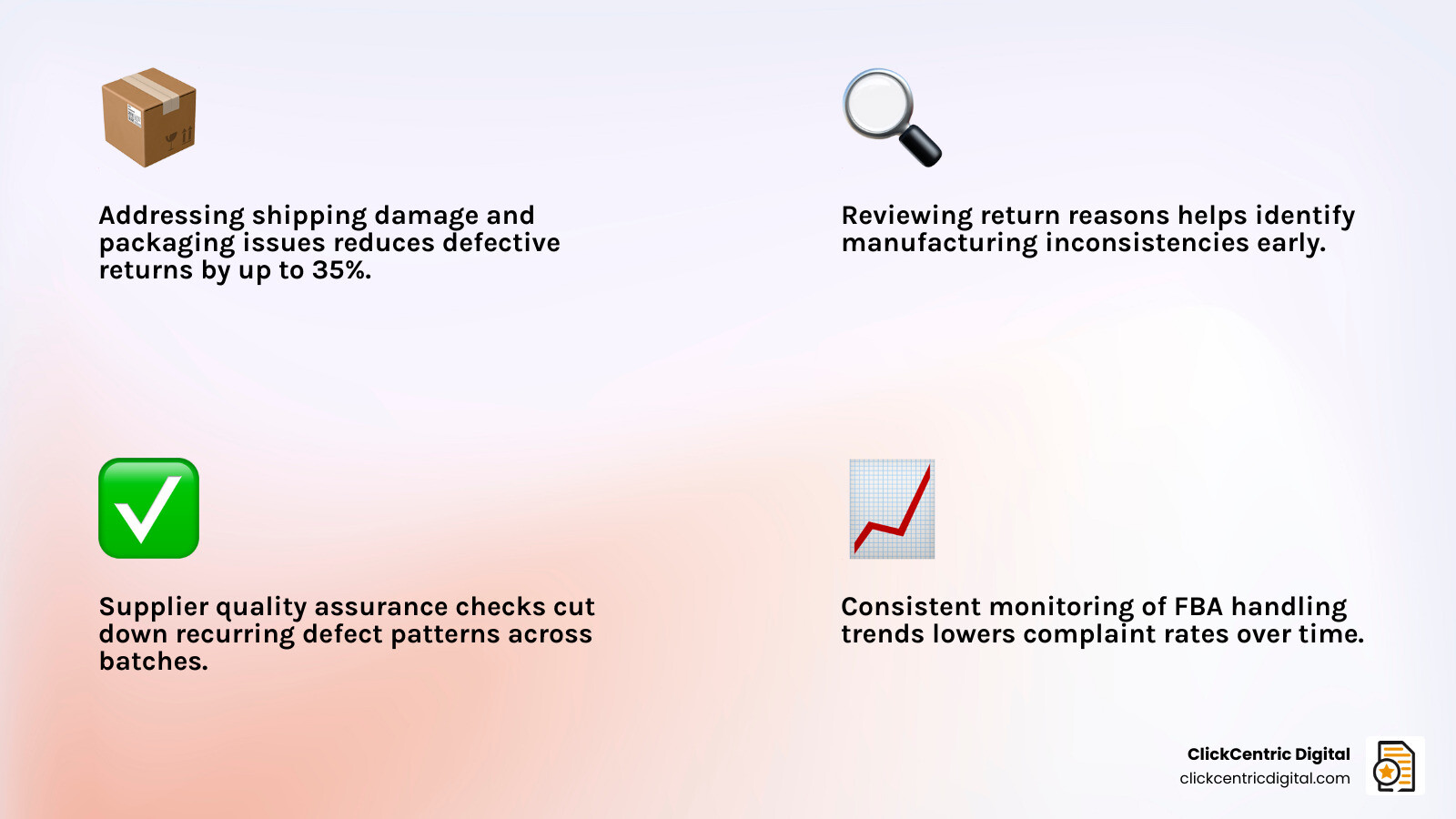
Fix fulfillment and product quality issues upstream
Some review problems are operational, not marketing.
Pay attention to:
- Damage during shipping
- Weak packaging
- Manufacturing inconsistencies
- Return reasons
- Supplier quality assurance
- FBA handling trends
- Defect patterns by batch or ASIN
If multiple buyers mention the same flaw, trust the pattern. Reviews are not just public commentary. They are free diagnostics, even when they are annoying.
Build a repeatable post-purchase review strategy
The safest long-term play is a compliant review-generation system.
Your preventive SOP can include:
- Use Amazon’s Request a Review feature consistently
- Time requests after delivery when the buyer has used the product
- Resolve support issues quickly
- Track complaint trends by ASIN
- Escalate recurring defects internally
- Monitor new reviews daily or weekly
- Avoid any selective or incentivized review tactics
This matters because reviews are tied directly to revenue. Research consistently shows that one bad review can drive away 22% of customers, while tiny rating improvements can create outsized sales gains.
Frequently Asked Questions About Amazon Negative Review Removal
Can sellers remove any negative review on Amazon?
No. Sellers cannot remove reviews just because they are negative. Amazon generally removes reviews only when they violate policy, such as profanity, personal information, fake content, competitor abuse, or seller-service complaints posted as product reviews.
How long does Amazon negative review removal take?
If Amazon approves removal, it may happen within hours to a few days. Standard review investigations often take 5-10 business days. More complex cases can stretch much longer, sometimes up to 90 days.
Does one bad review really affect sales and rankings?
Yes. Reviews heavily influence buying behavior. About 93% of customers read reviews before purchase, and a single negative review can drive away around 22% of customers. Even a 0.1 increase in rating can produce a 25-50% lift in sales, so review quality absolutely affects conversion and visibility.
Conclusion
Amazon negative review removal is real, but it is narrow. You can remove reviews that break Amazon’s rules. You usually cannot remove honest criticism, even when it feels unfair.
That means the winning approach is:
- Know whether you are dealing with a product review or seller feedback
- Identify actual policy violations
- Report clearly and document everything
- Follow up without going off the rails
- Mitigate and improve when removal is not possible
- Build a prevention system so fewer bad reviews happen at all
In other words, this is not about deleting everything negative. It is about protecting your reputation without creating bigger problems.
If you want to strengthen your broader review strategy beyond Amazon, start with Mastering Local Reviews to Win More Customers. And if you need help building a more durable brand protection system, here is more info about reputation management services.
Bad reviews may be part of doing business. Losing your mind over them does not have to be.
Sorry, the comment form is closed at this time.