


22 Jul Website Development Services: Essential Guide
Website Development Services: Essential Guide
What Website Development Really Means (And Why It Matters for Your Business)
Website development is the process of building, coding, and maintaining a website or web application — covering everything from how a site looks to how it functions behind the scenes.
Here’s a quick breakdown of what it covers:
- Front-end development — what visitors see and interact with (buttons, menus, pages)
- Back-end development — the server, database, and logic that powers the site
- Full-stack development — both front-end and back-end combined
- Web maintenance — ongoing updates, security patches, and performance tuning
For local business owners, a well-built website isn’t optional. It’s the foundation of your online visibility. Without it, you’re invisible in search results, missing customer trust signals, and leaving money on the table.
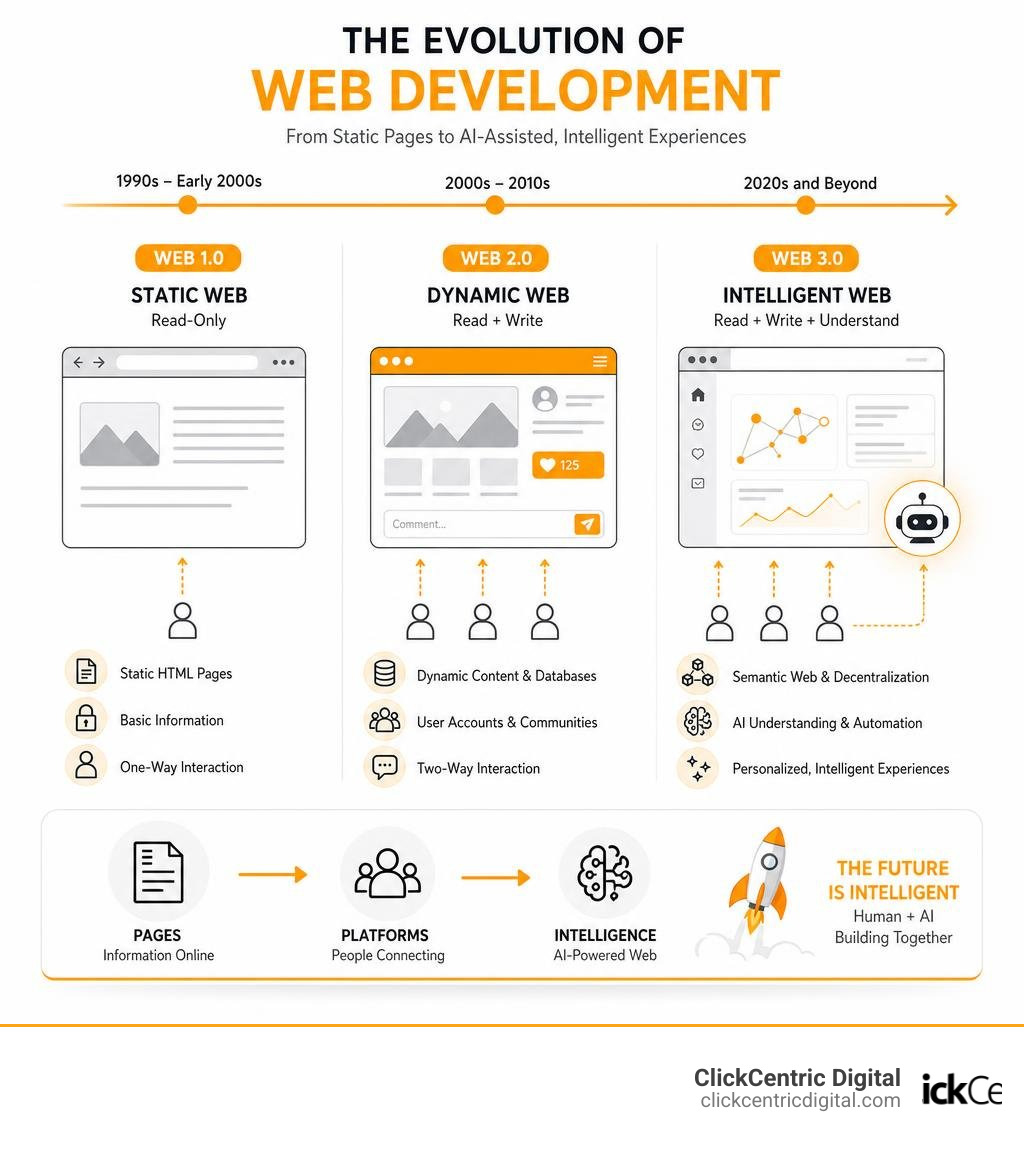
The first website went live in 1991. Since then, the web has transformed from simple static text pages into complex, interactive platforms that drive real business results. Today, over 15,000 new sites are launched every single day — and the bar for what makes a good website keeps rising.
The stakes are high. Google research shows that 53% of mobile visitors abandon a page that takes longer than 3 seconds to load. And with mobile searches now outpacing desktop, a poorly developed site doesn’t just frustrate users — it actively drives customers to your competitors.
Whether you’re building from scratch or improving an existing site, understanding how website development works helps you make smarter decisions about your digital presence.
What is Website Development and How Does It Differ From Web Design?
When people talk about building a website, they often use the terms “web design” and “web development” interchangeably. However, in the professional tech world, these represent two entirely distinct disciplines that must work in perfect harmony.
Web design is all about aesthetics, visual usability, and the overall feel of the site. A designer focuses on color schemes, typography, branding, graphic design, and user interface (UI) layouts. They map out where elements go using tools like Figma or Sketch to ensure a beautiful, intuitive user journey.
In contrast, website development is what happens under the hood. It is the practical application of writing code and programming languages to turn those flat visual designs into a functional, breathing digital product. While a designer creates the blueprint of a gorgeous car, the developer builds the engine, connects the transmission, and ensures that when a user steps on the gas pedal (or clicks a button), the car actually moves.
If your current online presence is lagging, looking dated, or failing to convert visitors into customers, it might be time to look at professional intervention. You can learn more about identifying these pain points in our guide on 5 Ways to Know If You Need Website Development Services.
The Core Pillars of Website Development
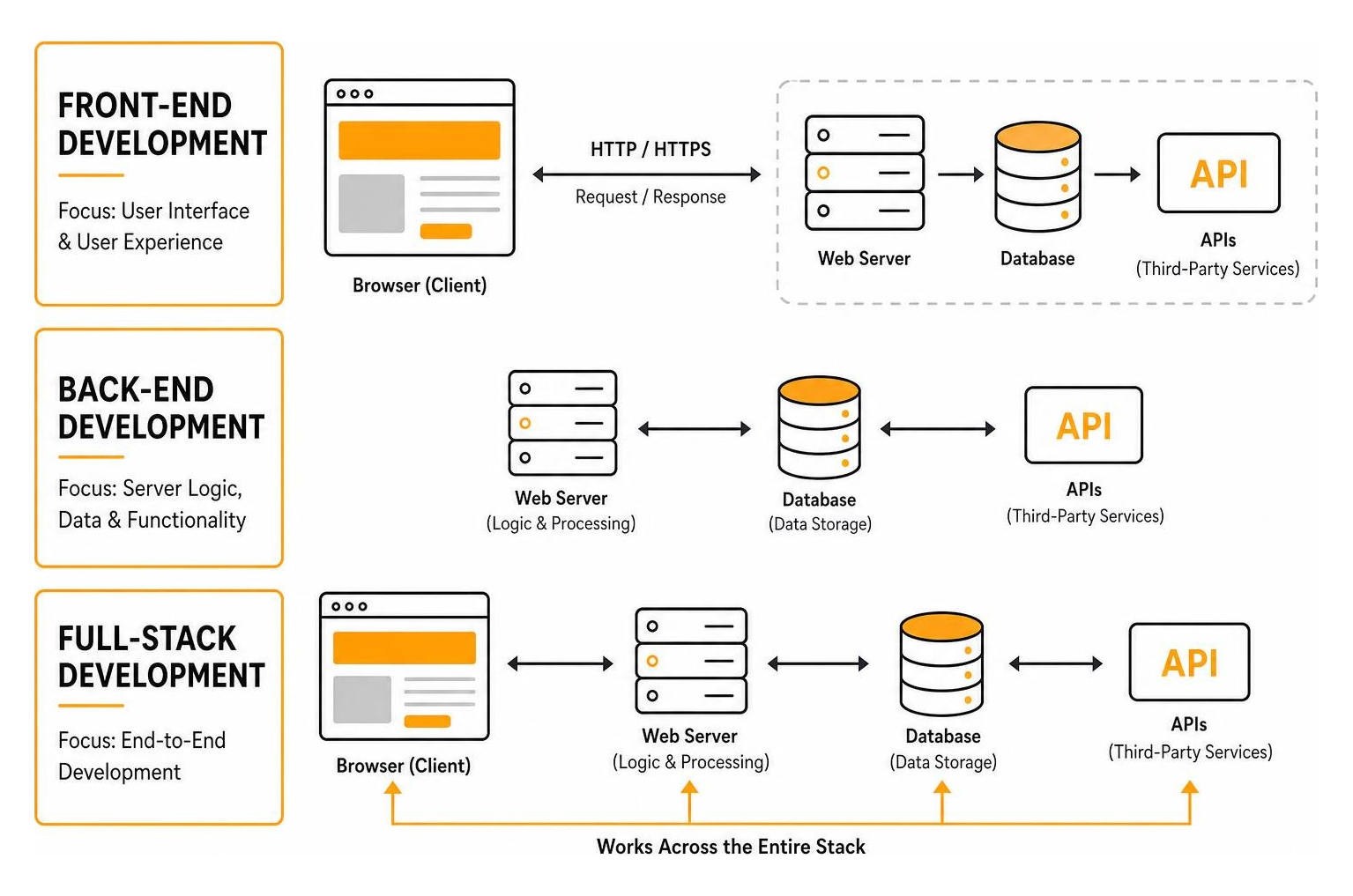
To fully understand how a website functions, we must look at the structural pillars that developers build and maintain. These pillars ensure that data flows seamlessly from a user’s screen to a remote server and back again:
- Client-Side (Front-End) Architecture: This is the visual layer of the code. It is executed directly within the user’s web browser (such as Chrome, Safari, or Edge).
- Server-Side (Back-End) Logic: This is the engine room. It runs on a remote server, processing requests, handling business logic, and deciding what data needs to be sent back to the client-side.
- Databases: The storage facility where all your critical information — user profiles, product catalogs, blog posts, and transaction records — is securely kept.
- APIs (Application Programming Interfaces): The communication bridges that allow your website to talk to third-party software, such as payment processors, mapping tools, or CRM systems.
Web Design vs. Web Development: Key Differences
To help visualize how these two fields divide their responsibilities, let’s look at this comparison:
| Feature | Web Design | Website Development |
|---|---|---|
| Primary Focus | Aesthetics, branding, visual layout, and user psychology | Functionality, database integration, logic, and speed |
| Key Objectives | Creating an engaging, accessible, and beautiful UI/UX | Writing clean, secure, and highly scalable code |
| Common Tools | Figma, Adobe XD, Sketch, Photoshop | VS Code, Git, Terminal, Chrome DevTools |
| Core Skills | Color theory, typography, graphic design, wireframing | Programming, database management, security protocols |
| Deliverables | Mockups, style guides, interactive visual prototypes | Live code, databases, API integrations, functional software |
The Three Main Types of Website Development
If you are looking to hire a developer or build a team, you will quickly notice that developers specialize in different areas. The development world is generally split into three main career paths.
Front-End Development: Crafting the User Interface
Front-end developers are responsible for everything a user clicks, touches, sees, and interacts with on a webpage. They take the visual assets from the web designers and translate them into clean, responsive code using core web technologies like HTML5 (to structure the content), CSS3 (to style and layout the elements), and JavaScript (to add dynamic, interactive behavior).
An excellent front-end developer ensures that the site displays beautifully on a 4K monitor, a tablet, and an older smartphone alike. They also focus heavily on accessibility, making sure that visually impaired users or those relying on assistive technology can navigate the site effortlessly. If you want to make sure your site is welcoming to all users, read our comprehensive guide on Inclusive Web Design Best Practices for a Website Everyone Can Use.
Back-End Development: Powering the Server and Database
While the front-end is the face of your website, the back-end is the brain. Back-end developers write the server-side code that handles data storage, security, and complex business logic.
For example, when a customer purchases a product on an e-commerce site, the back-end code verifies their credit card with a payment gateway, updates the inventory database, generates an invoice, and triggers an automated shipping email. This requires deep expertise in server-side languages, database management, and robust security practices to prevent data breaches. For businesses looking to build unique, complex tools that off-the-shelf software cannot handle, custom back-end engineering is a game-changer. Learn more about how this can protect and grow your bottom line in our article Bespoke vs Broke: How Custom Web Application Development Saves Your Business.
Full-Stack Development: The Complete Engineering Package
Can’t decide between front-end and back-end? Full-stack developers don’t have to. These versatile engineers are comfortable working on both sides of the development fence. They can design database schemas, write server-side APIs, and then jump over to style the front-end user interface that displays that data.
Full-stack developers are highly valued by startups and small-to-medium businesses because of their flexibility. They understand the entire software development lifecycle, making them excellent at planning system architecture, debugging complex integration issues, and deploying applications to cloud hosting environments.
The Step-by-Step Website Development Process
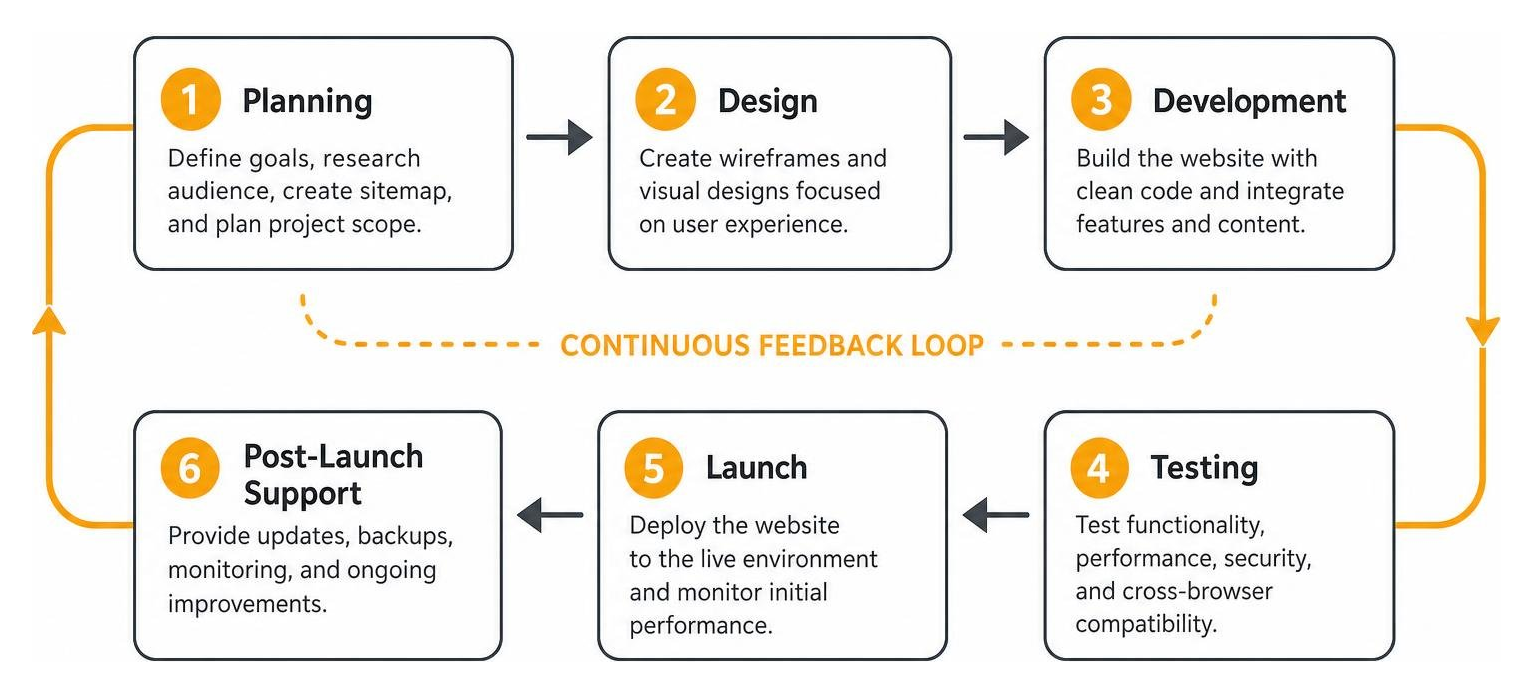
Building a high-performance website is a structured engineering project. Skipping steps or diving straight into coding without a clear plan is a recipe for bloated budgets, missed deadlines, and a frustrating launch. Here is the typical lifecycle we follow to ensure a successful build.
Phase 1: Discovery, Planning, and Sitemap Architecture
Every great website begins with thorough research. During the discovery phase, we align project stakeholders on goals, target audiences, budget, and timelines. We analyze competitor sites and audit any existing web assets.
With this research in hand, we build the site architecture or sitemap. This is the structural blueprint of your website, showing how pages connect and how users will navigate through the content. Once the sitemap is approved, we create low-fidelity wireframes. Wireframes are simple, black-and-white layouts that illustrate where features, text, and buttons will sit on the page without getting distracted by colors or imagery.
Phase 2: Design, Coding, and Content Migration
Once the structural layout is locked in, the creative team brings the wireframes to life with high-fidelity UI designs, incorporating your brand’s colors, typography, and imagery.
As soon as the designs are signed off, the development pipeline begins. Front-end developers turn the visual mockups into clean code, while back-end developers build the database structures and API integrations. Simultaneously, content authoring begins. This involves writing copy, optimizing images, and preparing existing data for migration. If you are upgrading an older site, this phase is critical to protect your search engine rankings. Discover how to execute this smoothly in The Ultimate Guide to an SEO-Friendly Website Redesign.
Phase 3: Quality Assurance, Testing, and Launch
Before any website goes live to the public, it must pass a rigorous quality assurance (QA) phase. We test the site across multiple web browsers (Chrome, Safari, Firefox, Edge) and physical devices to ensure the experience is flawless.
Here is our essential pre-launch checklist:
- Cross-Browser Verification: Ensure layout consistency across all major rendering engines.
- Form and Transaction Testing: Verify that all contact forms, checkout flows, and user sign-ups process data correctly.
- Link Integrity Check: Scan the site for broken links, missing images, or 404 errors.
- Performance Benchmarking: Run speed audits to ensure sub-second load times.
- SEO Elements Review: Confirm meta titles, descriptions, image alt tags, and schema markups are correctly configured.
- Security Audit: Verify SSL/TLS certificates are active and enforce HTTPS.
Phase 4: Post-Launch Maintenance and Support
The launch is not the finish line; it is the beginning of your website’s active life. Once the site is live, it requires ongoing monitoring, security updates, and performance tuning to remain healthy and competitive.
Failing to maintain your site can lead to broken plugins, slow loading speeds, and security vulnerabilities that hackers love to exploit. Even worse, major updates without careful supervision can ruin your search visibility overnight. Protect your digital investment by checking out our guide: Don’t Let Your Site Redesign Become a Search Engine Horror Story.
Modern Technologies, Frameworks, and AI in Website Development
The landscape of website development moves fast. Technologies that were cutting-edge a few years ago are now obsolete, replaced by faster, more efficient tools designed to build highly interactive web applications. To stay ahead, developers rely on a modern stack of frameworks, cloud services, and resources like web.dev to keep up with industry standards.
Essential Front-End Frameworks and Languages
While raw HTML, CSS, and JavaScript are the building blocks of the web, modern complex applications are built using JavaScript frameworks and libraries. These tools provide pre-written components and structures, allowing developers to build faster and write cleaner code.
- React: Developed by Meta, React is a highly popular library for building dynamic user interfaces based on reusable UI components.
- Angular: Supported by Google, Angular is a comprehensive, structured framework preferred by enterprise companies for complex applications. Want to dive deeper into this tool? See our guide on Angular for Web Development and How to Master It.
- Vue.js: A progressive, lightweight framework that is easy to learn and excellent for building fast single-page applications.
- TypeScript: A superset of JavaScript that adds static typing, helping developers catch bugs early in the writing process.
Back-End Languages, Databases, and Cloud Services
On the server side, developers choose languages and databases based on the specific needs of the application, prioritizing speed, security, and scalability.
- Node.js: Allows developers to use JavaScript on the server side, creating a highly efficient, single-language development stack.
- Python: Famous for its clean, readable syntax, Python is widely used for back-end logic, data analysis, and AI integrations.
- SQL Databases (PostgreSQL, MySQL): Relational databases that are perfect for structured data with complex relationships, like financial systems or user profiles.
- NoSQL Databases (MongoDB): Flexible, document-based storage ideal for rapidly changing data structures.
- Cloud Hosting (AWS, Google Cloud, Microsoft Azure): Scalable infrastructure platforms that ensure your web application can handle millions of concurrent users with high uptime.
If you are using specific back-end frameworks, choosing the right partner is vital. For example, if your platform relies on PHP, check out our guide on the Top CakePHP Web Development Company Traits You Need to Look For.
The Role of AI in Modern Website Development
We cannot talk about development in July 2026 without mentioning Artificial Intelligence. According to the 2025 Stack Overflow developer survey, over 80% of developers use AI tools at least monthly in their daily workflow.
AI-powered development tools like GitHub Copilot and Cursor have transformed how code is written. These assistants can instantly generate boilerplate code, debug complex errors, write unit tests, and translate code from one programming language to another.
However, AI has clear limitations. While it is incredibly efficient at writing code, it lacks the human empathy, intuitive business logic, and creative problem-solving skills required to design a truly user-centric website. A great website must connect with human emotions and align with real-world business goals — qualities that remain uniquely human.
Key Considerations: Performance, Security, and SEO
A beautiful website is useless if it is too slow to load, gets hacked, or cannot be found by Google. When we build websites, we treat performance, security, and search engine optimization (SEO) as foundational requirements, not optional add-ons.

Optimizing Website Performance and Core Web Vitals
Website speed is directly tied to your bottom line. As we mentioned earlier, more than half of mobile users will leave a site that takes over 3 seconds to load. To measure and enforce high-performance standards, Google uses a set of metrics called Core Web Vitals:
- Largest Contentful Paint (LCP): Measures loading performance. To provide a good user experience, LCP should occur within 2.5 seconds of when the page first starts loading.
- Interaction to Next Paint (INP): Measures page responsiveness. It tracks how quickly a page reacts when a user clicks a button, taps a link, or interacts with an input field.
- Cumulative Layout Shift (CLS): Measures visual stability. It ensures that text, images, and buttons don’t jump around on the screen as the page loads.
To optimize these metrics, we utilize advanced caching strategies, compress and convert images to modern formats like WebP, minify CSS and JavaScript files, and remove unnecessary third-party scripts.
Security Hardening and Data Protection
With cyber threats on the rise, securing your website and protecting customer data is paramount. A single security breach can destroy your brand’s reputation and lead to heavy legal penalties.
We protect websites from common threats — such as SQL injections, cross-site scripting (XSS), and DDoS attacks — by implementing a multi-layered security strategy:
- Enforcing HTTPS: Installing SSL/TLS certificates to encrypt all data transmitted between the user’s browser and your server.
- Secure Authentication: Implementing multi-factor authentication (MFA) and secure passkeys for user logins.
- Regular Backups: Automating daily, off-site backups so the website can be restored instantly in an emergency.
- Web Application Firewalls (WAF): Utilizing security layers to filter out malicious traffic before it reaches your hosting server.
Developing for Mobile Compatibility and Responsive Design
Since Google transitioned to mobile-first indexing, the search engine uses the mobile version of your website’s content for indexing and ranking. If your mobile site is difficult to navigate or slow, your overall search rankings will suffer.
Responsive web design ensures that your website automatically adapts its layout, image sizes, and navigation menus to fit any screen size. This involves using flexible grid layouts, media queries in CSS, and designing touch-friendly buttons that are easy to tap on a mobile device without accidentally clicking the wrong link.
Choosing Your Approach: Custom Development vs. All-in-One Platforms
When it comes to building your website, there is no one-size-fits-all solution. The best approach depends entirely on your business model, budget, technical resources, and long-term growth plans.
When to Use All-in-One Website Builders
All-in-one website builders like Wix, Squarespace, or Shopify are excellent options for startups, freelancers, and small local businesses that need to get online quickly with a limited budget.
These platforms offer drag-and-drop editors, thousands of pre-built templates, built-in hosting, and basic marketing tools. They allow non-technical business owners to launch a functional, professional-looking site without writing a single line of code. For example, Wix sites are designed with multi-cloud hosting to ensure 99.99% uptime, making them incredibly reliable for standard business needs.
The Power of Custom Web Development Services
While website builders are convenient, they come with limitations. As your business grows, you may find yourself restricted by template designs, bloated plugin code that slows down your site, and a lack of control over your database architecture. This restriction is what developers call technical debt.
Custom web development gives you absolute freedom. Your site is engineered from scratch to match your exact business workflows, offering unmatched speed, security, and scalability. It means you own 100% of your source code, have zero vendor lock-in, and can integrate any custom database or AI tool you require.
If you want to avoid the common pitfalls of hiring the wrong team for this critical work, take a look at our expert advice on how to Stop Hiring Bad Web Design Agencies.
Frequently Asked Questions about Website Development
What is the average cost of professional website development?
The cost of website development varies widely based on the complexity of the project, the features required, and the development approach. A basic business website built on a template can cost anywhere from $2,000 to $5,000. A highly customized, high-performance marketing site or e-commerce store typically ranges from $10,000 to $30,000. For complex, enterprise-level web applications with custom databases and deep API integrations, budgets can exceed $50,000+.
How long does it take to build a custom website from scratch?
A typical custom website development project takes anywhere from 8 to 16 weeks from the initial kickoff meeting to the final launch. This timeline is split across several phases: 2–4 weeks for discovery, planning, and wireframing; 4–6 weeks for visual design and coding; and 2–4 weeks for content migration, quality assurance testing, and deployment preparation.
Why is mobile responsiveness critical for website development?
Over 60% of global web traffic comes from mobile devices, and Google ranks websites based on their mobile performance. A mobile-responsive design ensures that your site is easy to read and navigate on any screen, which keeps visitors on your page longer, reduces bounce rates, and significantly increases your conversion rates and search engine rankings.
Conclusion: Partner with West Michigan’s Web Experts
Building a high-performance website is one of the most important investments your business will ever make. It is your digital storefront, your 24/7 salesperson, and the foundation of all your online marketing efforts.
At ClickCentric Digital, we specialize in helping businesses across West Michigan — including Grand Rapids, Holland, Grand Haven, South Haven, and Kalamazoo — build fast, secure, and conversion-optimized websites. We don’t just write code; we align your digital home with targeted strategies for local customer acquisition. From improving your local search rankings and managing online reviews to leveraging Google and Facebook paid traffic, we ensure your website is a powerful engine for business growth.
Ready to build a digital presence that outshines your competition? Explore our Website Design & Development services today, and let’s turn your web visitors into loyal customers.
Sorry, the comment form is closed at this time.