

10 Oct Why Your Business Needs Local SEO to Survive and Thrive
Why Your Business Needs Local SEO to Survive and Thrive
Why Local SEO Helps Businesses Get Found and Chosen

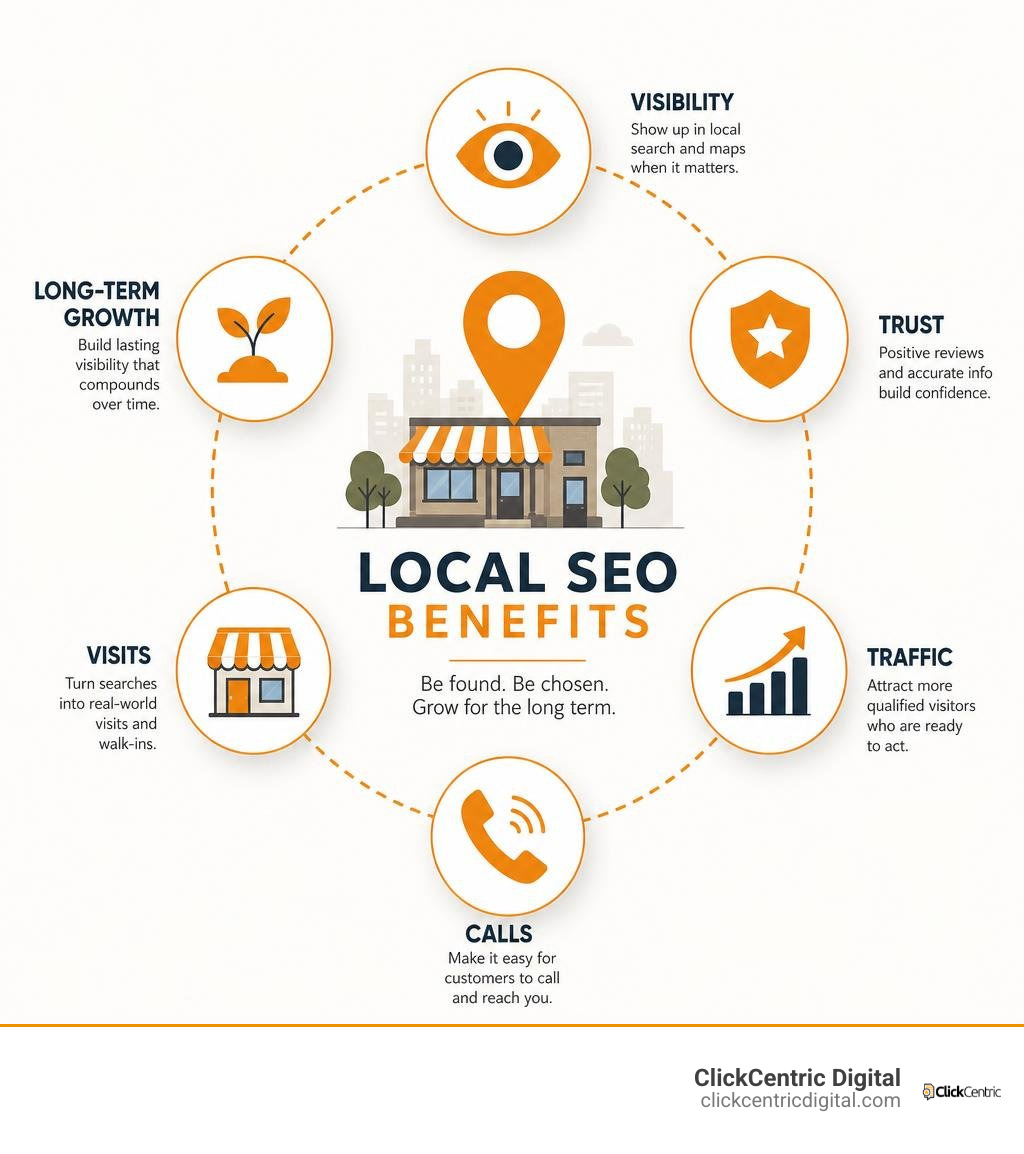
The biggest benefits of local SEO are simple: it helps nearby customers find your business in Google Search and Maps, trust what they see, and take action through calls, directions, bookings, or visits. For small businesses, that means more visibility among people who are already looking for what you sell.
Local searches often signal strong buying intent. Research cited in this guide shows that 76% of local-intent searches lead to an in-person visit within 24 hours, while 78% of people who search locally on a phone make a local purchase. If your listing, website, and reviews are hard to find, those customers may choose a competitor instead.
Local SEO earns that visibility by improving your Google Business Profile, keeping your business information accurate everywhere, building reviews, and creating useful pages for the places and services you serve. Unlike ads, which stop when the budget ends, strong local search visibility can build over time.
I’m Fred Dirkse, and this guide will show you how local SEO can turn nearby searches into real customers.
Understanding Local Search and How It Works
Local search is the mechanism that connects immediate physical demand with nearby commercial solutions. When a person pulls out their phone and types a query with geographic intent—or simply searches for a service without naming a city—search engines instantly evaluate whether the user needs a local provider.
Unlike broad national queries where search engines prioritize pure website domain authority and comprehensive educational content, local algorithms prioritize geographical relevance. According to practical insights on how local SEO benefits small businesses, optimizing your presence for these location-sensitive queries allows you to capture community demand at the exact moment a prospect is ready to buy.
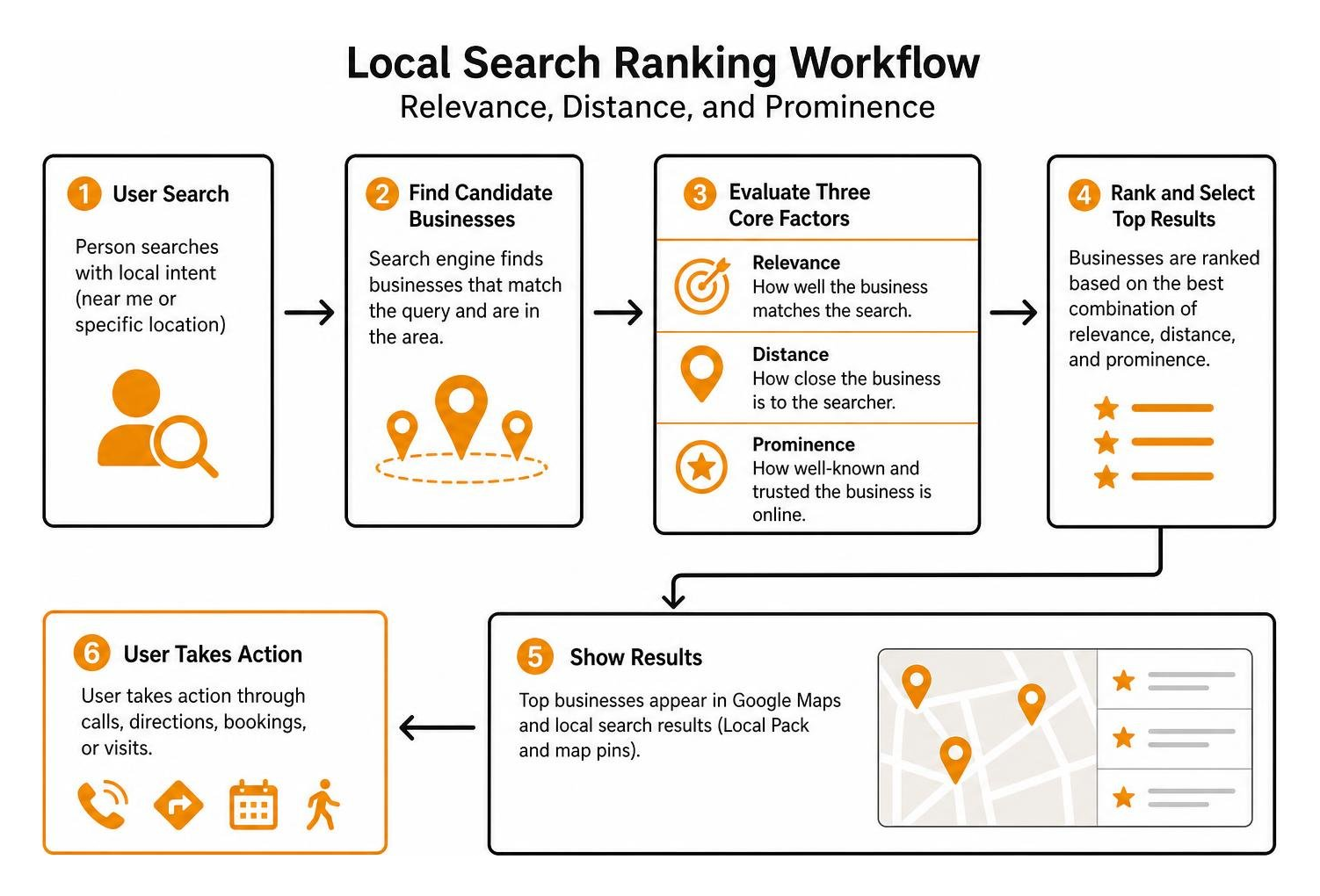
Search engines evaluate three core components to determine which companies appear in front of nearby consumers:
- Relevance: How accurately your business profile, service offerings, and website copy match the specific terms entered by the searcher.
- Distance: The physical proximity between the searcher’s current location (or the geographic term specified in their query) and your verified business address or defined service area.
- Prominence: The overall digital reputation, authority, and popularity of your company based on factors like review count, directory citations, website authority, and community links.
Understanding these mechanics ensures that your marketing efforts focus directly on the factors that move the needle for local discovery.
Ranking Factors in Google Maps
Google Maps is often the modern storefront for local commerce. When consumers look for immediate solutions, they look at map pins and the three featured listings beneath the map—commonly called the Local Pack.
Securing a spot in these top results requires aligning your digital footprint with the key Google Maps ranking factors for 2025 and beyond. Proximity is a major filter, but prominence and relevance dictate who takes the top three spots when multiple businesses operate in the same area.
Search algorithms evaluate whether your business address sits centrally within the service radius, whether your categories match consumer queries, and whether your business receives steady streams of positive customer engagement.
The Critical Role of Google Business Profile
Your Google Business Profile (GBP) serves as the anchor for your local presence. Industry research demonstrates that Google Business Profile signals carry roughly 32% of the total ranking weight in local algorithms—making it the single most impactful ranking asset you own.
To make the most of your listing, it is critical to claim your spot on the map with a free Google Business page and complete every available data field. Key setup elements include:
- Primary Category Selection: Choose the most accurate, specific primary category available, as this carries immense ranking weight.
- Secondary Categories: Add relevant supplementary categories that describe your additional services without diluting your core focus.
- Business Description: Write a clear, natural overview of your business incorporating your primary offerings and the neighborhoods you serve.
- Hours and Special Attributes: Keep regular operating hours, holiday schedules, and specific attributes (like wheelchair accessibility or emergency availability) up to date.
- High-Resolution Visuals: Regularly upload authentic photos of your storefront, team, vehicles, and completed projects. Profiles featuring active photo updates consistently earn higher click-through rates and driving direction requests.
The Primary Benefits of Local SEO for Small Businesses

Understanding why local search engine optimization matters comes down to looking at bottom-line growth. With over 200 million monthly “near me” searches happening across the web and 80% of US consumers searching for a local business online every single week, local search is no longer an optional channel—it is core infrastructure.
Let’s explore the primary advantages that make local search optimization a game-changing investment for small and medium-sized enterprises.
High-Intent Traffic and Immediate Foot Traffic
General digital advertising often involves casting a wide net over people who may or may not need your services today. Local SEO flips this dynamic on its head by capturing users who are actively hunting for a solution right down the street.
When users conduct mobile searches with local intent, 76% visit a related physical business within 24 hours, and 88% visit within a single week. By taking steps to optimize for local search and dominate your neighborhood, you intercept prospects at the bottom of the sales funnel. These searchers are not casually researching a topic for next year; they are looking for a nearby business they can call or visit today.
Tangible Benefits of Local SEO on Conversion Rates
Because local queries carry immediate commercial intent, the traffic generated converts at substantially higher rates than standard organic web traffic. A consumer typing “furnace repair near me” or searching for a service provider in Grand Rapids or Holland is experiencing an active need.
When you stop being invisible with these local SEO strategies, you eliminate the friction between discovery and contact. Direct action buttons built into local map listings allow users to click to call, book an appointment, or request turn-by-turn directions within a fraction of a second. This streamlined user experience translates into more closed deals and fewer lost leads.
Maximizing the Long-Term Benefits of Local SEO Over Paid Ads
Paid digital ads can generate fast traffic, but they require continuous funding. The moment you pause your ad budget, your lead flow drops to zero. Local search optimization, on the other hand, builds equity in your digital assets that compounds over time.
Research highlights that the average three-year ROI of a local SEO campaign exceeds 300%, while the cost-per-lead runs roughly 61% lower than traditional outbound marketing.
| Feature / Metric | Local SEO Strategy | Paid Advertising (PPC) |
|---|---|---|
| Upfront Setup Time | 1 to 3 months for foundational gains | Immediate launch |
| Ongoing Lead Cost | Decreases over time as authority grows | Remains fixed or increases with ad competition |
| Traffic Longevity | Sustained organic rankings and visibility | Stops immediately when ad spend stops |
| Average 3-Year ROI | 300%+ with compounding returns | Linear return tied directly to budget |
| Trust Factor | High organic trust via reviews and Local Pack | Labeled as sponsored/ad placements |
When evaluating how to choose between local SEO and Google Ads for your business, while paid ads provide short-term surges, organic local optimization builds durable digital market share that pays dividends for years.
Outperforming Local Competitors and Building Trust
In any given town or service radius, your target customers are dividing their attention among a handful of visible options. If your competitors dominate the top three spots in Google Maps, they capture the lion’s share of incoming calls.
Learning how to win the Local Pack in 2026 and beyond allows smaller operators to outrank well-funded regional or national competitors. Local algorithms reward local relevance, citation consistency, and community trust over raw corporate ad spend. An independent business with hundreds of authentic customer reviews and clean local citations can easily outrank a national chain’s satellite branch.
Key Pillars of an Effective Local SEO Strategy

A successful local search campaign requires a coordinated effort across your Google Business Profile, off-page directory citations, website structure, and reputation management.
One foundational element is maintaining strict Name, Address, and Phone Number (NAP) consistency. Companies that maintain over 95% NAP consistency across their primary online citations rank an average of 3.2 positions higher in the Local Pack compared to businesses with mismatched or outdated directory listings.
Customer Review Generation and Reputation Management
Online reviews serve as the primary trust layer for modern consumers. In fact, 98% of U.S. consumers read online reviews of local businesses at least occasionally, with 76% doing so regularly or always. Furthermore, 97% of consumers read reviews before making a purchasing decision.
Search engines use customer reviews not only as a trust metric for users, but as an active ranking signal. Understanding the math behind a better local search strategy involves recognizing that review velocity (how steadily you gain new feedback), overall star ratings, and the specific keywords customers include in their feedback directly influence map visibility.
To build a healthy review profile:
- Request Feedback Systematically: Ask satisfied clients for reviews immediately following a successful project, transaction, or service visit via text or email links.
- Respond to Every Review: Take time to publicly respond to both positive and negative reviews. A thoughtful, professional response to a critical review shows prospective buyers that you stand behind your work and value customer care.
- Encourage Detailed Feedback: When appropriate, encourage clients to mention the specific service they received and the city or neighborhood where the work was performed.
Targeted Local Keyword and On-Page Optimization
Your website must clearly communicate its geographic focus to search engines. Rather than stuffing generic keywords across your pages, structure your website with dedicated, high-value service area pages and localized landing pages.
To optimize your website for local discovery:
- Incorporate Geographic Identifiers Naturally: Include your primary city, neighboring communities, and regional terms within page title tags, H1 headers, image alt text, and body copy.
- Implement LocalBusiness Schema Markup: Add structured data to your website’s code to explicitly state your legal business name, street address, operating hours, geolocation coordinates, and accepted payment types to search engine crawlers.
- Secure Community Backlinks: Partnering with local chambers of commerce, sponsoring youth sports teams, or collaborating with non-profit organizations are practical ways to earn valuable local links. If you need dedicated link acquisition, exploring the best way to find a local SEO link building company that delivers can help you secure high-authority regional mentions without risking search penalties.
Common Local SEO Mistakes to Avoid
Many businesses fail to see meaningful ranking improvements because of easily preventable errors. Avoiding these common pitfalls will save time and protect your rankings:
- Keyword Stuffing Your Business Name: Adding extra keywords to your Google Business Profile name (e.g., “Main Street Plumbing – Best Cheap Plumber Near Me”) violates Google’s terms of service and can lead to listing suspension.
- Mismatched NAP Information: Listing different phone numbers, old suite numbers, or varied company spellings across Yelp, YellowPages, Facebook, and industry directories creates confusion for search engines and drops your Local Pack ranking.
- Ignoring or Deleting Critical Reviews: Attempting to ignore negative feedback or aggressively arguing with reviewers damages consumer trust. Address issues calmly, take difficult conversations offline, and demonstrate professionalism.
- Neglecting Mobile Performance: Since the vast majority of local searches occur on smartphones, a slow-loading website with tiny, hard-to-tap buttons will cause immediate bounce rates and lost sales.
- Creating Low-Quality Duplicate Location Pages: Copying identical text across dozens of city landing pages and merely swapping the city name creates thin, duplicate content that search engines frequently ignore. Always write unique, helpful content for every area you serve.
Frequently Asked Questions About Local SEO
How long does it take to see results from local SEO?
Local SEO is an ongoing strategy that delivers compounding results. While basic fixes—such as claiming an unverified Google Business Profile, cleaning up incorrect NAP information, and optimizing category selections—can produce noticeable ranking improvements within 3 to 6 months, building market dominance takes time. Achieving top-tier visibility in competitive markets typically compounds over 6 to 12 months as your review profile, local backlinks, and on-page authority mature.
What is the difference between local SEO and organic SEO?
The primary distinction lies in geographic intent and search engine placement. Organic SEO focuses on ranking a website for informational or transactional queries regardless of the searcher’s physical location, competing on a national or global scale. Local SEO targets searchers within a specific geographic radius, aiming to secure placement within Google Maps and the Local 3-Pack, driving phone calls, direction requests, and in-person foot traffic.
Why are customer reviews so crucial for local rankings?
Customer reviews act as both a direct algorithmic ranking signal and a vital conversion factor. Google evaluates the quantity, frequency, and sentiment of your reviews to determine your prominence score. High star ratings and detailed customer feedback validate your business’s trustworthiness, significantly increasing the likelihood that a user will click your listing over a competitor with fewer or poorer reviews.
Conclusion
Securing prominent visibility in local search is essential for sustainable business growth. By claiming your map listings, standardizing directory citations, actively gathering positive client reviews, and optimizing your web pages for geographic relevance, you build a steady pipeline of inbound local customers.
If you are ready to stop leaving money on the table and want to capture dominant map positioning in your market, partner with our team at ClickCentric Digital. Explore our proven search engine optimization Google Maps ranking solutions today to put your business on the map and turn nearby searches into loyal, long-term clients.
Sorry, the comment form is closed at this time.