

03 Oct The Price is Right? Google Ads Management Cost for Local Businesses 2026-2026
The Price is Right? Google Ads Management Cost for Local Businesses 2026-2026
What Local Businesses Should Expect to Pay for Google Ads Management in 2026
Google Ads management cost for local businesses 2026 typically falls between 10% and 20% of ad spend, with 15% a common benchmark. Small local accounts may instead pay a flat monthly retainer, usually $500 to $5,000, while consultants often charge $75 to $200 per hour.
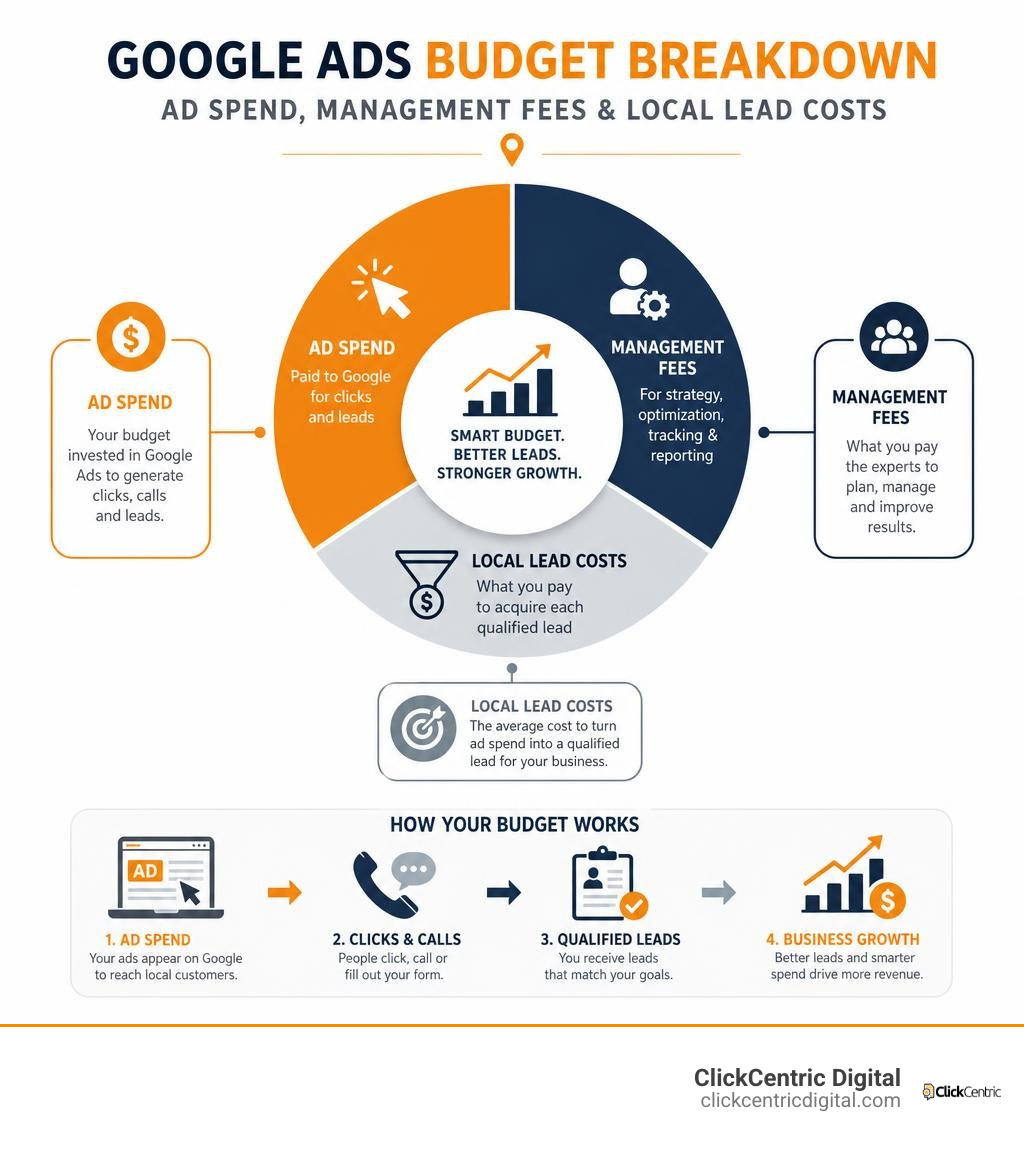
The important distinction is simple: your ad spend goes to Google for clicks and leads. Your management fee pays the person or agency building, tracking, and improving the campaign.
| Cost item | Typical 2026 range |
|---|---|
| Starter Google Ads spend | $600 to $2,500 per month |
| Common small-business ad spend | $1,000 to $10,000 per month |
| Agency management fee | 10% to 20% of ad spend |
| Flat management retainer | $500 to $5,000 per month |
| Consultant hourly rate | $75 to $200 per hour |
A business that says it has a “$2,000 Google Ads budget” can mean two very different things. Is all $2,000 going to Google? Or does that total also need to cover management, call tracking, setup, and reporting? The answer changes how many clicks, calls, and leads the campaign can realistically generate.
Costs also vary sharply by market. A restaurant may face lower click costs than a dentist, roofer, or law firm. That is why a smart budget starts with lead goals and expected cost per lead, not a round number that feels comfortable.
I’m Fred Dirkse, and the next sections will help you compare pricing models and build a local Google Ads budget that is clear, measurable, and built for growth.
Agency Pricing Models and Google Ads Management Cost for Local Businesses 2026
When evaluating google ads management cost for local businesses 2026, local business owners quickly realize that agency pricing is not one-size-fits-all. Understanding how marketing agencies structure their pricing helps you protect your profit margins and ensure that every dollar you invest delivers measurable returns.
At ClickCentric Digital, we believe the golden rule of paid search budgeting is establishing a strict boundary between direct media spend paid directly to search platforms and professional fees paid for account governance. Conflating these two figures creates blind spots in performance reporting and obscures true ROI. For a comprehensive overview of how professional campaign handling works, explore our Paid Traffic Management solutions.
To better understand market dynamics, consult this resource on Google Ads Budget for Small Business (2026 Guide), which illustrates how budget structures differ across various commercial verticals.
Primary Pricing Structures for Google Ads Management Cost for Local Businesses 2026
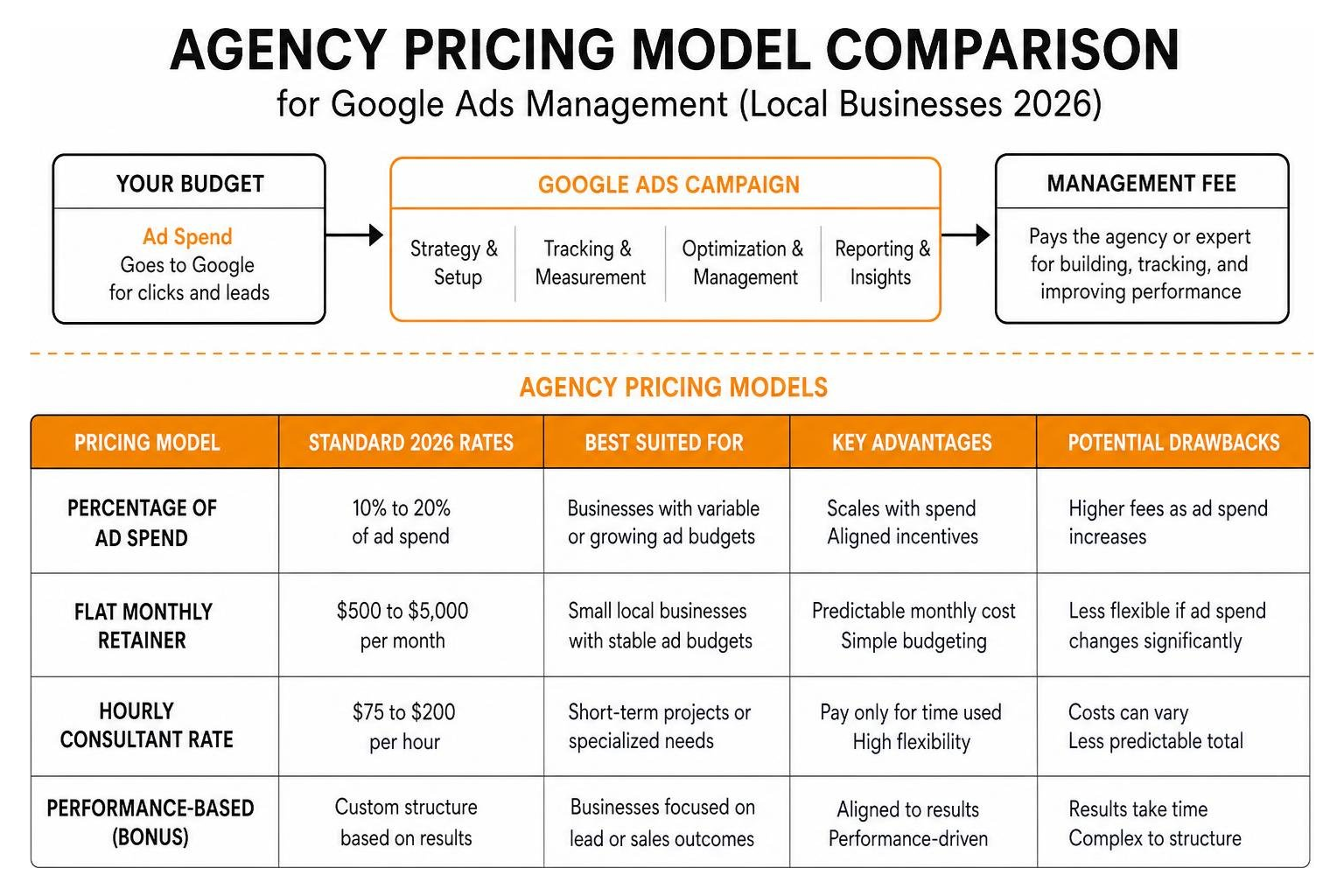
Agencies, freelancers, and digital marketing consultants generally utilize four primary fee structures when managing Google Ads for local businesses:
| Pricing Model | Standard 2026 Rates | Best Suited For | Key Advantages | Potential Drawbacks |
|---|---|---|---|---|
| Percentage of Ad Spend | 10% to 20% of monthly ad spend | Scaling accounts spending over $5,000/month | Directly aligns agency compensation with campaign expansion | Higher spend does not always equal linear workload increases |
| Flat Monthly Retainer | $500 to $5,000/month | Small-to-midsize accounts ($1k-$10k spend) | Predictable operational expenses and stable budgeting | Fixed fee can feel high if ad spend temporarily scales back |
| Hybrid Structure | Lower flat retainer + 10% spend over baseline | Growing regional service companies | Guarantees minimum agency compensation while sharing upside | Requires careful math to avoid double-dipping fees |
| Hourly Rate | $75 to $200/hour | One-off account audits, troubleshooting, or consults | Pay strictly for actual time spent working | Harder to forecast monthly marketing expenses |
- Percentage of Ad Spend: Charging between 10% and 20% of ad spend (with 15% serving as the industry benchmark) is a standard agency model. For example, if a home services company in Grand Rapids or Kalamazoo spends $6,000 per month on Google search campaigns, a 15% management fee adds $900 per month.
- Flat Monthly Retainer: Many agencies set minimum monthly thresholds, such as $500 to $1,500 for lower-tier spend accounts, scaling up to $5,000 per month for complex multi-location enterprises. Retainers provide fee clarity regardless of minor seasonal fluctuations in ad spend.
- Hybrid Pricing: A common hybrid arrangement pairs a lower base retainer (e.g., $750/month) with a modest percentage of spend (e.g., 10%) once monthly media budgets exceed a set threshold (e.g., $5,000).
- Hourly Fees: Consultative work, custom tag implementation, and deep account audits typically range from $75 to $200 per hour across standard digital marketing firms.
Uncovering Hidden Fees and Account Management Costs
Beyond base management retainers, local business owners should carefully review service contracts for hidden or auxiliary costs that can impact total campaign investments:
- Initial Setup Fees: Launching a campaign requires keyword taxonomy research, negative keyword assembly, conversion tracking, ad copy creation, and landing page audit setups. Initial setup fees typically range from $500 to $2,500 for local service accounts.
- Dynamic Call Tracking: For call-heavy local verticals like plumbers, electricians, and legal services, dynamic call tracking platforms (e.g., CallRail) are crucial. Third-party software licenses and call recording services typically add $50 to $250 per month.
- Reporting and Analytics Integration: Custom Looker Studio dashboards, automated attribution pipelines, or specialized executive reporting may carry extra setup charges or monthly platform maintenance fees.
- Contract Terms and Early Termination Penalties: Beware of rigid 12-month lock-in contracts with steep cancellation penalties. High-performing agencies usually operate on flexible 30-day to 90-day agreements backed by performance.
Realistic Monthly Ad Spend Ranges and Cost Benchmarks Across Industries
Understanding realistic ad spend expectations requires evaluating actual search engine statistics across the small business sector. Data from thousands of active local Google Ads accounts reveals clear budget tiers:
- 24% of small businesses spend under $1,000 per month on Google Ads media.
- 39% of small businesses spend between $1,000 and $10,000 per month.
- 37% of small businesses spend over $10,000 per month.
- Across all industries nationwide, the average small business Google Ads account spends approximately $3,100 per month on ad spend.
For local companies in West Michigan—such as Holland, Grand Haven, or South Haven—a prudent starting ad spend budget is $1,000 to $2,500 per month. For lean trial campaigns targeting hyper-local zip codes, running $20 to $50 per day works out to roughly $600 to $1,500 per month. For an in-depth look at multi-channel budget allocations, see The Complete Guide To Small Business Advertising.
Calculating Ad Budgets for Local Campaigns Based on Industry CPL
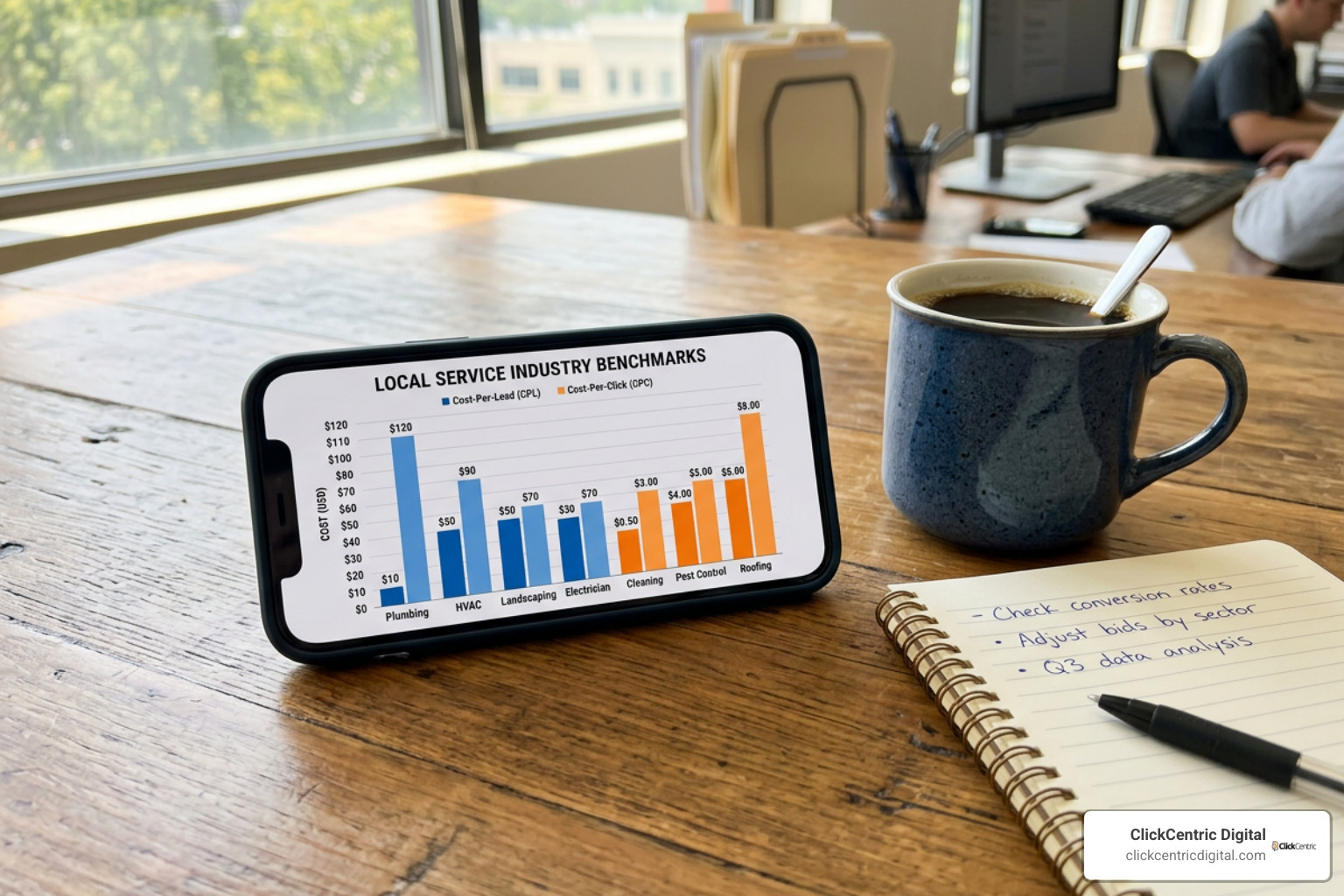
Setting a budget based on arbitrary figures is a recipe for disappointment. Instead, work backward from your revenue targets, conversion metrics, and industry benchmarks. Across all industries on Google Search in 2026, the average cost per click (CPC) stands at $5.42. However, local service verticals experience wide variations in click and lead costs:
| Industry Vertical | Average Search CPC | Average Cost Per Lead (CPL) | Estimated Budget Needed for 20 Monthly Leads |
|---|---|---|---|
| Arts & Entertainment | $1.63 | ~$27 | $540 |
| Restaurants & Food | $2.05 | ~$32 | $640 |
| Travel & Tourism | $2.14 | ~$38 | $760 |
| Real Estate | $3.22 | ~$55 | $1,100 |
| Physicians & Surgeons | $4.76 | ~$70 | $1,400 |
| Education & Training | $4.81 | ~$75 | $1,500 |
| Business Services | $5.87 | ~$85 | $1,700 |
| Health & Fitness | $6.17 | ~$90 | $1,800 |
| Dentists | $8.00 | ~$105 | $2,100 |
| Home & Home Improvement | $8.33 | ~$115 | $2,300 |
| Attorneys & Legal Services | $9.87 | ~$131 | $2,620 |
For example, a residential roofer preparing to scale locally can consult our specialized resource, the Step By Step Guide To Google Ads For Roofers. If your average cost per lead is $115, securing 20 qualified inquiries per month requires at least $2,300 in direct monthly media spend, plus agency management fees.
Strategic Scaling and Managing Daily Budget Limits
A common point of confusion for local business owners is Google’s daily budget spending logic. When you set a daily budget of $50 ($1,520 per month average), Google Ads may spend up to twice your daily budget ($100) on days with high search volume and user intent.
However, Google balances this over the monthly billing cycle. Your total charge will never exceed your set daily budget multiplied by 30.4 (the average number of days in a month). If high traffic causes Google to overdeliver beyond this monthly limit, Google automatically credits your account for the overage.
When scaling campaigns, avoid increasing daily budgets by more than 20% to 30% at a time. Sudden, massive budget increases can push smart bidding algorithms back into a learning phase, volatilely impacting your CPL.
In-House Google Ads Management vs. Hiring an Agency
Faced with agency retainers, many small business owners consider managing campaigns in-house. While “DIY” campaign management saves on initial management fees, it often results in higher overall costs due to inefficient spend.
Google’s default settings are engineered to maximize ad reach, which can deplete budgets quickly if not carefully managed. Common budgeting and technical mistakes made during self-management include:
- Relying heavily on Broad Match keywords without robust negative keyword lists, causing ads to display for irrelevant search queries.
- Failing to set up granular conversion tracking via GA4 or Google Tag Manager, making it impossible to determine which keywords drive real phone calls or form submissions.
- Neglecting mobile-specific landing page optimization, resulting in low conversion rates despite high ad click costs.
- Failing to adjust device bids, spending heavily on desktop traffic when most local service searches occur on mobile devices.
- Ignoring geographic exclusions, causing ads to appear for searchers outside your operational service areas.
To learn how to avoid administrative burn-out while managing paid traffic, check out our guide on Mastering Google PPC Management Without Losing Your Mind. Professional management often pays for itself by reducing wasted ad spend and securing higher-quality local leads.
Integrating Maps Ads, LSAs, and SAB Requirements into Your Ad Cost Strategy
A successful local advertising strategy extends beyond standard search ads. Modern local search marketing combines standard Google Search campaigns, Google Maps Promoted Pins, and Local Services Ads (LSAs) into a unified budget strategy.
Local Services Ads and Promoted Pins in the Google Ads Management Cost for Local Businesses 2026
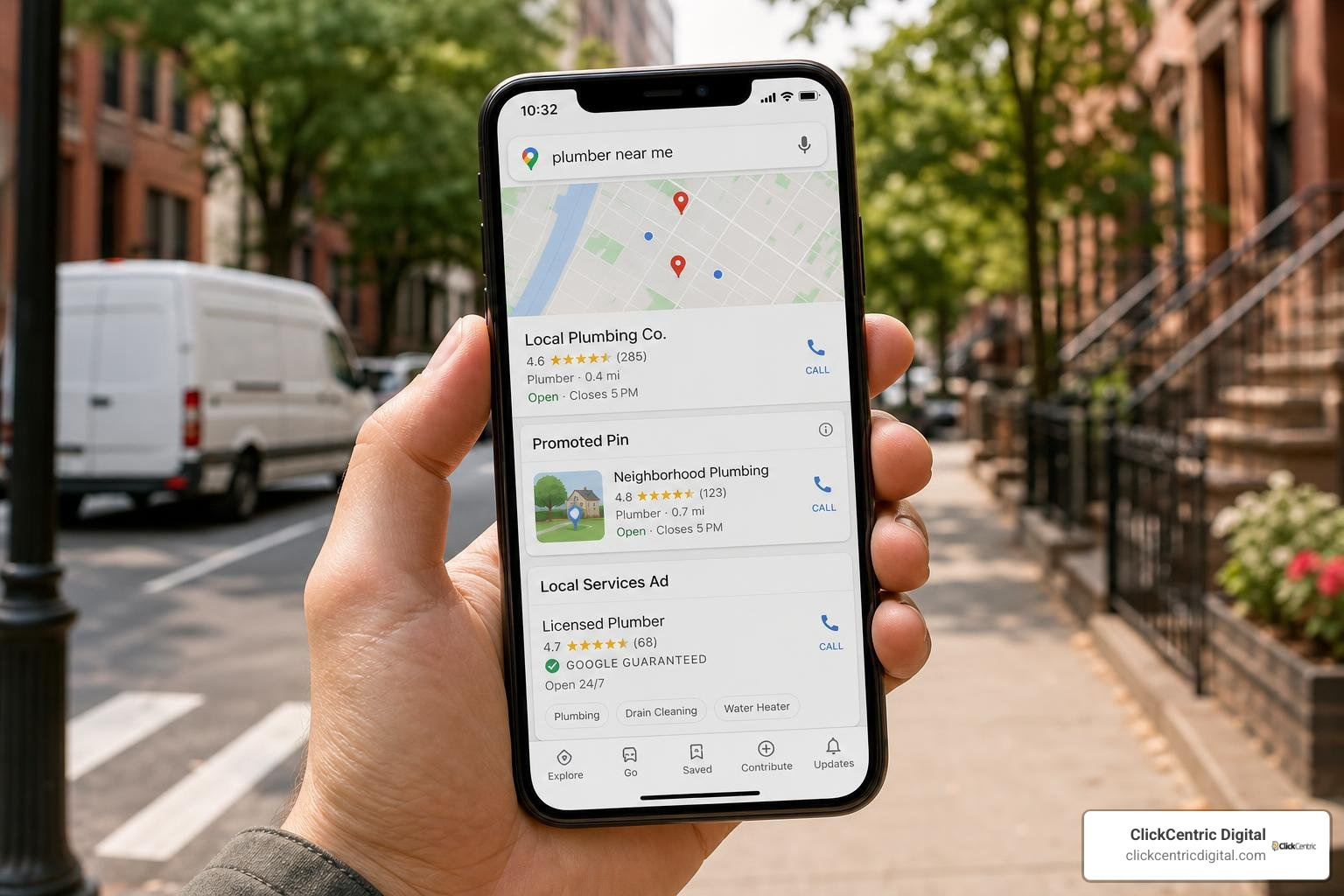
Google Maps ads and Local Services Ads (LSAs) give local businesses direct access to nearby consumers searching with high buying intent:
- Local Services Ads (LSAs): Positioned at the absolute top of Google search result pages, LSAs operate on a Pay-Per-Lead (PPL) model rather than Pay-Per-Click. You only pay when a prospective customer calls, texts, or books directly through the ad. Backed by the “Google Guaranteed” or “Google Screened” badge, LSAs often deliver a lower cost per lead compared to traditional PPC campaigns.
- Google Maps Ads & Promoted Pins: By linking your Google Business Profile to your Google Ads account via Location Assets, your business can appear at the top of Google Maps search results with custom square pins. These ads charge standard CPC rates when users click for driving directions, call the business, or view business details.
Building solid profile authority is essential. Accumulating 25 to 50 positive Google reviews before running map-based ads dramatically boosts click-through and conversion rates. For home service businesses, review our Google Ads Home Services Guide 2026 to maximize map integrations.
Managing Campaign Logistics for Service-Area Businesses vs. Storefronts
Managing campaign targeting differs significantly between brick-and-mortar storefronts and Service-Area Businesses (SABs):
- Storefront Businesses: Physical retail stores, dental practices, and restaurants rely heavily on precise radius targeting (e.g., a 3- to 10-mile radius around the business address) and Google Maps pins to drive foot traffic.
- Service-Area Businesses (SABs): Home contractors, mobile detailers, and plumbers visit customers at their locations and do not host clients at a public address. Under Google Business Profile rules, SABs hide their street address and define service coverage using zip codes, cities, or counties.
- Geo-Targeting Boundaries: Google recommends restricting service area boundaries to approximately a two-hour drive radius from your base location. Setting overly broad service areas weakens local relevance signals and dilutes ad performance.
SAB profiles with hidden street addresses are ineligible for certain traditional Google Maps Promoted Pin features. However, they can still capture local service traffic through targeted Google Search campaigns and Local Services Ads. For tactics on reaching local buyers without a public storefront, read our guide on Little Known Ways To Target Local Customers With Google Ads.
Frequently Asked Questions About Google Ads Costs
What is the average agency management fee for local Google Ads in 2026?
The standard agency management fee for local accounts ranges from 10% to 20% of monthly ad spend, with 15% being the industry benchmark. For lower-spend accounts (under $3,000/month), agencies typically charge a flat monthly retainer ranging between $500 and $1,500 per month to cover administrative overhead.
How should a local business divide budget between ad spend and management fees?
A practical rule of thumb is allocating 70% to 80% of your total marketing budget directly to search platform ad spend, reserving 20% to 30% for management fees, setup costs, and call tracking software. For example, with a $2,500 total monthly investment, assign $2,000 to Google ad spend and $500 to agency management fees.
What is a realistic starting monthly ad spend for a small local business?
A reasonable starting ad spend for a local business testing Google Ads is $1,000 to $2,500 per month ($20 to $50 per day). This spending range generates enough click volume and conversion data within 60 to 90 days to evaluate cost-per-lead numbers, optimize campaign keywords, and determine long-term ROI.
Conclusion
Navigating google ads management cost for local businesses 2026 requires balancing clear ad spend allocations with high-performing management strategies. By understanding standard pricing models, anticipating hidden administrative fees, and factoring in industry-specific CPL benchmarks, local business owners can make informed decisions that drive steady revenue growth.
Whether you operate a storefront in Grand Rapids, Holland, or Kalamazoo, or manage a regional service business across West Michigan, success comes down to tracking conversions accurately, bidding strategically, and optimizing campaigns consistently.
Ready to get the most out of your advertising budget? Partner with the local search experts at ClickCentric Digital. Explore The Small Business Guide To Affordable Google Ads Management Services or contact our team today to build a high-performing Google Ads strategy built for your business.
Sorry, the comment form is closed at this time.