

03 Jun Step-by-Step Guide to Google Ads for Roofers
Step-by-Step Guide to Google Ads for Roofers
Why Google Ads for Roofers Is One of the Fastest Ways to Get Roofing Leads
Google Ads for roofers is a pay-per-click advertising system that puts your roofing business at the top of Google search results when homeowners are actively searching for services like “roof repair near me” or “emergency roof replacement.”
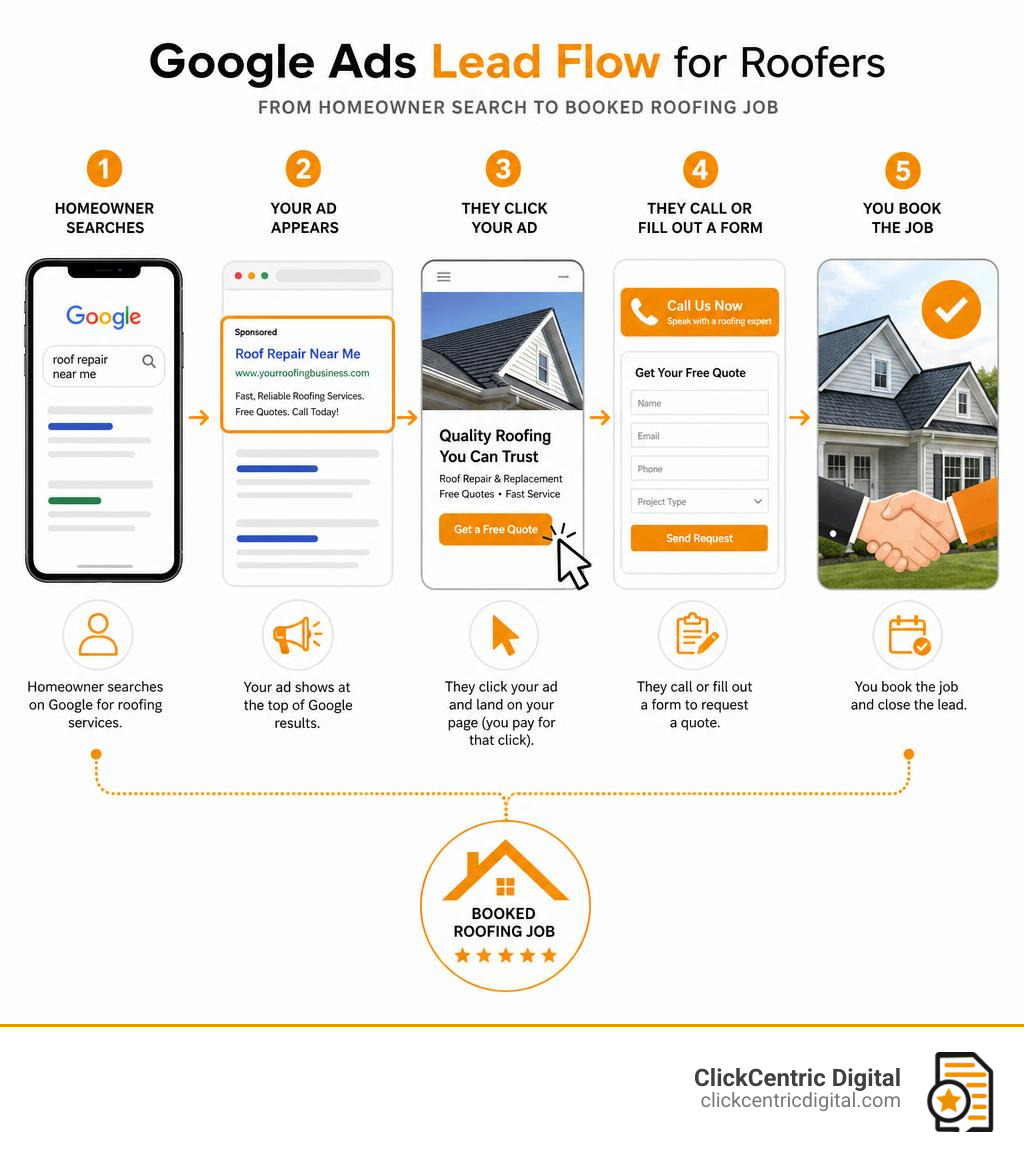
Here’s how it works at a glance:
- A homeowner searches for a roofing service on Google
- Your ad appears at the top of results — above organic listings
- They click your ad and land on your page (you pay for that click)
- They call or fill out a form to request a quote
- You book the job and close the lead
Key facts for 2026:
- Google handles 8.5 billion searches per day — homeowners are searching for roofers right now
- Average roofing CPCs range from $15 to $60+ depending on your market
- Well-run campaigns generate leads for $100–$350 per qualified roofing inquiry
- Industry-average conversion rates sit at 5–10%, but optimized campaigns can hit 15–30%
Think about this scenario: a hailstorm rolls through your city on a Tuesday night. By Wednesday morning, hundreds of homeowners are grabbing their phones and searching “hail damage roof repair” — right now, today. The roofers who show up at the top of those results get the calls. The ones who don’t, don’t.
That’s the core promise of Google Ads for roofing businesses. Unlike SEO, which can take 3–6 months to show results, a properly built Google Ads campaign can start generating phone calls within days of launching.
But “properly built” is doing a lot of work in that sentence. Many roofers waste significant budget on campaigns that target the wrong searches, send clicks to weak pages, or lack the tracking needed to know what’s actually working.
This guide walks you through everything — from campaign setup and keyword strategy to budgets, landing pages, and ROI tracking — so your ad spend turns into booked roofing jobs.
What Are Google Ads and How Do They Work for Roofing Companies?
Google Ads is Google’s advertising platform. For roofers, the most common version is PPC, or pay-per-click, where you pay when someone clicks your ad or taps to call.
When a homeowner searches something like “roof repair near me,” Google runs an instant ad auction. Your ad position depends on more than your bid. Google also looks at:
- Your keyword relevance
- Your ad copy
- Your landing page quality
- Your expected click-through rate
- Your ad assets, such as calls, locations, and sitelinks
- The searcher’s location, device, and intent
This is why the highest bidder does not always win. A roofer with a clear local ad, a fast landing page, and strong call tracking can often compete more efficiently than a company simply throwing money at clicks.
And the opportunity is huge. Google processes about 5.9 million searches per minute and 8.5 billion searches per day. For local roofers in Grand Rapids, Holland, Grand Haven, South Haven, Kalamazoo, and the rest of West Michigan, that means homeowners are searching for roofing help every day.
The Main Types of Google Ads Roofers Can Use
Roofing companies can use several Google ad formats, but not all deserve equal budget.
Search Ads
These text ads show when someone searches roofing keywords. This is usually the best starting point because intent is high.Call-focused Search Ads
These are built to drive phone calls, especially for urgent searches like leaks, storm damage, or emergency repairs.Local Services Ads
LSAs appear above traditional search ads in some local results. They use a pay-per-lead model and can show trust badges after verification. They can be useful, but they offer less keyword control than regular Search campaigns.Display Remarketing
These ads follow previous website visitors across Google’s Display Network. They are better for staying top-of-mind than for capturing urgent searches.YouTube Remarketing
Helpful for brand trust, especially if you have videos showing crews, completed work, or customer education.Performance Max
This campaign type runs across Google properties. It can work, but we usually recommend caution until your account has reliable conversion data. Letting automation loose too early can be like handing your truck keys to a raccoon.
| Campaign Type | Best For | Pros | Watch-Outs |
|---|---|---|---|
| Search Ads | Repairs, replacements, commercial roofing, storm damage | Strong keyword control, high intent, good tracking | Needs careful negatives and landing pages |
| Call-Focused Search | Emergency leaks, urgent repairs, storm response | Fast phone leads, mobile-friendly | Requires call tracking and good phone answering |
Why Google Ads Works Well for Roofing Lead Generation
Roofing is a strong fit for Google Ads because homeowners often search when they already need help. They are not casually browsing roof leaks for fun. If water is dripping into the living room, they want answers now.
Google Ads works well for roofers because it gives you:
- Immediate visibility at the top of search results
- Local targeting by city, zip code, or service area
- Keyword control so you can focus on buyer intent
- Budget control by day, campaign, and service line
- Fast testing of offers, ads, and landing pages
- Scalability during busy seasons or after storms
That does not mean organic search is unimportant. The best local growth plans combine ads, SEO, reviews, and referral systems. If you want a broader view of how paid ads fit into your marketing mix, read The Complete Guide to Small Business Advertising.
Search Campaigns vs Call-Focused Campaigns for Roofers
Most roofing companies should not choose between Search campaigns and call-focused campaigns. They should use both, with different jobs.
Use standard Search campaigns for:
- Roof replacement
- Commercial roofing
- Metal roofing
- Insurance claim help
- Planned inspections
- Quote request forms
Use call-focused campaigns for:
- Emergency roof repair
- Active leaks
- Storm damage
- Tarping
- Same-day inspections
A hybrid structure works best. Search campaigns capture people who want to research, compare, and request quotes. Call-focused campaigns capture people who want to talk to a roofer right now.
Step-by-Step Campaign Setup for Google Ads for Roofers
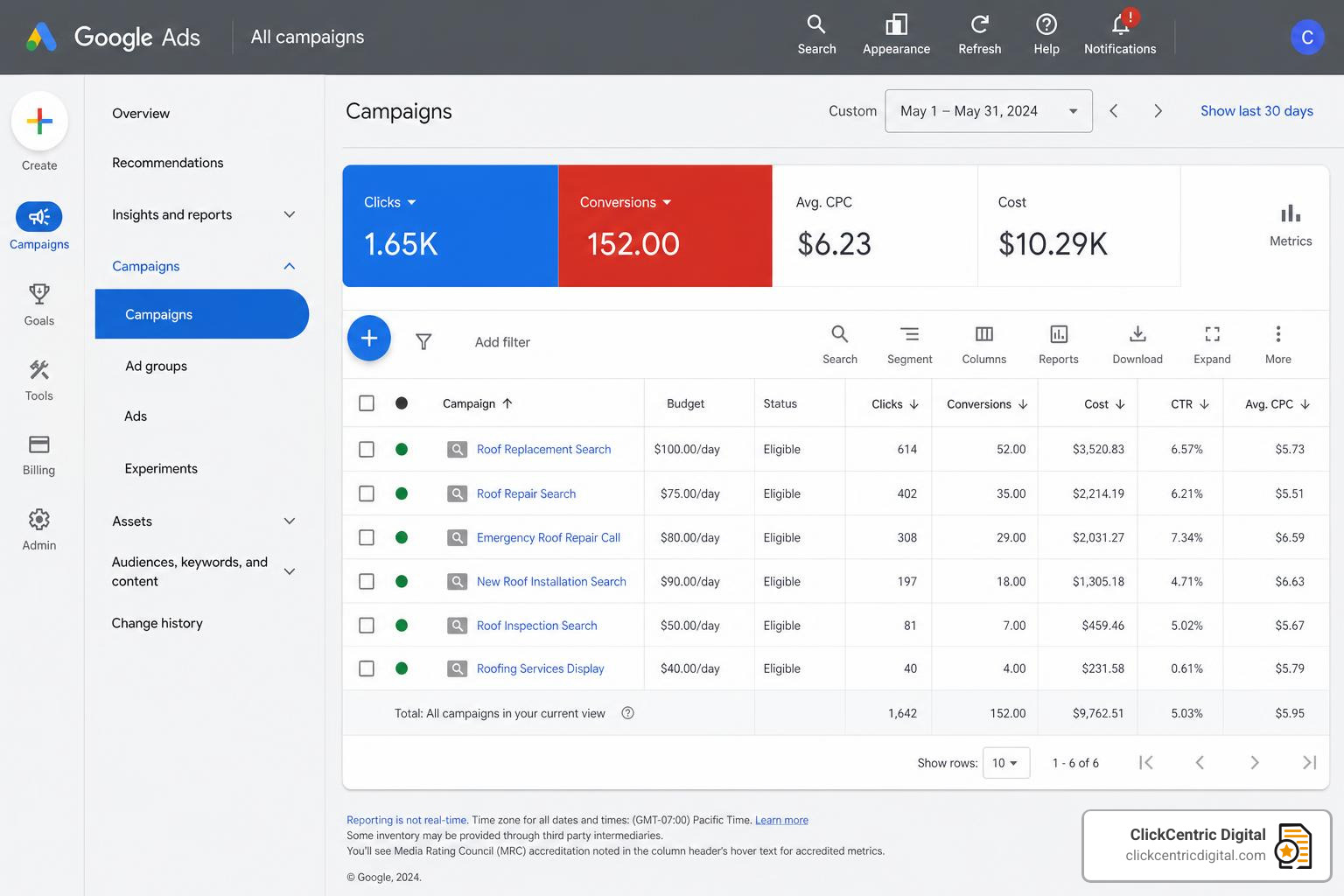
Here is the simple version of how we would structure a roofing Google Ads account.
- Choose the Leads objective.
- Select a Search campaign.
- Set up conversion actions before launch.
- Target only your true service area.
- Use the location setting for people in or regularly in your targeted locations.
- Segment campaigns by service.
- Add call assets, location assets, and sitelinks.
- Send traffic to dedicated landing pages.
- Review search terms constantly after launch.
For West Michigan roofers, that might mean separate campaigns for Grand Rapids roof repair, Holland roof replacement, Kalamazoo emergency roofing, and Grand Haven storm damage instead of one giant “roofing” campaign trying to do everything.
How to Choose Roofing Keywords for Google Ads for Roofers
Good roofing keywords show buying intent. Bad keywords attract researchers, job seekers, DIYers, and people who want materials instead of service.
Strong keyword examples include:
- “roof repair near me”
- “emergency roof repair”
- “roof replacement”
- “roofing contractor near me”
- “metal roof installer”
- “commercial roofing company”
- “hail damage roof repair”
- “roof inspection after storm”
- “roof replacement Grand Rapids”
- “roof repair Holland MI”
- “roofing company Kalamazoo”
Use Google Keyword Planner to estimate search volume and CPC ranges. In roofing, phrase match and exact match are usually safer than broad match, especially when starting. Broad match can bring in loose searches that sound related to Google but are useless to your crew.
Example: you bid on “roof repair,” and broad match shows you for “how to repair roof shingles yourself.” Congratulations, you just paid to teach someone how not to hire you.
Negative Keywords Every Roofer Should Add Before Spending Money
Negative keywords tell Google what not to show your ads for. This is one of the easiest ways to protect budget.
Add negative keyword categories like:
- DIY: “how to,” “do it yourself,” “tutorial”
- Jobs: “jobs,” “careers,” “hiring,” “salary”
- Education: “training,” “certification,” “classes”
- Materials: “shingles,” “metal panels,” “roofing supplies”
- Retail stores: “Home Depot,” “Lowe’s,” “Menards”
- Free/cheap: “free materials,” “used,” “cheapest”
- Research-only: “reviews,” “complaints,” “license lookup”
- Non-service locations outside your area
- Services you do not offer
Then review the Search Terms report weekly, especially during the first 60 days. Real user searches will reveal new negatives you did not think of.
Campaign Structure That Matches Roofing Buyer Intent
The biggest campaign structure mistake is putting every roofing search into one campaign. Emergency repair, replacement, storm damage, insurance claims, and commercial roofing are different buyers with different urgency levels.
A better structure:
- Emergency Repair Campaign: always on, call-focused, high urgency
- Roof Replacement Campaign: core revenue, estimate-focused
- Storm Damage Campaign: built in advance, activated after storms
- Insurance Claim Campaign: trust and process-focused
- Commercial Roofing Campaign: separate keywords and landing page
- Remarketing Campaign: stays in front of past visitors
This kind of segmentation also makes budget decisions easier. If replacement leads are more profitable than small repairs, you can fund that campaign more aggressively.
There are plenty of business-owner discussions about shifting from referral-only growth to paid traffic. The short version from most practical conversations is this: Google Ads can work when the keywords, landing pages, and tracking are built correctly. Here is one Google Ads setup discussion on the topic.
Roofing Ad Copy That Gets Calls and Estimate Requests
Your ad copy should quickly answer three questions:
- Do you offer the service I need?
- Do you serve my area?
- Why should I call you instead of the next roofer?
Strong roofing ads use:
- The target keyword in the headline
- Local wording, such as “Serving West Michigan”
- Clear calls to action
- Trust signals like licensed, insured, warranties, and reviews
- Offers such as free inspections or free estimates
- Urgency for emergency campaigns
- Insurance help for storm campaigns
Example headline ideas:
- “Emergency Roof Repair in Grand Rapids”
- “Schedule a Free Roof Inspection”
- “Storm Damage Roofing Help”
- “Local Licensed Roofing Contractors”
- “Call Now for Leak Repair”
Test offers carefully. A “free inspection” may outperform a discount because roofing is a trust-heavy service, not an impulse coupon purchase.
Roofing Google Ads Costs, Budgets, and ROI Tracking
Roofing clicks are not cheap. But one closed replacement or insurance job can justify a meaningful ad budget.
Research across the industry shows roofing CPCs often range from $15 to $60+, with storm-season clicks sometimes going higher in competitive areas. Google Search CPCs also rose by 9% in the last quarter of 2023, contributing to a 17% increase in ad spend. In other words, guessing is getting expensive.

How Much Should Roofers Spend on Google Ads in 2026?
A practical 2026 budget range:
- Starter budget: $1,500-$2,500/month
- Mid-size roofing company: $3,000-$5,000/month
- Competitive metro or storm growth push: $5,000-$10,000+/month
A $500/month roofing budget usually does not create enough click volume to learn anything useful. If clicks cost $30 and your budget is $500, that is only about 16 clicks for the entire month. One bad day can wreck the data.
A simple planning formula:
Target daily clicks x estimated CPC = daily budget
If you want 10 clicks per day and your average CPC is $35:
10 x $35 = $350/day
That does not mean every roofer must spend that much immediately. It means you need enough budget to generate statistically useful data.
What Is a Good Cost Per Lead for Roofing Campaigns?
Reasonable roofing CPL benchmarks:
- Emergency repair leads: $100-$175
- Roof replacement leads: $200-$350
- Storm damage or insurance leads: $350-$500
But cost per lead is only part of the story. A $300 lead that turns into a $14,000 roof replacement is much better than a $75 lead that never answers the phone.
Track:
- Cost per lead
- Cost per qualified lead
- Cost per booked inspection
- Close rate
- Average job value
- Gross profit
- Return on ad spend
Typical roofing job values can range from around $8,500 to $20,000+, depending on the project. That is why ROI tracking matters more than “cheap leads.”
How to Track ROI From Click to Closed Roofing Job
At minimum, track:
- Phone calls from ads
- Form submissions
- Calls from landing pages
- Booked inspections
- Qualified versus unqualified leads
- Closed revenue by source
Tools commonly used include Google Analytics 4, Google Tag Manager, call tracking software, and a CRM. Dynamic phone numbers help connect calls back to the keyword or campaign that generated them.
The goal is not just to know that “Google Ads got 40 leads.” The goal is to know:
- Which campaign produced booked inspections?
- Which keyword produced closed roofing jobs?
- Which city or zip code had the best profit?
- Which calls were spam, salespeople, or wrong-location leads?
For a deeper look at staying sane while managing PPC data, see Mastering Google PPC Management Without Losing Your Mind.
Landing Pages and Optimization Strategies That Lower Cost Per Lead
Sending paid roofing traffic to your homepage is usually a mistake. Homepages are built for general browsing. Google Ads landing pages should be built for one action: call or request an estimate.
A dedicated landing page improves relevance, Quality Score, and conversion rate.
What a High-Converting Roofing Landing Page Needs
A strong roofing landing page includes:
- A headline that matches the ad
- One clear CTA
- Click-to-call phone number above the fold
- Short estimate form
- Local service area proof
- Reviews or testimonials
- License and insurance information
- Warranty details
- Before-and-after project photos
- Financing information if available
- Emergency service banner when relevant
- FAQ section
- Fast mobile load speed
- Thank-you page for tracking
Keep navigation limited or removed. Every extra link is an escape hatch.
Conversion Rate Benchmarks for Roofing Google Ads
Industry-average Google Ads conversion rates often fall around 5-10%. Strong roofing campaigns can reach 8-12% with relevant landing pages and good traffic. Highly optimized campaigns may see 15-30%, especially when call-first design, tight keywords, and local proof all work together.
Conversion rate alone is not enough, though. A campaign can convert at 25% and still produce poor leads if it targets the wrong searches. Always pair conversion rate with lead quality and booked appointment rate.
Advanced Strategies for Better Conversion Rates and Lower CPL
Once the basics are working, improve performance with:
- Geo bid adjustments by city or zip code
- Device bid adjustments, especially for mobile calls
- Ad scheduling around phone coverage
- Weekly Search Terms reviews
- A/B testing headlines and landing pages
- Remarketing for replacement and insurance leads
- Storm campaign preparation before peak weather
- Click fraud monitoring in high-CPC markets
- Google Business Profile optimization
- Strong review generation
- Audience observation for better data
Roofers should also watch reviews closely. A strong local reputation can improve conversion rates because homeowners are trusting you with a large, stressful purchase.
If clicks are coming in but calls are not, it may be time to audit the account. Here is why working with a trained PPC professional can help: Stop Wasting Clicks: Why You Need a Certified PPC Expert.
Common Google Ads Mistakes Roofers Make and How to Avoid Them
Most roofing ad waste comes from a few repeat problems:
- Broad match keywords with no control
- No negative keyword list
- Weak or missing conversion tracking
- Sending traffic to the homepage
- Mixing all services in one campaign
- Targeting too large an area
- Using the wrong location setting
- Leaving Search Partners or Display Network on accidentally
- No call tracking
- Optimizing for clicks instead of booked jobs
- Running too small a budget to collect data
The Biggest Budget-Killing Mistakes in Roofing PPC
Here are the mistakes we would fix first:
One campaign for every service
Emergency repairs and roof replacements should not share the same budget, ads, and landing page.Whole-state targeting
If you serve West Michigan, do not pay for clicks from outside your actual service area.Wrong presence setting
Use people in or regularly in your targeted locations, not people merely interested in them.No dedicated landing pages
Message match matters. “Emergency roof repair” should land on an emergency repair page.No CRM tracking
Leads are not revenue. Track through to booked and closed jobs.Ignoring search terms
Google will show you exactly where waste is happening. Read the report.Using Performance Max too early
Automation works better after you have clean conversion data.Not owning the ad account
Your business should have admin access and ownership of your data.
Search Ads, Call Campaigns, or Both: The Best Mix for Roofers
For most roofers, the best mix is:
- Search campaigns for replacements, inspections, commercial work, and planned estimates
- Call-focused campaigns for urgent leaks and emergency repair
- Remarketing for people who visited but did not convert
- LSAs where available and profitable
- Strong landing pages for each major service
Search gives control. Call campaigns drive fast conversations. LSAs can add lead volume, but they do not replace traditional Google Ads because keyword control is limited.
If you want help building the right mix instead of guessing, our Paid Traffic Management service is designed around local customer acquisition through search and ads.
In-House vs Professional Management for Roofing Google Ads
You can manage Google Ads in-house if you have:
- Time to check campaigns weekly
- Comfort with conversion tracking
- Someone who understands keyword match types
- A system for call tracking and CRM updates
- Budget for testing
- Patience for the 30-90 day optimization period
Professional management makes sense when:
- CPCs are high
- You are not sure which leads are profitable
- You need landing pages and tracking built correctly
- You want transparent reporting
- You want regular testing
- You want someone watching wasted spend
- Your team should be focused on selling and installing roofs
Always make sure you own your Google Ads account, tracking assets, and landing page data. A good partner should explain what is happening in plain English, not hide behind dashboards and wizard smoke.
Also, better marketing creates more estimate requests. Make sure your quoting process is ready. This Accurate Roof Bid Checklist: How to Avoid Costly Estimating Blunders can help tighten the sales side after the lead comes in.
Conclusion
Google Ads can be one of the fastest ways for roofers to generate local leads, but only when the account is built with discipline.
The winning formula is simple:
- Target high-intent roofing keywords
- Separate campaigns by buyer intent
- Use negative keywords aggressively
- Focus on your real service area
- Build dedicated landing pages
- Track calls, forms, booked inspections, and revenue
- Use Search and call-focused campaigns together
- Review performance regularly
- Scale what produces profitable roofing jobs
At ClickCentric Digital, we help local businesses in Grand Rapids, Holland, Grand Haven, South Haven, Kalamazoo, and across West Michigan attract more customers through search, reviews, and paid traffic.
If you want your roofing ads to generate more than clicks, we can help you build a campaign that is tied to real calls, real estimates, and real revenue.
Ready to stop guessing? Get help with paid traffic management.
Sorry, the comment form is closed at this time.