


23 Jun The Ultimate Guide to Google Ads for Home Services
The Ultimate Guide to Google Ads for Home Services
Why Google Ads for Home Services Is a Game-Changer for Local Contractors
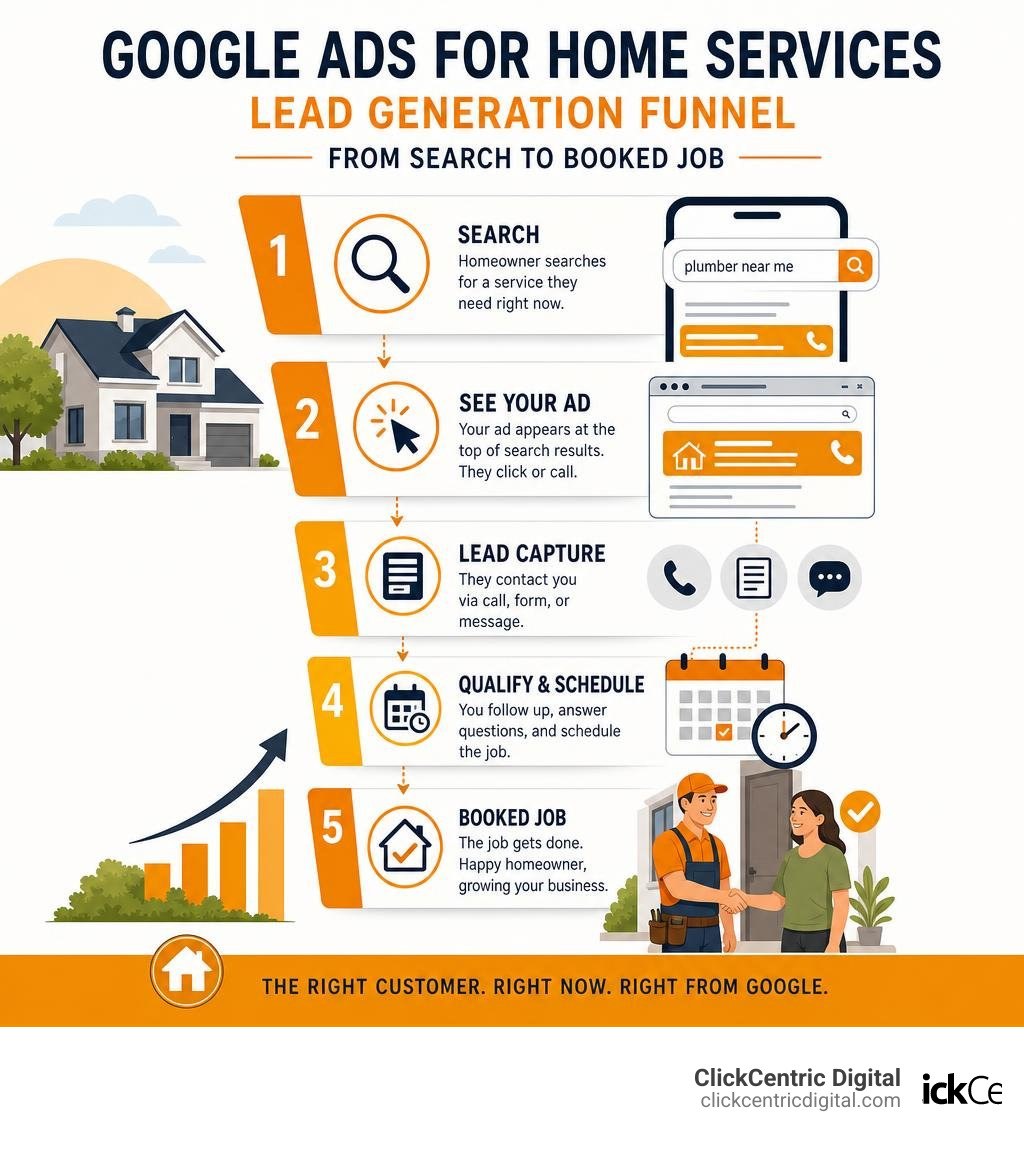
Google Ads for home services gives local contractors and service businesses a direct line to customers who are ready to hire right now.
Here’s a quick overview of what you need to know:
- Google Local Services Ads (LSAs) appear at the very top of search results — above traditional ads and organic listings
- LSAs charge per lead, not per click, so you only pay when a real customer contacts you
- Traditional Google Search Ads use a pay-per-click model and give you more control over keywords and messaging
- The Google Guarantee badge signals trust to homeowners and is backed by up to $2,000 in coverage from Google
- Most home service trades are eligible, including plumbing, HVAC, roofing, electrical, and landscaping
- Average cost per lead on LSAs runs around $53 across trades, compared to roughly $104 on traditional Google Ads
Think about it this way: when a pipe bursts at 2 AM, a homeowner grabs their phone and searches “emergency plumber near me.” They’re not browsing. They’re ready to call. Google Ads puts your business in front of that person at that exact moment.
The challenge? Most home service businesses either avoid Google Ads entirely or waste money on poorly set-up campaigns. This guide walks you through everything — from LSA setup and eligibility to costs, optimization, and common mistakes to avoid.
Understanding Google Ads for Home Services
For local contractors throughout West Michigan—whether you are operating out of Grand Rapids, Holland, Grand Haven, South Haven, or Kalamazoo—the digital landscape in 2026 is fiercely competitive. When homeowners face an urgent home maintenance issue, they do not dig through paper directories. They turn to Google.
To win these high-value jobs, we need to understand the two primary paid advertising channels Google offers: Traditional Google Search Ads and Google Local Services Ads (LSAs). Both play critical roles in a well-rounded strategy, but they operate on completely different mechanics.
Traditional Search Ads run on a pay-per-click (PPC) model. You bid on specific keywords (like “furnace repair Grand Rapids”), and you pay every time someone clicks on your ad, regardless of whether they call you or immediately leave your website.
On the other hand, Google Local Services Ads operate on a pay-per-lead (PPL) model. Instead of paying for a simple website visit, you only pay when a homeowner directly contacts your business via phone call or message through the LSA platform.
To help you get more value out of your marketing spend, we often recommend deploying a blended strategy. Combining both formats allows you to dominate the search engine results page (SERP), capturing maximum real estate at the very moment local homeowners need your help. For a deeper dive into making your local campaigns convert, check out our guide on Local PPC Campaigns That Actually Bring People Through the Door.
| Feature | Google Local Services Ads (LSAs) | Traditional Google Search Ads |
|---|---|---|
| Payment Model | Pay-per-lead (phone calls, messages) | Pay-per-click (website visits) |
| Ad Placement | Absolute top of Google search results | Below LSAs, above organic results |
| Trust Badge | Google Guaranteed badge included | None (uses custom ad extensions) |
| Keyword Control | None (Google matches based on job categories) | Complete control over match types and bids |
| Landing Page | Google-hosted business profile | Custom landing pages or your website |
| Verification | Requires background, license, and insurance checks | Standard Google Ads account setup |
Traditional Google Ads for Home Services
Traditional Google Search Ads are highly customizable. They allow us to bid on precise keywords, structure campaigns around specific service lines, and write custom ad copy that highlights your unique selling propositions—such as “Family-Owned in Holland Since 1998” or “24/7 Emergency Service in Kalamazoo.”
With traditional search campaigns, we can use ad extensions (like call extensions, location extensions, and sitelinks) to make your ads larger and more informative. This format is incredibly effective for planned, high-ticket projects like kitchen remodeling or complete HVAC system replacements, where homeowners want to click through to a custom landing page to read reviews, view past work, and fill out a detailed project inquiry form.
However, because you pay for every single click, standard PPC campaigns require expert management to keep costs from spiraling. If you bid on overly broad terms or fail to optimize your landing pages, you will end up paying for clicks that never turn into paying customers. This is why working with specialists is so critical; you can read more about why this matters in our article Stop Wasting Clicks: Why You Need a Certified PPC Expert.
Google Local Services Ads (LSAs) Explained
Google Local Services Ads are designed specifically to build immediate trust and drive direct phone leads. When they appear, LSAs capture roughly 13.8% of all local search clicks, and 29% of searchers actually prefer clicking them over traditional text ads because of the prominent trust signals they display.
To explore this platform directly, you can visit Reach Local Customers with Local Service Ads – Google Ads.
At the core of the LSA program is the Google Guaranteed badge. When your business earns this green checkmark, Google is essentially vouching for your credibility. If a customer is unsatisfied with the quality of your work, Google may reimburse them up to $2,000 (lifetime limit per customer in the United States). This guarantee dramatically lowers the barrier to entry for a stressed homeowner who needs to hire a contractor quickly. Because LSAs appear above every other search result on both desktop and mobile, they provide unmatched visibility for emergency home service searches.
Eligibility and Requirements for Google LSAs
Earning the Google Guaranteed badge is not as simple as entering a credit card number. Because Google puts its own reputation (and up to $2,000) on the line, they put local service providers through a rigorous screening process.
To understand the onboarding process from Google’s official documentation, you can refer to Getting started with Local Services Ads – United States – Local Services Help.
To successfully launch and maintain your LSA campaigns in West Michigan, your business must satisfy several strict criteria:
- Background Checks: Google requires owner and employee background checks through its partner screening portals. For most home service trades, any technician who enters a customer’s home must pass this check.
- Business Licensing: You must submit active, valid state and local professional licenses matching your trade and service areas (such as state of Michigan electrical or mechanical licenses).
- Liability Insurance: You must provide proof of general liability insurance meeting Google’s minimum coverage requirements for your specific industry.
- Customer Reviews: You must maintain a strong rating on your connected Google Business Profile (typically a minimum of 3.0 stars, though successful campaigns in competitive markets like Grand Rapids usually require a 4.5+ star rating).
Eligible Home Service Verticals
Not every business can run LSAs, but the program has expanded significantly to cover the vast majority of major residential trades. Eligible verticals include:
- Plumbing and drain cleaning
- HVAC (heating, ventilation, and air conditioning)
- Roofing and gutter services
- Electrical services
- Landscaping and lawn care
- Pest control
- Home cleaning and maid services
For specific trades like roofing, where job values are exceptionally high and competition in West Michigan is fierce, combining LSAs with highly targeted search ads is the ultimate growth lever. For a tailored blueprint on this vertical, read our Step-by-Step Guide to Google Ads for Roofers.
The Google Guarantee Badge and Screening Process
The screening process is designed to protect consumers, but it can be a major bottleneck for contractors who try to navigate it alone. During verification, Google verifies your business registration, double-checks your liability insurance policy directly with your provider, and reviews individual technician licenses.
While this screening is underway, Google sometimes allows businesses in certain verticals to run “pre-badge ads.” These ads allow you to start receiving leads while your full background checks are still processing, though your ads will rank below fully verified competitors who already sport the green Google Guaranteed badge.
How to Set Up and Optimize Your Campaigns
Setting up your campaigns correctly from day one prevents wasted ad spend and ensures you only target homeowners within your actual service radius.
Step-by-Step Setup for Google Ads for Home Services
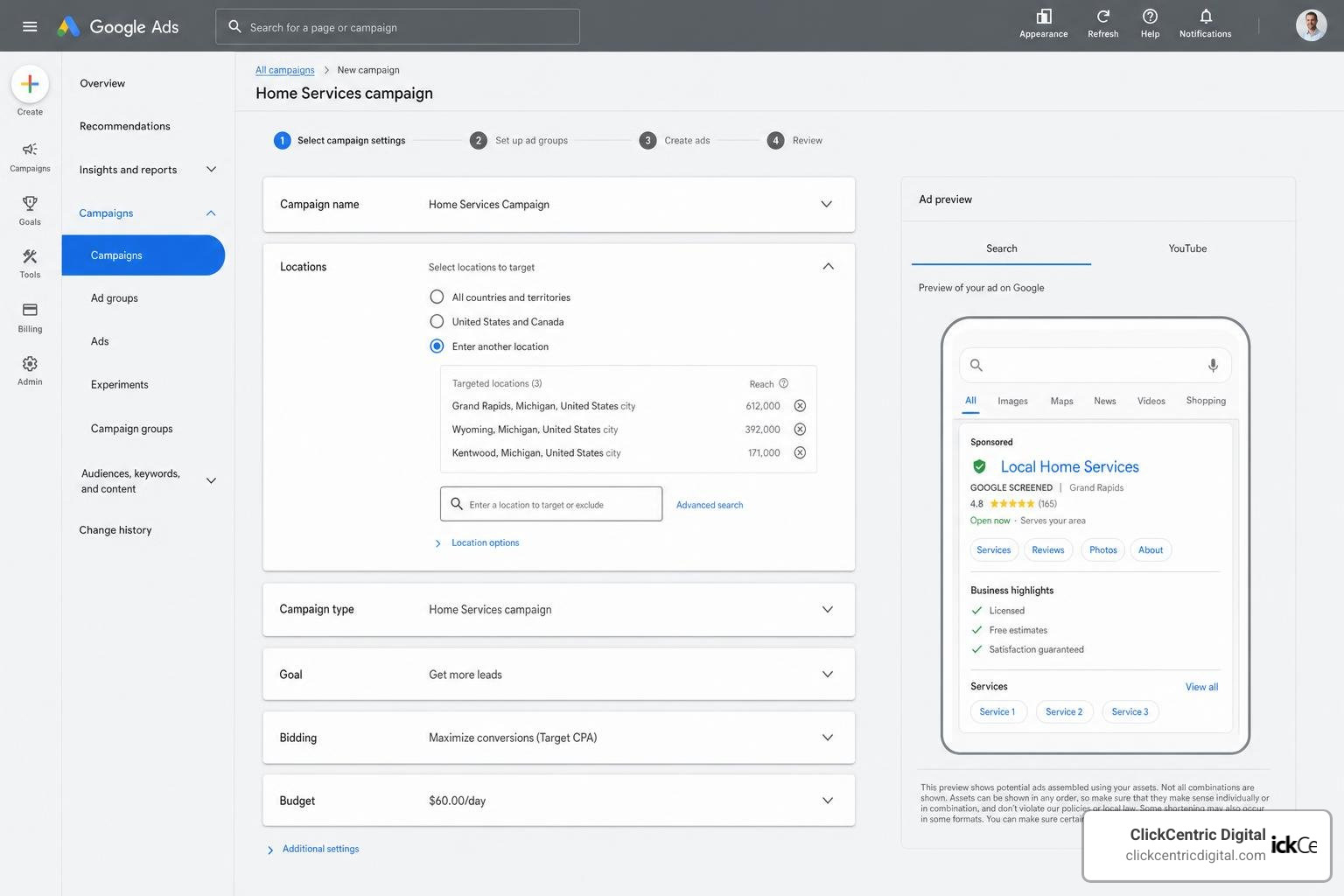
To get started with google ads for home services, follow this step-by-step framework:
- Create or Link Your Google Ads Account: Ensure your account is set up with the correct time zone (Eastern Time for Grand Rapids, Holland, etc.) and currency settings. Link your active Google Business Profile to sync your existing reviews.
- Define Your Exact Service Areas: Do not simply target “West Michigan” or an entire county if you do not have the capacity to dispatch trucks there. Use precise radius targeting (e.g., 20 miles around Grand Rapids or Holland) or select specific zip codes where you know your close rates are highest.
- Select Your Service Categories and Job Types: In the LSA dashboard, check off only the specific services you actually want to perform. If you are a plumber who doesn’t do commercial septic work, leave that box unchecked so you don’t pay for irrelevant leads.
- Set Your Weekly Budget: Google will ask you to set a weekly budget based on the number of leads you want to receive. A good starting point for new advertisers is budgeting for 10 to 20 leads per week. For traditional search ads, we recommend starting with at least $30 to $50 per day per campaign.
- Submit Verification Documents: Upload your general liability insurance certificate, professional licenses, and initiate the background checks for your field team.
If you are looking for an affordable way to have experts build and manage these campaigns for you, check out The Small Business Guide to Affordable Google Ads Management Services.
Advanced Optimization Strategies for LSAs
Once your ads are live, your work isn’t done. The LSA ranking algorithm is a “black box,” but we know it heavily weights several key factors that you can actively control:
- Review Management: Google ranks businesses with higher star ratings and higher review volumes more prominently. Make it a daily habit to request reviews from customers immediately after completing a job. Sending a direct text link within 24 hours of service yields the highest conversion rate.
- Response Time and Answer Rates: This is the single biggest ranking factor that contractors overlook. Google tracks how quickly you answer phone calls and respond to message leads. If you let calls go to voicemail, your ranking will plummet. If you are busy on a job site, use an AI receptionist or a dedicated dispatch service to ensure every call is answered by a live person.
- Lead Disputes: Not every lead you receive will be valid. If someone calls you looking for a service you don’t offer, or from outside your service area, you can dispute the lead directly in the LSA dashboard within 30 days to get credited back.
To streamline this process, you can utilize specialized software tools to automate review requests and track performance. Learn more in our guide on Top Tools for Google Ads Management That Actually Work.
Cost, Billing, and ROI Expectations
Understanding your numbers is the key to scaling your business predictably. Let’s break down what you can expect to pay and the kind of return on investment (ROI) your home service business can generate.
Average Cost Per Lead by Trade
While traditional Search Ads charge per click (with emergency keywords like “burst pipe plumber” sometimes costing $35 to $75 per click in major markets), LSAs only charge when a lead is generated. Across the United States, the blended average cost per lead (CPL) for LSAs is approximately $53.
Here is what the average CPL and performance metrics look like by trade:
- Electrical: ~$39 CPL | Average Book Rate: 43.4% | Average Closed ROAS: 8.52x
- HVAC: ~$51 CPL | Average Book Rate: 44.0% | Average Closed ROAS: 9.55x
- Plumbing: ~$57 CPL | Average Book Rate: 44.5% | Average Closed ROAS: 6.85x
- Roofing: ~$75 – $120+ CPL (due to exceptionally high average ticket sizes)
For home service providers, LSAs are often 49% cheaper than traditional Search Ads on a cost-per-lead basis. However, because Search Ads offer unlimited volume and precise keyword targeting, they remain necessary for scaling beyond LSA caps. To explore how to balance these budgets effectively, refer back to The Small Business Guide to Affordable Google Ads Management Services.
Managing Budgets and Disputing Bad Leads
Your LSA budget is highly flexible. You set a weekly target, and Google will never exceed your monthly max (which is your weekly budget multiplied by 4.3). If your schedule is completely booked or your technicians are spread thin across Ottawa or Kent County, you can pause your ads instantly through the LSA app to halt incoming leads.
When you do receive an invalid lead—such as a telemarketer, a job seeker, or a homeowner outside your defined geographic service area—you can submit a dispute in the LSA dashboard. Google reviews these recorded calls (which must be set up as non-dynamic tracking numbers) and regularly refunds the lead cost directly to your account.
Common Mistakes to Avoid in Home Service Advertising
Many contractors launch Google Ads campaigns only to pause them a month later, claiming “Google Ads doesn’t work for my business.” In almost every case, the failure is due to a few common, preventable mistakes.

Neglecting Phone Lead Responsiveness
The absolute fastest way to destroy your LSA campaign is by failing to answer the phone. Research shows that a staggering 74.1% of contractor phone calls go unanswered or get sent to voicemail.
If Google sends you three phone leads in a row and you fail to answer them, the algorithm will automatically drop your ad placement to give those leads to a competitor who is ready to answer. Treat every LSA call as an emergency. If your team cannot answer live during nights and weekends, adjust your ad scheduling so your ads only run during your precise office hours.
Poor Keyword and Location Targeting
In traditional Search Ads, many businesses waste thousands of dollars by bidding on broad match keywords without utilizing negative keywords. For example, if you bid on the broad term “plumbing,” your ad might show up when someone searches “plumbing jobs,” “free plumbing diagrams,” or “DIY plumbing on YouTube.”
We must implement aggressive negative keyword lists to filter out:
- DIY terms (“how to,” “do it yourself,” “tutorial”)
- Career searches (“jobs,” “salary,” “hiring,” “school”)
- Low-value search terms (“cheap,” “free”)
- Irrelevant services (“commercial” if you only do residential, or vice versa)
Additionally, avoid the trap of setting your location targeting too wide. If your shop is in Grand Rapids, targeting the entire West Michigan region might result in paying for click traffic in South Haven or Kalamazoo that your team cannot service efficiently. Keep your radius tight and expand only when you have the capacity to scale. For a comprehensive look at avoiding these pitfalls, check out Mastering Google PPC Management Without Losing Your Mind.
Frequently Asked Questions about Local Service Ads
Do I pay for clicks or leads with Google LSAs?
With Google Local Services Ads (LSAs), you only pay for valid leads (phone calls or direct messages) that last longer than two minutes or result in a text message. You never pay for impressions, views, or standard clicks on your ad.
Can I run traditional Google Ads and LSAs at the same time?
Yes, and we highly recommend doing so. Running both ad formats simultaneously allows your business to occupy multiple premium spots at the top of the search page. This maximizes your brand’s digital footprint and captures both high-intent emergency callers (via LSAs) and research-oriented homeowners looking for specific project details (via Search Ads).
How long does the Google Guaranteed verification take?
The verification process typically takes anywhere from two to five weeks. The timeline depends heavily on how quickly you can submit your business licenses, liability insurance certificates, and how fast your team completes their background checks through Google’s screening partners.
Conclusion
Mastering google ads for home services is the single fastest way to build a predictable, high-ROI lead flow for your contracting business in West Michigan. By combining the immediate trust and pay-per-lead safety of Google Local Services Ads with the precise targeting and customization of traditional Search Ads, you can dominate the local market from Grand Rapids to Kalamazoo.
At ClickCentric Digital, we specialize in helping home service providers navigate these platforms, manage their online reputations, and turn search engine visibility into booked jobs. Whether you want to launch your first LSA campaign or optimize an existing PPC budget, we are here to help you scale.
Ready to start bringing high-value customers through your doors? Explore our strategies for Local PPC Campaigns That Actually Bring People Through the Door or read The Complete Guide to Small Business Advertising to take your local marketing to the next level.
Sorry, the comment form is closed at this time.