


16 Oct How to Perfect Your Dental Social Media and Facebook Ads Strategy
How to Perfect Your Dental Social Media and Facebook Ads Strategy
Core Benefits and Essentials of Social Media Dental Marketing
To perfect your social media dental marketing and Facebook ads strategy, combine monthly batched educational video content with targeted local Meta ad campaigns. Produce short video explainers answering common patient concerns, and run geo-targeted ads using a structured 60/30/10 budget split—allocating 60% of spend to cold local acquisition within 5–15 miles, 30% to retargeting website visitors, and 10% to creative testing. Routing paid traffic to single-service landing pages converts interest into booked appointments.
With 67.5% of dental practitioners now utilizing social platforms in their practices, social media has shifted from an optional experiment to an indispensable engine for sustainable practice growth. When executed strategically, social media accomplishes several core business objectives simultaneously:
- Builds Local Practice Visibility: Keeps your clinic top-of-mind within your immediate geographic community so patients remember you when a toothache or cosmetic goal arises.
- Strengthens Patient Recall and Retention: Regular hygiene tips, office updates, and friendly reminders re-engage existing patients, reducing churn and encouraging regular cleanings.
- Drives Measurable Inquiries: Provides direct avenues for prospective patients to ask questions, view financing options, and transition smoothly from browsing to booking.
- Showcases Real Clinical Results: Highlights smile transformations, advanced technology (such as digital scanners and 3D imaging), and patient success stories.
Staying ahead of modern communication standards is essential for every practice. Educational resources like the Michigan Dental Association continuing education on digital marketing highlight the value of combining digital engagement with high clinical standards to keep practices thriving in an evolving healthcare landscape.
Why Modern Patients Expect an Active Practice Presence
Before modern patients book a dental exam, they conduct extensive digital reconnaissance. CDC data reveals that roughly two-thirds of adults visit a dentist annually, yet dental anxiety remains one of the greatest hurdles preventing people from seeking regular care.
When prospective patients land on an inactive profile that has not posted in six months, they wonder if the clinic is still operational or investing in modern standards. In contrast, an active profile featuring behind-the-scenes clinic tours, smiling team members, and gentle explanations of common procedures instantly lowers pre-appointment anxiety.
Prospective patients want to know:
- Who will be cleaning my teeth?
- Is the office clean, modern, and welcoming?
- How does the team treat nervous patients?
Social media acts as a 24/7 virtual open house. If you are not actively showcasing your clinic’s culture and real people, prospective patients will choose the practice down the road that does. It is time to stop being a secret and start running local Facebook ads paired with authentic organic content.
Overcoming Misinformation and Building Clinical Trust
According to research published in JMIR Formative Research, 72.1% of dental professionals use social platforms for oral health promotion and education. However, only 8.7% of surveyed dentists trust the overall credibility of health information circulating across social channels, and 63.4% believe online dental misinformation can complicate the traditional dentist-patient relationship.
This gap presents a massive opportunity for your clinic. By publishing evidence-based preventative guidance, debunking viral DIY dental trends (such as dangerous charcoal abrasives or at-home teeth filing), and providing clear procedural breakdowns, you establish your practice as the trusted clinical authority in your area.
Furthermore, search and discovery algorithms increasingly rely on textual depth to evaluate your practice’s clinical authority. Research on the impact of AI on dental social media shows that conversational discovery engines analyze post captions and spoken video transcripts to recommend local providers. Writing rich, descriptive captions that detail procedures, technology, and patient benefits reinforces your practice’s local clinical reputation while directly serving your community.
Platform Selection and High-Converting Content Strategies
You do not need an active profile on every emerging social app. Spreading your team too thin leads to generic, inconsistent posting that fails to attract patients. Instead, focus your energy on the platforms that match your target patient demographics.
| Platform | Primary Demographics | Ideal Content Formats | Patient Conversion Intent |
|---|---|---|---|
| Adults 35–65+ (Families & Seniors) | Community updates, video explainers, local ads, patient reviews | High: Excellent for family dentistry, restorative care, and dental implants | |
| Adults 18–34 (64% of user base) | Reels, aesthetic before-and-after cases, office culture Stories | High: Best for cosmetic dentistry, clear aligners, and teeth whitening | |
| YouTube | All age demographics | In-depth procedure walkthroughs, practice overviews, Shorts | Medium to High: Dominant for long-term clinical education and procedural search |
| TikTok | Adults 18–29 | Casual educational Q&As, myth-busting, day-in-the-life clips | Low to Medium: Strong for brand awareness and youth preventative education |
| Working professionals | Practice milestones, team hiring, professional networking | Low: Best for B2B networking and recruiting rather than patient acquisition |
Prioritizing Facebook, Instagram, and Video Channels
With 97% of surveyed dentists using Facebook as their primary marketing platform, Meta’s ecosystem remains the gold standard for dental patient acquisition. Facebook provides direct access to primary healthcare decision-makers—often parents managing appointments for their entire household.
Instagram, where 64% of users are under 34, is the premier visual stage for elective and aesthetic treatments. Highlighting Invisalign cases, porcelain veneers, and cosmetic bonding performs exceptionally well here.
For local businesses, mastering Meta’s platform mechanics is vital. Reviewing The Ultimate Guide to Local Business Facebook Campaigns and Lead Gen will give you a clear framework for turning platform engagement into predictable local inquiries.
The 4-Part Post Framework and Batch Content Workflows
Most dental social posts fail because they read like dry clinical textbooks. Patients do not search for “comprehensive endodontic therapy”—they want to know “why does my tooth throb when drinking cold water?”
To capture attention and prompt action, structure your posts using the 4-Part Dental Post Framework:
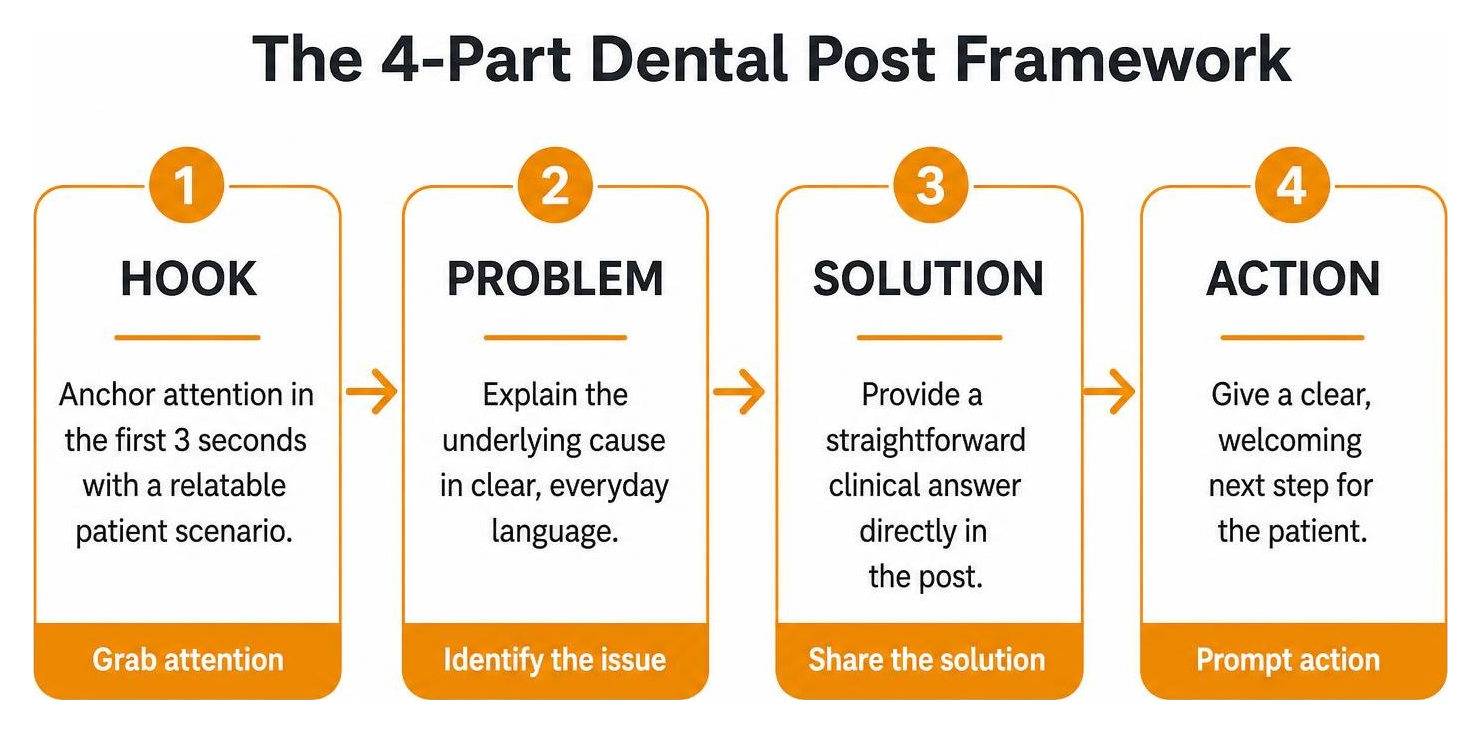
- Hook: Anchor the first 3 seconds in a relatable patient scenario (“Notice a sharp pain when sipping your morning coffee?”).
- Problem: Explain the underlying cause in clear, everyday language without medical jargon (“Enamel wear or micro-cracks can expose sensitive nerve pathways.”).
- Solution: Provide a straightforward clinical answer directly inside the post (“A simple desensitizing treatment or bonding often resolves the sensitivity in a single visit.”).
- Action: Give a clear, welcoming next step (“If sensitivity lasts more than three days, tap the link in our bio to book an evaluation.”).
The 4-Hour Monthly Batching Workflow
Clinical teams are busy treating patients; no practice has time to brainstorm content daily. Instead, block out one 4-hour session per month to produce a full month of content:
- Hour 1 (Scripting): Outline 8–10 common patient questions asked at the hygiene desk that week.
- Hour 2 (Filming): Record short 30–60 second video answers with the dentist and hygiene staff on a smartphone.
- Hour 3 (Editing & Captions): Add burned-in captions (since up to 85% of social users browse video with sound muted).
- Hour 4 (Scheduling): Schedule posts across Facebook and Instagram using a standard social media calendar tool.
Maintain a healthy content balance: 40% Educational, 20% Behind-the-Scenes & Team, 20% Patient Transformations, 10% Practice News, and 10% Direct Promotions.
Addressing Treatment Costs, Financing, and Membership Plans
Treatment cost remains the single greatest barrier to patient treatment acceptance. Addressing financial realities openly on social media builds trust and removes friction before the patient even calls.
- Promote In-House Dental Memberships: Uninsured patients often delay preventative care. Highlighting an in-house membership plan (e.g., “$35/month covering two cleanings, exams, and 15% off treatments”) converts price-sensitive followers into loyal recurring revenue. Membership patients visit 2 to 4 times more often than non-insured patients and accept treatment at higher rates.
- Feature Flexible Financing Options: Highlight partnerships with third-party healthcare financing platforms. Showing that a $3,000 restorative case breaks down into manageable monthly payments makes care accessible.
- Use “Zero-Click” Transparency: Break down common insurance terms, explain how annual maximums work, and provide clear price ranges for common elective procedures right in your posts.
Paid Facebook and Meta Ads Strategies for Predictable Patient Acquisition
While organic social media nurtures your existing community and reinforces trust, organic reach on Meta platforms typically reaches under 10% of your audience. Organic posting alone cannot guarantee a consistent pipeline of new patients. To scale predictably, you must combine organic content with targeted local advertising.

Running profitable campaigns requires a structured approach. To avoid wasted spend, follow proven guidelines on how to run Facebook ads for local business without losing your shirt.
Implementing a 60/30/10 Ad Budget Distribution
Rather than boosting random posts, structure your monthly advertising budget using a 60/30/10 budget split:
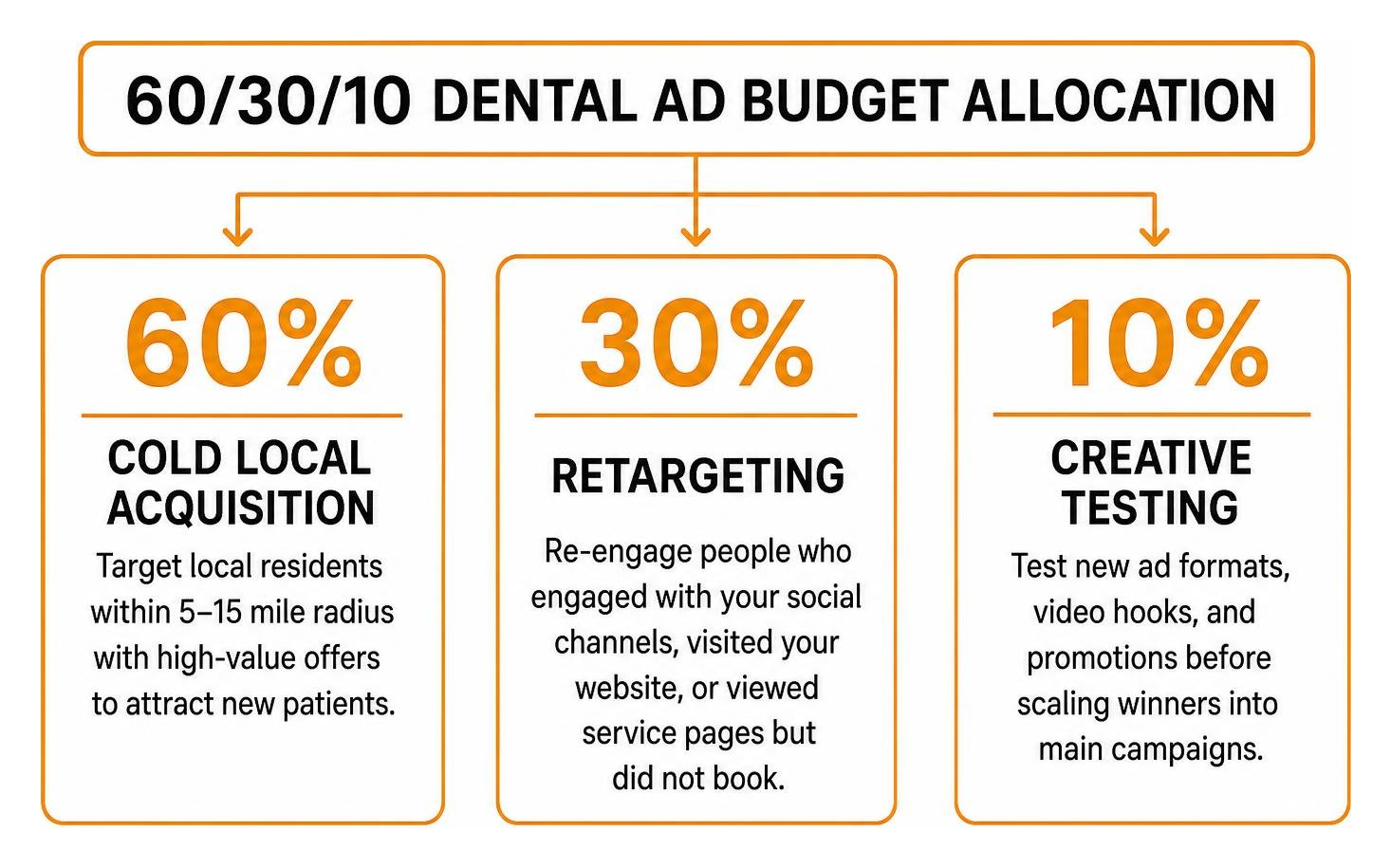
- 60% Cold Local Acquisition: Target local residents living within a 5–15 mile radius around your clinic. Use high-value offers such as new patient cleaning specials, complimentary clear aligner consultations, or emergency same-day exam availability.
- 30% Retargeting: Target individuals who engaged with your social channels, visited your website, or viewed specific service pages but did not book.
- 10% Creative Testing: Test fresh ad formats, new video hooks, and seasonal promotions before rolling them into your main cold campaigns.
Applying proven strategies such as 8 pro tips to maximize your Facebook campaign results ensures your ad dollars generate consistent booked appointments.
Retargeting High-Intent Website Visitors with Dedicated Landing Pages
The biggest mistake dental clinics make with paid advertising is sending ad traffic to their generic homepage. When a prospective patient clicks an ad for clear aligners and lands on a homepage discussing pediatric cleanings and root canals, they get distracted and leave.
Always route ad clicks to a dedicated, single-focus landing page featuring:
- A clear headline matching the exact ad offer.
- Direct online booking or a simple 3-field contact form.
- Real before-and-after transformation photos.
- Video testimonials from consenting patients.
- Trust badges, financing details, and clinic location maps.
By installing the Meta Pixel across your site, you can automatically retarget visitors who viewed your cosmetic or implant pages with tailored reminder ads. Retargeting ads regularly convert at 3 to 5 times the rate of cold traffic. For practices looking to scale without operational headaches, partnering with dedicated paid traffic management experts ensures maximum return on your advertising spend.
HIPAA Compliance, Reputation Management, and Review Response Protocols
Healthcare marketing carries strict legal responsibilities. Marketing your practice on social media must never compromise patient privacy or violate Health Insurance Portability and Accountability Act (HIPAA) standards.
For broader insights into ethical local promotion, consult the complete guide to small business advertising.
Maintaining Strict Patient Privacy on Public Social Feeds
Protecting Protected Health Information (PHI) is non-negotiable. A casual photo taken in an operatory that accidentally displays a patient’s chart, computer screen, or identifiable anatomy can trigger severe regulatory penalties.
Follow these strict HIPAA guardrails:
- Obtain Written Media Releases: Never publish a photo, video, or testimonial featuring a patient—even if they verbally agreed—without a signed, specific media consent form on file.
- De-Identify All Clinical Images: Ensure x-rays, intraoral scans, and case documentation contain no visible patient names, dates of birth, or identification numbers.
- Keep Clinical Discussions Out of Direct Messages: When prospective or existing patients ask clinical questions via Facebook Messenger or Instagram DMs, provide a friendly, standardized response redirecting them to a secure channel: > “Thank you for reaching out! For your privacy and clinical safety, we cannot discuss specific medical conditions over social media. Please call our team at (555) 019-2834 or book a private consultation through our secure portal at [link].”
- Conduct Annual Staff Training: Ensure every team member understands that tagging patients on personal accounts or discussing office visits publicly is strictly prohibited.
Responding to Patient Reviews and Social Inquiries Safely
With 98% of consumers reading local reviews before selecting a business, managing your public feedback directly impacts appointment volume. However, responding to reviews as a dental clinic requires careful phrasing.
Never confirm or deny that a reviewer is a patient of your practice. Confirming a patient relationship publicly is a direct HIPAA violation.
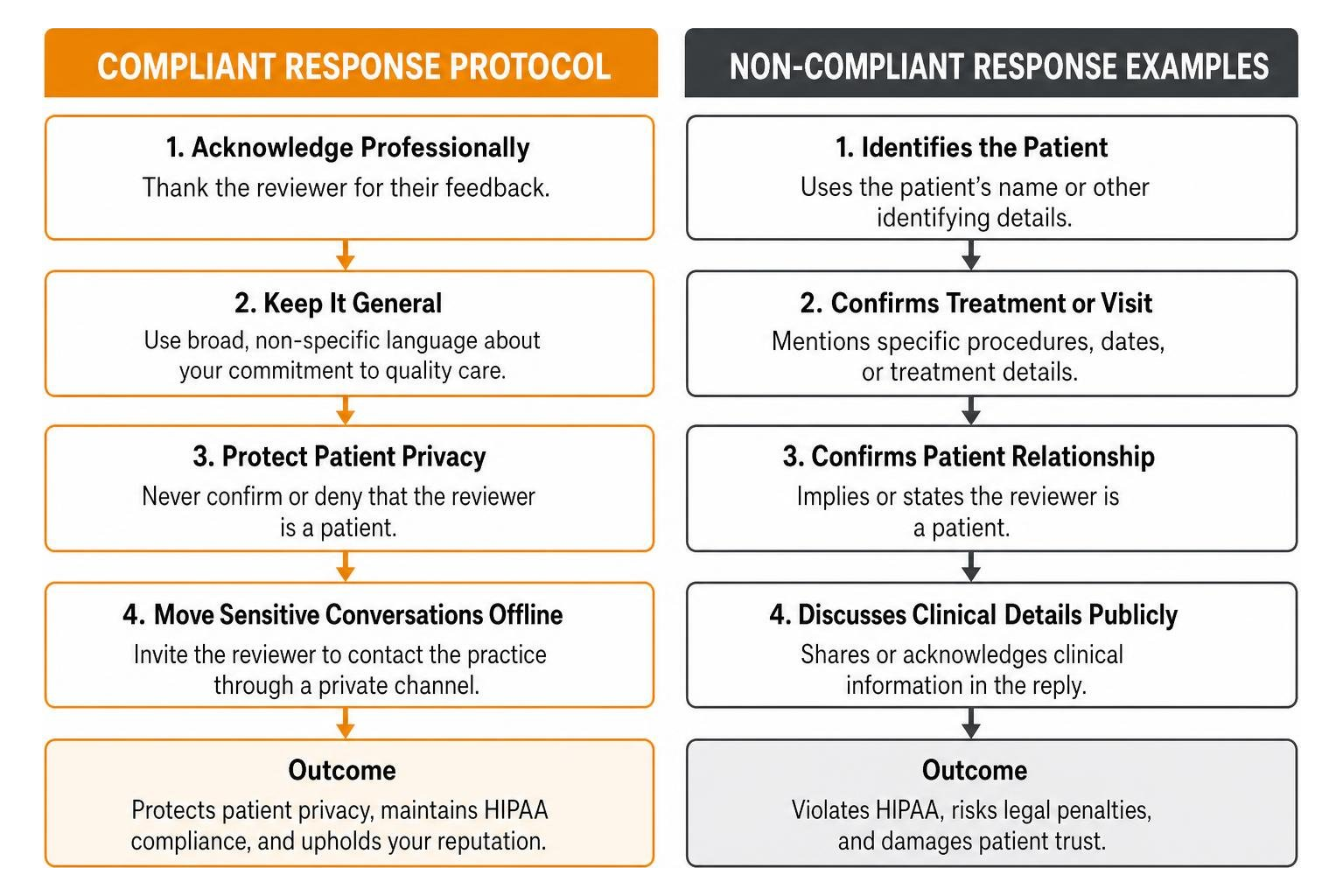
- Incorrect Response (HIPAA Violation): “Thanks for the review, Sarah! We loved helping you with your crown prep yesterday and look forward to seeing you for your permanent seating!”
- Compliant Response (Safe & Professional): “Thank you for sharing your feedback. Our practice is dedicated to delivering compassionate, high-quality care to every person who visits our office. We appreciate your support!”
When handling a negative review, remain professional, neutral, and move the conversation offline immediately:
“At our practice, patient comfort and quality care are our top priorities. We take all feedback seriously. Because patient privacy regulations prevent us from discussing specific care details publicly, we encourage you to contact our office manager directly at (555) 019-2834 so we can address your concerns.”
Managing your digital reputation requires ongoing diligence. If your clinic needs dedicated guidance managing local feedback and paid growth, discover why you need a local Facebook ads expert for your business.
Measuring ROI, Tracking CAC, and Budgeting for Long-Term Growth
Social media marketing should never be an untracked expense. To build a sustainable growth engine, you must measure how online engagement translates into revenue in your practice management system.
Key Performance Indicators and Cost Per Booked Appointment
Move past superficial vanity metrics like “likes” and “shares.” Track the key metrics that directly measure practice growth:
- Cost Per Lead (CPL): Total ad spend divided by the number of form submissions, message inquiries, or inbound calls generated.
- Cost Per Booked Appointment (CPBA): Total marketing investment divided by the number of patients who schedule an initial visit.
- Patient Acquisition Cost (CAC): The total financial investment required to get a new patient into the dental chair.
- Allowable CAC: The maximum acceptable acquisition cost based on patient value. A healthy benchmark is spending up to 15%–20% of a patient’s first-year production value. For example, if a new patient generates an average of $1,200 in their first year (cleanings, basic restorations), an allowable CAC of $180–$240 delivers strong long-term profitability.
Integrate call tracking numbers and unique booking links on your social channels and ad landing pages to tie new patient revenue directly to your marketing efforts.
Monthly Time and Financial Investment Benchmarks
A successful dental marketing plan balances software tools, paid advertising spend, and consistent production:
- Solo Practitioner Practice:
- Paid Ad Budget: $500 – $1,200 / month
- Software & Scheduling Tools: $50 – $150 / month
- Time Commitment: 4–6 hours / month (using batch production workflows)
- Multi-Provider / Group Practice (3+ Operatories):
- Paid Ad Budget: $1,500 – $3,500+ / month
- Software & Tracking Tools: $150 – $300 / month
- Management: In-house marketing coordinator or specialized digital marketing agency
Frequently Asked Questions About Social Media Dental Marketing
Which social media platform brings the highest ROI for dental practices?
Facebook and Instagram deliver the highest return on investment for local dental clinics. Facebook provides superior targeting for family decision-makers, restorative cases, and dental implants, while Instagram excels at generating visual interest and conversions for elective cosmetic dentistry, veneers, and clear aligners.
How can dentists ensure social media posts remain strictly HIPAA-compliant?
Dentists must obtain signed, written media consent forms before publishing any patient imagery or testimonials. Practices must never verify patient relationships in public review replies or comments, keep all diagnostic and treatment discussions out of direct messages, and ensure all radiographs or background computer screens are completely stripped of protected health information.
What is a realistic monthly ad budget for a local dental clinic?
A single-doctor dental practice should typically invest between $500 and $1,200 per month in targeted Meta ads. Larger, multi-provider practices should allocate between $1,500 and $3,500+ per month, distributing spend across cold patient acquisition (60%), retargeting (30%), and creative testing (10%).
Conclusion
Building a thriving dental practice in today’s digital environment requires a reliable patient acquisition system. By pairing educational, human-centered social content with targeted local Facebook advertising, you eliminate the uncertainty of traditional marketing and create a consistent pipeline of new patients.
At ClickCentric Digital, we specialize in helping local practices dominate local search, launch high-converting paid traffic campaigns, and build patient trust. If you are ready to transform your online presence and keep your treatment chairs filled, explore our comprehensive solutions for strategic dental reputation management and review growth today.
Sorry, the comment form is closed at this time.