


25 Aug The Complete Guide to a Search Engine Optimization Website Audit
Start With a Search Engine Optimization Website Audit
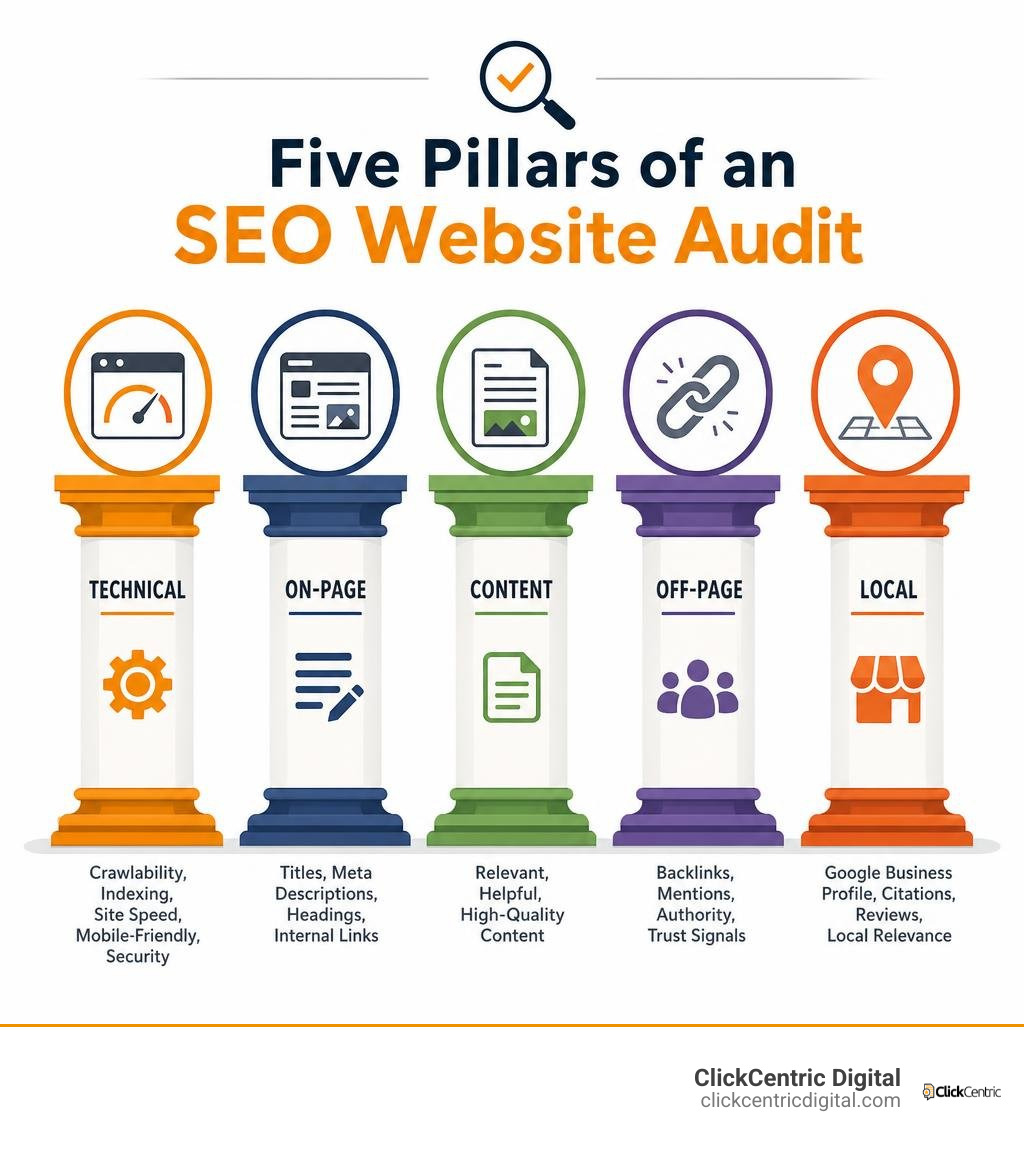
A search engine optimization website audit is a practical checkup of everything that may stop your site from being found, trusted, and chosen in search results. Start by crawling your site, checking what Google can index, reviewing page speed and mobile usability, then examining your titles, content, links, local listings, and reviews.
Focus first on issues that can block customers from finding you:
- Make sure important pages are crawlable, indexed, secure, and mobile-friendly.
- Fix missing or duplicate title tags, meta descriptions, headings, and internal links.
- Improve pages that do not match what local customers are searching for.
- Check Google Business Profile details, citations, and reviews for accuracy.
- Prioritize fixes by likely traffic or revenue impact, not by the total number of warnings.
This matters because organic search drives 45.1% of search-result clicks, while mobile accounts for 63% of organic search visits. Yet many sites have avoidable problems: missing metadata, duplicate pages, slow experiences, weak backlinks, or inconsistent business information.
A complete audit is not a list of scores to chase. It is a diagnosis that helps you identify the few changes most likely to improve rankings, calls, leads, and visits. In 2026, it should also assess whether your business can appear in AI Overviews and other AI-powered search answers.
I am Fred Dirkse, and this guide will walk you through how to find, prioritize, and fix the SEO issues holding your website back.
Glossary for search engine optimization website audit:
What Is a Search Engine Optimization Website Audit and Why Is It Crucial?
When search rankings drop or growth stalls, guessing what went wrong is a recipe for wasted time. An SEO audit serves as a comprehensive health assessment for your web presence, inspecting every moving part—from server response codes and page architecture to on-page copy and off-page reputation.
The average website carries over 4,500 crawl-detected SEO issues that quietly undermine visibility. When left unaddressed, these issues act as invisible bottlenecks: search engine crawlers struggle to discover important pages, users bounce due to sluggish load times, and conversion rates plummet. Understanding Why Professional Website SEO Audit Services Are Your Site’s Best Friend comes down to having a clear, data-backed diagnostic roadmap instead of shooting in the dark.
Core Business Benefits and Traffic Uplift
Executing a meticulous audit is not an academic exercise; it generates direct commercial returns. Research shows that a thorough SEO audit delivers a 25% to 40% organic traffic uplift within 4 to 6 weeks of implementing critical fixes.
When you resolve technical snags, streamline indexing, and align your messaging with real customer intent, you unlock several core business advantages:
- Enhanced Search Engine Visibility: Search engines can effortlessly crawl, understand, and index your high-converting service pages.
- Improved Organic Click-Through Rates (CTR): Compelling, properly formatted metadata attracts qualified clicks over competitors.
- Lower Bounce Rates and Higher Engagement: Lightning-fast speeds and mobile-optimized layouts keep visitors engaged.
- Sustainable Competitive Advantage: While competitors publish content on broken foundations, your optimized structure maximizes the value of every new page.
Recommended Audit Frequency and Trigger Events
SEO is not a one-and-done project. We recommend scheduling a comprehensive website audit every 6 to 12 months for standard business websites, while quarterly reviews are ideal for fast-growing or larger catalogs. In addition to scheduled maintenance, specific trigger events demand an immediate, targeted audit:
- Domain Migrations and Redesigns: Prevent traffic collapse by following The Ultimate Guide to an SEO-Friendly Website Redesign to preserve link equity and URL structures.
- Algorithm Updates: Google’s March 2026 Core Update affected 55% of monitored sites, heavily penalizing thin content and weak trust signals. Major updates require an immediate structural review.
- Sudden Traffic Drops: Any unexplained organic traffic drop greater than 20% over a 2-week period signals an urgent need for diagnostics.
- Rapid Content Expansion: Adding dozens of new pages in a short window can create cannibalization and crawl budget strain.
For an actionable reference checklist, you can also consult external frameworks like the SEO Audit Checklist 2026 – Complete Audit Guide – Sunil Pratap Singh and the SEO Audit Template: Complete Checklist (2026) .
Technical Infrastructure and On-Page Diagnostics
Search engines cannot rank what they cannot properly crawl and render. Technical SEO establishes the foundation upon which all content and authority rely.

Executing a Technical Search Engine Optimization Website Audit
A technical evaluation ensures search engine bots can access and evaluate your content without encountering dead ends. To get the technical foundation right, our team at ClickCentric Digital focuses on several vital areas:
- Crawlability and Indexing Directives: Inspect your
robots.txtfile to verify that essential CSS, JavaScript, and key URLs are not inadvertently blocked. Ensure your XML sitemap is dynamically updated, error-free, and submitted directly to Google Search Console. - Canonicalization and Duplicate Content: Roughly 29% of websites suffer from duplicate content problems. Verify that canonical tags point to preferred URL variants, and ensure consistent redirects between
wwwandnon-wwwversions as well as trailing slashes. - Core Web Vitals and Site Speed: Currently, only 47% of sites reach Google’s “good” Core Web Vitals thresholds in 2026, and only 12% of mobile sites pass all performance benchmarks. Evaluate Largest Contentful Paint (LCP under 2.5s), Cumulative Layout Shift (CLS under 0.1), and Interaction to Next Paint (INP under 200ms).
- Mobile Usability and HTTPS Security: With mobile driving 63% of organic visits, responsive design, touch targets (at least 44x44px), and sitewide SSL/HTTPS encryption are non-negotiable.
For deeper technical diagnostics, explore our complete breakdown of Technical SEO Auditing Services: The Ultimate Guide.
On-Page Elements, Metadata, and Architecture
Once technical crawlers can traverse your site freely, turn your attention to individual page elements:
- Title Tags: Keep title tags unique, front-loaded with primary keywords, and under 60 characters to avoid truncation in SERPs.
- Meta Descriptions: About 34% of web pages are missing meta descriptions entirely. Craft actionable descriptions between 145 and 155 characters that serve as compelling ad copy to boost CTR.
- Header Tag Hierarchy: Maintain a strict structure with a single, keyword-focused
per page, followed by logicalandtags. - Internal Linking and Orphan Pages: Build contextual links between related topic clusters to distribute PageRank efficiently and ensure zero orphan pages exist.
- Image Optimization: Compress images into modern WebP formats, declare explicit height and width attributes to stop layout shifts, and provide descriptive alt text for accessibility.
Auditing Content Quality, Backlink Profiles, and Local Presence
Great technical health gets your foot in the door; high-quality content and authoritative signals determine who takes the top spots.

Content Depth, Search Intent, and E-E-A-T Signals
Search algorithms continue to evolve to penalize low-effort, unverified text. If you suspect your content is underperforming, see our guide on Is Your Website Slacking? Why You Need Professional SEO Audit Services to get it back on track.
When auditing content, evaluate three distinct factors:
- Search Intent Alignment: Determine whether a query requires informational advice, transactional product details, or comparative commercial guides. Reformat pages that fail to satisfy search intent immediately.
- Thin Content and Decay: Flag pages with fewer than 400 words that offer no unique value. Consolidate overlapping posts to eliminate keyword cannibalization.
- E-E-A-T Signals (Experience, Expertise, Authoritativeness, Trustworthiness): Google’s recent core updates target unverified content. Add clear author bios, verifiable industry credentials, transparent editorial policies, and direct citations to authoritative studies.
Backlink Profile Health and Toxic Link Identification
Backlinks remain a primary ranking factor: pages ranking in Google’s top 10 boast an average of 3.8 times more backlinks than lower-ranking competitors, yet 95% of web pages across the internet have zero backlinks.
During an off-page audit, examine:
- Referring Domain Quality: Evaluate the topical authority and trust metrics of domains linking to your content.
- Anchor Text Distribution: Maintain a natural distribution consisting of 30–50% branded anchors, topical phrases, and under 5% exact-match commercial anchors to avoid manual filters.
- Toxic Links and Spam: Identify automated link networks, paid link schemes, or scraper spam. Review our SEO Audit Services Survival Guide to learn when to submit a disavow file versus letting Google’s automated systems simply ignore low-tier spam.
Local SEO Health: GBP, Citations, and Reviews
For businesses serving local communities—such as our clients across Grand Rapids MI, Holland, Grand Haven MI, South Haven MI, and Kalamazoo MI—local optimization dictates customer acquisition.
Local search consistency directly impacts consumer trust:
- 93% of consumers are frustrated by inaccurate information found online.
- 80% of consumers lose trust in a local business if contact details or business information are inconsistent.
- 71% of local consumers report that incorrect listing details led to a negative customer experience.
Audit your local presence using our Beginners Guide to Small Business SEO:
- Google Business Profile (GBP): Verify your primary business category, add detailed secondary categories, list exact operating hours, and keep your photo gallery updated.
- NAP Consistency: Ensure your business Name, Address, and Phone number match identically across all top directories.
- Review Strategy: Positive customer reviews can increase your website’s credibility by up to 73%. Audit your review velocity and ensure team members respond to both positive and negative reviews within 72 hours.
The Modern Layer: AI Search Visibility and Engine Optimization
AI Overviews now appear on nearly half of all Google searches, and AI search traffic has surged by 527% in a single year. Conducting an audit in 2026 requires an evaluation of Generative Engine Optimization (GEO) alongside classic SEO.
To ensure your brand gets cited across AI-driven search models like ChatGPT, Perplexity, and Google AI Overviews:
- Structured Data Coverage: 80% of websites have not implemented schema markup. Audit your structured data using Google’s Rich Results Test, ensuring complete
Organization,LocalBusiness,Article,FAQPage, andProductschemas. - AI Crawler Directives: Check your
robots.txtconfiguration to confirm you are not unintentionally blocking AI crawlers (such asGPTBot,ClaudeBot, orPerplexityBot) from reading public content. - LLMs Text Integration: Consider providing a clean
/llms.txtfile at your domain root to help large language models parse your core services and business facts accurately. - Factual, Quotable Formatting: Format key answers directly under H2 or H3 headings using clear, concise definitions that generative engines can easily pull into answer cards.
If you are just getting started with audit tooling, explore Free SEO Audits: The Best Tools for Beginners to inspect your baseline AI and technical readiness.
Framework for Prioritizing and Implementing Audit Fixes
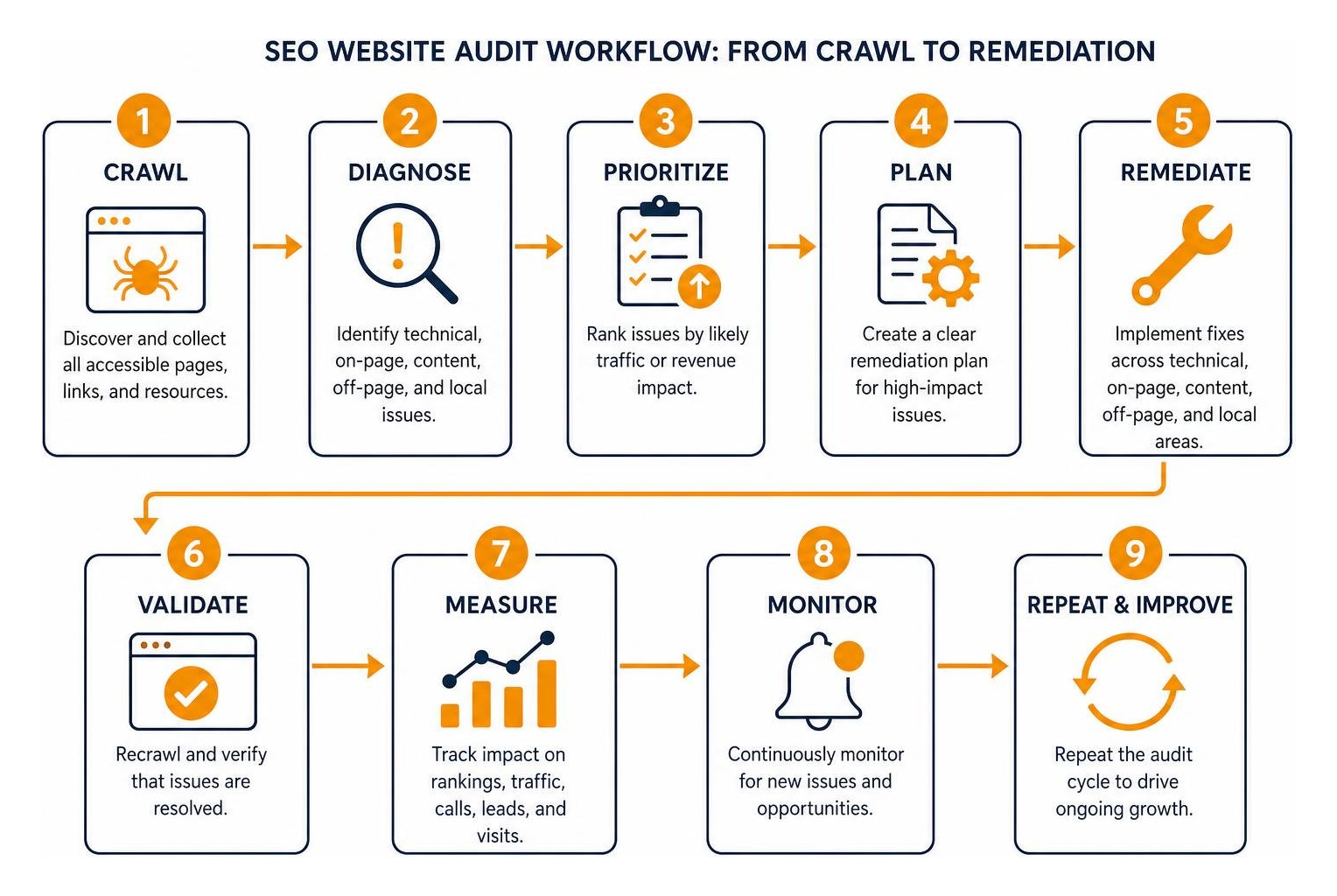
An audit report with hundreds of discovered errors can easily cause analysis paralysis. To drive maximum traffic and revenue, organize your remediation tasks into a three-tiered prioritization framework based on business impact and execution effort.
| Priority Tier | Typical Issues | Business Impact | Target Resolution Window |
|---|---|---|---|
| Tier 1: Critical Blockers | Sitewide noindex tags, broken sitemaps, robots.txt crawl blocks, server 5xx errors, malware alerts, critical mobile usability failures | High / Blocker | Fix Immediately (1–7 Days) |
| Tier 2: High-Value Optimizations | Core Web Vitals remediation, missing meta descriptions, duplicate title tags, broken internal links, thin core service copy, missing Schema markup | High / Medium | Fix Within Month 1 (2–4 Weeks) |
| Tier 3: Ongoing Enhancements | Low-priority image compression, minor directory citations, updating dated blog statistics, backlink reclamation, general readability tweaks | Moderate / Incremental | Ongoing Maintenance (Quarterly) |
Prioritizing Fixes from Your Search Engine Optimization Website Audit
When working through your remediation plan, avoid spending days perfecting minor issues on pages that get no organic traffic. Direct development resources toward high-impact fixes on core product and service landing pages first.
Once your team fixes technical blockers, re-crawl the URLs and submit them for re-indexing in Google Search Console. For teams that want expert support tackling complex audit findings, partnering with The Best Website Audit SEO Service for People Who Hate Losing Traffic ensures fast, error-free execution.
Frequently Asked Questions About SEO Website Audits
How long does a comprehensive website SEO audit take to complete?
The timeline depends heavily on website scale and complexity:
- Small websites (under 100 pages): 4 to 8 hours for crawl analysis and manual review.
- Mid-size websites (100 to 1,000 pages): 2 to 4 business days for a complete multi-pillar diagnostic.
- Large enterprise or e-commerce sites (1,000+ pages): 1 to 3 weeks to evaluate faceted navigation, dynamic rendering, server log files, and international architecture.
Do I need paid tools to run an effective SEO audit?
No. You can conduct a solid baseline audit using free tools provided by search engines, including Google Search Console, Google PageSpeed Insights, Google’s Rich Results Test, and Lighthouse. Paid audit suites add convenience, automated scheduling, and in-depth competitor backlink intelligence, but foundational diagnostics can be completed entirely for free.
What is the difference between a general SEO audit and a technical SEO audit?
A technical SEO audit examines backend infrastructure—server configuration, crawlability, indexing directives, site speed, and structured data. A complete, general SEO audit encompasses technical health while also evaluating on-page metadata, content quality, keyword search intent, off-page backlink authority, local directory citations, and AI search visibility.
Conclusion
A well-executed website audit removes the guesswork from organic growth. By diagnosing technical crawl errors, refining on-page metadata, updating decayed content, and verifying local business data, you build a resilient digital presence that consistently wins top rankings and attracts high-intent customers.
At ClickCentric Digital, we specialize in helping businesses across West Michigan—including Grand Rapids MI, Holland, Grand Haven MI, South Haven MI, and Kalamazoo MI—dominate search results and convert local traffic into loyal clients.
Ready to capture local market share and elevate your visibility? Discover how our targeted strategies for Search Engine Optimization Google Maps Ranking can put your business in front of the customers searching for your services today.
Sorry, the comment form is closed at this time.