


20 Aug Technical SEO Auditing Services: The Ultimate Guide
Technical SEO Auditing Services: The Ultimate Guide
What Technical SEO Auditing Services Reveal Before Rankings Slip
Technical SEO auditing services examine the behind-the-scenes parts of your website that help search engines crawl, understand, index, and rank your pages. They are designed to find problems that can quietly reduce Google visibility, organic leads, and customer trust – even when your content and marketing look strong.
A professional technical audit should give you a clear, prioritized view of issues such as:
- Pages blocked from Google by
noindextags, robots rules, or bad canonical settings - Broken links, redirect chains, and pages with no internal links
- Slow mobile pages and failing Core Web Vitals
- Duplicate titles, thin pages, and weak site structure
- JavaScript or rendering issues that stop important content from appearing to search engines
- Accessibility problems that create a worse experience for real visitors
- AI Overview and generative-search risks that may reduce clicks to pages that already rank
This matters because organic search remains a major source of trackable web traffic, while a small group of high-performing pages often produces most organic leads. A technical failure on one of those pages can cost far more than a minor drop in a vanity metric.
For local businesses, the goal is straightforward: make sure customers can find your services, location, and contact information when they search. For larger sites, the same fundamentals apply, but crawl budget, complex templates, migrations, and thousands of URLs raise the stakes.
I’m Fred Dirkse, and this guide will help you understand what a useful technical SEO audit should uncover, how findings should be prioritized, and why fixing the right issues can protect long-term search growth.
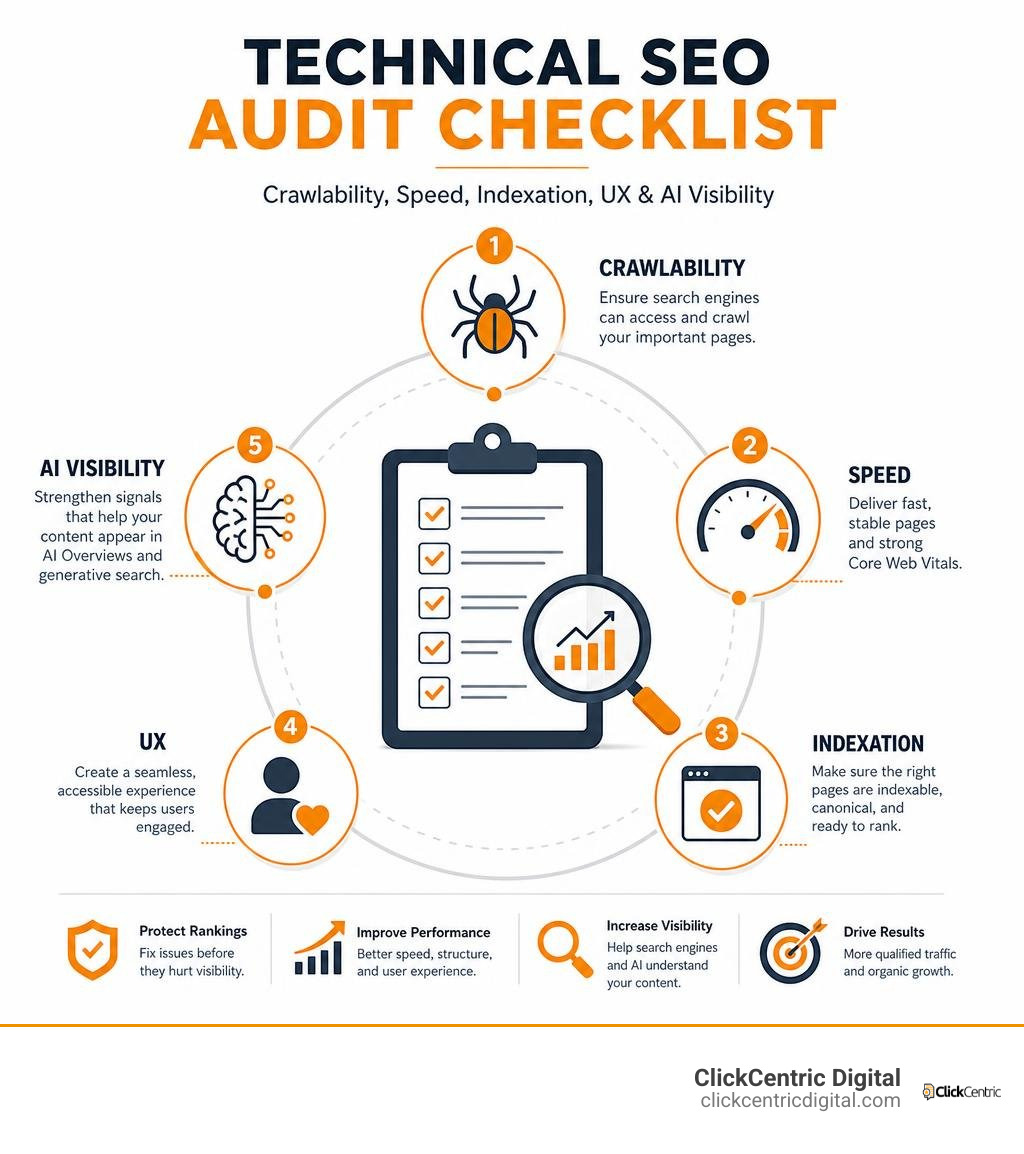
Technical seo auditing services terms at a glance:
Why Enterprise Brands Need Technical SEO Auditing Services
When you invest heavily in content creation, branding, and digital campaigns, you expect search engines to reward your efforts with high-intent traffic. However, organic search represents 53.3% of all trackable web traffic across the internet—more than every other marketing channel combined. If your site’s underlying codebase is broken, Google cannot process your content properly. Position #1 in organic search commands 27.6% of all clicks, whereas dropping to position #10 cuts your click-through rate to just 2.4%. When technical errors pull your pages down the search engine results pages (SERPs), your potential customers simply click on someone else.
In our work assisting businesses across West Michigan—from Grand Rapids and Holland to Kalamazoo, Grand Haven, and South Haven—we frequently see enterprise sites losing thousands of qualified visits simply because their site architecture blocks search bots. Think of your website like a high-performance sports car: you can paint it a brilliant color and write amazing marketing copy, but if the engine has a cracked block, you aren’t winning any races.
Investing in Why You Need Professional SEO Audit Services protects your brand investments. Without routine technical checkups, silent errors pile up. In fact, research shows that 73% of B2B sites lost organic traffic between 2024 and 2025, frequently due to unmitigated core algorithm updates, unhandled migrations, and expanding technical debt.
Differentiating Dedicated Technical SEO Auditing Services from Basic Site Crawlers
Many internal marketing teams run automated software audits and wonder why their rankings still drop. While self-serve software tools flag high-level syntax errors, automated site crawlers lack strategic context. They report what looks wrong alphabetically, but they cannot tell you which specific fixes will generate revenue.
Here is how automated audit tools compare to specialized technical seo auditing services:

A standard crawler will highlight a missing meta tag on a privacy policy page with the same urgency as a site-wide canonical error that accidentally de-indexes your main revenue-generating service pages. Specialized technical auditing services go far beyond simple crawlers by analyzing raw server logs to observe true search engine bot behavior, reviewing complex single-page application (SPA) JavaScript rendering, and developing custom implementation specifications. To explore how human expertise transforms diagnostic data into actionable results, read our detailed comparison on The Best Website Audit SEO Service for People Who Hate Losing Traffic.
Connecting Technical Infrastructure to User Experience and Accessibility
Google does not evaluate technical health in a vacuum; it evaluates how quickly and effectively a real human visitor can consume your content. Technical infrastructure directly shapes overall user experience (UX) and digital accessibility.
When mobile pages lag, visitors abandon their carts. Industry research demonstrates that every 0.1-second improvement in mobile site speed yields an 8% increase in retail conversions, while a 100-millisecond reduction in load time can boost average order values by 9.2%.
Furthermore, technical auditing bridges the gap between Web Content Accessibility Guidelines (WCAG) compliance and search engine indexation:
- Alt Text Integrity: 74% of audited websites miss image alt text. Proper alt text allows screen readers to describe visual elements for visually impaired users while simultaneously giving search bots vital context.
- Header Structure: Proper H1-H6 hierarchy simplifies navigation for users relying on assistive technology while clarifying topical authority for Google.
- Touch Target Padding: Preventing tap target overlap ensures seamless mobile navigation, lower bounce rates, and better user engagement.
By resolving infrastructure flaws, you solve user friction and accessibility barriers at the exact same time.
Core Categories of a Comprehensive Technical SEO Audit

A thorough audit leaves no stone unturned. We evaluate your website across eight core operational dimensions to ensure your platform runs cleanly for both users and search crawlers.
Crawlability, Indexation, and Site Architecture
Before a page can rank, Googlebot must be able to crawl its links and add it to the search index. Yet, statistical analysis of enterprise sites reveals that 50.6% of websites accidentally block high-value pages with noindex directives, and 69.3% contain orphan pages—pages completely disconnected from internal navigation with zero inbound links pointing to them.
Our deep dive into infrastructure examines:
- Robots.txt & Meta Directives: Verifying that core conversion paths aren’t inadvertently hidden from search bots.
- XML Sitemap Health: Cleaning out sitemap bloat so that only indexable, canonical 200-OK pages are submitted.
- Crawl Budget Optimization: Resolving infinite crawl loops, multi-layered filter parameters, and 21.6% of site redirect chains that burn up your server crawl budget.
- Internal Link Hierarchy: Utilizing hub-and-spoke link distribution to eliminate orphan pages and flow link equity to high-margin service offerings.
- Canonical Tags: Preventing cross-domain content cannibalization and URL parameter dilution.
For a complete breakdown of indexation troubleshooting, check out our SEO Audit Services Survival Guide.
Core Web Vitals and Page Speed Optimization
Page speed is an explicit ranking factor and a critical benchmark for user retention. Modern performance audits focus heavily on Google’s Core Web Vitals (CWV):
- Largest Contentful Paint (LCP): Measures perceived loading speed. Industry data shows 26.9% of websites fail LCP tests, frustrating users before main content loads.
- Interaction to Next Paint (INP): Evaluates page responsiveness when a user clicks, taps, or types. Unoptimized main-thread JavaScript creates sluggish responses.
- Cumulative Layout Shift (CLS): Measures visual stability. Asynchronous loading ads or un-dimensioned images cause page elements to jump unexpectedly.
Our technical audits analyze render-blocking CSS/JS resources, server response times (TTFB), next-generation image compression (WebP/AVIF), and browser caching rules to ensure smooth performance across all desktop and mobile devices.
AI Overviews, Generative Search, and Exposure Risks
Search engine optimization is constantly evolving. As of late 2025, 60.32% of US Google queries display an AI Overview, a metric that doubled over just 15 months. When an AI Overview appears above traditional organic results, position #1 loses an average of 58.0% of its organic clicks to generative answer summaries.
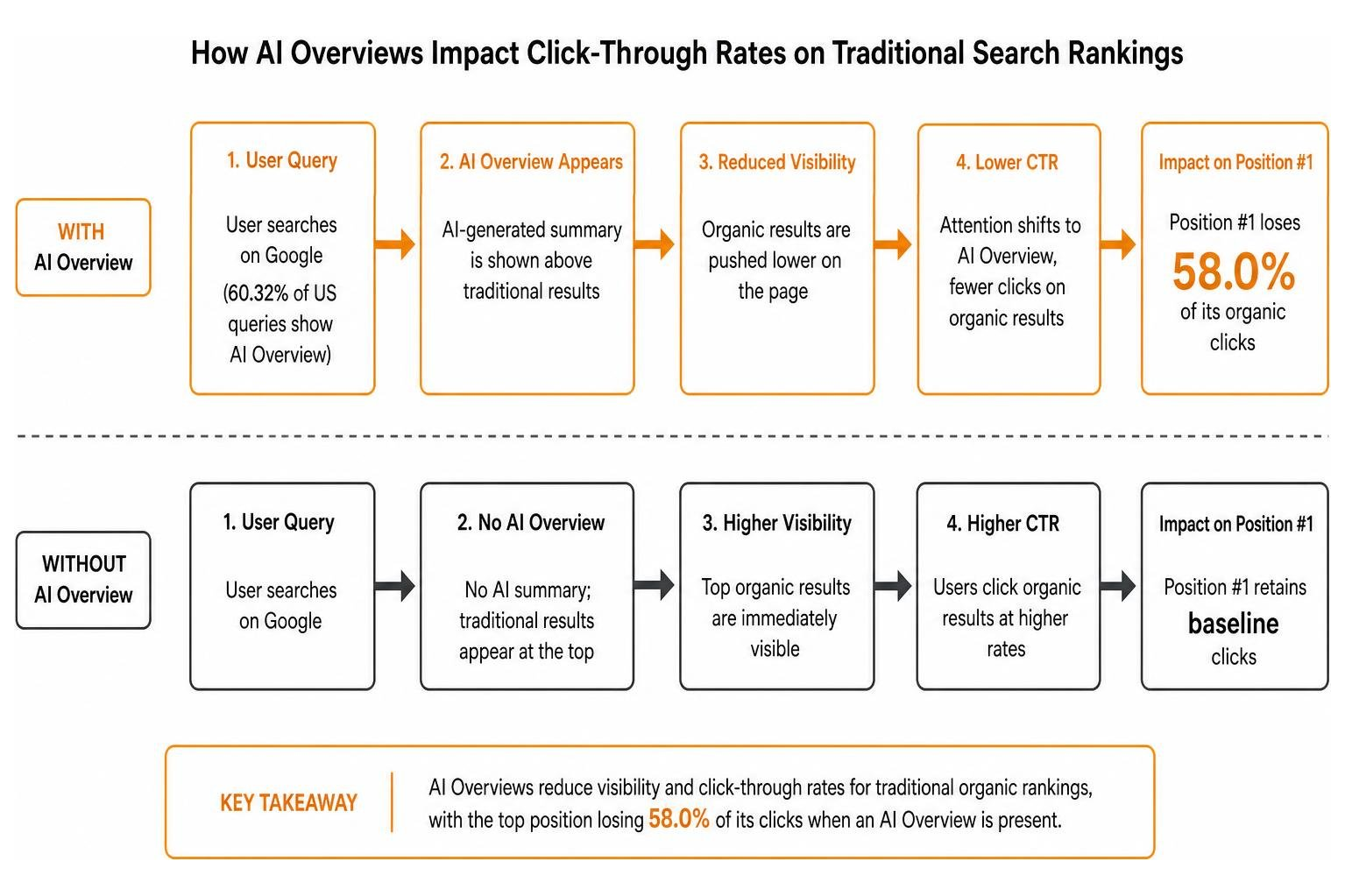
Professional technical seo auditing services must adapt to this reality by analyzing Generative Engine Optimization (GEO) factors:
- Citability Audits: Assessing whether your technical content is structured with clear schema tags and concise answer blocks so LLMs (Large Language Models) like Gemini, ChatGPT, and Perplexity cite your brand as the primary source. (Brands cited inside AI Overviews earn 35% more organic clicks than non-cited competitors).
- LLMs.txt & Crawler Permissions: Ensuring your server configuration grants appropriate access to AI crawlers while protecting proprietary assets.
- Cannibalization Analysis: Identifying queries vulnerable to AI summary theft and restructuring page metadata to capture high-intent user clicks.
Hidden Technical Errors That Silently Sabotage Rankings

The most expensive technical SEO errors are the ones no one is actively tracking. A site can appear visually pristine while under-the-hood glitches destroy its search performance.
To help you understand where to focus your resources, the matrix below highlights common hidden errors and their relative impact versus implementation effort:
| Technical Error | Frequency Rate | Business Impact | Developer Fixing Effort | Priority Ranking |
|---|---|---|---|---|
Accidental noindex Tags |
50.6% of audited sites | Severe (De-indexes pages) | Low (Quick meta tag edit) | Critical (Immediate) |
| Orphan Pages (No Links) | 69.3% of audited sites | High (Zero authority flow) | Medium (Internal link update) | High |
| Missing Image Alt Text | 74.0% of audited sites | Medium (Accessibility/SEO) | Low (CMS field entry) | Medium |
| Redirect Chains & Loops | 21.6% of audited sites | High (Burns crawl budget) | Medium (Server rule updates) | High |
| Failing Core Web Vitals | 35.0% of audited sites | High (Lower rankings/conversions) | High (Code refactoring) | High |
| Duplicate Title Tags | 53.7% of audited sites | Medium (SERP confusion) | Low (Template adjustment) | Medium |
For instance, when a company undergoes a website migration or redesign without technical oversight, 75% lose organic traffic due to un-mapped 301 redirects, broken canonical structures, or lost server directives. Finding these issues before or immediately after launch preserves your search footprint.
The Audit Process, Developer Hand-off, and Expected ROI
A technical audit is only as valuable as its actual implementation. Handing a developer an unorganized 200-page automated PDF report usually leads to pushed-back timelines and zero progress. Comprehensive auditing services streamline implementation from kickoff to execution.
The Step-by-Step Execution of Professional Technical SEO Auditing Services
A thorough technical SEO audit follows a structured 5-stage timeline:
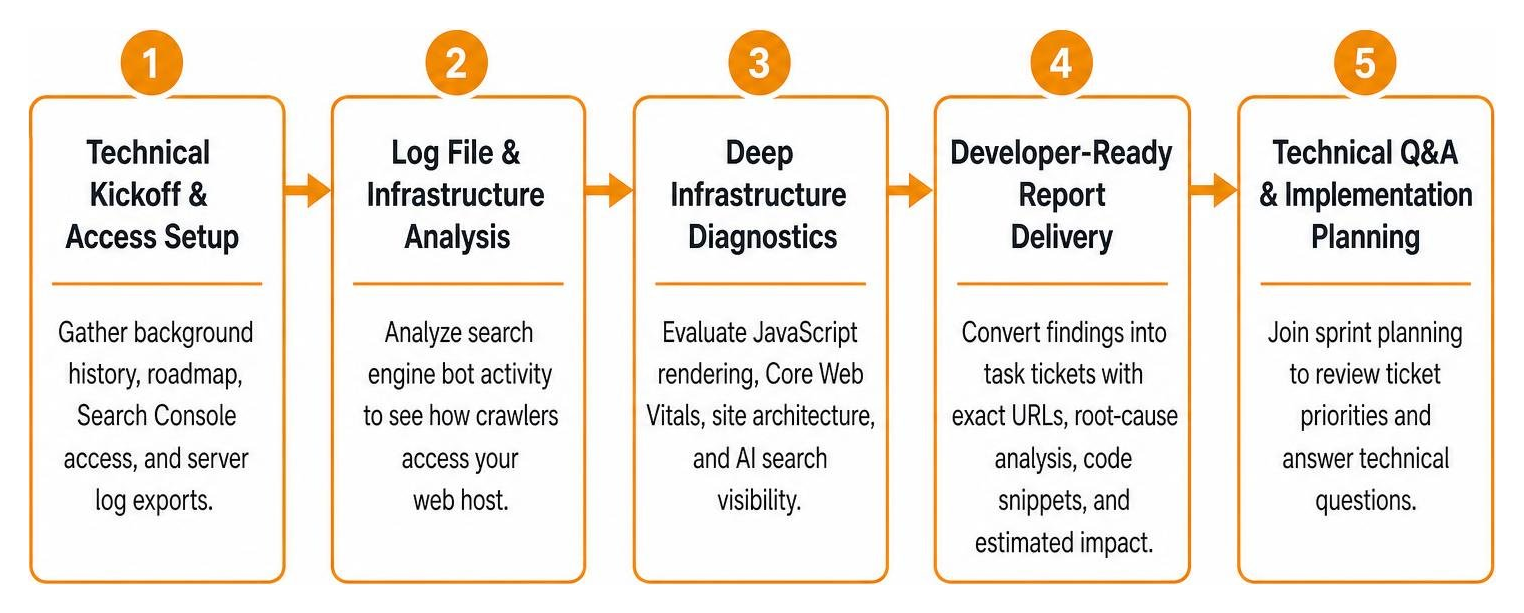
- Technical Kickoff & Access Setup: We gather background history, upcoming feature roadmaps, Search Console access, and server log exports.
- Log File & Infrastructure Analysis: We analyze true search engine bot activity to observe how crawlers access your web host.
- Deep Infrastructure Diagnostics: We evaluate JavaScript rendering (React, Angular, Vue, Next.js), Core Web Vitals, site architecture, and AI search visibility. For those starting out with basic diagnostic setups, check our guide on Free SEO Audits: The Best Tools for Beginners.
- Developer-Ready Report Delivery: We convert raw findings into clear task tickets equipped with exact problem URLs, root-cause analyses, code snippets, and estimated ranking impact.
- Technical Q&A & Implementation Planning: We join your dev team’s sprint planning session to review ticket priorities and answer technical questions.
Prioritizing Developer Workflows and Measuring Business Impact
We structure findings into 30/60/90-day implementation roadmaps that integrate cleanly into existing project management tools like Jira, Trello, or Asana. Tasks are explicitly split into “High-Impact / Low-Effort” quick wins and larger engineering initiatives.
The business return on technical SEO fixes is well-documented:
- Massive Financial ROI: Enterprise benchmarks reveal an average 584% three-year ROI from technical SEO investments, with full financial payback achieved in under 3 months.
- Superior Lead Conversion: Organic search leads deliver a 14.6% close rate, compared to just 1.7% for traditional outbound marketing.
- Targeted Growth: Because 60% to 80% of organic leads originate from just 10% to 20% of your pages, fixing technical bugs on high-value templates produces dramatic revenue gains.
Initial ranking movements typically begin within 3 months of implementation, with measurable revenue attribution surfacing at 4–6 months and full compounding ROI realized within 7–9 months. For full technical details on our methodology, visit our partner portal for a Technical SEO Audit – SEOAudits.Digital or explore dedicated SEO Audit Services | In-Depth Technical SEO Audits in 7 Days.
Frequently Asked Questions About Technical SEO Audits
How does technical SEO auditing differ for local businesses vs. large enterprise sites?
Local businesses—such as service providers operating in Grand Rapids, Holland, or Kalamazoo—focus heavily on targeted URL structures, localized schema markup, location page hierarchies, and Google Business Profile integration. For local sites, the goal is ensuring search engine crawlers can clearly associate service offerings with regional geographic boundaries.
Enterprise sites, by contrast, feature complex web stacks, multi-language international directories, faceted navigation, single-page application frameworks, and hundreds of thousands of pages. Enterprise technical SEO auditing prioritizes crawl budget allocation, server log trends, complex canonical mapping, and scalable automated site health rules.
How long does a deep-dive technical SEO audit take and when will we see results?
A comprehensive, human-led technical audit typically takes 7 to 10 business days to complete, depending on site size and technical complexity.
Once your development team deploys the recommended fixes:
- Search engine re-crawling and indexing updates occur within 2 to 4 weeks.
- Traffic improvements and rank recovery begin moving within 1 to 3 months.
- Full conversion rate benefits and revenue growth compound at the 4 to 6-month mark.
Why are AI Overviews and generative search changing technical SEO metrics?
Generative search displays direct answers at the top of the SERP, causing a shift in organic click behavior. Rank tracking alone no longer tells the full story; a page ranking #1 under an AI Overview can experience a drop in click-through rate if it fails to get cited within the generated summary. Technical SEO audits now evaluate citability factors, structured markup, content freshness, and semantic readability to ensure search engines attribute answer citations directly to your platform.
Conclusion
Your brand’s digital presences, content marketing campaigns, and paid initiatives depend heavily on a solid technical foundation. Leaving unseen crawl errors, slow mobile load times, broken redirect loops, or indexation tags unchecked silently drains organic traffic and leads away from your business.
At ClickCentric Digital, we help businesses across Grand Rapids, Holland, West Michigan, Grand Haven, South Haven, and Kalamazoo diagnose hidden site errors, optimize site performance, and build clear technical roadmaps that fuel long-term growth.
Ready to protect your search performance and maximize your web traffic? Learn why Why Professional Website SEO Audit Services Are Your Site’s Best Friend, or explore our specialized Search Engine Optimization & Google Maps Ranking Services to get started today!
Sorry, the comment form is closed at this time.