

16 Sep Stop Hammering Money Away on Bad Contractor Facebook Ads
Stop Hammering Money Away on Bad Contractor Facebook Ads
Are Contractor Facebook Ads Actually Worth Your Money?

Contractor Facebook ads can be a powerful and cost-effective way to generate leads — but only when set up correctly.
Here’s a quick breakdown of what works:
- Best for: Residential services (roofing, painting, siding, HVAC, remodeling)
- Average cost per lead: $15–$50 (vs. $50–$200+ on Google Ads)
- Top ad formats: Before-and-after videos, photo carousels, lead forms
- Best targeting: Homeowners aged 30+, filtered by zip code and household income
- Respond to leads within: 5 minutes for 2–3x higher conversion rates
- Not ideal for: Cold B2B commercial construction outreach (LinkedIn or Google work better there)
If you’re running contractor Facebook ads right now and not seeing results, you’re not alone. Most contractors either waste money on the wrong audience, run weak offers, or skip the follow-up entirely — and wonder why the phone isn’t ringing.
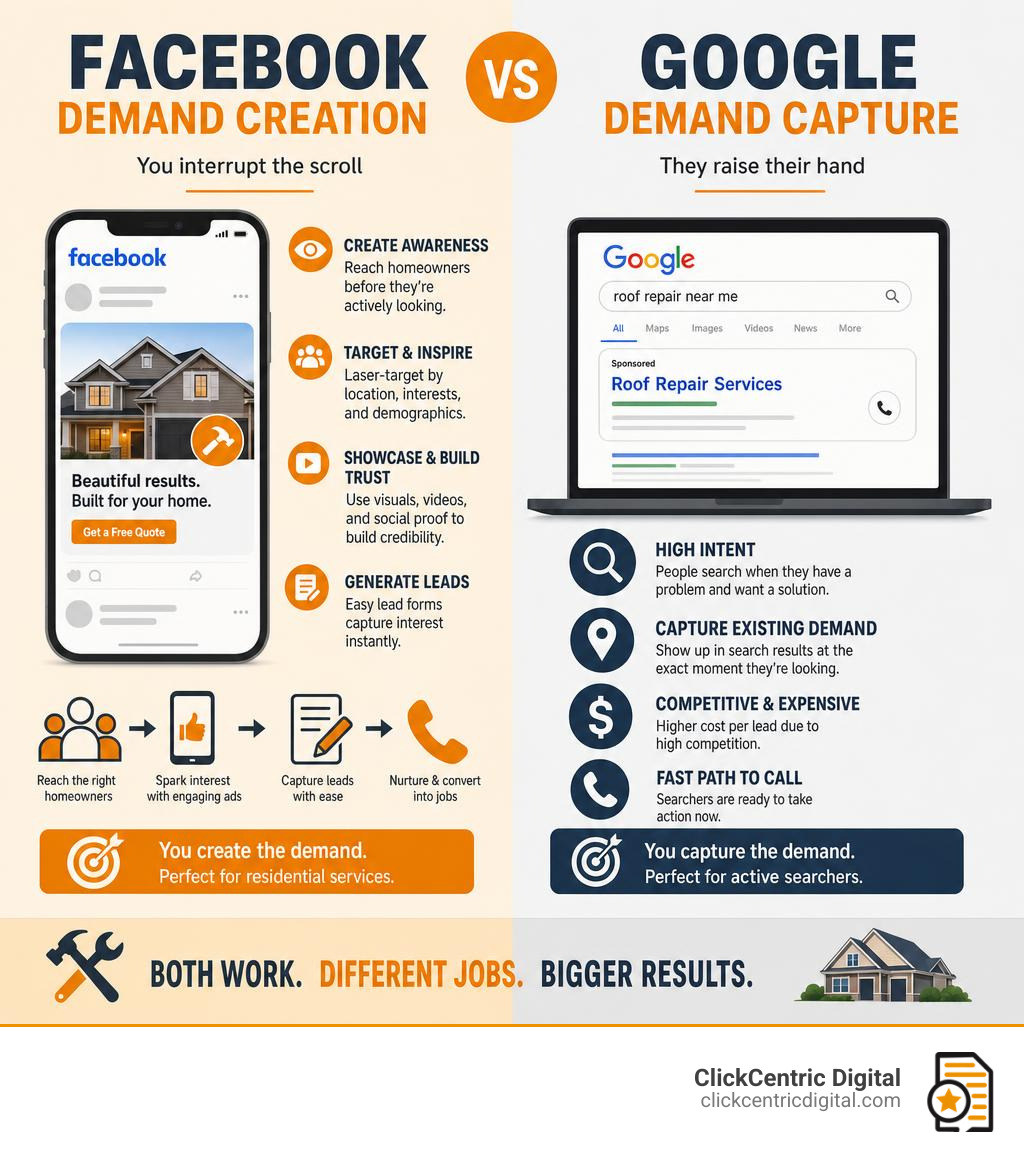
Facebook isn’t like Google. People aren’t on Facebook looking for a roofer or a painter. They’re scrolling through photos and videos. That means your ad has to interrupt them in a way that feels relevant and worth stopping for.
The good news? When you get it right, Facebook can generate leads at 3 to 5 times lower cost than Google Ads. One documented case study produced 297 leads for under $15 each for a seasonal home improvement business.
But there’s a catch — and it’s a big one for commercial contractors. Facebook works very differently depending on whether you’re targeting homeowners or commercial decision-makers. Getting that distinction wrong is one of the fastest ways to burn through your budget.
This guide walks you through exactly how to make contractor Facebook ads work — from targeting and creative to budgets, lead forms, and follow-up.
Residential vs. Commercial: Do Contractor Facebook Ads Actually Work?
If you ask a room full of West Michigan builders whether social media marketing works, you will get two completely different answers depending on who they serve.
For residential contractors—those doing kitchen remodels in East Grand Rapids, roof replacements in Holland, or building custom decks in South Haven—the answer is a resounding yes. Facebook and Instagram are visual goldmines. Homeowners love scrolling through beautiful transformations, and targeting them is relatively straightforward because Meta knows exactly who owns a home, where they live, and even their estimated household income.
However, if you are a commercial contractor looking to bid on multi-million dollar concrete, structural steel, or commercial roofing projects, the story changes. While residential leads can be generated consistently, commercial lead generation on Meta platforms is a much steeper uphill battle.
In community discussions surrounding effective advertising methods for contractors?, the consensus is clear: while some niche subcontractors (like framing or local light commercial roofing) have managed to pull leads from Facebook, the platform is overwhelmingly geared toward the residential market. For a comprehensive overview of how local businesses should approach their overall marketing strategy, check out The Complete Guide to Small Business Advertising.
Why Commercial Campaigns Fail on Meta Platforms
Why is there such a massive divide? It comes down to the psychology of the buyer and the mechanics of the platform.
- B2B Decision-Makers Are Hard to Pinpoint: On Facebook, a facility manager, property developer, or school board member is logged in as a private citizen. They are looking at photos of their grandkids or arguing about politics, not actively looking to hire a structural concrete sub. Meta’s interest targeting for professional titles is notoriously muddy.
- Extremely Long Sales Cycles: A homeowner can decide to hire a painter for their Grand Haven living room in an afternoon. A commercial development project in downtown Grand Rapids requires board approvals, detailed architectural plans, formal bidding processes, and months of vetting.
- Low Search Intent: Facebook is an interruption-based platform. Commercial buyers do not make high-risk, six-figure vendor decisions based on a sponsored post they saw while scrolling in bed.
Additionally, local market pressures make wasting ad budget highly risky. As highlighted by local industry media, Most contractors in West Michigan are one slow month away from … financial strain. Spending thousands of dollars trying to reach institutional commercial buyers on a platform built for consumer scrolling is a fast track to a dry pipeline.
Commercial decision-makers rely heavily on established networks, pre-qualification lists, and formal industry bodies. If you’re looking to network in the West Michigan B2B space, engaging with organizations like the Associated Builders and Contractors, Western Michigan Chapter will yield far better long-term relationship assets than a broad-reach social media ad.
Alternative Platforms for Commercial Construction Lead Generation
If Facebook isn’t the primary engine for commercial construction leads, where should you put your ad dollars?
- Google Ads: This is a “demand capture” platform. When a property manager in Kalamazoo searches for “commercial flat roof repair near me”, they have immediate, high-intent search criteria. Google Ads allow you to bid on those exact keywords. While the cost-per-click is significantly higher than Facebook, the conversion rate to a real bid opportunity is vastly superior for commercial services.
- LinkedIn: This is the ultimate platform for B2B professional networking. Instead of guessing who the property managers or general contractors are, LinkedIn allows you to target users by their exact job titles, company sizes, and industries. You can run ads directly targeting project managers, estimators, and developers across West Michigan.
- Reddit: Often overlooked, local and industry-specific subreddits are excellent places for subtle, organic authority building and highly targeted local discussions. Commercial builders can monitor regional forums for discussions about upcoming developments or local vendor recommendations.
The Blueprint for High-Converting Contractor Facebook Ads
To win with contractor facebook ads in the residential space, you need a system. You can’t just hit the “Boost Post” button on a random photo and hope for the best. To build a highly profitable campaign, we use a three-step blueprint: the right offer, the right creative, and the right targeting.
Crafting Irresistible Offers for Contractor Facebook Ads
Nothing is more critical to your campaign’s success than your offer. If your ad copy says “We do roofing. Call us for a quote,” your campaign will likely fail. You need a low-friction offer that lowers the barrier to entry for a homeowner.
- High-Value, Low-Friction Offers: Instead of offering a generic “10% off” (which can feel sketchy or cheap), offer something tangible. A “Free 15-Point Storm Damage Inspection” or a “Free Custom Kitchen Design Session with 3D Rendering” provides immediate, high perceived value without requiring the homeowner to commit to a purchase upfront.
- Leverage Before-and-After Photos: Homeowners buy the destination, not the journey. Showing a side-by-side comparison of a weathered, peeling house next to a beautifully painted home in Holland MI is incredibly persuasive.
- Authentic Video Testimonials: A polished, corporate video often looks like an ad and gets scrolled past. A raw, vertical smartphone video of a happy client standing in front of their newly remodeled Grand Rapids home saying, “We loved working with this team,” builds instant trust.
For a deeper dive into making your local ad campaigns highly profitable without wasting your budget, check out our guide on How to Run Facebook Ads for Local Business Without Losing Your Shirt.
Targeting Strategies for Homeowners vs. Commercial Decision-Makers
To get your irresistible offer in front of the right eyes, you must configure your targeting parameters carefully.
When setting up your targeting, keep these best practices in mind:
- Precise Zip Code Targeting: Don’t just target “West Michigan.” Target specific high-value neighborhoods. If you are a high-end renovator, you should focus your ad spend on specific zip codes in East Grand Rapids or Grand Haven. Check out the types of projects winning in these areas on Best 15 General Contractors in East Grand Rapids, MI – Houzz and Best 15 General Contractors in Grand Haven, MI | Houzz.
- Demographic Filters: Target users aged 30 and older. Statistically, this is the bracket most likely to own a home and have the financial capability to fund major home improvements, whether it’s a new deck in South Haven (see examples of local workmanship at South Haven Contractors (Decking, Siding, Roofing)) or a complete HVAC overhaul.
- Custom and Lookalike Audiences: Upload your existing customer list to Facebook. Meta can analyze your past clients and build a “Lookalike Audience” of similar homeowners in West Michigan who share their behaviors, demographics, and interests.
- Broad Local Targeting: Since Meta’s privacy updates, hyper-detailed interest targeting has become less effective. Often, setting a tight geographic radius (e.g., 15 miles around Holland or Kalamazoo) and letting Meta’s algorithm optimize based on who interacts with your high-quality ad creative yields the lowest cost-per-lead.
For a visual walkthrough of setting up these campaigns, check out How I Run Facebook Ads for Contractors & Construction … – YouTube.
Campaign Structure, Budgets, and the Math Behind the Leads
To run profitable contractor facebook ads, you must understand the numbers. If you do not track your cost-per-lead (CPL) and return on ad spend (ROAS), you are essentially flying blind.
Comparing CPL and ROAS Across Residential and Commercial Sectors
The cost metrics and expectations vary wildly depending on whether you are chasing residential projects or commercial contracts.
| Metric | Residential Campaigns | Commercial Campaigns (Meta) |
|---|---|---|
| Average Cost Per Lead (CPL) | $15 – $50 | $150 – $500+ (Highly volatile) |
| Lead Volume | High (Consistent weekly flow) | Very Low |
| Typical ROAS | 5x – 10x (Shorter sales cycle) | Hard to measure (1-2 deals/year) |
| Primary Ad Format | Lead Forms, Messenger | Landing Page, PDF Downloads |
| Audience Size | Large (Local homeowners) | Tiny (Niche business owners) |
While Google Ads might charge you $50 to $150+ for a high-intent roofing lead, a well-optimized Facebook ad campaign can regularly secure qualified residential leads for under $15 to $30.
Structuring Your Contractor Facebook Ads for Maximum ROI
To keep your costs low and your lead quality high, structure your Meta Ads Manager account using these structural principles:
- Campaign Budget Optimization (CBO): Let Meta’s AI distribute your daily budget to the highest-performing ad sets. If one target audience or creative is outperforming the others, the system automatically shifts your budget there.
- Rigorous A/B Testing: Never run just one ad. Test at least three different creatives simultaneously (e.g., one before-and-after image carousel, one smartphone selfie video of you on a job site, and one customer testimonial video).
- Retargeting Sequences: Most people will not fill out a lead form the first time they see your ad. Set up a retargeting campaign to show a different ad (like a list of your 5-star reviews or your licensing and insurance details) to anyone who visited your website or engaged with your Facebook page in the last 30 days.
To ensure your leads don’t slip through the cracks once your structure is in place, read through The Local Service Guide to Not Getting Ghosted by Facebook Ads.
Lead Nurturing: Turning Clicks into Booked Construction Jobs
Generating a lead on Facebook is only 20% of the battle. The real magic—and where most contractors fail miserably—is the follow-up.
Facebook leads are notoriously “cold” compared to Google leads. A user searching on Google is actively looking to buy. A user on Facebook was interrupted by your ad, thought “Hmm, my roof does look a bit worn,” filled out your form, and then went back to scrolling. They will forget they filled out your form within 30 minutes.

- The 5-Minute Rule: You must call your Facebook leads within 5 minutes. Data shows that responding to a lead in under 5 minutes results in a 2x to 3x higher conversion rate than waiting 30 minutes. If you wait until the end of the day to call your leads, you are throwing your ad budget directly into the trash.
- Instant CRM Integration: Do not rely on downloading CSV files from Facebook Ads Manager. Use automation tools to instantly sync your Facebook Lead Forms with your CRM (like ServiceTitan, Jobber, or HubSpot). The second a lead is submitted, your phone should ring, or an automated text message should go out to the client.
- Automated Text and Email Follow-Ups: If they don’t answer your first call, immediately send an automated text: “Hey [Name], this is [Your Name] from [Company]. I saw you requested a free roof inspection for your home in Kalamazoo. Do you have 2 minutes for a quick call to schedule it?”
To understand why this immediate, automated approach is so vital for local service businesses, read our analysis on Why Your Auto Shop Needs Facebook Ads Today—the lead psychology is identical!
Frequently Asked Questions about Contractor Facebook Ads
What is the average cost per lead for contractor Facebook ads?
For residential contractors, the average cost per lead (CPL) typically ranges between $15 and $50 when campaigns are properly optimized. In highly competitive areas or for very high-end services, it can creep higher, but it remains significantly cheaper than Google Ads.
Should I use lead forms or landing pages for contractor ads?
We highly recommend starting with Facebook Instant Forms (Lead Ads). Because they pre-fill the user’s contact information directly from their Facebook profile, they have incredibly high conversion rates. However, if you find your lead quality is too low (e.g., wrong phone numbers), you can add custom questions to your forms or transition to a dedicated landing page to add friction and filter out unmotivated prospects.
How do I target high-income homeowners on Facebook?
You can target high-income homeowners by overlaying geographic targeting (focusing on high-value zip codes in areas like East Grand Rapids or Grand Haven) with demographic filters. You can target users who match “Homeowner” status and select Meta’s behavioral targeting for households in the top 10% or 25% of ZIP code income in the United States.
Conclusion
Running successful contractor facebook ads isn’t about luck—it’s about execution. By defining your target market, crafting low-friction offers, structuring your campaigns correctly, and implementing a relentless 5-minute follow-up process, you can build a predictable lead-generation engine that keeps your crews busy year-round.
At ClickCentric Digital, we specialize in helping local contractors across West Michigan—from Grand Rapids and Holland to Grand Haven, South Haven, and Kalamazoo—scale their businesses through targeted local search strategies, review management, and paid traffic.
Ready to stop hammering money away on ads that don’t convert? Let us build a custom lead-generation system for your business. Stop Being a Secret and Start Running Local Facebook Ads with ClickCentric Digital today.
Sorry, the comment form is closed at this time.