

24 Oct Local Search Ranking Improvement: A Roadmap to the Top
Local Search Ranking Improvement: A Roadmap to the Top
Why Local Search Rankings Make or Break Your Business in 2026
If you’re wondering how do i improve my local search rankings, here’s the short answer:
- Claim and fully optimize your Google Business Profile (accurate name, address, phone, category, photos)
- Keep your NAP consistent across every directory and platform
- Generate a steady flow of reviews and respond to every single one
- Create location-specific pages on your website with local keywords
- Build local citations and backlinks from community sources
- Add LocalBusiness schema markup to your website
That’s the core of it. The rest of this guide shows you exactly how to execute each step.
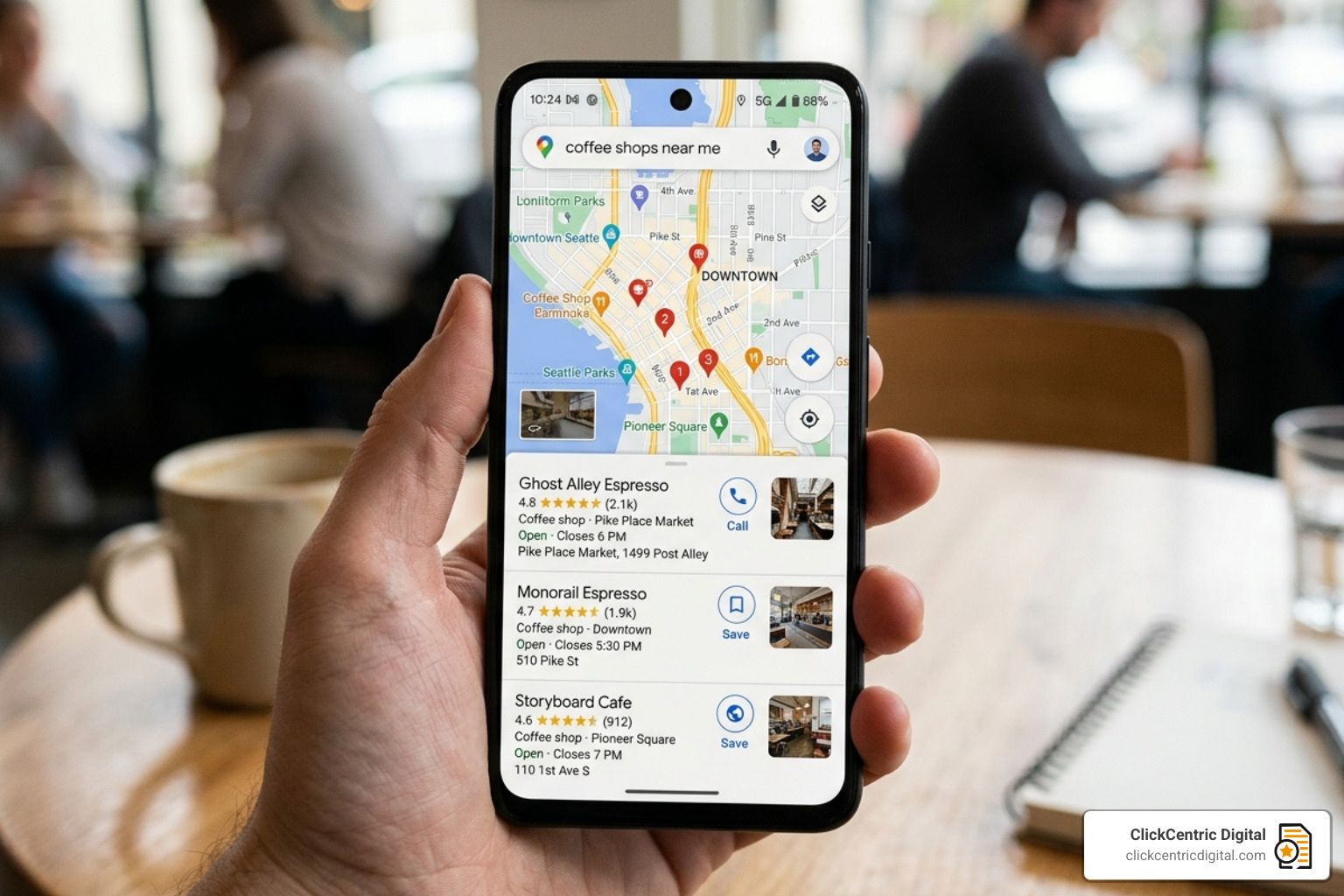
Local search has become the front door of almost every local business. When someone nearby needs a plumber, a dentist, or a restaurant, they pull out their phone and search. And they act fast. Research shows that 76% of people who search for something nearby visit a business within 24 hours.
Here’s what makes that number matter: 46% of all Google searches have local intent. That’s nearly half of all searches on the world’s most-used platform. If your business isn’t showing up, a competitor is getting those customers instead.
The businesses that win these searches don’t always have the biggest budgets. They simply understand how Google decides who to show — and they play by those rules consistently.
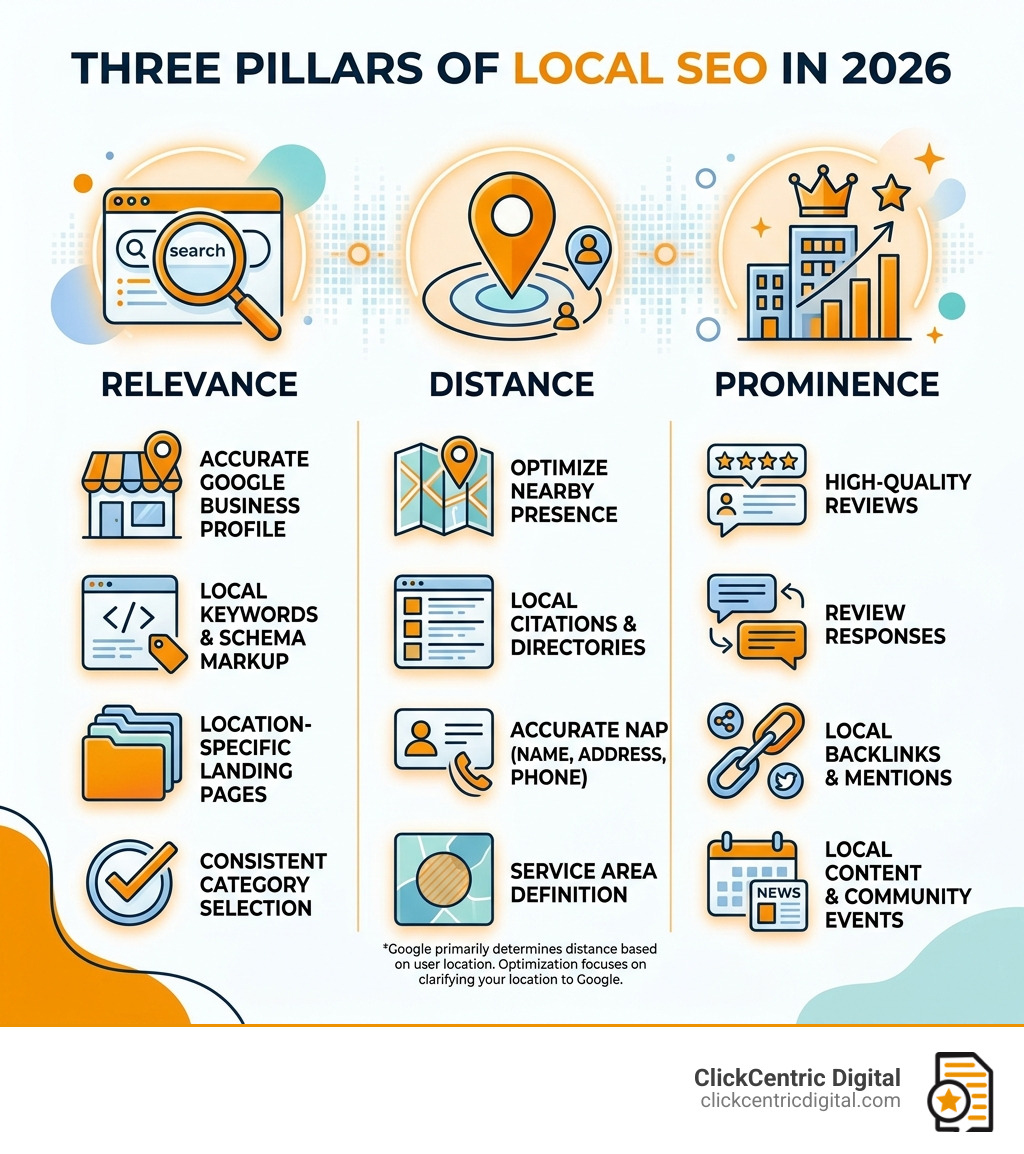
Google ranks local businesses using three core signals:
- Relevance — how well your business matches what someone searched for
- Distance — how close your business is to the person searching
- Prominence — how well-known and trusted your business appears online
You can’t control distance. But you can absolutely influence relevance and prominence — and that’s where the real opportunity lives.
Basic how do i improve my local search rankings glossary:
Understanding the Three Pillars of Local Search
To truly master the question of “how do i improve my local search rankings,” we first have to peek under the hood of Google’s local algorithm. Google doesn’t just pick businesses at random; it uses a complex mathematical formula designed to give the user the best possible result for their immediate needs.
In 2026, this algorithm has become even more sophisticated, but it still rests on the three pillars we mentioned: Relevance, Distance, and Prominence. According to official Tips to improve your local ranking on Google, providing complete and accurate business information is the foundation of helping Google understand your business.
At ClickCentric Digital, we call this the “Local SEO Equation.” If you want to dive deeper into the variables, you can check out our guide on The Math Behind a Better Local Search Strategy.
Proximity and Distance Factors
Proximity is the “where” of local SEO. Google calculates the distance between the searcher (based on their IP address or GPS) and your business location. While you can’t move your physical storefront closer to every customer, you can ensure Google knows exactly where you are.
For businesses in West Michigan, whether you are in Grand Rapids, Holland, or Kalamazoo, your geo-coordinates matter. If you are a service-area business (like a plumber) without a storefront, your “service area” settings in your profile tell Google which neighborhoods you cover. This is a critical component of Local SEO Michigan: How to Rank Higher in Google’s Local Pack.
Building Prominence and Authority
Prominence is essentially your business’s “fame” on the internet. Google looks at how much information it can find about you across the web. This includes backlinks from local news sites, mentions in community directories, and your overall review count.
A high “prominence” score tells Google, “This business is a trusted authority in this area.” To build this, you need a mix of high-quality local links and a strong brand presence. For a deep dive into these signals, Local SEO: The Definitive Guide for 2026 (+ Free Toolkit) is an excellent resource for understanding how authority is calculated today.
How Do I Improve My Local Search Rankings with Google Business Profile?
Your Google Business Profile (GBP) is the single most important tool in your local SEO shed. It is your digital storefront. If your website is your “home,” your GBP is the “sign on the street” that points people toward you.
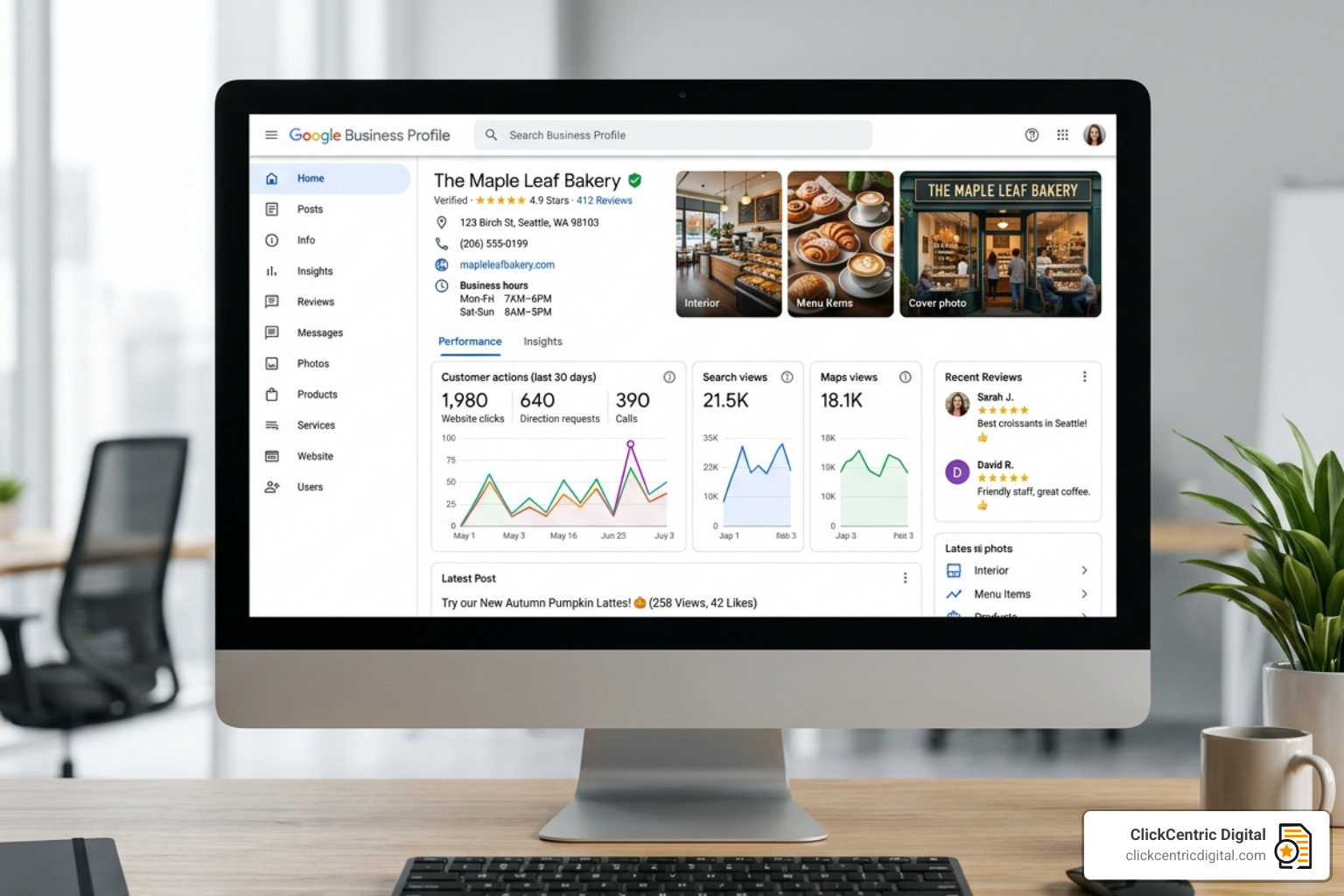
The first step is claiming and verifying your profile. Without verification, you have no control over the information Google displays. Once verified, you must ensure your NAP (Name, Address, Phone) data is 100% consistent with what is on your website. Inconsistencies act like “friction” for Google’s crawlers, making them less likely to trust your data. Our team at ClickCentric Digital specializes in helping you Get Your Business on the Map and Stay There through meticulous profile management.
Optimizing Categories: How Do I Improve My Local Search Rankings?
One of the most common mistakes we see is choosing the wrong business category. Your primary category is the strongest relevance signal you can send to Google. If you are a “Family Dentist,” don’t just settle for “Dentist.” Be as specific as possible.
Secondary categories also matter. They allow you to show up for a broader range of related searches without diluting your primary focus. For a step-by-step on category selection, see our resource on Search Engine Optimization Google Maps Ranking. Your service descriptions should be detailed and include the specific keywords local customers use when they need your help.
Visual Content and Google Posts
Did you know that businesses with 100+ photos on their profile get 520% more calls than the average business? In 2026, visual content isn’t just “nice to have”—it’s a conversion engine. High-quality photos of your team, your office in Grand Rapids, or your completed projects in Holland build immediate trust.
Additionally, you should be using Google Posts at least once a week. Think of these as “mini-ads” or social media updates that appear directly in your search results. They signal to Google that your business is active and relevant. Learn more about How to Master Local Map Optimization for More Customers to see how posts can drive traffic.
On-Page SEO and Hyper-Local Content Strategies
While your GBP gets you in the Map Pack, your website’s on-page SEO is what keeps you there and helps you dominate the organic results below the map. You need to tell search engines exactly which geographic areas you serve.
According to Local SEO: How to Optimize Your Website for Local Searches – Alligo, your website must be optimized for local intent. This means including your city and neighborhood names in your title tags, H1 headers, and meta descriptions. We help our clients Optimize for Local Search and Dominate Your Neighborhood by creating a “geo-relevant” content map.
LocalBusiness Schema Markup
Schema markup is a piece of code you add to your website to help search engines understand your data. For local businesses, “LocalBusiness” JSON-LD schema is the gold standard. It tells Google’s AI exactly what your opening hours are, what services you offer, and where your physical locations are in West Michigan.
Think of it as a “translator” for robots. If your website is missing this, you’re making Google guess—and Google hates guessing. If you’re worried your site’s technical setup is holding you back, consider The Best Website Audit SEO Service for People Who Hate Losing Traffic.
Creating Unique Location Landing Pages
If you serve multiple cities—say, Grand Haven, South Haven, and Kalamazoo—you shouldn’t just have one “Locations” page. You need unique landing pages for each city.
The secret here is uniqueness. Don’t just swap out the city name in the same paragraph. Mention local landmarks (like the Grand Haven Pier), neighborhood-specific details, and local Q&A. This is a core part of how we ensure our clients Don’t Get Lost in the Crowd with a Better Local Search Marketing Strategy.
Building Authority with Reviews and Citations
Reviews are the “social currency” of the internet. In 2026, they are more than just a customer service metric; they are a confirmed ranking factor. Google looks at your review volume, your average rating, and your “review velocity”—how frequently you get new reviews.
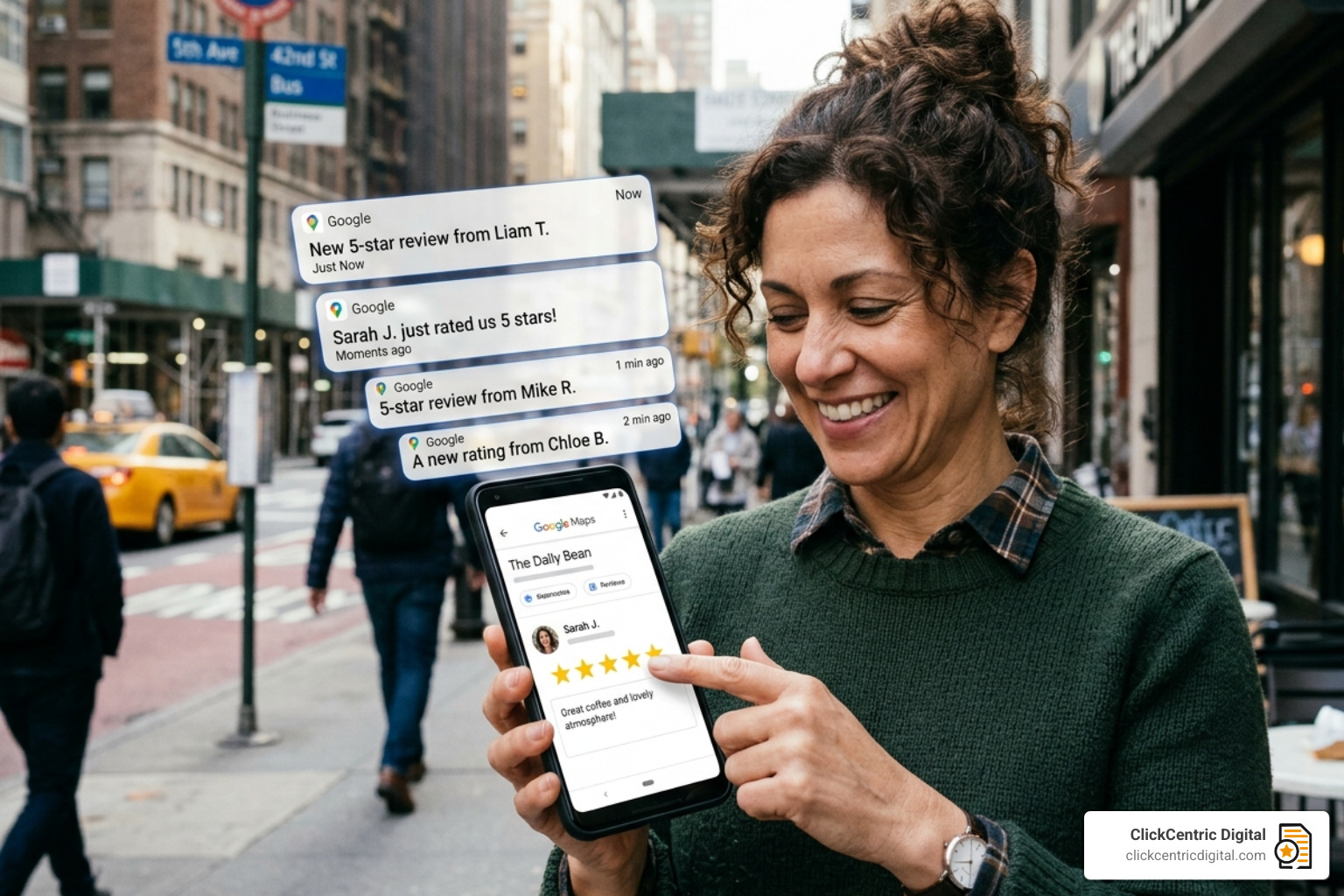
Citations (mentions of your business name, address, and phone number on other websites) also play a massive role. Even if they don’t link back to your site, they act as “votes of confidence” for your business’s existence. We focus on Mastering Local Reviews to Win More Customers because we know that a 4.8-star rating with 200 reviews will almost always beat a 5.0-star rating with only 5 reviews.
Review Management: How Do I Improve My Local Search Rankings?
How you respond to reviews is just as important as getting them. Google has stated that responding to reviews helps your visibility. When you respond, be professional, prompt, and if possible, naturally include a service keyword.
There is also a “10-review threshold” that many experts believe exists—once you hit 10 reviews, Google begins to trust your entity significantly more. To see where you stand, you can Stop Guessing Your Local Map Ranking and start tracking your progress through our tools.
Local Link Building and Citations
Not all links are created equal. For local SEO, a link from the Grand Rapids Chamber of Commerce is often more valuable than a link from a national blog. Why? Because it proves local relevance.
Focus on:
- Sponsoring local little league teams in Holland.
- Joining the local Chamber of Commerce.
- Getting mentioned in West Michigan news outlets.
- Listing your business in industry-specific directories.
For a complete strategy on this, see The Local SEO Company Michigan Guide for Business Owners.
Advanced 2026 Tactics: AI Search and Mobile Performance
The search landscape in 2026 has shifted toward “Answer Engines.” Google’s AI Overviews (formerly SGE) and tools like ChatGPT often pull data directly from your Google Business Profile and website schema.
To win here, you need “Answer-First” content. This means structuring your website so that it answers common customer questions directly and concisely. We’ve developed strategies on How to Win the Local Pack in 2026 and Beyond that focus specifically on these AI-driven signals.
Optimizing for Voice and Conversational Queries
“Hey Siri, where is the best HVAC repair in Kalamazoo open now?” Voice search is conversational. People don’t speak in keywords; they speak in questions.
To capture this traffic, you need FAQ sections on your service pages that use natural, long-tail language. This is one of the burgeoning Google Maps Ranking Factors for 2025 and 2026. If your site answers the “who, what, where, and when” of your business clearly, you’ll be the one the voice assistant recommends.
Mobile Speed and Core Web Vitals
If your website takes more than 3 seconds to load on a mobile device, you’ve already lost the customer. In local search, urgency is high. Mobile users want a “click-to-call” button and a fast-loading map.
Google’s Core Web Vitals are a set of metrics that measure user experience. Slow sites are penalized with lower rankings because they provide a poor experience. You can browse our Category Local SEO resources to find more tips on technical mobile optimization.
Frequently Asked Questions about Local Rankings
How long does it take to see local SEO results?
Generally, you will see foundational improvements within 60-90 days. However, local SEO is about building momentum. The more consistent you are with reviews and posts, the faster you will climb. Highly competitive markets in Grand Rapids may take 4-6 months to reach the top spot.
Does hiding my address hurt my local rankings?
If you are a Service Area Business (SAB) and don’t have a physical shop for customers to visit, Google allows you to hide your address. This does not inherently hurt your rankings, provided your service areas are correctly defined. However, proximity is still calculated from your “hidden” home base.
How do I rank for “near me” searches?
Ranking for “near me” is less about using the phrase “near me” on your site and more about your GBP optimization and proximity signals. When your NAP is consistent and your profile is active, Google will naturally associate you with “near me” queries in your specific West Michigan neighborhood.
Conclusion
Improving your local search rankings isn’t a “one-and-done” task—it’s a continuous process of proving to Google that you are the most relevant, prominent, and trustworthy option for your neighbors.
At ClickCentric Digital, we specialize in taking the guesswork out of this process. Whether you are looking for a 90-day action plan to dominate the Grand Rapids market or you need help managing your reputation in Kalamazoo, we have the targeted strategies to help you acquire more local customers.
Ready to take the top spot? Check out our specialized Search Engine Optimization Google Maps Ranking services and let’s get your business on the map.
Sorry, the comment form is closed at this time.