

07 Oct How to Dominate Local Maps Marketing and Win More Customers
How to Dominate Local Maps Marketing and Win More Customers
How Local Maps Marketing Turns Nearby Searches Into Customers

To improve your local Maps visibility, start with your Google Business Profile. Verify it, choose the right categories, keep your hours and services accurate, add clear photos, and ask customers for honest reviews. Then make sure your website explains what you offer and where you offer it. Track where you appear across your service area, not just from your own phone.
The goal is to show up when someone nearby is ready to act. A strong Google Map Pack listing can help that person call, request directions, or visit your business without ever opening your website.
I’m Fred Dirkse, and I’ll show you how these pieces work together to bring in more local customers.
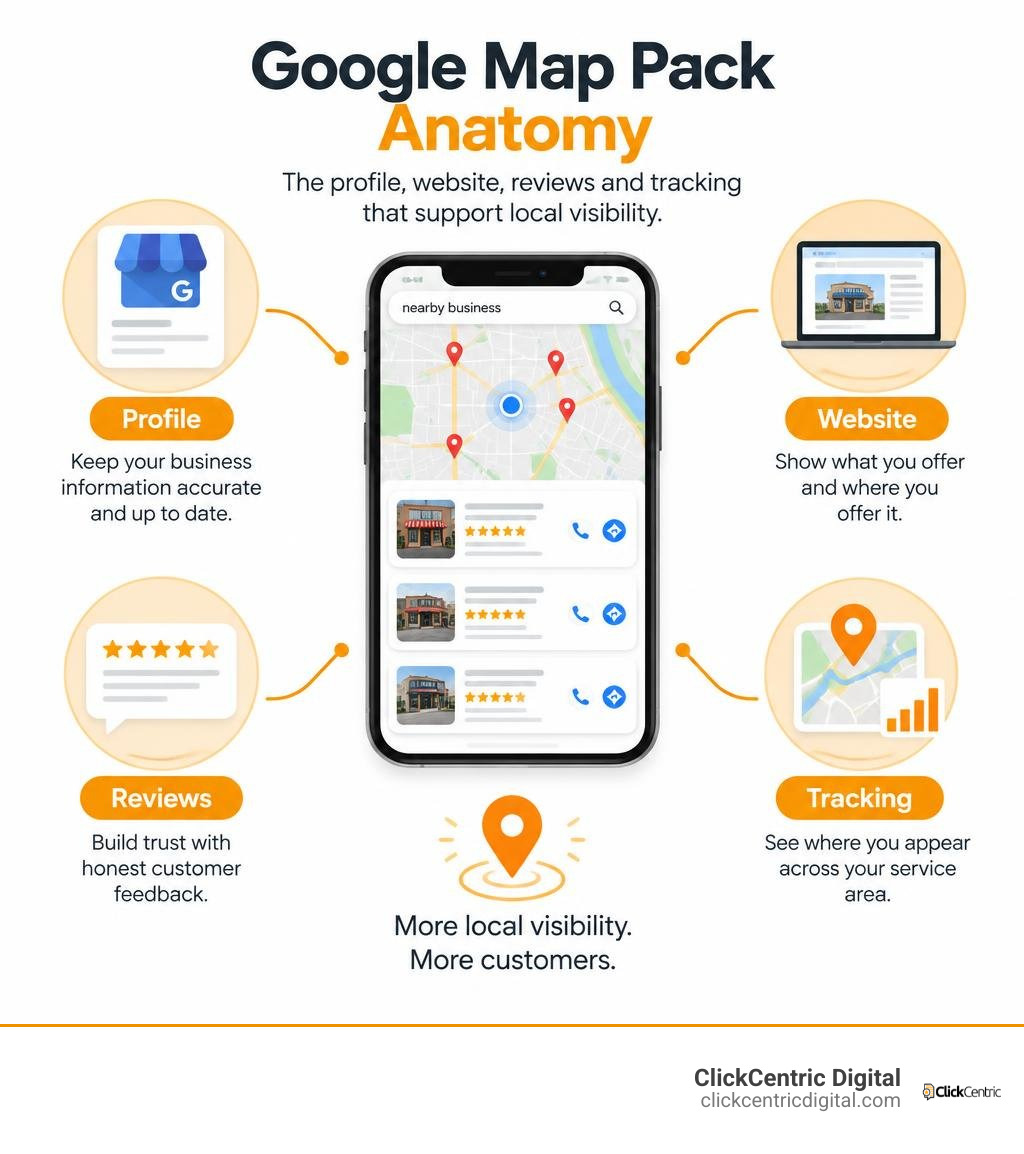
Simple guide to local maps marketing:
Why Google Maps Is the Primary Engine for Local Business Growth
Modern search behavior has shifted dramatically toward immediacy. When potential clients open their smartphones, they are rarely looking to browse several pages of organic search results. Instead, 46% of all Google searches carry distinct local intent. Whether a homeowner needs emergency plumbing repair or a diner is looking for the best evening meal, map-driven search results capture high-intent buyers at the precise moment they are prepared to make a financial commitment.
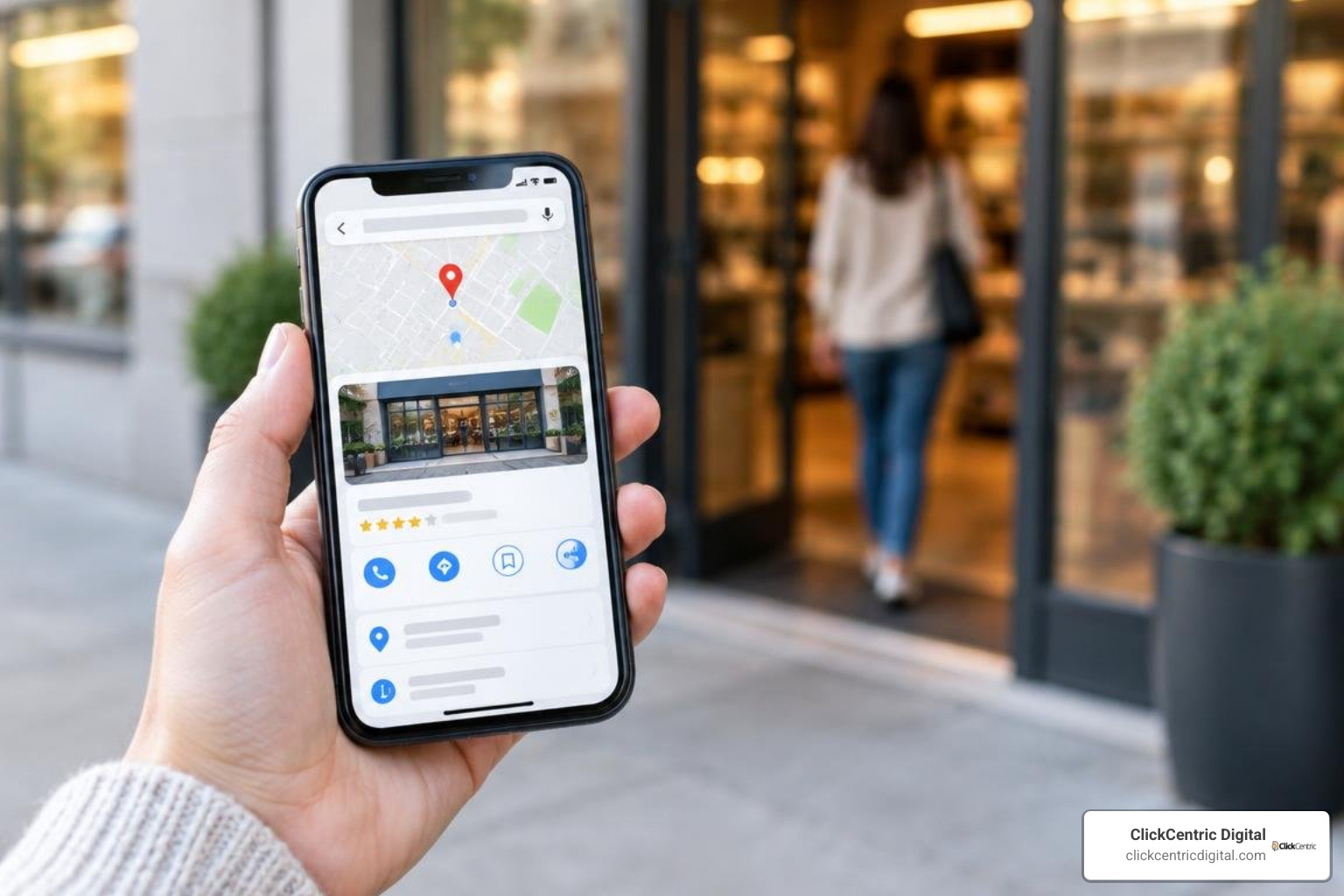
Your presence on Google Maps operates as a 24/7 digital storefront. Over 60% of consumers rely on map-related data—such as immediate operating hours, review scores, and route availability—to make direct contact decisions. Earning a spot in the coveted Google Local 3-Pack places your business directly above conventional organic links.
This prime placement produces zero-click conversions, where users call your phone number or click for turn-by-turn navigation without ever visiting your primary website. Securing these high-value interactions requires improving local Google rankings by treating your profile as an active, living component of your customer acquisition pipeline.
Core Pillars of an Effective Local Maps Marketing Strategy
Mastering local maps marketing requires a balanced approach combining on-profile optimization, strong website signals, and consistent customer feedback loops.
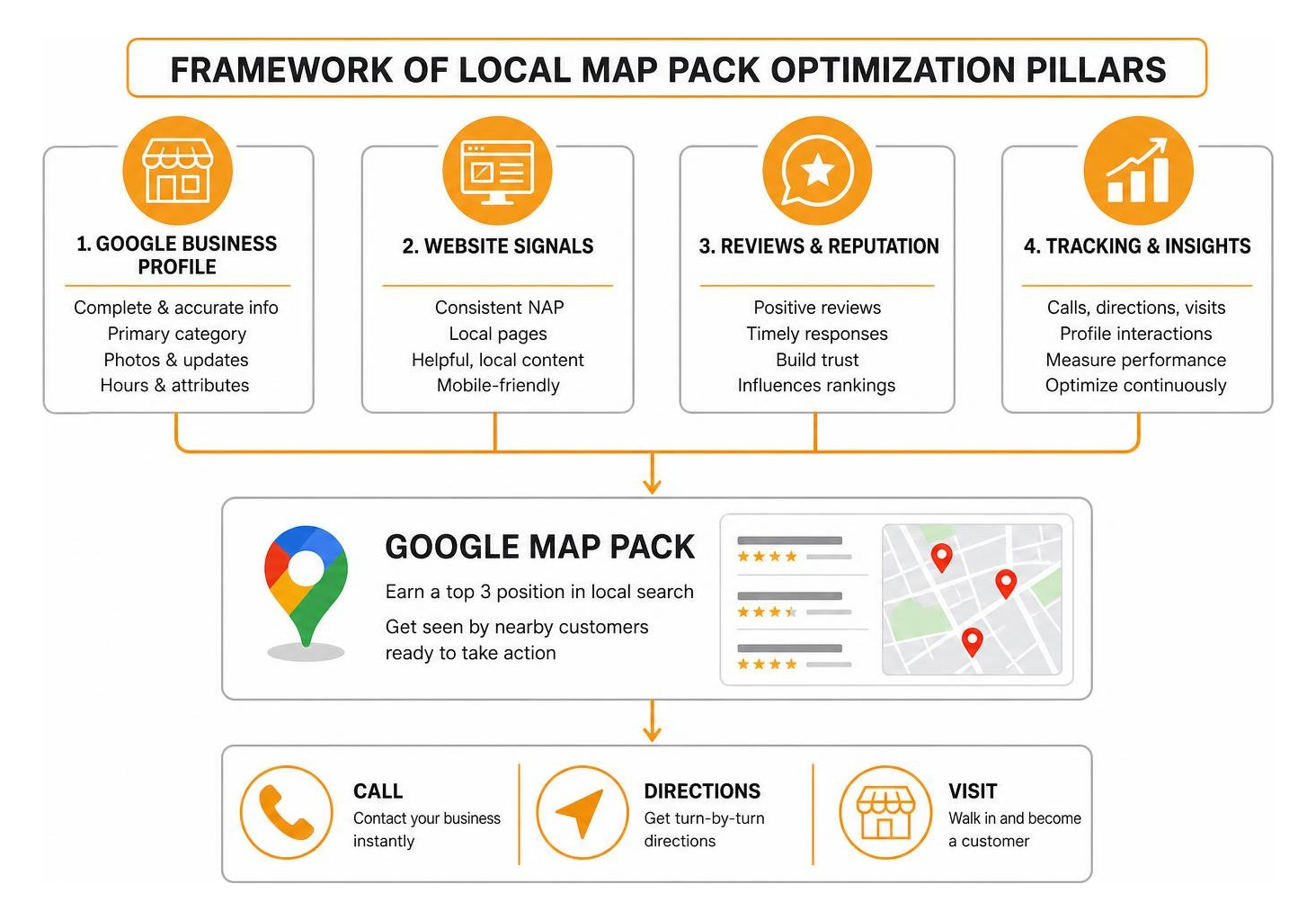
Optimizing Your Google Business Profile for Maximum Reach
Your Google Business Profile (GBP) serves as the primary data node for Google’s local algorithm. Claiming and completing your verification via postcard, video, or phone is just the initial baseline. To dominate competitive search queries, your profile data must be exhaustive.
- Select the Precise Primary Category: Your primary category carries massive algorithmic weight. If you operate an auto repair shop, setting “Brake Shop” versus “Auto Repair Shop” will alter which searches trigger your profile.
- Utilize Secondary Categories Wisely: Add secondary categories that accurately reflect your supplementary services without diluting your core entity focus.
- Complete Profile Attributes: Fill in every available attribute, from accessibility features to accepted payment types. These micro-attributes help match your listing with voice search and filtered queries.
- Publish High-Resolution Media: Upload authentic storefront photos, interior images, and staff pictures. Profiles featuring regular photo additions secure far higher interaction rates than stagnant listings.
- Post Weekly Business Updates: Regularly publish updates detailing special offers, company announcements, and seasonal service reminders to reinforce your activity.
Maintaining active and accurate data is essential for winning the local pack in 2026 and beyond.
Essential On-Page Factors for Local Maps Marketing
Your website provides the geographic and topical context that Google uses to validate your map listing. A weak website will suppress your local ranking, even if your GBP looks spotless.
- Geo-Targeted Keyword Research: Target intent-rich search phrases that pair your services with real neighborhoods and service regions (such as Grand Rapids MI, Holland, Grand Haven MI, or Kalamazoo MI).
- Localized Landing Pages: For businesses serving multiple communities across West Michigan, create distinct service pages tailored to each physical area. Each page must feature original, helpful content rather than boilerplate keyword swaps.
- Authoritative Backlinks and Citations: Secure listings in respected business directories, local Chamber of Commerce databases, and regional partner sites to validate your business entity.
Implementing these proven local SEO strategies bridges the gap between your on-page copy and your Google Maps prominence.
Turning Customer Reviews into Ranking Signals and Conversions
Customer reviews function both as a primary ranking signal and as social proof for conversion. Search engines evaluate review volume, review velocity (the steady pace at which you earn feedback), and the natural keyword sentiment embedded in customer text.
To maximize the impact of your review acquisition efforts, focus on sustainable, high-impact strategies:
| Strategy / Approach | Impact on Local Rankings | Customer Conversion Influence | Execution Effort |
|---|---|---|---|
| Direct SMS / QR Code Invites | High (Steady Review Velocity) | High (Authentic, Detailed Feedback) | Low (Automated post-service) |
| Review Keyword Prompting | High (Natural Keyword Sentiment) | High (Mentions specific services) | Medium (Staff training required) |
| Active Owner Responses | Medium (Trust and Entity Signal) | High (Demonstrates customer care) | Low (Ongoing routine) |
| Mass Review Blasts (Occasional) | Low (Triggers spam filters) | Low (Appears unnatural or forced) | Low (Batch emails) |
Encourage satisfied clients to include photos in their reviews. A profile populated with genuine customer-submitted media builds immediate trust and signals genuine, real-world engagement to local search algorithms.
The Technical Connection: Map Embeds, Schema, and Entity Authority
Beyond surface-level profile optimization, technical signals validate your physical location and establish local entity authority.
API-Driven Dynamic Map Embeds vs. Static iFrames
Many webmasters embed Google Maps by copying a basic iframe from the public “Share” button. While visually functional, this approach misses valuable algorithmic opportunities.
A static embed acts as an isolated third-party frame. In contrast, integrating a dynamic map via the Google Maps JavaScript API connects your digital domain directly to your Google Cloud Project and verified business entity.
A dynamic API-driven map centered precisely on a storefront can boost “near me” search visibility by up to 40% in two weeks. Furthermore, loading map scripts dynamically ensures fast page speeds. By lazy-loading your interactive map assets, you maintain optimal Core Web Vitals while giving search engines clear entity validation. Learn more about the hidden link between map embeds and organic local traffic to understand how technical integration drives local visibility.
Aligning LocalBusiness Schema Coordinates with Exact Map Pins
Local search engines cross-reference structured data to ensure physical authenticity. If your LocalBusiness Schema lists geographic coordinates that deviate even slightly from your GBP pin placement, you create micro-discrepancies that undermine Google’s confidence in your location.
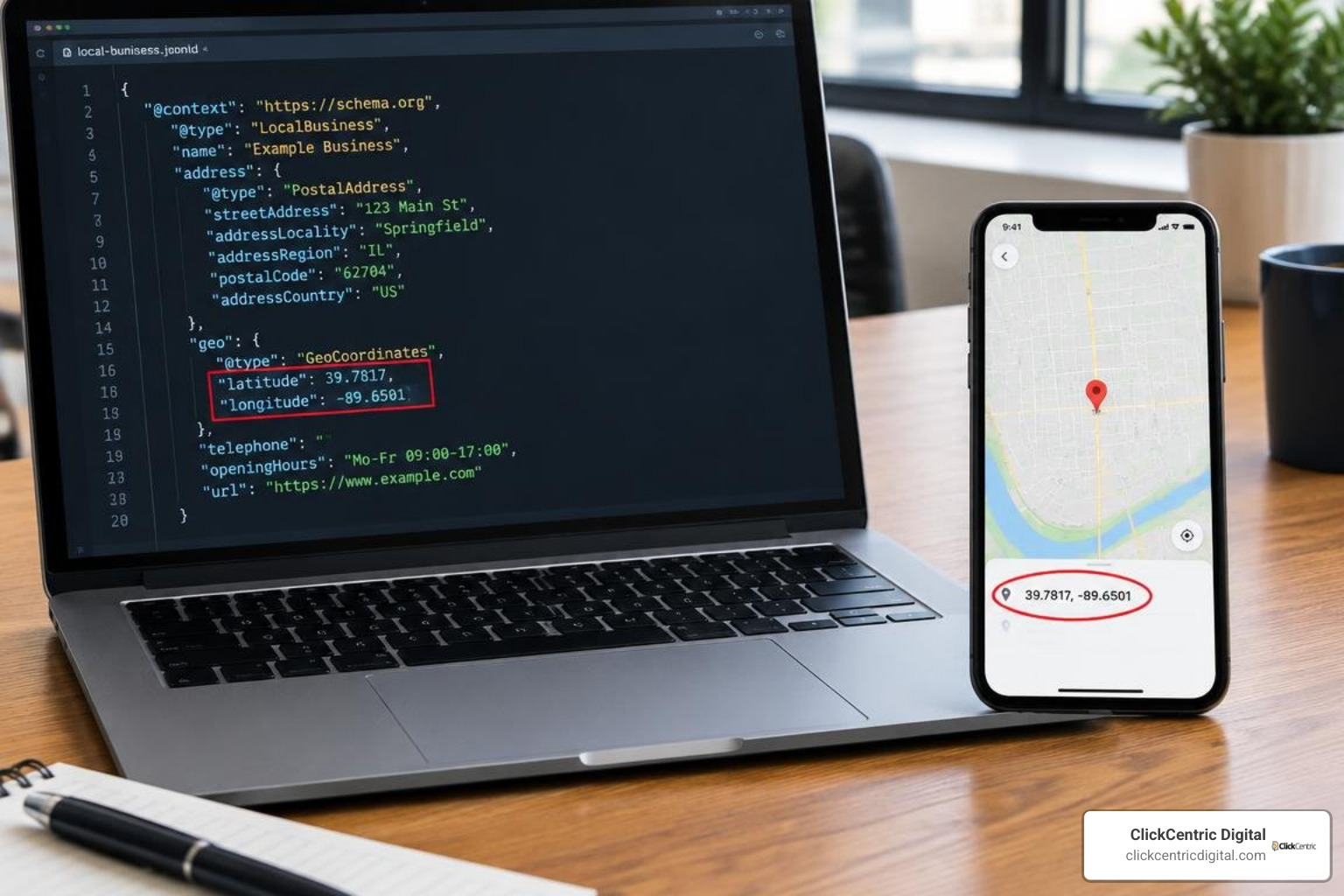
Ensure that your schema markup contains exact latitude and longitude values matching your Google Maps location:
- Verify your pin’s precise coordinates down to six decimal places directly within Google Maps.
- Embed those matching coordinates within your website’s JSON-LD
LocalBusinessschema undergeo.latitudeandgeo.longitude. - Match your listed street address, postal code, and phone number exactly to your GBP listing.
Eliminating these coordinate discrepancies establishes an ironclad link between your on-page data and your physical presence.
Paid Acceleration: Leveraging Google Maps Advertising
While organic local maps marketing produces sustainable, long-term ROI, paid map advertising offers immediate visibility in competitive markets.
Scaling Paid Visibility with Local Maps Marketing Ads
Google Maps ads allow businesses to place their locations directly in front of active searchers.
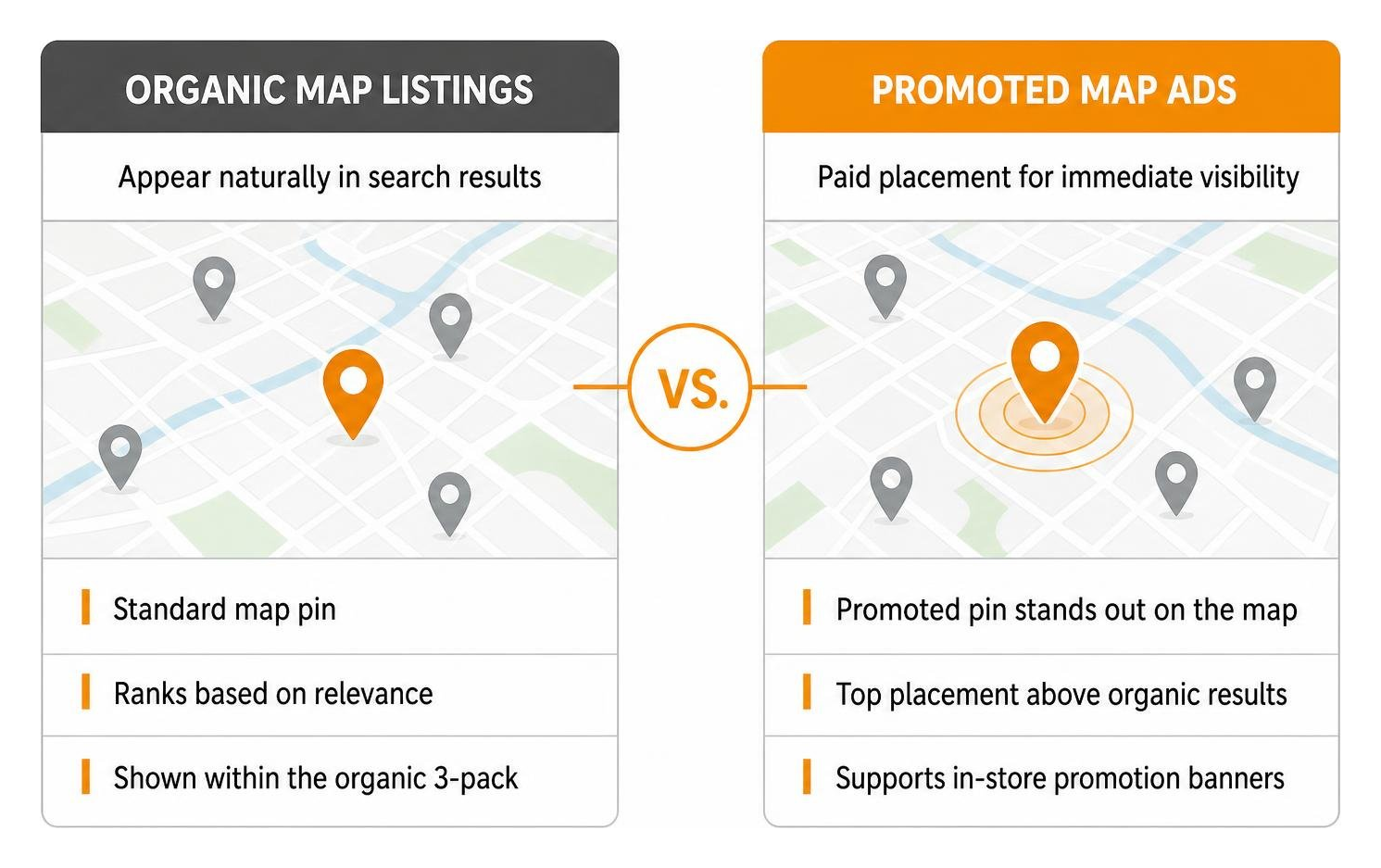
Key advertising formats include:
- Promoted Pins: Distinctive branded pins that appear on the map canvas as users browse local roads and neighborhoods, highlighting your location over nearby competitors.
- Promoted Locations: Paid listings that secure top placement above the organic 3-pack within Google Maps search results.
- In-Store Promotion Banners: Ad extensions displaying specific discounts, deals, or seasonal offers directly within your business listing card.
- Local Inventory Integration: Feeds that showcase available in-stock products to nearby users searching on mobile devices.
By linking your Google Ads account to your Business Profile, you can unlock robust Google Maps advertising techniques that place your business in front of customers ready to buy. To ensure healthy returns, balance aggressive ad placement with strict budget caps by managing Google Maps ad costs.
Tracking Conversions and Measuring Return on Ad Spend
Local map campaigns require tracking mechanisms tailored to real-world engagement:
- Direction Requests: Measures users who request turn-by-turn navigation to your facility.
- Click-to-Call Conversions: Tracks phone inquiries initiated directly from the map interface.
- Local Store Visits: Analyzes modeled location data to estimate how many ad interactions resulted in a physical walk-in.
- Local Impression Share: Identifies how often your promoted pin displays across target geographic radiuses.
Reviewing these metrics lets you adjust your bids based on geographic performance, focusing your ad spend on high-converting neighborhoods.
Monitoring Rankings, Avoiding Traps, and Future-Proofing in 2026
Local map visibility is fluid; search results change based on the physical distance between the searcher and your business.
Tracking Proximity with Geogrid Rank Tracking
A business rarely ranks in position #1 across an entire city. Instead, visibility drops as the user moves farther away from your physical address.
Using geogrid rank tracking platforms allows you to visualize your search rankings across a mapped grid of coordinate points. This approach helps you:
- Identify specific geographic dead zones where your visibility drops.
- Measure the real impact of your on-page optimization across different zip codes.
- Monitor third-party “suggested edits” to your profile before Google accepts inaccurate changes.
Rather than relying on manual searches from a single desk, you can optimize your visibility across your entire target area by monitoring local map rankings accurately.
Critical Local SEO Mistakes to Avoid
Many businesses inadvertently damage their local search performance by relying on outdated tactics:
- Keyword Stuffing the Business Name: Adding extra keywords or locations to your official profile name (e.g., “Main Street Plumbing – Best Emergency Plumber”) violates Google’s guidelines and risks algorithmic shadow-bans or listing suspensions.
- Creating Duplicate Profiles: Setting up multiple listings for the same physical office splits your review signals and authority, lowering rankings for both profiles.
- Over-Focusing on Exact NAP Matches: Modern search engines use fuzzy matching to reconcile minor formatting differences (like “St.” versus “Street”). Spending hours manually hunting down trivial citation discrepancies offers little return compared to building genuine local authority.
Avoiding these traps ensures you can protect your visibility and maintain long-term map rankings.
Emerging Trends: Visual AI and Entity-Based Local Search
Local search engines increasingly prioritize entity authority and multimodal search capabilities.
Google Lens and integrated visual AI tools now scan storefront imagery, interior photos, and product shelves to answer user queries visually. Businesses that maintain updated, high-resolution imagery make it easier for machine learning models to parse their real-world offerings.
Furthermore, search engines look for “proof-of-life” signals across the web. Regular mentions from community groups, regional lifestyle profiles like Visit South Haven, and active local sponsorships prove to Google that your business is a trusted pillar of your local community.
Frequently Asked Questions About Local Maps Marketing
Can a dynamic map embed really improve local map rankings?
Yes. Integrating an API-driven dynamic map embed establishes an interactive connection between your domain and your Google Cloud verified entity. The resulting user engagement and coordinate alignment provide clear geographic relevance signals to search algorithms.
How often should a business post updates on its Google Business Profile?
We recommend publishing an update at least once per week. Search engines favor active listings, and regular posts about promotions, service offerings, and company events provide fresh signals that help break ranking ties against stagnant competitors.
What is the biggest mistake that causes profile suspensions or ranking drops?
The most frequent cause of severe penalties is adding artificial keywords to the business title field. Maintaining an exact match with your legal, real-world business name is essential for remaining compliant with platform guidelines.
Conclusion
Dominating local map results is not about finding quick shortcuts or exploiting temporary algorithmic loopholes. It requires a comprehensive marketing strategy that pairs a fully optimized Google Business Profile with clean technical schema markup, strong on-page content, and a steady stream of authentic customer reviews.
At ClickCentric Digital, we help local businesses turn nearby searches into loyal, paying customers through targeted search optimization and high-impact paid map campaigns across West Michigan. If you are ready to expand your market footprint and lead your local search pack, explore our tailored local marketing solutions by partnering with our local search specialists today.
Sorry, the comment form is closed at this time.