
11 Sep The Secret Sauce of High-Converting Custom Landing Pages
The Secret Sauce of High-Converting Custom Landing Pages
Why Custom Landing Pages Are the Key to More Leads and Sales
Custom landing pages are standalone web pages built with a single goal in mind — to turn visitors into leads or customers.
Here’s a quick breakdown of what they are and why they work:
| Feature | Custom Landing Page | Standard Website Page |
|---|---|---|
| Purpose | One focused goal (sign up, buy, call) | General information |
| Design | Tailored to a specific audience or campaign | Generic, one-size-fits-all |
| Navigation | Minimal or none (reduces distractions) | Full site navigation |
| Conversion focus | High — every element drives one action | Low — competes with other goals |
| Personalization | Matched to ad, audience, or offer | Rarely personalized |
Not long ago, building a professional landing page meant hiring an agency and spending thousands of dollars — for a single page. Today, the tools have changed. But the strategy behind what makes a landing page actually convert hasn’t.
And that gap — between having a page and having a page that works — is where most local businesses lose out.
Research consistently shows that visitors sent to a dedicated landing page convert at significantly higher rates than those landing on a generic product or home page. In fact, landing page visitors have been shown to convert and spend twice as much as those arriving on standard ecommerce pages.
For a local business owner trying to get more calls, bookings, or form fills from Google Ads or Facebook traffic, that difference is everything.
This guide breaks down the exact ingredients that separate a high-converting custom landing page from one that just sits there looking pretty.
Why Custom Landing Pages Outperform Standard Templates
If you’ve ever used a “free” template from a basic website builder, you know the feeling. It looks okay, but it feels a bit… hollow. It doesn’t quite match your brand, and it certainly doesn’t speak the language of your customers in Grand Rapids or Holland. This is where custom landing pages take the lead.
Standard templates are designed to be “good enough” for everyone, which usually means they aren’t great for anyone. When we build custom pages, we focus on a conversion lift that templates simply can’t match. Why? Because a custom design allows for complete brand consistency and a user experience (UX) that is mapped directly to your customer’s journey.
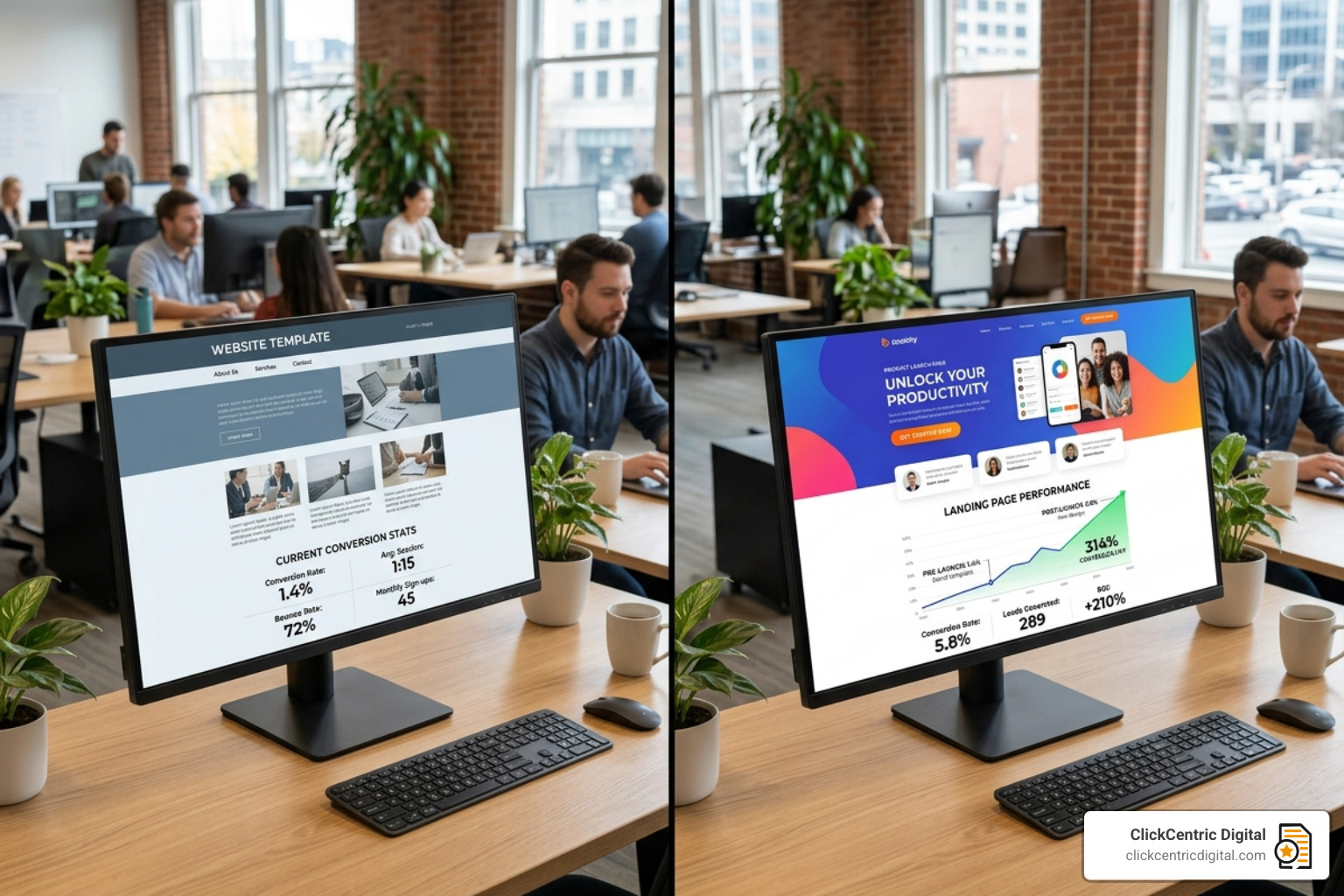
One of the biggest advantages of Customizable landing page software: Design made simple is the ability to eliminate “leaks” in your funnel. A standard website page is full of distractions—About Us links, social media icons, and navigation menus that lead people away from the goal. A custom page acts like a focused beam of light, guiding the visitor toward a single action.
Personalization is another heavy hitter. By using Paid Traffic Management, we can ensure that if someone clicks an ad for “Emergency HVAC Repair in Kalamazoo,” they land on a page that screams “Emergency HVAC Repair in Kalamazoo,” not a generic homepage that mentions every service from plumbing to roofing. This relevance is why custom pages have significantly lower bounce rates. You’re giving the user exactly what they asked for, immediately.
In the competitive West Michigan market, having a page that loads faster and speaks directly to local needs gives you a massive competitive advantage. While your competitors are sending traffic to their 10-year-old homepages, your high-speed, high-relevance landing page is busy collecting leads.
Essential Ingredients for Designing High-Converting Pages
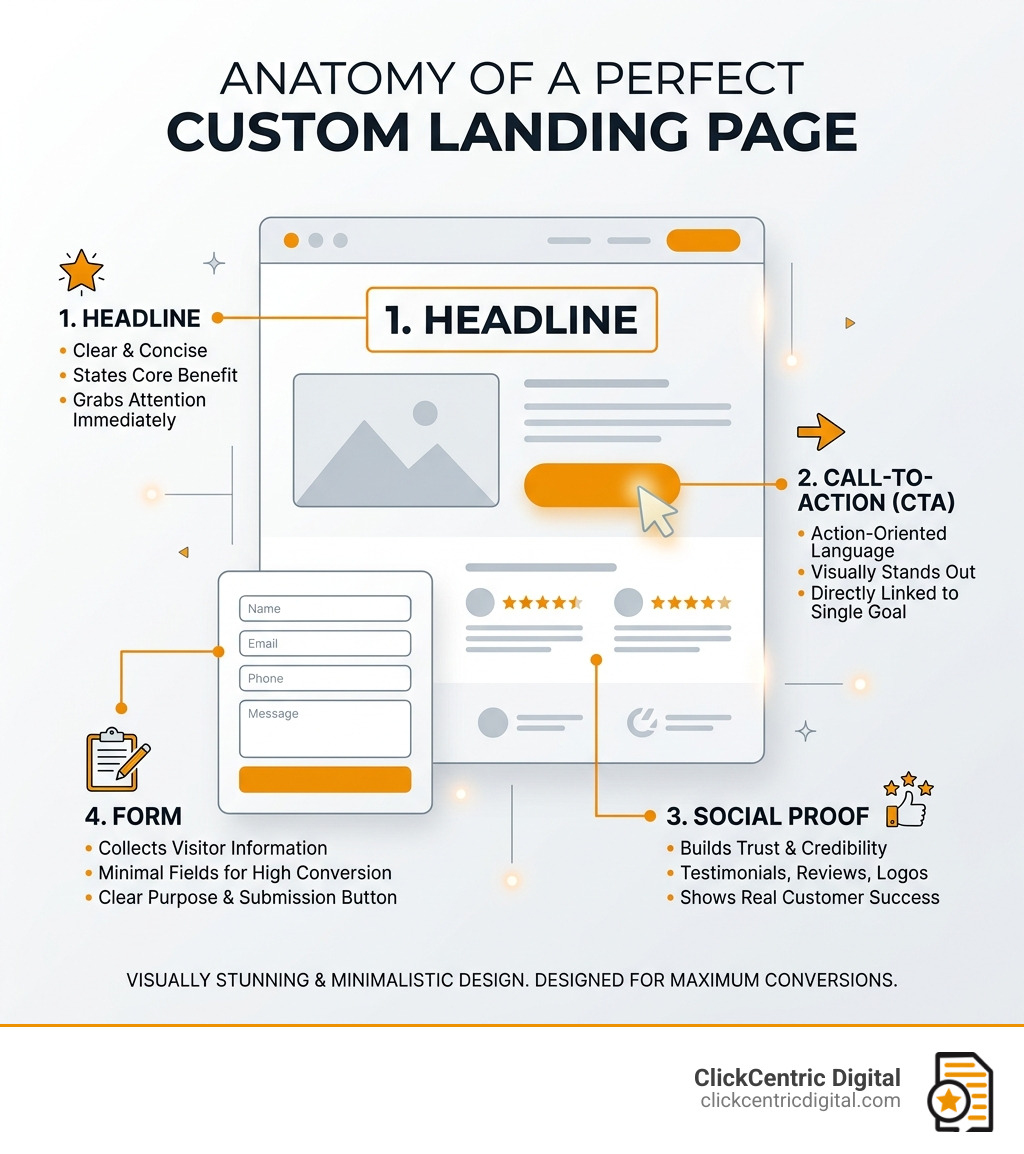
Creating a page that converts isn’t about throwing spaghetti at the wall. It’s about science. We look at visual hierarchy—the order in which a user’s eye moves across the page. By using white space effectively, we give the most important elements (like your headline and CTA) room to breathe.
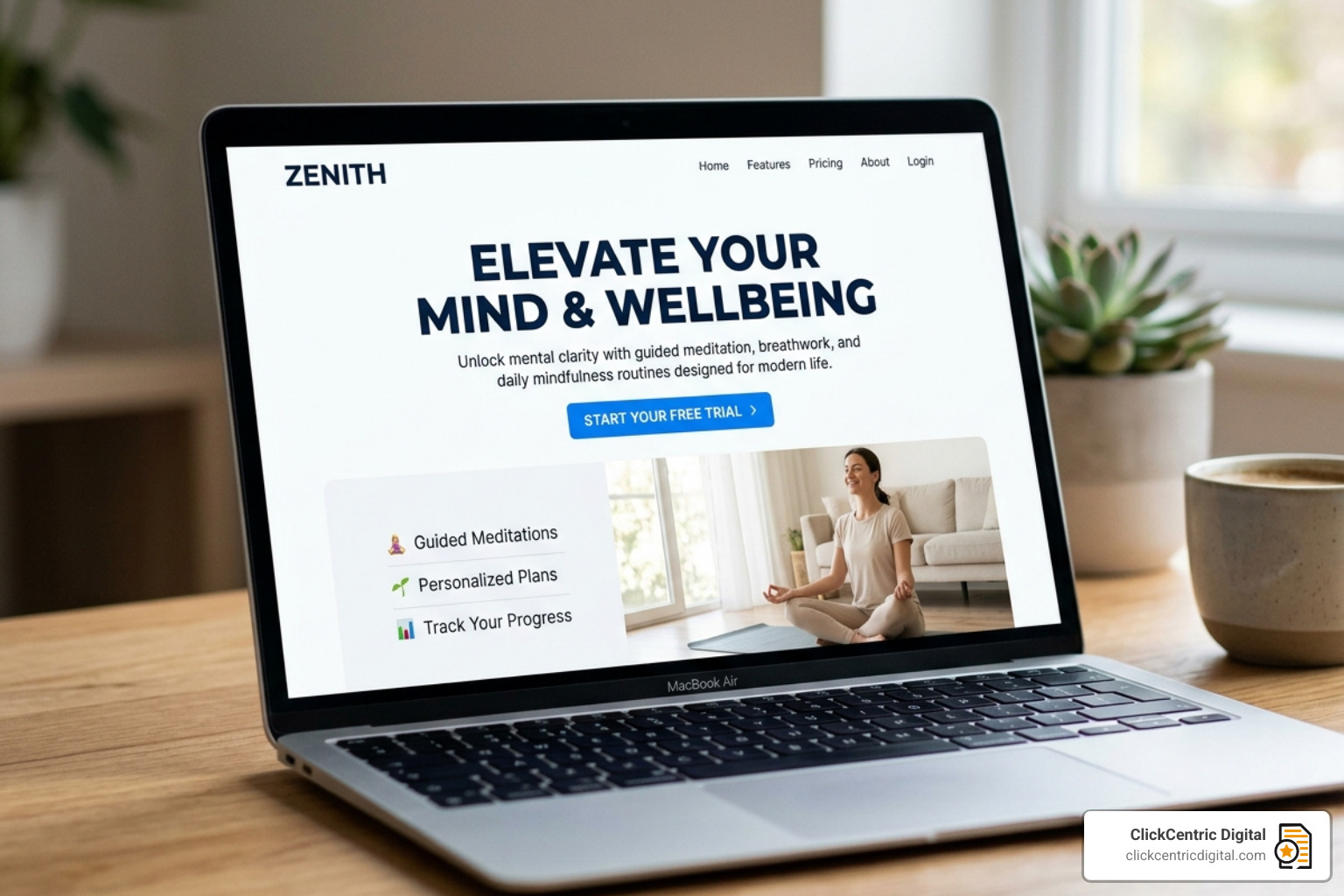
Every high-converting page needs a rock-solid value proposition. This is the answer to the visitor’s question: “What is in it for me?” If you’re a contractor in Grand Haven MI, your value prop shouldn’t just be “We do roofing.” It should be “Get a New Roof in 48 Hours with a Lifetime Warranty.”
Social proof and trust signals are non-negotiable in 2026. This includes:
- Real customer reviews (bonus points if they mention the specific city).
- Trust badges (BBB, local chamber of commerce).
- Case studies or “before and after” photos.
- Industry certifications.
For those looking for professional help, Landing Page Design Services can provide that “pixel-precise” look that builds instant authority. We often combine this with our own Website Design Development expertise to ensure the page isn’t just a pretty face—it’s a functional workhorse.
Mobile-first design is also critical. With the majority of local searches happening on smartphones while people are on the go in South Haven MI or Holland, your page must be lightning-fast and easy to navigate with a thumb. If your page takes more than three seconds to load, you’ve likely lost half your audience.
Crafting the Perfect CTA for Custom Landing Pages
Your Call to Action (CTA) is the most important element on the page. It’s the “final boss” of your marketing funnel. To make it effective, use action-oriented copy. Instead of a boring “Submit” button, try “Get My Free Quote” or “Claim My 20% Discount.”
Contrast is your friend here. If your page is mostly blue and white, your CTA button should be a bold orange or green—something that pops. We also use psychological triggers like urgency (“Offer ends Friday!”) or scarcity (“Only 3 spots left this month!”) to nudge visitors over the finish line.
Tools like Dynamic & Personalized Landing Pages Made Easy allow us to reduce friction by pre-filling form fields or showing different CTAs based on whether the visitor is a new lead or a returning customer. The goal is to make it as easy as possible for them to say “yes.”
The Role of AI in Building Custom Landing Pages
By 2026, AI has moved from a “cool toy” to an essential tool in our Web Development toolkit. AI helps us in several ways:
- Content Generation: Generating variations of headlines and body copy to see what resonates best with different audiences.
- Predictive Analytics: Analyzing billions of conversion data points to suggest layouts that are statistically likely to perform better.
- Smart Traffic: Automatically directing visitors to the page variant where they are most likely to convert based on their device, location, and even the time of day.
- Dynamic Text Replacement (DTR): This is a game-changer. DTR allows us to change the text on your landing page to match the exact search term the user typed into Google. If they searched for “Best Painter in West Michigan,” the headline can automatically update to say exactly that.
Integrating Your Landing Pages with the Marketing Stack
A landing page shouldn’t be an island. It needs to be the heart of your data ecosystem. When someone fills out a form on your custom page, that data needs to move—fast.
This is where CRM synchronization comes in. Whether you use HubSpot, Salesforce, or a specialized local tool, your landing page should feed leads directly into your sales pipeline. This allows for immediate email automation and lead nurturing. In the time it takes for a potential customer in Kalamazoo MI to close their browser, they should already have a “Thank You” email or a text message sitting in their inbox.
We often talk about Mastering Google PPC Management Without Losing Your Mind, and a big part of that is tracking. You need tracking pixels (Meta Pixel, Google Tag Manager) properly installed so you can “retarget” people who visited your page but didn’t convert.
Advanced integrations might also include:
- Analytics Dashboards: Seeing exactly where your traffic is coming from and which buttons they are clicking.
- Webhook Integration: Sending data to specialized apps like Slack or a custom booking calendar.
- Heatmaps: Visualizing where people are scrolling and where they are getting stuck.
Optimizing for Local Search and Paid Traffic
For businesses in West Michigan, the “local” part of local SEO is vital. Your custom landing pages need to do more than just look good; they need to prove to Google that you are a relevant authority in your specific service area.
NAP consistency (Name, Address, Phone number) is the foundation. If you have locations in Grand Rapids MI and Holland MI, each should have its own dedicated page with its own specific contact info. We call these Service Area Landing Pages (SALPs).
Using Local PPC Campaigns That Actually Bring People Through The Door means targeting very specific geographic areas. Your landing page should reflect this by mentioning local landmarks (like the Blue Bridge in Grand Rapids or Windmill Island in Holland). This isn’t just for the users; it helps search engines understand your “entity” and its relation to the local area.
If you’re running Facebook ads, you’ll want to check out How To Run Facebook Ads For Local Business Without Losing Your Shirt. Facebook traffic is often more “top-of-funnel,” meaning people are browsing, not necessarily searching for a solution right this second. Your landing page for Facebook needs to be even more engaging, perhaps using a quiz or a lead magnet to capture interest.
Local SEO Strategies for Custom Landing Pages
To truly dominate the local search results, we focus on keyword intent. A person searching for “roofing prices Grand Rapids” has a different intent than someone searching for “emergency roof leak repair.” Your pages should be optimized for these specific nuances.
Here are some advanced local strategies we use:
- Localized Content: Including reviews from neighbors in that specific city.
- Schema Markup: Using “LocalBusiness” structured data to help Google display your address, hours, and ratings directly in the search results.
- Internal Linking: Connecting your landing pages to your main service pages to build “link equity” across your site.
- Google Maps Integration: Embedding a map that shows your service radius or physical location.
For many, the hurdle is cost. But as we explain in The Small Business Guide To Affordable Google Ads Management Services, the “expense” of a custom landing page is actually an investment that pays for itself by lowering your cost-per-lead.
Frequently Asked Questions about Landing Page Optimization
What is the difference between a custom landing page and a standard website page?
A standard website page (like your homepage) is designed for exploration. It has many links and covers many topics. A custom landing page is built for a single purpose: conversion. It removes all distractions and focuses the visitor on one specific action, like calling your business or filling out a form.
How do I set up a custom domain for my landing page in 2026?
Most modern landing page builders allow you to connect a subdomain (like promo.yourbusiness.com) or a completely separate domain. In 2026, this is usually done via a simple CNAME record update in your DNS settings. Using a custom domain is highly recommended because it builds trust and looks much more professional than a generic builder.com/yourpage URL.
What are the limitations of using free landing page builders?
While “forever-free” plans exist (like those from Mailchimp or HubSpot), they often come with significant strings attached. These usually include:
- Branding: A “Powered by [Builder Name]” watermark that can hurt your credibility.
- Domain Limits: You often can’t use your own custom domain on a free plan.
- Feature Caps: Limits on the number of visitors, form submissions, or A/B tests you can run.
- Lack of Automation: Free plans often restrict your ability to send automated follow-up emails.
Conclusion
At ClickCentric Digital, we’ve seen how a single, well-crafted custom landing page can transform a struggling ad campaign into a lead-generating machine. Whether you’re serving customers in Grand Rapids, Holland, or anywhere in West Michigan, the secret sauce is always the same: focus, relevance, and data-driven optimization.
Stop sending your hard-earned traffic to a generic page and hoping for the best. By focusing on conversion rate optimization and leveraging the latest in AI and local SEO, you can ensure your business isn’t just seen—it’s chosen.
Ready to stop “leaking” leads and start growing your local presence? We’re here to help you navigate the complex world of digital marketing with strategies that actually bring people through your door.
Sorry, the comment form is closed at this time.