

13 May How to Cook Up a Five-Star Restaurant SEO Strategy
How to Cook Up a Five-Star Restaurant SEO Strategy
Why Most Restaurants Are Invisible Online (And How to Fix It)
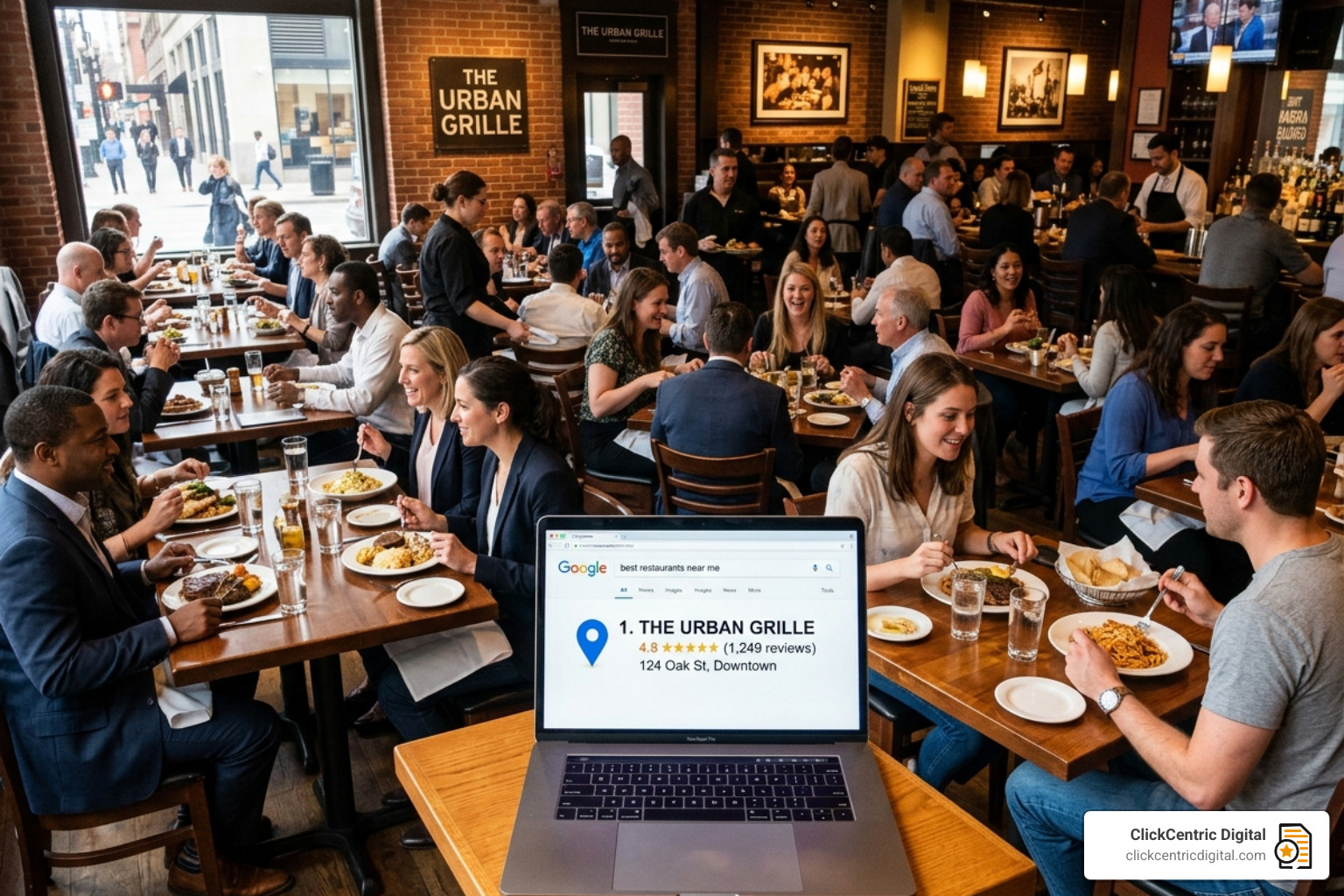
A solid restaurant seo strategy is the difference between a packed dining room and empty tables — and the numbers make that painfully clear.
93% of diners use online search to find restaurants. If you’re not showing up near the top, you’re invisible to almost everyone actively looking for food in your area right now.
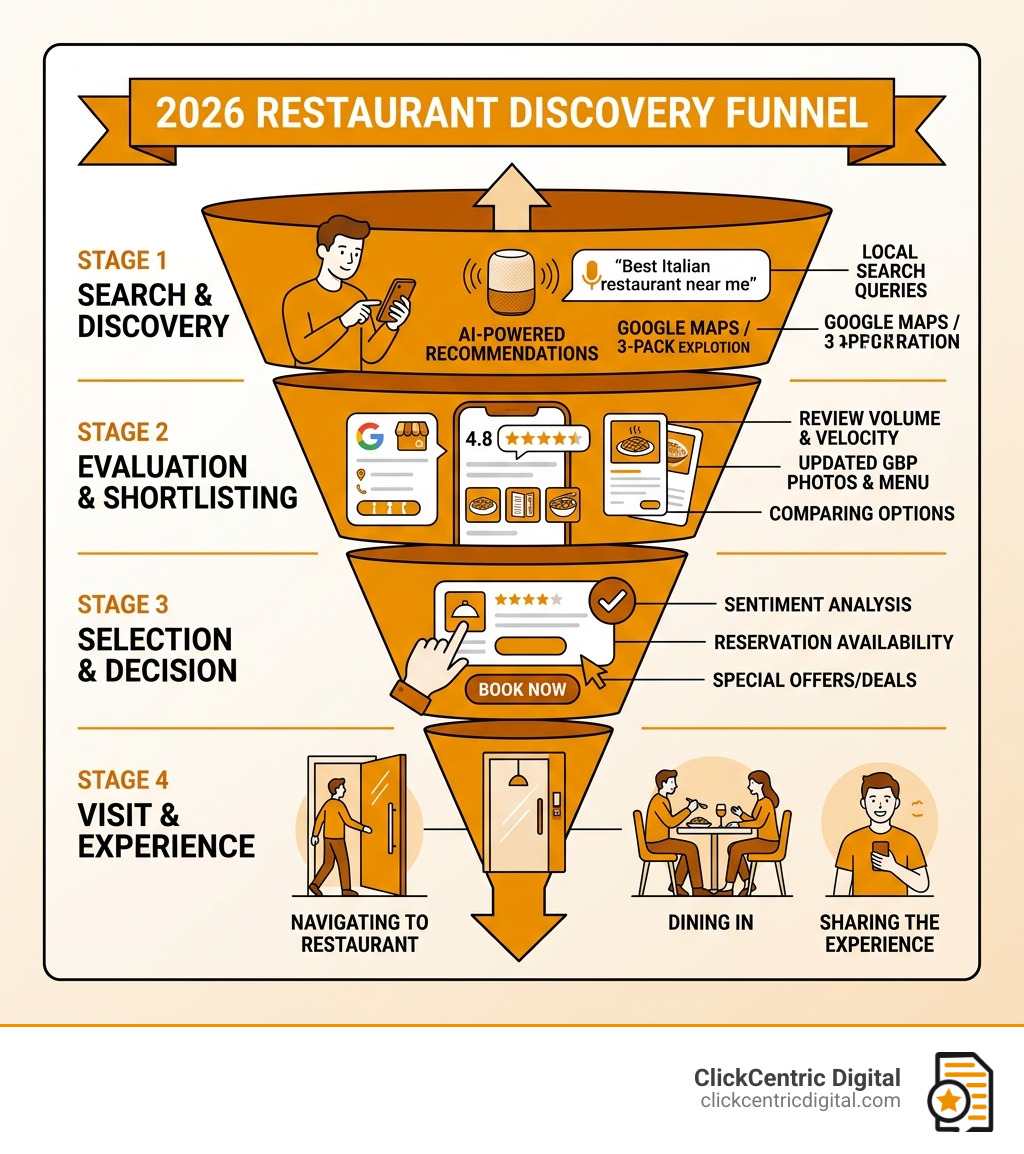
Here’s a quick overview of what an effective restaurant SEO strategy covers in 2026:
- Google Business Profile (GBP) — Claim, complete, and actively manage your listing with photos, menu, hours, and a direct ordering link
- Local 3-Pack rankings — Optimize for Google’s map results, where the vast majority of local clicks happen
- Reviews — Build review volume and velocity; 200 reviews at 4.3 stars outranks 15 reviews at 4.8 every time
- Technical website SEO — Mobile-friendly, fast-loading, with your menu in HTML (not PDF)
- Schema markup — Structured data that helps AI search tools and voice assistants surface your restaurant
- Local citations and backlinks — Consistent business info across directories builds trust with Google
The search landscape has also shifted. In 2026, AI-powered tools like Google’s AI Overviews and ChatGPT are actively recommending restaurants based on structured data, review sentiment, and how well your online presence is built out. It’s not enough to just have a website anymore.
The good news? Most of your competitors aren’t doing this well. The restaurants winning on Google are simply doing the fundamentals consistently — and that’s something any owner can learn.
Key restaurant seo strategy vocabulary:
The Ingredients of a Winning restaurant seo strategy
To rank well in West Michigan, whether you are in Grand Rapids, Holland, or Kalamazoo, you need to understand how Google decides who gets the “prime real estate” on the search results page. That real estate is the Google Local 3-Pack.
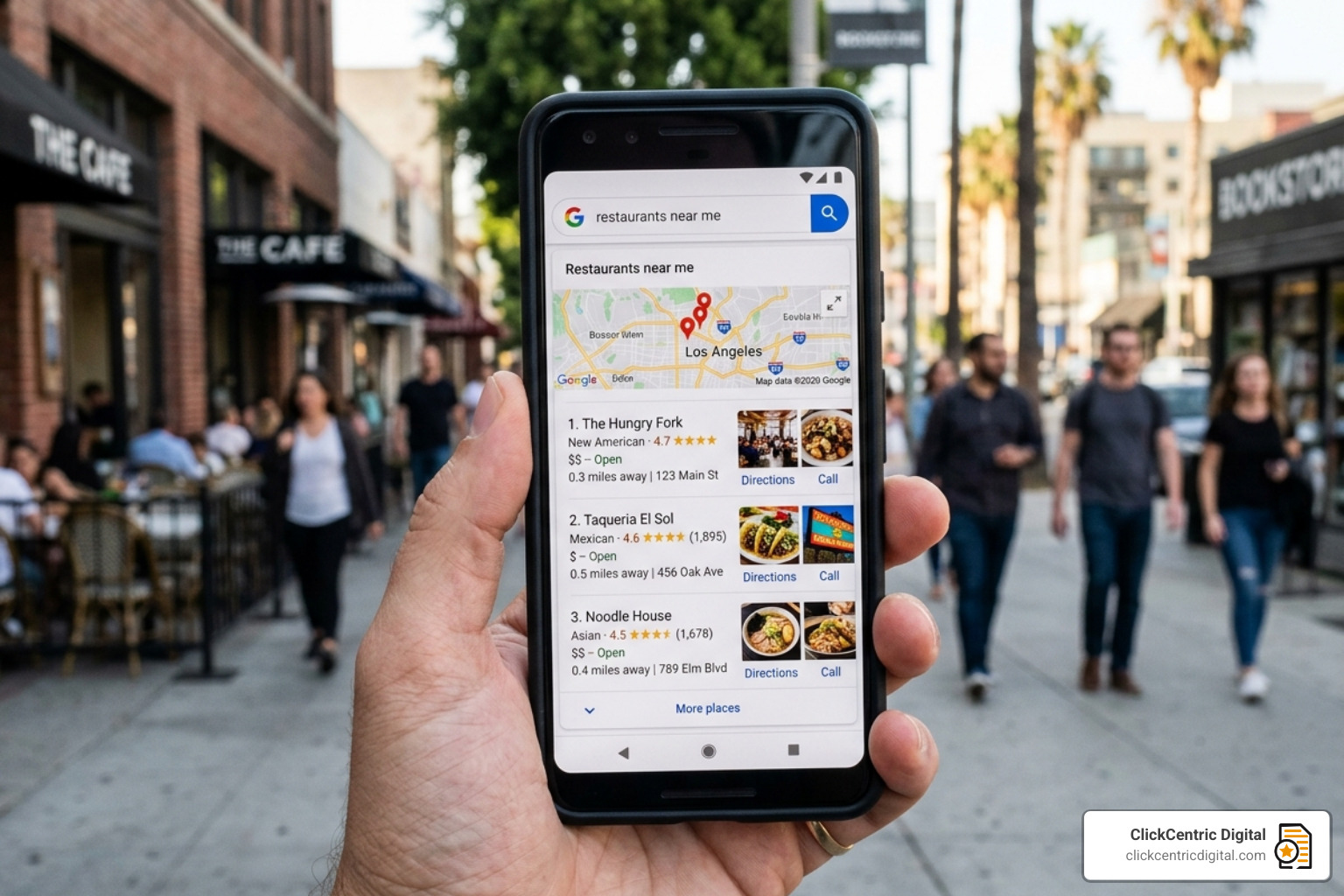
When someone searches for “best tacos in Grand Haven” or “sushi near me,” Google displays three local businesses at the very top of the page, usually accompanied by a map. This section captures the vast majority of clicks. To get there, your restaurant seo strategy must master three core pillars:
- Relevance: How well does your restaurant match what the user is looking for? If they search for “vegan options,” does your online content prove you have them?
- Distance: How close is your restaurant to the person searching? While we can’t move your building, we can ensure Google knows exactly where you are.
- Prominence: How well-known is your restaurant online? This is determined by your reviews, backlinks from local West Michigan blogs, and your overall digital footprint.
At ClickCentric Digital, we focus on The Math Behind a Better Local Search Strategy to help our clients bridge the gap between “being a great restaurant” and “being a great search result.”
One of the most critical factors for prominence is NAP consistency. NAP stands for Name, Address, and Phone Number. If your Facebook page says “The Pizza Shack,” your website says “Pizza Shack LLC,” and Google Maps says “Pizza Shack on Main St,” Google gets confused. In SEO, confusion equals lower rankings.
Finally, distinguish between Discovery and Branded searches. A branded search is when someone types your name specifically. A discovery search is when they type “best burgers in Holland MI.” A winning restaurant seo strategy prioritizes discovery searches because that is how you find new customers who haven’t heard of you yet.
Optimizing Your Google Business Profile for Maximum Flavor
Your Google Business Profile (GBP) is often more important than your website. It is the first thing people see, and in 2026, it is where many people complete their entire journey—from finding you to placing an order—without ever clicking away.
To maximize your visibility, you must follow the latest Google Maps Ranking Factors for 2025 and beyond. Here is your checklist for a high-performing profile:
- Primary and Secondary Categories: Don’t just pick “Restaurant.” Be specific. If you’re an “Italian Restaurant,” make that your primary category. Use secondary categories for “Pizza Delivery” or “Catering Service.”
- Menu Integration: Don’t just upload a photo of your menu. Use the built-in Menu editor in GBP to list your dishes, descriptions, and prices. This allows Google to index your specific items, meaning you can rank for searches like “truffle fries in Kalamazoo.”
- Direct Ordering Links: This is a game-changer. Ensure your “Order Online” button points directly to your own website, not a third-party app that takes a 30% commission.
- Attributes: Check every box that applies. Are you woman-owned? Do you have outdoor seating? Is there a gender-neutral restroom? These attributes help you show up in filtered searches.
- Weekly Updates: Use “Google Posts” to share weekly specials, events, or behind-the-scenes photos. Profiles that are updated frequently signal to Google that the business is active.
Ranking in the Local 3-Pack with Your restaurant seo strategy
Getting into the top three isn’t just about filling out forms; it’s about engagement. Google tracks how people interact with your listing.
One of the best ways to boost engagement is through geotagged photos. When you or your customers upload photos taken at your restaurant, the metadata in those images confirms your location to Google’s algorithm. Businesses with photos receive 42% more direction requests on Google Maps than those without.
Encourage User-Generated Content (UGC). When a diner posts a photo of their meal and leaves a detailed review mentioning your city (e.g., “Best brunch in South Haven!”), it provides a massive boost to your local relevance. You can learn more about these tactics in our guide on How to Win the Local Pack in 2026 and Beyond.
Don’t forget the Q&A section. You can actually post your own questions and answer them! Common questions like “Do you have gluten-free crust?” or “Is there parking in the back?” should be answered clearly to help both customers and AI search tools understand your offerings.
Technical Website Requirements and AI Search Readiness
While your GBP does the heavy lifting for local discovery, your website is your digital home. In 2026, Google uses mobile-first indexing, meaning it looks at the mobile version of your site to determine your ranking. If your site is slow or hard to navigate on a phone, your restaurant seo strategy will fail.
The biggest mistake restaurants make is using PDF menus. Search engines struggle to read PDFs, and they are a nightmare for customers to pinch-and-zoom on a smartphone.
- HTML Menus are Mandatory: Your menu should be live text on a webpage. This makes every dish searchable and allows AI tools like ChatGPT to “read” what you serve.
- Site Speed: Every second of delay reduces ordering conversions by 20-30%. Aim for a load time of under 3 seconds. Use WebP image formats to keep things fast.
- HTTPS Security: A “Not Secure” warning will scare away hungry customers faster than a bad health inspection.
- Core Web Vitals: These are Google’s specific metrics for speed, responsiveness, and visual stability. We detail these in our resource on Search Engine Optimization & Google Maps Ranking.
Using Schema Markup to Enhance Your restaurant seo strategy
If you want to appear in voice searches (“Siri, find a steakhouse near me”) or AI Overviews, you need Schema Markup. This is a hidden layer of code that tells search engines exactly what your data means.
Instead of Google “guessing” your hours, Schema tells it: “This is the opening time.” We recommend implementing the following types:
- Restaurant Schema: Includes your cuisine, price range, and address.
- Menu Schema: Lists every dish, ingredient, and price in a structured format.
- Review Schema: Helps those gold stars appear directly in the search results (rich snippets).
By using structured data, you Optimize for Local Search and Dominate Your Neighborhood by becoming the most “readable” option for AI-powered search engines.
Mastering Reviews and Local Citations
Reviews are the “social proof” that fuels your restaurant seo strategy. But here is a secret: Google cares more about review volume and velocity than a perfect 5.0 rating.
A restaurant with 200 reviews and a 4.3 rating will almost always outrank one with 15 reviews and a 4.8 rating. Why? Because 200 reviews suggest a popular, busy establishment that Google can trust.
The Review Strategy:
- Velocity: You need a steady stream of new reviews. A sudden spike of 50 reviews followed by months of silence looks suspicious to Google.
- Response Strategy: Respond to every review—the good, the bad, and the ugly—within 48 hours. This increases your trustworthiness by 1.7x in the eyes of consumers.
- Sentiment Analysis: In 2026, AI search tools analyze the words in your reviews. If people constantly mention “best pizza in Grand Rapids,” you will rank higher for that specific phrase.
You can dive deeper into this in our guide on Mastering Local Reviews to Win More Customers.
Local Citations and Backlinks: Your restaurant needs to be mentioned on other reputable websites. This includes:
- Directories: Yelp, TripAdvisor, Apple Business Connect, and Yellow Pages.
- Local Press: Getting mentioned in a “Best of West Michigan” article or a local news segment provides high-quality backlinks.
- Hyper-Local Links: Sponsoring a local Little League team in Holland or a charity event in Kalamazoo can often earn you a link from their site, which signals to Google that you are a pillar of the community.
Frequently Asked Questions about Restaurant SEO
How long does it take to see results from a restaurant SEO strategy?
SEO is a marathon, not a sprint. However, for restaurants, the timeline is often faster than for other industries.
- Month 1: Fix the foundation (GBP, NAP consistency, technical site fixes).
- Month 2-3: Build momentum through reviews and local citations.
- Month 4-6: See significant gains in Local 3-Pack rankings and direction requests.
Most restaurants see a compounding return on investment after the 90-day mark. The key is to Get Your Business on the Map and Stay There through consistent effort.
Should I prioritize SEO or paid ads first?
We always recommend building an SEO foundation first. Why? Because if you run paid ads to a website that is slow or has no reviews, you are wasting your money.
However, they work best together. Use SEO for long-term, “free” traffic, and use paid ads (Google or Facebook) to promote limited-time events or new menu launches. For a look at how this works in other local niches, check out our piece on Local SEO for Veterinarians: Fetching More Clients from Google.
Why are direct ordering links better than third-party apps?
Third-party delivery apps are a double-edged sword. While they provide reach, they often take 15-30% of your revenue. By prioritizing direct ordering links in your restaurant seo strategy, you:
- Save on Commissions: Keep more of your hard-earned profit.
- Own the Data: You get the customer’s email address for future marketing.
- Improve SEO: Google sees the traffic going to your site, which boosts your rankings.
One taqueria saw a 256% increase in revenue simply by shifting their focus to direct ordering and optimizing their online presence.
Conclusion
Cooking up a five-star restaurant seo strategy isn’t about magic; it’s about the right ingredients and a consistent recipe. By focusing on your Google Business Profile, mastering the Local 3-Pack, and ensuring your website is technically sound for the AI-driven world of 2026, you can ensure your restaurant is the first choice for hungry diners in West Michigan.
At ClickCentric Digital, we specialize in helping local businesses in Grand Rapids, Holland, Kalamazoo, and across West Michigan dominate their neighborhood. Whether you need help with review management or a full-scale digital overhaul, we are here to help you grow.
Ready to fill those tables? Explore our Blog for more tips, or learn more about our Search Engine Optimization – Google Maps Ranking services today.
Sorry, the comment form is closed at this time.