

25 Sep Buyer’s Guide: Best Local PPC Management for 2026
Buyer’s Guide: Best Local PPC Management for 2026
Why Local PPC Management Can Make or Break Your Business Visibility in 2026
Local PPC management is the practice of running paid search ads — on platforms like Google Ads and Microsoft Ads — that are precisely targeted to reach customers in a specific geographic area, whether that’s a city, a zip code, or a three-mile radius around your storefront.
If you’re a local business owner trying to get more calls, walk-ins, and booked jobs, here’s what you need to know upfront:
What local PPC management involves, at a glance:
- Geographic targeting — showing ads only to people near your location
- High-intent keywords — capturing searches like “plumber near me” or “dentist in [your city]”
- Ad extensions — adding your phone number, address, hours, and offers directly to the ad
- Landing pages — sending clicks to pages built for local conversion, not your generic homepage
- Bid adjustments — spending more on searchers closest to your business, less on those far away
- Ad scheduling — running ads only when your business can actually answer the phone
The stakes are real. 80% of consumers use a search engine when looking for a local business. And half of all mobile searches have local intent — meaning people are searching right now, near you, ready to buy.
But here’s the problem most local business owners run into: they set up a Google Ads campaign, see clicks on the dashboard, and assume it’s working. Often, it isn’t. Budget leaks to irrelevant searches, ads run at 2 AM when no one can answer, and clicks go to a homepage that doesn’t convert.
That’s exactly what this guide is here to fix.
Whether you’re deciding between managing campaigns yourself or hiring an agency, this buyer’s guide walks you through everything — strategy, costs, red flags, and what “good” actually looks like in 2026.
What Local PPC Management Means in 2026
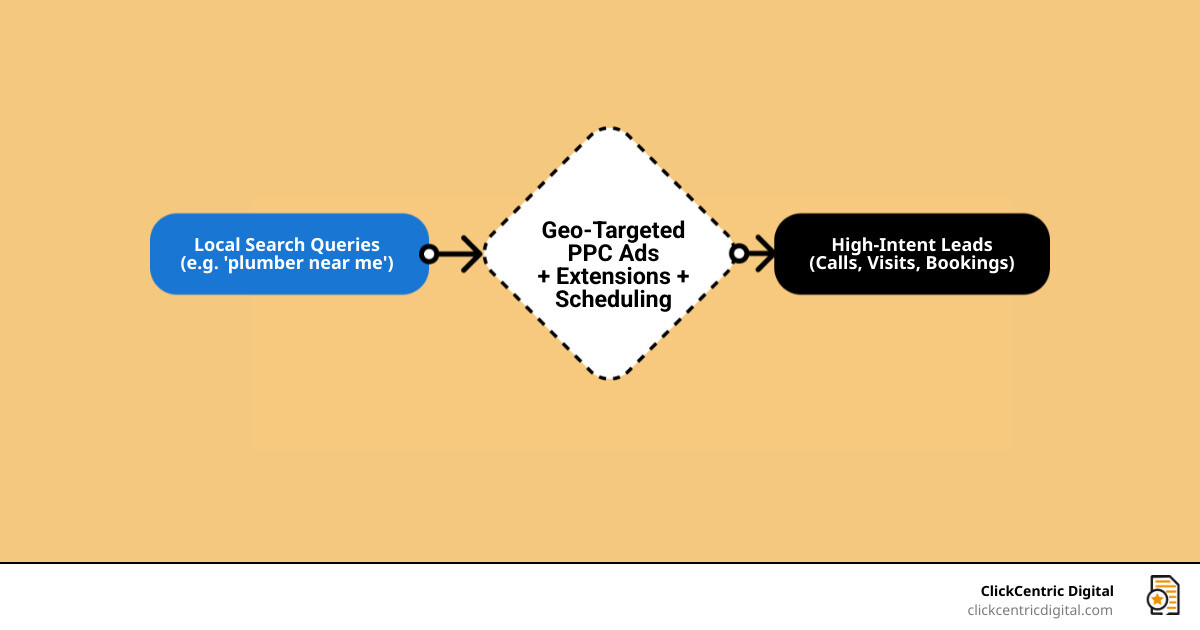
In 2026, local PPC management is no longer just “run some Google Ads in my city and hope for the best.” It is a structured system for buying visibility where and when local demand exists, then turning that visibility into calls, form leads, booked appointments, and in-store visits.
That means managing:
- Google Ads and Microsoft Ads
- geographic targeting by city, zip code, or radius
- search terms and negative keywords
- mobile-first ad formats
- Google Maps and local visibility signals
- landing pages built for specific service areas
- tracking that measures real leads, not vanity clicks
For businesses in Grand Rapids, Holland, Grand Haven, South Haven, Kalamazoo, and the wider West Michigan market, local intent matters because convenience matters. People usually choose the provider that looks nearest, most relevant, and easiest to contact.
What is local PPC management and why it matters
At its core, local PPC management is paid search with geographic precision. Instead of advertising to everyone, we narrow your spend to the places that actually produce revenue.
That matters because local search behavior is high intent. Someone searching “roof repair near me” or “urgent care Kalamazoo” is much closer to taking action than someone making a broad informational search.
A good local campaign helps you:
- show up for nearby buyers
- reduce wasted spend outside your service area
- prioritize areas with better close rates
- support store visits and phone calls
- compete in crowded local markets without needing a giant budget
There is also a practical reason to care: local search results change constantly. Ads, map placements, extensions, and mobile layouts all influence what people click. Local PPC gives you faster control than SEO alone.
Google’s own Google Ads Help is also useful for understanding current platform features, location settings, and campaign options as they evolve.
Who benefits most from local PPC campaigns
Local PPC is especially valuable for businesses that depend on customers from a defined geography. That includes:
- small businesses trying to win more local leads
- franchises needing location-level visibility
- multi-location companies routing leads to the nearest branch
- home service providers working by service radius
- healthcare practices and clinics
- law firms targeting city-specific demand
- restaurants and hospitality brands
- B2B companies serving regional markets
If your revenue depends on being found in the right local market, local PPC is relevant. If your customers can come from anywhere, it is less essential. Pretty simple.
Local PPC vs broader paid search
Broader paid search casts a wider net. Local PPC is more surgical.
The difference shows up in three places:
Relevance
Local ads can mention the city, neighborhood, or service area directly.Budget control
You avoid paying for clicks from places you do not serve.Conversion quality
Hyper-local traffic usually converts better because the searcher is nearby and ready to act.
Local campaigns also connect better to map-based behavior. Roughly 35% of local keywords show local pack ads, which means maps visibility and location assets can directly affect click-through and foot traffic.
If you want a deeper look at campaign design, see our guide on local PPC campaigns that bring people through the door.
How to Build a Local PPC Management Strategy That Actually Converts
Strong local PPC starts before the first ad goes live. We need clear goals, accurate targeting, clean conversion tracking, and a campaign structure that gives the ad platforms useful data.
Geographic targeting best practices for local PPC management
This is where many campaigns go wrong.
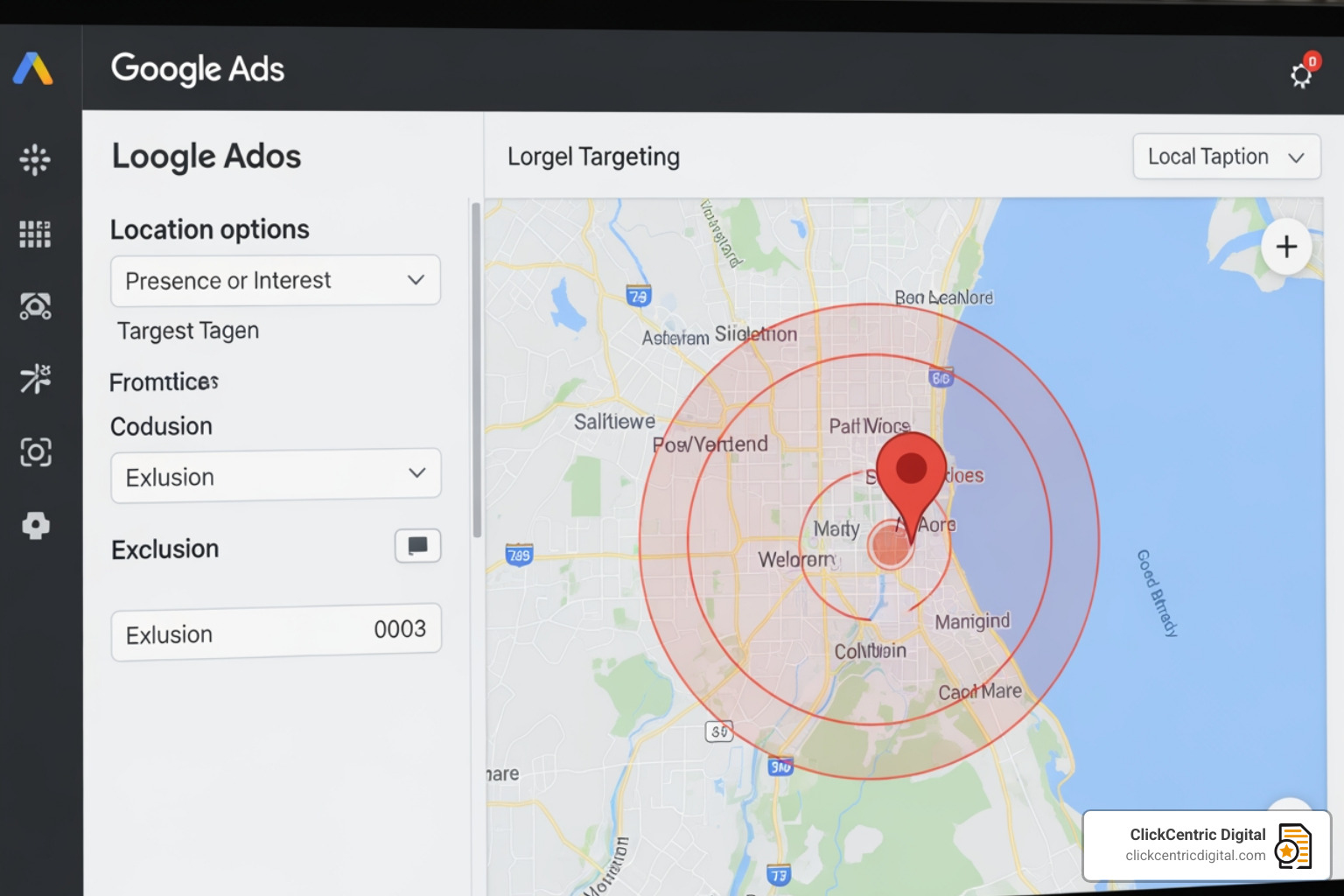
A business says, “We can serve anyone within 25 miles,” so they target 25 miles. In reality, conversion rates often drop as distance increases, and cost per acquisition can climb sharply after the first few miles.
A smarter approach is tiered targeting:
- 0-3 miles: highest bids
- 3-7 miles: moderate bids
- beyond 7 miles: lower bids, tighter filtering, or exclusions
This kind of radius strategy helps avoid the “radius trap,” where you technically can serve a faraway customer but rarely do so profitably.
Best practices include:
- target by zip code when performance differs across neighborhoods
- exclude cities or areas that never convert
- use presence targeting, not broad interest targeting, when possible
- apply bid adjustments for high-value service areas
- consider commuter traffic if your audience searches near work, not home
For many local accounts, zip code bidding beats broad city targeting because it gives tighter control. Not every part of a city performs the same.
Keyword strategies for near me and hyper-local searches
Local keyword strategy should mix obvious location terms with more specific intent phrases.
Start with these buckets:
- service + city
- service + near me
- service + neighborhood
- problem + city
- emergency or urgent modifiers
- landmark-based local phrases where relevant
Examples of intent types:
- “family dentist holland mi”
- “water heater repair grand rapids”
- “same day plumber near me”
- “auto repair near downtown”
“Near me” keywords matter, but they can also be expensive and crowded. In many accounts, long-tail local phrases convert more efficiently than generic high-volume terms.
We also recommend mining the search terms report constantly. That is where you find:
- converting local phrases to scale
- irrelevant searches to block with negatives
- local language customers actually use
Negative keywords are a huge part of local PPC management. Without them, you pay for job seekers, DIY queries, irrelevant locations, and low-intent research traffic.
Campaign and ad group structure for cleaner data
Campaign structure should support intent, not just keyword obsession.
For many local advertisers, SIAGs, or single-intent ad groups, outperform rigid SKAG-style structures. Why? Because grouping closely related terms by intent often gives the platform more data, faster learning, and enough volume to optimize bidding.
A practical local setup might look like this:
Campaign: Plumbing – Grand Rapids
- Ad group: Water Heater Repair
- Ad group: Drain Cleaning
- Ad group: Emergency Plumber
Campaign: Plumbing – Holland
- Ad group: Water Heater Repair
- Ad group: Drain Cleaning
- Ad group: Emergency Plumber
That structure keeps:
- keywords aligned to a service theme
- ad copy tightly relevant
- landing pages matched to intent
- reporting cleaner by service area
SKAGs are not always wrong, but in 2026 they are often too fragmented for local accounts with limited data. Intent clusters usually make more sense.
Ad scheduling, dayparting, and peak demand timing
Running ads 24/7 sounds ambitious. It is often just expensive.
If no one answers the phone at 11:42 PM, those clicks are usually low value. Local campaigns should align with when your team can convert leads.
Best practices:
- run ads during business hours
- stop ads 15-30 minutes before closing
- increase bids during peak call windows
- reduce or pause low-converting hours
- adjust for weekday vs weekend behavior
- account for seasonality and weather-driven demand
A lunch rush strategy may matter for restaurants. Morning urgency may matter for medical or repair services. Heat waves can spike HVAC demand. Rain can increase certain emergency service searches. Dayparting is not glamorous, but it saves money.
Ads That Win Clicks and Calls in Local Markets
The best local ads feel close, specific, and easy to act on.
Writing ad copy that feels local
Good local ad copy answers the searcher’s silent question: “Are you actually near me, and can you help right now?”
That means using:
- city names and service areas
- neighborhood language when appropriate
- clear offers
- urgency when the service fits
- strong call-to-action language
- proof signals like reviews, years in business, or local experience
For example, generic copy says “Trusted Roof Repair Services.” Better local copy says “Roof Repair in Grand Rapids – Fast Local Service.”
You can also use dynamic location insertion in some campaigns to adapt headlines to the user’s area, as long as the result still reads naturally.
A little local flavor helps. Too much becomes weird. If your ad reads like a tourist brochure, we have gone too far.
The best ad extensions and local ad features to use
Extensions are not optional for local campaigns. They give people more ways to convert without making them work for it.
Most useful local assets include:
- location extensions
- call extensions
- sitelinks
- structured snippets
- callout assets
- promotion assets
Why they matter:
- Location extensions connect ads to your address and can support maps visibility.
- Call assets make mobile conversion easier.
- Sitelinks can send users to service pages, financing info, offers, or contact pages.
- Structured snippets highlight service categories or brands.
- Promotions can push limited-time local offers.
If you sell physical inventory, local inventory features may also help bridge searchers from ads to nearby product availability.
How Google Business Profile improves paid performance
Your Google Business Profile can strengthen local paid performance by improving location accuracy, hours, directions, and proximity signals within Google’s ecosystem.
A well-maintained GBP helps with:
- location extensions
- directions and map actions
- accurate hours
- review visibility
- nearest-location routing for multi-location businesses
This matters because local searchers often compare businesses fast. If your ad says one thing and your profile shows outdated hours or the wrong location, trust drops immediately.
GBP and paid search work best together, not separately. If you want to understand the map side better, read our guide on Google Maps ad costs and how to not go broke.
Landing Pages, Mobile Experience, and Conversion Rate Optimization
Clicks are not the goal. Conversions are.
A local campaign can have strong targeting and ads, then fall apart because traffic lands on a slow, vague homepage. This is incredibly common.
| Destination | Typical result |
|---|---|
| Generic homepage | Lower relevance, weaker conversion rates, more friction |
| Dedicated local landing page | Better message match, stronger trust, higher lead quality |
How to optimize landing pages for local relevance
A local landing page should continue the conversation started in the ad.
That usually means including:
- a localized H1
- the exact service searched
- city or service area references
- testimonials from nearby customers
- local photos when available
- trust badges, awards, or certifications
- a visible phone number and form
- an embedded map where appropriate
Message match matters. If the ad says “Emergency Plumber in Holland,” the landing page should not open with “Welcome to Our Company” and a stock photo of a smiling family in Arizona.
Pages should feel local, useful, and easy to act on.
Why mobile optimization is non-negotiable for local campaigns
This is the part many businesses still underestimate.
More than 62% of internet traffic comes through mobile, and 50% of mobile searches have local intent. On top of that, 50% of consumers who do a local search on a smartphone visit a store within a day.
So yes, mobile matters a little.
Also:
- 40% of mobile users are likely to bounce if a page takes longer than a few seconds to load
- 60% of users who have a bad mobile experience will not buy from that brand again
For local PPC, mobile optimization means:
- fast load times
- tap-to-call buttons
- thumb-friendly forms
- short, scannable sections
- visible hours and address
- no annoying popups blocking the screen
A local ad click often comes from someone standing in a parking lot, sitting in a truck, or making a quick decision between two providers. The page must help them act now.
Conversion tracking that measures real business outcomes
This is one of the biggest buyer beware issues in local PPC management.
Not all conversions are equal. A button click is not the same as a booked job. A page view is definitely not revenue, no matter how pretty the chart looks.
We want tracking tied to outcomes such as:
- qualified phone calls
- booked appointments
- completed lead forms
- direction requests
- store visits where available
- offline sales imported from a CRM
We also want to avoid fake conversions, such as:
- every click on a phone number
- time on site goals
- duplicate form fires
- low-value page visits
Good tracking lets you calculate CPA and ROAS honestly. It also helps identify which locations, devices, and services produce the best leads. For a broader foundation on account management, see Mastering Google PPC management without losing your mind.
Costs, KPIs, and Advanced Tactics for Better ROI
The cost of local PPC management depends on both ad spend and management complexity.
How much local PPC management costs and what affects pricing
Common pricing models include:
- monthly management fees
- one-time setup fees
- hourly consulting
- percentage of ad spend
Research shows many PPC managers charge roughly $75 to $200 per hour, while some agencies offer monthly packages starting under $1,000 and scaling upward based on scope.
What affects cost:
- ad budget size
- number of locations
- service-area complexity
- industry competition
- landing page needs
- reporting depth
- call tracking and CRM integration
- how much cleanup the account needs
There is also a practical floor. Very small budgets can make optimization difficult because there is not enough data to learn from. Research suggests around $600 per month in ad spend is often the minimum needed to gather meaningful signals, though competitive local markets may need more.
What success looks like in local PPC
Success is not “we got impressions.”
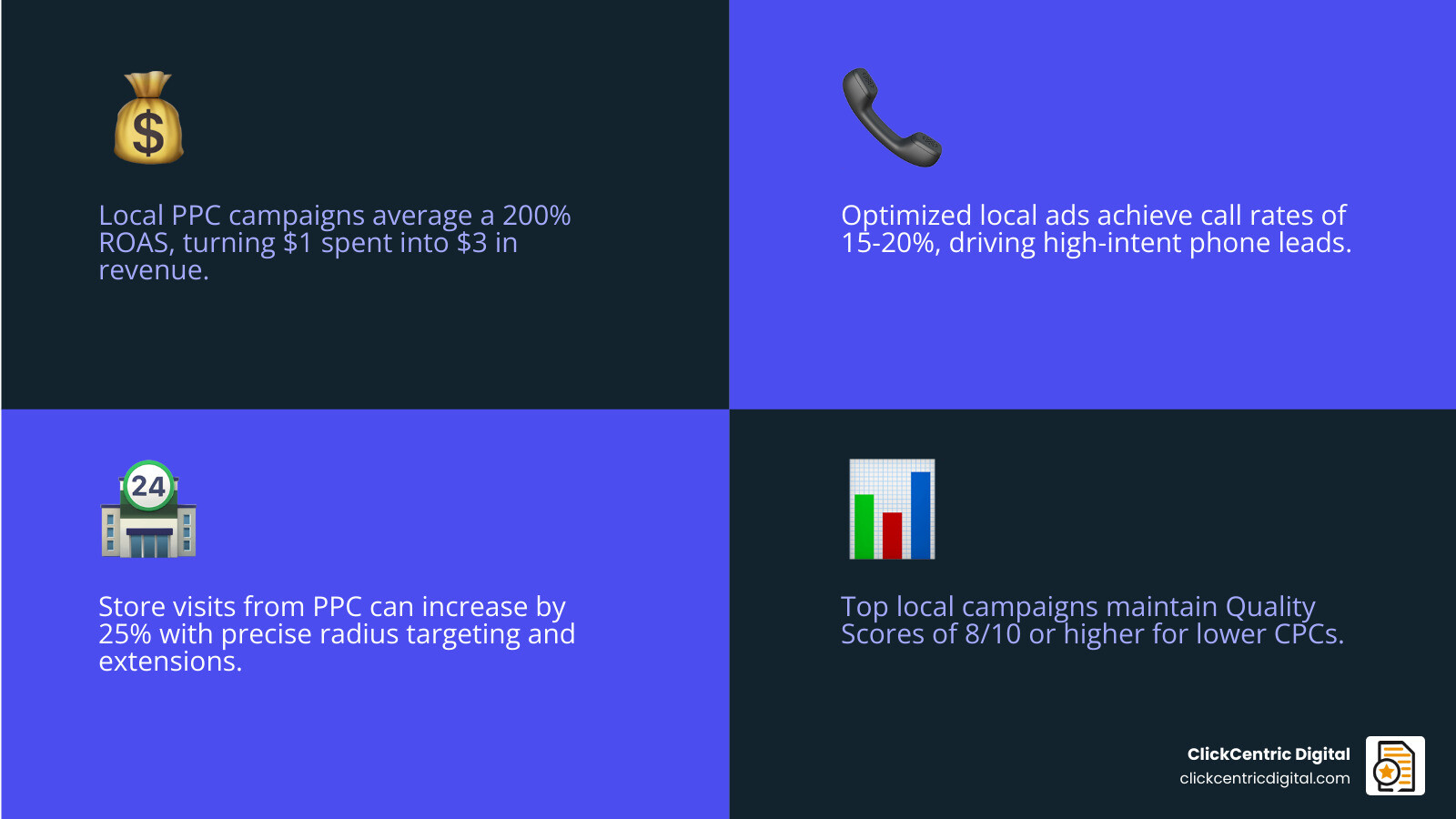
For local accounts, we care about metrics like:
- cost per lead or CPA
- return on ad spend
- call rate
- lead quality
- impression share in target areas
- conversion rate by location
- Quality Score
- close rate from lead to customer
- store visits or direction requests where applicable
Geographic ROI is especially useful. One zip code may produce cheap leads that never close, while another produces fewer leads but much better customers. Smart local PPC management reallocates budget accordingly.
Advanced tactics that can outperform generic local campaigns
Once the fundamentals are working, advanced tactics can create an edge.
Examples include:
- weather-triggered ad messaging for seasonal services
- competitor geofencing in specific situations
- remarketing to previous site visitors
- audience layering by household or in-market behavior
- device bid adjustments
- localized promotional offers
- early testing of new platform features when available
Weather-based messaging is especially useful for HVAC, roofing, landscaping, and emergency services. A well-timed heat-wave ad can outperform a generic evergreen message.
Remarketing also works well locally because many prospects compare multiple providers before choosing. Staying visible can increase return visits and branded searches.
When to hire an agency instead of managing in-house
In-house management can work if you have:
- enough time
- solid platform knowledge
- tracking expertise
- landing page support
- discipline to test and optimize weekly
An agency makes more sense when:
- spend is being wasted and you cannot diagnose why
- you need faster testing and tighter reporting
- multiple locations must be managed
- your internal team is stretched thin
- conversion tracking is messy
- local growth matters enough to treat PPC as a revenue channel, not a side project
A good agency should bring process, transparency, and constant optimization. If you’re weighing support options, start with why you need a certified PPC expert and the small business guide to affordable Google Ads management services.
Common Mistakes Buyers Should Avoid When Choosing Local PPC Management
Many local campaigns do not fail because PPC “doesn’t work.” They fail because the setup is sloppy.
Mistakes that waste budget fast
Watch for these common problems:
- broad geographic targeting with no exclusions
- no negative keyword management
- ads running 24/7
- traffic sent to the homepage
- weak or fake conversion tracking
- the wrong Google Business Profile attached
- desktop-first pages in a mobile-first market
- ignoring the search terms report
- slow landing pages
- leaning too hard on vanity metrics
Another issue to watch is low-quality network traffic. Some accounts waste budget on placements or partner inventory that brings lots of cheap clicks but poor leads. If the traffic looks busy and the phone stays quiet, that is a clue.
Questions to ask before hiring a local PPC provider
Before you sign anything, ask:
- Who owns the ad account?
- How do you define a conversion?
- How often do you review search terms and negatives?
- How do you handle geographic targeting and bid adjustments?
- Will you build or improve landing pages?
- What reporting do we get, and how often?
- How do you measure lead quality, not just lead volume?
- How will you align ads with business hours?
- How do you use GBP and location assets?
- What is your testing plan for ads, pages, and bids?
Red flags include vague answers, dashboard-only reporting, no discussion of landing pages, and an obsession with clicks over revenue.
Conclusion: How to Choose the Best Local PPC Management Partner for 2026
The best local PPC management partner for 2026 is not the one promising magic. It is the one focused on fit, precision, tracking, and real business outcomes.
Your buyer checklist should include:
- clear local targeting strategy
- strong negative keyword process
- mobile-first ads and landing pages
- honest conversion tracking
- reporting tied to CPA and ROAS
- GBP alignment
- dayparting and bid adjustments by location
- a plan for ongoing testing and optimization
At ClickCentric Digital, we focus on targeted strategies that help local businesses attract nearby customers through search and paid traffic. Whether you serve Grand Rapids, Holland, Grand Haven, South Haven, Kalamazoo, or the surrounding West Michigan market, the goal is the same: spend smarter, waste less, and turn local searches into real revenue.
If you are ready to evaluate your options, explore our paid traffic management services and take the next step with a strategy built for local growth.
Sorry, the comment form is closed at this time.