

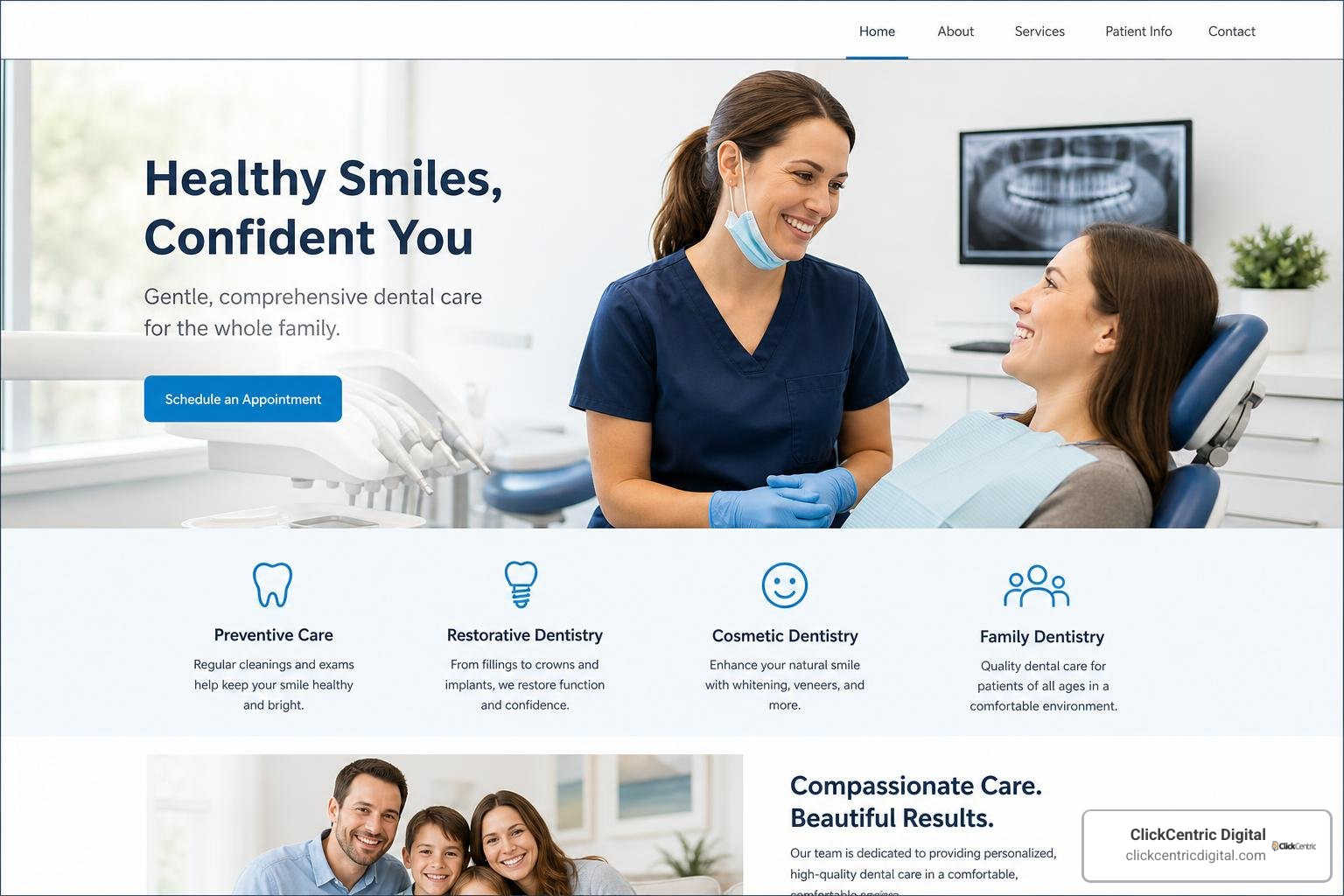
09 Sep The Ultimate Guide to Comparing Dental Website Design Services
The Ultimate Guide to Comparing Dental Website Design Services
Your Dental Website Is Either Winning Patients or Losing Them
Website design for dentists is the process of building and optimizing a dental practice’s online presence to attract local patients, build trust, and convert visitors into booked appointments.
Here’s what a high-performing dental website needs:
- Mobile-first design — loads fast and works perfectly on smartphones
- Online scheduling — lets patients book without calling
- Clear navigation — services, team, location, and contact info are easy to find
- Local SEO foundations — schema markup, Google Maps integration, and location-specific content
- Trust signals — real patient photos, reviews, and before/after galleries
- HIPAA-compliant forms — secure contact and intake forms
- Custom photography and video — builds personal connection before the first visit
Think about this: a patient searches for a dentist near them. They land on your website. Research shows they decide whether to stay or leave within three seconds — based on how the site makes them feel, not your actual clinical skills.
Over 90% of patients visit a dental practice’s website before ever making contact. And 77% search Google before choosing a dentist. That means your website isn’t just a brochure. It’s your busiest front desk employee — working 24/7.
The problem? Most dental websites were built years ago by a generalist agency (or a cousin who “knows computers”). They look dated, load slowly, and don’t guide visitors toward booking. They’re losing patients every single day to competitors with sharper, faster, more trustworthy sites.
Choosing the right dental website design service — and knowing what to look for — can be the difference between a practice that grows steadily and one that stays invisible online.
I’m Fred Dirkse, and in this guide I’ll walk you through everything you need to compare dental website design services, make a smart investment, and build a site that actually brings in new patients.
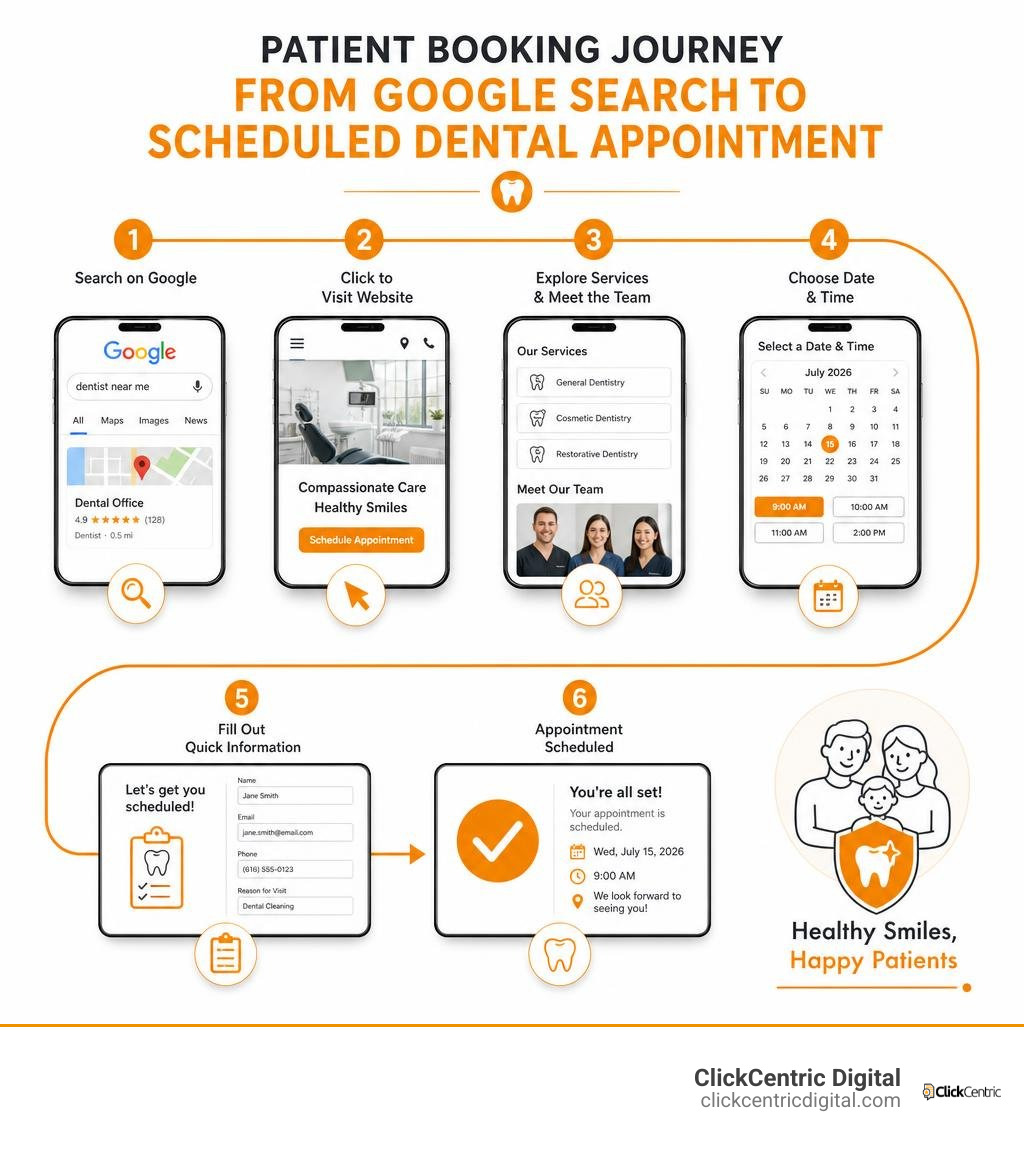
Why Professional Website Design for Dentists is Your Best Patient Acquisition Tool
In the digital landscape of July 2026, your physical office in Grand Rapids or Holland might be spotless, state-of-the-art, and welcoming—but if your digital storefront is cluttered and slow, prospective patients will assume your clinical care is outdated too. Your website is your primary engine for patient acquisition. It acts as your 24/7 digital front desk, introducing your team, explaining your services, and securing bookings while your physical office is closed.
Investing in professional digital assets is no longer optional. When you evaluate the ROI of your marketing budget, a high-converting website outpaces almost every other channel. It serves as the landing pad for your local SEO efforts, your Google and Facebook ads, and your social media campaigns. To understand how web development integrates with your broader growth strategy, explore our deep dive on web design marketing.

Mobile-First Architecture in Website Design for Dentists
Over 70% of all local dental searches occur on mobile devices. If a parent in Kalamazoo or Grand Haven is searching for an emergency dentist while comforting a child with a toothache, they are doing it from a smartphone. They do not have the patience to pinch, zoom, or wait for a heavy desktop site to load.
Mobile-first architecture means your website is engineered from the ground up for handheld screens, then scaled up for desktops—not the other way around.
- Core Web Vitals & Speed Optimization: Google explicitly rewards fast-loading websites that meet strict performance metrics (LCP, FID, CLS). A delay of just two seconds can cause your bounce rate to spike by over 50%.
- Tap-Friendly Navigation: Buttons must be large enough to tap easily, and critical actions (like calling the office or booking an appointment) must remain sticky or floating at the bottom of the screen.
- Responsive Layouts: Content must seamlessly reflow to fit any screen size, whether it is an iPhone, an iPad, or a widescreen desktop monitor.
Online Scheduling and Frictionless Contact Accessibility
The modern patient expects instant gratification. If they have to wait until Monday morning at 8:00 AM to call your office and book a cleaning, they will likely find another clinic that offers self-scheduling.
Integrating frictionless online booking options directly into your website design for dentists dramatically improves conversion rates. By utilizing real-time scheduling widgets, patients can view available slots, select their preferred time, and input their insurance details in under a minute.
For patients who still prefer to speak with a human, contact accessibility must be front and center. Click-to-call phone numbers should be positioned prominently in the header of every page, alongside a highly visible “Request Appointment” button. Reducing the number of clicks required to make contact is the fastest way to turn casual web traffic into active patients.
Core Principles of Modern Dental Web Design
A beautiful website is useless if visitors cannot find the information they need. Modern dental web design relies on clear navigation, intuitive page hierarchy, and clean layouts that reduce cognitive load. When a user arrives, they should immediately understand:
- What services you offer (general dentistry, implants, cosmetics, pediatric).
- Where you are located (with clear links to local maps for Grand Rapids, Holland, or Grand Haven).
- Who you are (the dentists and the clinical team).
- How to schedule an appointment.
Furthermore, your website must be accessible to every member of your community. This includes older adults, individuals with visual impairments, and users with cognitive differences. Adhering to inclusive web design best practices ensures that your practice complies with ADA standards while expanding your reach to all prospective patients in West Michigan.
Local SEO and AI Search Optimization
To win new patients, your website must be visible where people are looking. Traditional local SEO ensures you rank highly in Google’s Map Pack and organic search results for phrases like “dentist in Grand Rapids MI” or “family dentistry Holland MI.” To achieve this, your site needs a solid, SEO friendly website redesign that incorporates localized keywords, structured page hierarchies, and clean URL paths.
However, in 2026, we must also optimize for AI search engines like ChatGPT, Google AI Overviews, Gemini, and Perplexity. When a user asks an AI assistant, “Who is the best pediatric dentist in Grand Haven MI that accepts Delta Dental?”, the AI reads your website’s structural data to formulate its answer.
To ensure your practice is cited by AI search platforms, we implement:
- Definition-First Service Pages: Structuring content to clearly define treatments, costs, and expectations in plain language.
- Local Business Schema Markup: Embedding precise code (such as
Dentist,LocalBusiness, andFAQPageschema) that search engines and AI models use to verify your address, phone number, hours, and services. - Targeted Local Content: Building dedicated landing pages for specific West Michigan neighborhoods to capture hyper-local search intent.
For example, local practices that optimize their site structure often see a dramatic rise in organic visibility, establishing local search dominance in West Michigan. By implementing clean hierarchies and localized content, practices in Grand Rapids, Holland, and Kalamazoo can stand out in highly competitive search results.
Building Patient Trust with Custom Media and Testimonials
Dentistry is deeply personal, and for many, it is associated with anxiety. Your website must work to ease that fear and build immediate trust. The most effective way to do this is by replacing cold, corporate stock photography with high-quality, custom media.
When prospective patients see real, high-resolution photos of your welcoming office, your friendly front-desk staff, and your actual dentists, their anxiety drops. High-impact video content, such as a brief office tour or a doctor introduction video, creates an authentic connection before the patient ever steps foot in your clinic.
Additionally, visual proof of your clinical expertise is incredibly persuasive. A dedicated, easy-to-navigate before-and-after gallery allows patients to see real smile transformations (such as veneers, dental implants, or Invisalign) performed by your team. To elevate your visual identity, combining custom media with professional dental branding establishes a cohesive brand that commands authority in your local market.
Practice Management and Communication Tool Integrations
Your website shouldn’t exist in a vacuum; it should act as an extension of your physical office operations. Modern dental websites integrate seamlessly with your Practice Management Software (PMS) and Customer Relationship Management (CRM) tools like Dentrix, Open Dental, RevenueWell, or Weave.
These integrations allow for:
- Automated Scheduling: Bookings made online instantly sync with your office calendar, reducing double-bookings and manual data entry for your front desk.
- Digital Patient Intake: Secure, HIPAA-compliant digital intake forms allow patients to fill out their medical histories, insurance info, and consent forms on their phone before arriving.
- Two-Way Texting and Live Chat: Floating chat widgets allow patients to text your front desk directly from the website, turning casual questions into scheduled appointments.
All data collected through these portals must be handled securely. Implementing SSL encryption, secure hosting, and HIPAA-compliant form builders is non-negotiable for protecting patient privacy and maintaining legal compliance.
Custom vs. Template-Based Dental Website Development
When comparing dental website design services, one of the most critical decisions you will make is choosing between a custom-built website and a template-based platform.
Template-based designs are built on pre-existing layouts. While they can be launched quickly, they often suffer from generic branding, bloated code, and rigid structures that make custom SEO strategies difficult to implement. Conversely, custom dental website development is engineered from scratch around your practice’s unique brand, target patient demographics, and specific local SEO goals.
To see how advanced templates can speed up development while maintaining a clean code structure, tools like the Caliora Website Page Template for Webflow offer a middle ground for modern, high-speed designs.
| Feature | Template-Based Dental Websites | Custom Dental Web Design |
|---|---|---|
| Unique Branding | Limited; other practices may use the exact same layout | 100% unique; built to reflect your physical practice |
| Page Speed & Performance | Often slower due to bloated, generic code libraries | Highly optimized; sub-2-second load times on mobile |
| SEO Flexibility | Rigid; hard to customize schema and page architecture | Unlimited; structured specifically for Google and AI search |
| Ownership | Often tied to a proprietary platform with monthly lock-ins | You own 100% of the files, code, and hosting account |
| Integration Capability | Limited to pre-approved widgets | Can integrate with any PMS, CRM, or custom API |
The True Cost of Custom Website Design for Dentists
When analyzing the cost of a professional website, it’s helpful to view it as an investment rather than an expense. A cheap template site might save you money upfront, but if it fails to convert visitors, it will cost you tens of thousands of dollars in lost patient revenue over time.
Typically, professional dental website packages range from $2,500 to $6,000+ for a complete, custom build, depending on the complexity of your services and required integrations. Ongoing hosting and maintenance fees generally range from $30 to $100 per month for high-performance servers (like WP Engine or Kinsta).
Consider the ROI: with the average lifetime value of a single dental patient exceeding $1,000, your new website only needs to convert three or four new patients to completely pay for itself. Practices that implement high-performance designs often see a dramatic increase in monthly bookings, making the initial investment highly profitable.
Key Considerations for a Dental Website Redesign
If your practice already has an online presence but it’s failing to deliver results, it might be time for a professional website redesign. However, rebuilding a live website requires careful planning to ensure you don’t destroy your existing search engine rankings.
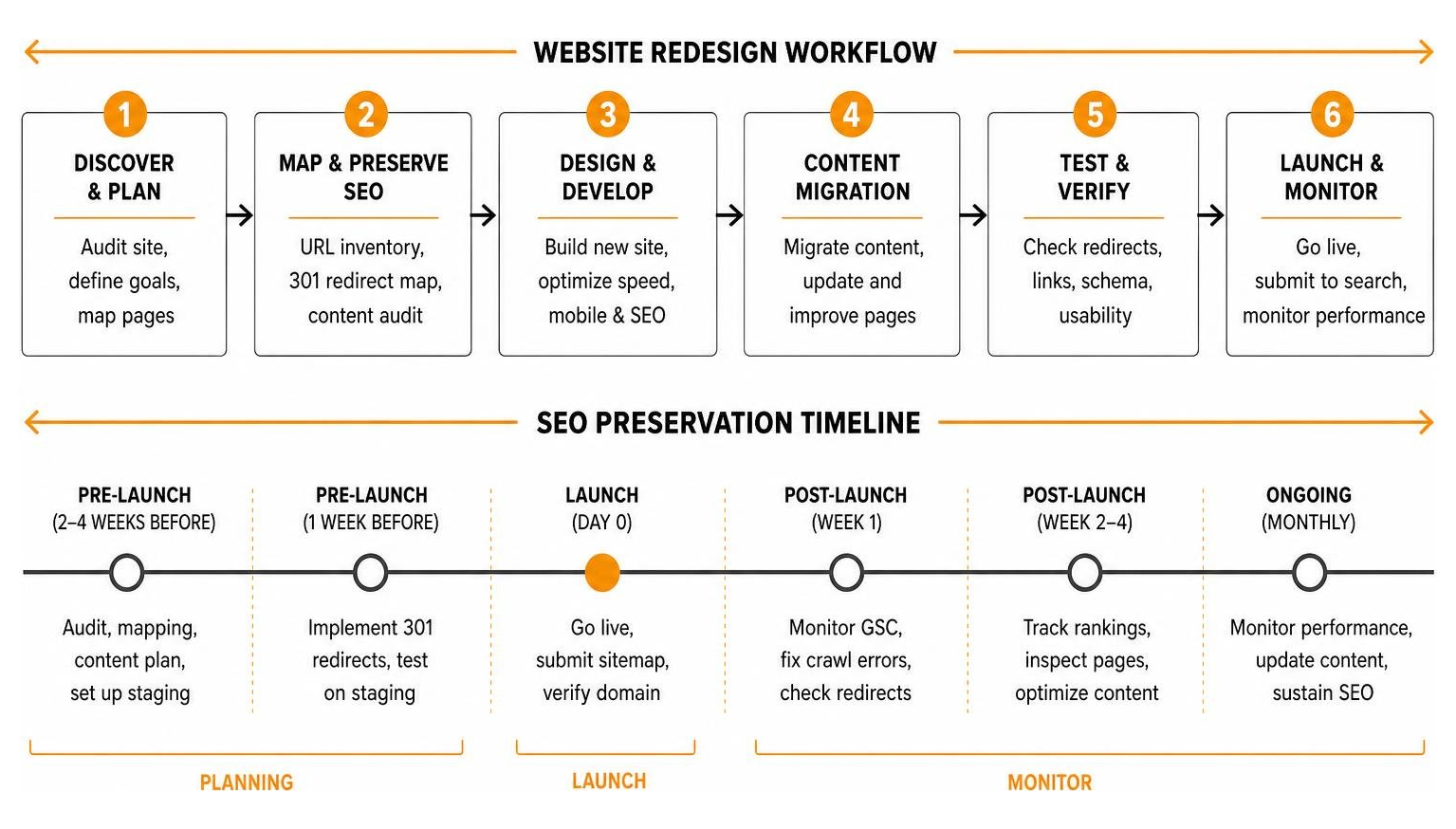
When executing a redesign, we focus on:
- 301 Redirect Mapping: Ensuring every old URL is permanently redirected to its corresponding new page so you don’t lose backlink authority or trigger “404 Page Not Found” errors.
- Content Migration: Carefully preserving your top-performing blog posts and service pages while rewriting thin content to target modern search intent.
- Google Search Console Verification: Monitoring the indexing status of your new site immediately after launch to catch and fix any technical crawl errors.
Common Dental Website Design Mistakes to Avoid
To ensure your website converts at the highest possible rate, avoid these common design pitfalls:
- Using Too Much Stock Photography: Patients can spot fake, staged smiles from a mile away. It creates a cold, impersonal barrier. Always use real photos of your team and office.
- Slow Page Load Speeds: If your homepage takes more than three seconds to load, users will click back to Google and choose a competitor.
- Cluttered Layouts and Unclear Navigation: Forcing users to hunt through confusing drop-down menus to find basic pricing, location, or contact info will drive them away.
- Buried Contact Information: Your phone number, address, and booking button should be visible instantly on every single page without scrolling.
- Neglecting Local Target Pages: Grouping all your services on a single page instead of creating dedicated, SEO-optimized pages for implants, veneers, and cleanings limits your search rankings.
Frequently Asked Questions about Dental Web Design
How long does it take to build a new dental website?
A standard professional dental website typically takes 4 to 6 weeks from the initial kickoff meeting to the final launch. Complex projects—such as multi-location practices or sites requiring deep custom API integrations—may take 8 to 10 weeks. This timeline includes discovery, wireframing, custom copywriting, visual design, development, and rigorous pre-launch testing.
Are dental websites required to be HIPAA compliant?
Yes. Any website that collects Protected Health Information (PHI)—such as patient intake forms, medical histories, or appointment request forms containing clinical details—must be fully HIPAA compliant. This requires secure SSL encryption, encrypted databases, and secure form delivery systems to ensure patient privacy is protected at all times.
How often should a dental practice update its website?
From a technical and design perspective, a complete website redesign is recommended every 2 to 3 years to keep pace with evolving web standards, security protocols, and visual trends. However, content updates (such as adding patient reviews, updating team bios, and publishing educational blog posts) should occur continuously to maintain your search engine authority.
Conclusion
Your website is the digital gateway to your practice. In West Michigan’s competitive dental market—from Grand Rapids and Holland to Grand Haven and South Haven—having a fast, modern, and trustworthy online presence is the single most effective way to grow your patient list.
Whether you are building your first website, looking to upgrade a dated template, or aiming to dominate local search and AI search engines, we are here to help. At ClickCentric Digital, we specialize in helping local dental practices optimize their digital footprints, manage online reviews, and leverage targeted search and paid traffic campaigns to win lifelong patients.
Ready to transform your online presence? Learn more about our custom Website Design Development services and schedule your digital audit today.
Sorry, the comment form is closed at this time.