


07 Sep Put Your Business on the Map with These Local SEO Strategies
Put Your Business on the Map with These Local SEO Strategies
Why Local Map SEO Is the Highest-ROI Channel Most Businesses Are Ignoring
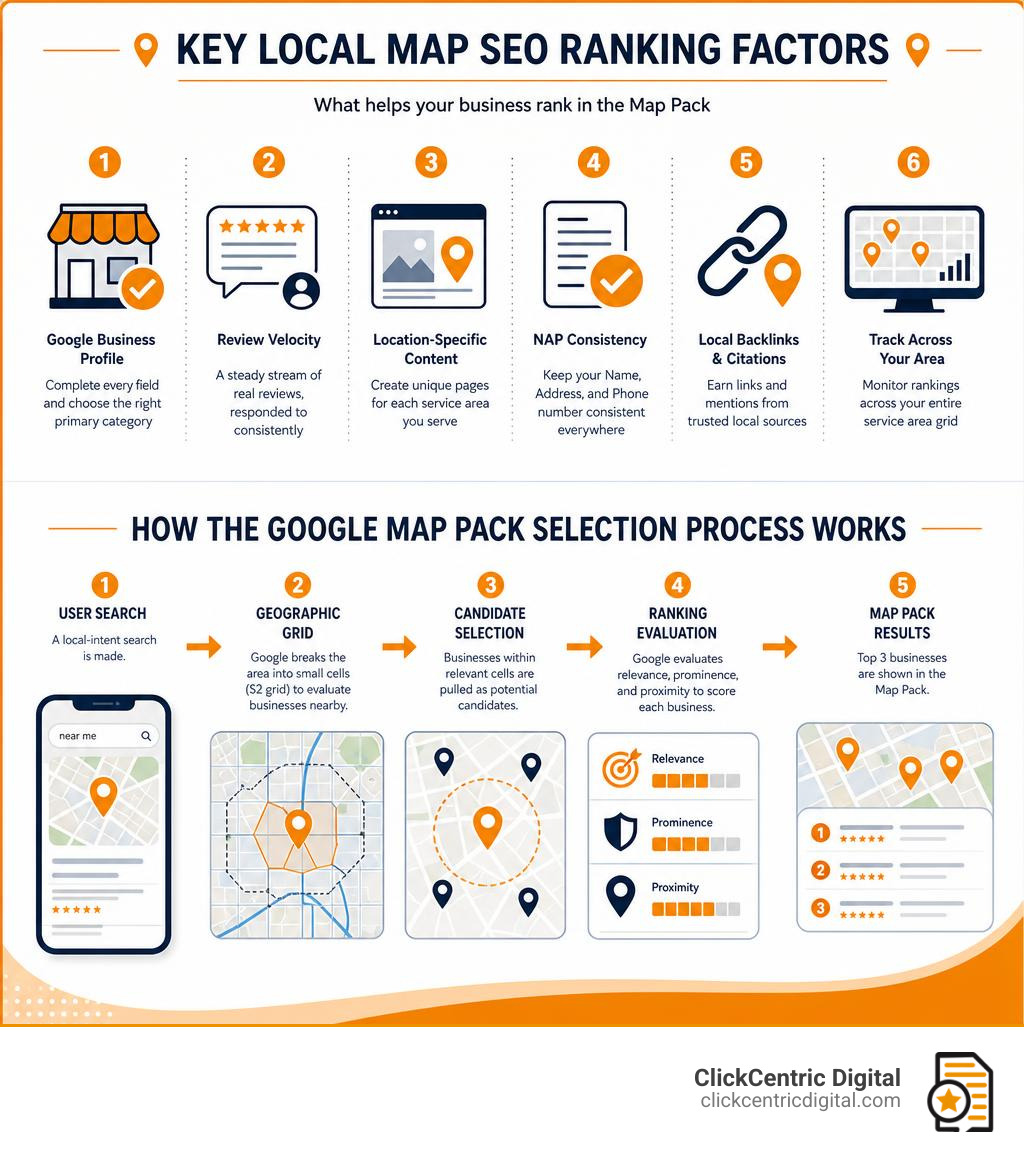
Local map SEO is the practice of optimizing your business to appear in Google’s Map Pack and across the geographic grid that determines who shows up when nearby customers search for what you sell.
Here’s what good local map SEO gets you, fast:
- Claim and verify your Google Business Profile — complete every field, pick the right primary category
- Build review velocity — a steady stream of real reviews, responded to consistently
- Create location-specific pages on your website — unique content tied to your actual service areas
- Keep your NAP consistent — same name, address, and phone number everywhere it appears online
- Earn local backlinks and citations — from directories, local press, and community partners
- Track rankings across your full service area — not just from one pin on the map
The stakes are real. Positions 1 through 3 in the Map Pack capture roughly 80% of clicks for local-intent searches. And according to industry data, 50% of all calls to local businesses come directly from the Google Maps pack.
That means if you’re not in the top 3, you’re largely invisible — even to customers who are standing a block away from your front door.
But here’s the problem most business owners don’t realize: local search rankings are not city-wide. They change street by street. A competitor two miles away might outrank you in your own neighborhood, while you dominate somewhere they’ve never touched. Traditional SEO tools won’t show you this. A single-point rank check gives you a false sense of security.
The local search landscape has also shifted in ways that catch even experienced marketers off guard. The old model — where whoever was closest to the searcher won — is largely dead. In its place is a more complex system built around geographic cells, content relevance scoring, entity trust, and AI-driven search surfaces that are rewriting the rules in real time.
This guide breaks all of it down, from the technical foundations to the practical weekly habits that move the needle.
Discover more about local map seo:
The Evolution of Local Map SEO: Proximity vs. S2 Occupancy
For years, many businesses treated Google Maps rankings like a simple distance contest:
‘Whoever is closest to the searcher wins.’
Distance still matters, but in 2026 it is no longer the whole story. Google’s own documentation explains that local results are primarily based on relevance, distance, and prominence:
- Relevance – how well your business matches the search
- Distance – how close your business is to the searcher or searched area
- Prominence – how trusted, known, reviewed, and referenced your business is
The modern version of local map SEO is about strengthening all three across the real geography where your customers search. That means thinking less like ‘I rank in Grand Rapids’ and more like ‘I rank in these specific neighborhoods, corridors, and service zones across Grand Rapids, Holland, Grand Haven, South Haven, Kalamazoo, and West Michigan.’
This is where S2 cells come in.
Google has used advanced geographic indexing systems to understand the real world. S2 geometry is one way geographic space can be divided into cells, or small map sections. While Google does not publish every detail of its Maps ranking algorithm, S2-style grid thinking is extremely useful for local SEO because rankings vary by location, not just by keyword.
If you want a deeper breakdown of ranking signals, read our guide to Google Maps ranking factors.
Understanding S2 Cells and Geographic Grids
S2 cells are a way of dividing the earth into manageable geographic pieces. Instead of treating a city as one big blob, a grid system breaks it into smaller areas. Each area can be evaluated for search demand, competition, relevance, and business visibility.
In plain English: Google Maps does not see ‘West Michigan’ the way a person does. It sees a web of geographic points, roads, neighborhoods, business entities, searcher locations, and intent patterns.
Advanced local SEO tracking often uses geo-grids to simulate searches from different latitude and longitude coordinates. For example, a business might scan rankings from a 5×5 or 9×9 grid around its location. Each grid point acts like a different customer searching from that exact spot.
That helps answer questions like:
- Are we visible near our actual storefront?
- Do we rank in the neighborhoods where our best customers live?
- Are we losing visibility near a competitor?
- Do we rank in Holland but disappear in Grand Haven?
- Are we strong in central Kalamazoo but weak around the outer service area?
S2 cell thinking helps us stop guessing. Instead of checking one keyword from one office computer and declaring victory, we can see the actual pattern of visibility across a local market.
The Death of Pure Proximity in Local Map SEO
The old proximity model rewarded businesses mainly because they were closest. That created a frustrating experience for companies with better reviews, stronger websites, and better service but slightly farther physical locations.
The newer model is more layered. Distance still influences results, especially for ‘near me’ searches, but it often acts more like a tiebreaker when relevance and prominence are similar.
A business can improve its visibility outside its immediate address area by strengthening:
- Google Business Profile relevance
- Review quantity, quality, and recency
- Local landing pages
- Service-area clarity
- Local backlinks and citations
- Website authority
- Consistent NAP data
- Strong engagement signals
Think of proximity like the cover charge at a concert. You still need it to get in the room, but it does not guarantee the best seat. Your relevance and trust signals decide whether you make it into the front row.
To go deeper on practical implementation, see how we master local map optimization.
How the Google Map Pack Selection Process Works
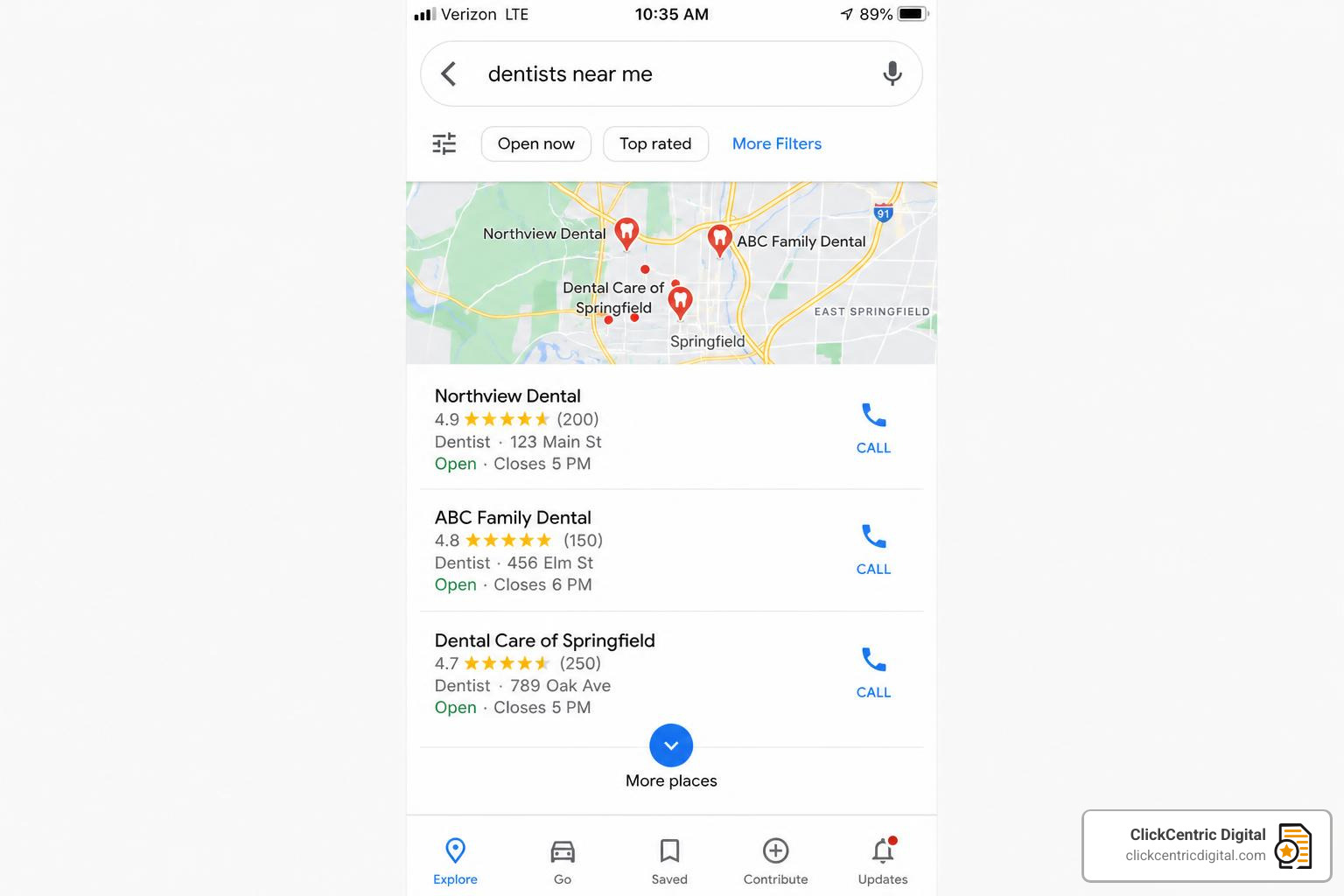
The Google Map Pack, often called the 3-pack, is the group of three local business listings that appears for many local-intent searches. These listings usually include the business name, rating, review count, category, hours, address or service area, call button, website link, and directions.
This is the money zone.
For many local businesses, the Map Pack drives more immediate action than traditional organic search. Industry data shows that about 50% of calls to local businesses can come directly from the Maps pack. Positions 1 through 3 capture roughly 80% of clicks for local-intent queries.
Here is a simple way to think about Map Pack click distribution:
| Map Pack Position | Approximate Click Opportunity | Why It Matters |
|---|---|---|
| Position 1 | 35% to 45% | Highest trust, most visibility, easiest mobile click |
| Position 2 | 20% to 30% | Strong visibility, often compared against position 1 |
| Position 3 | 15% to 25% | Still inside the main decision set |
| Below top 3 / More places | Much lower | Requires an extra click and more effort |
These numbers vary by industry, device, query, and market, but the lesson is consistent: if your business is not in the 3-pack, many customers will never see you.
The Two-Stage K-Cluster Algorithm
A practical way to understand Map Pack selection is as a two-stage process.
First, Google builds a candidate set. It looks for businesses that could reasonably satisfy the query based on category, location, relevance, profile data, and trust signals. This is where spam filtering, duplicate listings, guideline violations, and weak profiles can knock a business out before the race even starts.
Second, Google chooses the three seats. The winners are not always the closest three businesses. They are the three businesses that best match the query, location, and confidence signals for that searcher.
The selection process may consider signals like:
- Primary Google Business Profile category
- Secondary categories
- Services and products listed
- Review signals
- Website relevance
- Local authority
- Searcher location
- Business hours
- Listing completeness
- Spam risk
- Historical engagement
- Entity confidence
This is why a business can rank well in one part of Grand Rapids but not another, or appear for “emergency plumber” but not “water heater repair,” even though both services are on the same website.
Also, guideline compliance matters. Keyword-stuffed business names, fake locations, duplicate listings, and virtual-office abuse can create short-term gains but long-term risk. Suspensions are not a fun SEO strategy. They are the digital equivalent of locking your keys in the car while it is running.
BERT Optimization and the Three Vectors
BERT is part of Google’s natural language understanding. For local SEO, the main idea is simple: Google is better at understanding meaning, not just matching exact keywords.
A page that says “roof repair Holland MI” twenty times is not automatically better than a page that clearly explains roof leak repair, storm damage, neighborhoods served, timing, materials, warranties, and local proof.
For local content, we think about three helpful relevance vectors:
Contextual vector
Does the page clearly explain the service, problem, solution, and business expertise?Positional vector
Does the page connect that service to a real place, such as Holland, Grand Haven, South Haven, Kalamazoo, Grand Rapids, or a specific West Michigan service area?Segment vector
Is the content organized in a way Google can understand, with clear headings, tables, FAQs, service sections, schema, and internal links?
High-confidence content is specific. It tells Google exactly what you do, where you do it, and why your business is a trusted match.
Low-confidence content says vague things like “we provide high-quality solutions for all your needs.” That could describe a plumber, a dentist, a sandwich shop, or your uncle’s garage band. Google needs more clarity than that.
Structuring Your Website for S2 Cell Dominance
Your website is not separate from your Google Maps visibility. It supports your Google Business Profile by reinforcing relevance, location, authority, and trust.
A strong local website structure helps Google connect:
- Your business entity
- Your services
- Your physical or service-area geography
- Your reviews and proof
- Your local content
- Your Google Business Profile
The goal is not to create thin pages for every city in Michigan. The goal is to build useful, unique pages for the real markets you serve.
The Hub-and-Spoke Silo Architecture
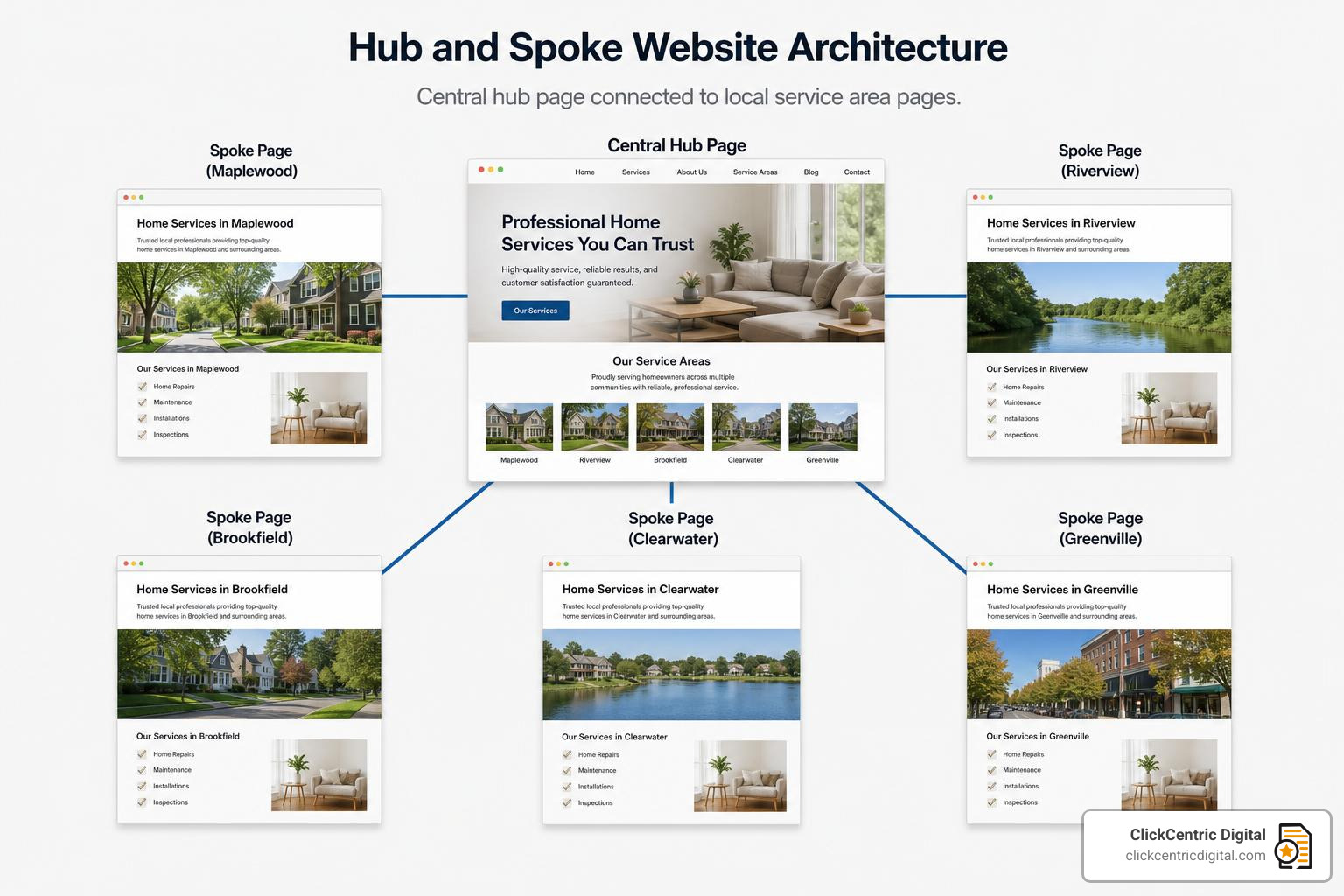
A hub-and-spoke structure is one of the cleanest ways to organize local SEO content.
The hub page is the main authority page for a service or location. The spoke pages support it with more specific topics, neighborhoods, nearby cities, FAQs, or service variations.
For example, a West Michigan service business might use:
- Main hub: Local SEO services in West Michigan
- Spoke: Local SEO in Grand Rapids MI
- Spoke: Google Maps optimization in Holland MI
- Spoke: Review strategy for Grand Haven MI businesses
- Spoke: Local search visibility in Kalamazoo MI
- Spoke: Service-area SEO in South Haven MI
A practical internal linking rule is:
- Link each spoke up to the main hub
- Link each spoke to 2 or 3 related spokes
- Link the hub down to the most important spokes
This creates a clear topical map. Google can understand which page is the main authority and which pages support it.
This kind of structure also helps users. Someone searching in Kalamazoo does not want a generic statewide page. They want to know that you understand their local market, local competitors, and customer behavior.
Industry case studies have shown that structured local optimization can drive meaningful traffic gains, including examples of multi-location brands seeing sizable increases in customer traffic after stronger Maps and profile optimization. The bigger lesson: structure compounds. A clean local architecture supports rankings, conversions, and reporting.
Information Gain and Unique Local Content
Google does not need 20 pages that say the same thing with the city name swapped out. That is how businesses accidentally create doorway pages.
Unique local content should add information that only belongs on that page.
Good local page elements include:
- Local photos
- Specific service-area details
- Nearby landmarks
- Common local customer problems
- Local testimonials or review themes
- Driving or parking details for storefronts
- Local project examples
- City-specific FAQs
- Local regulations, seasonality, or weather considerations
- Embedded map where appropriate
- Clear NAP information
For example, a page for Holland MI should not be a clone of a Grand Rapids page. Holland has different neighborhoods, customer behavior, seasonal traffic patterns, and local search competition.
Information gain means the page teaches Google and the reader something new. If the only difference is the city name, the page is probably too thin.
On-Page and Off-Page Signals for Local Map SEO in 2026
Local map rankings improve when your whole digital footprint tells the same story.
Your Google Business Profile says one thing. Your website says the same thing. Your citations confirm it. Your reviews reinforce it. Your backlinks support it. Your photos and posts show that the business is active.
That consistency builds entity trust.
For more on current ranking priorities, read our guide on how to win the Local Pack in 2026.
Google Business Profile Optimization and Review Velocity
Your Google Business Profile is the foundation of local map visibility.
At minimum, optimize:
- Business name, exactly as used in the real world
- Primary category
- Secondary categories
- Address or service area
- Phone number
- Website URL
- Business hours and holiday hours
- Services
- Products, if relevant
- Attributes
- Photos and videos
- Business description
- Q&A
- Posts and updates
The primary category is especially important. It should match what the business actually is, not just what it wants to rank for. A wrong category can suppress visibility even if everything else is strong.
Reviews are another major trust signal. The winning pattern is not a sudden burst of 50 reviews and then silence for a year. It is steady review velocity.
A healthy review strategy includes:
- Asking happy customers at the right moment
- Making the review link easy to access
- Using QR codes where appropriate
- Never buying or gating reviews
- Responding to every review
- Mentioning service details naturally in replies
- Watching for recurring customer language
Industry research shows that 76% of consumers who are asked to leave a review go on to do so. In other words, many businesses do not have a review problem. They have an asking problem.
Off-page signals also matter. Local citations and backlinks help validate your business entity. A link from a relevant local organization, community partner, chamber, news outlet, or industry directory is usually more valuable than a pile of random low-quality directory links.
Technical Local Signals and Schema Markup
Technical SEO supports local map SEO by making your business information easy for search engines to crawl, understand, and trust.
Important technical signals include:
- Fast, mobile-friendly pages
- HTTPS security
- Crawlable location pages
- Clear site architecture
- NAP in the footer and contact page
- Embedded Google Map where useful
- LocalBusiness schema
- Review schema where compliant
- Service schema where appropriate
- Consistent title tags and headings
- Internal links to location and service pages
LocalBusiness schema is structured data, usually added as JSON-LD. It helps clarify your business name, address, phone number, URL, hours, service area, and business type.
The key rule: schema should match visible content and your Google Business Profile. Do not use schema to stuff hidden keywords or claim locations you do not actually serve.
NAP consistency still matters because it reduces confusion. If your website says one phone number, your Google profile says another, and a directory has an old address, Google has to decide which version to trust. That friction can hurt rankings and conversions.
Navigating AI Surfaces: AI Overviews and Ask Maps
Local search is no longer limited to blue links and map pins. Customers are increasingly seeing AI-generated answers, AI Overviews, and conversational map experiences.
That means local visibility now includes:
- Google Maps
- Google Search
- Map Pack results
- Local organic pages
- AI Overviews
- Ask Maps-style experiences
- Voice-like conversational queries
AI systems tend to compress trust. They pull from clear, consistent, corroborated entities. If your business information is messy, thin, or inconsistent, AI has less reason to mention you.
To improve AI-era local visibility, focus on:
- Clear entity information
- Consistent NAP across the web
- Strong Google Business Profile data
- Helpful local pages
- Real reviews with service details
- FAQ content that answers natural questions
- Structured data
- Local mentions and citations
- Strong brand signals
In simple terms: make your business easy to understand, easy to verify, and easy to recommend.
AI is not replacing local SEO. It is raising the bar. The businesses with the clearest local entity signals are more likely to show up wherever customers ask for recommendations.
Measuring and Tracking Performance Across Geographic Cells
You cannot improve what you only check from your desk.
Local rankings vary by block, road, neighborhood, and searcher location. A business can be number 1 at its address and number 9 just a few miles away. That is why geographic rank tracking is essential.
Useful local map SEO KPIs include:
- Map Pack rankings by grid point
- Share of local visibility across a service area
- Calls from Google Business Profile
- Direction requests
- Website visits from GBP
- Review volume and average rating
- Review response rate
- Conversion rate from local landing pages
- Rankings by keyword and location
- Competitor visibility by cell
- Citation accuracy
- Local backlink growth
For most local businesses, we recommend tracking rankings across a grid rather than a single point. A 5×5 grid can be a good starting point for smaller local markets, while denser or more competitive areas may require more granular tracking.
The goal is not to obsess over every tiny ranking movement. The goal is to spot patterns:
- Where are we strong?
- Where are we invisible?
- Which keywords are improving?
- Which competitors dominate specific cells?
- Which areas need content, reviews, or links?
- Are calls and direction requests increasing?
This is how local SEO becomes a real growth system instead of a monthly guessing game.
If you are tired of checking rankings manually, read our guide on how to stop guessing your local map ranking.
Frequently Asked Questions about Local Map SEO
How long does it take to see results from local map SEO?
Most businesses can start seeing early movement within 30 to 90 days after fixing major Google Business Profile, review, citation, and website issues.
Bigger gains often take 3 to 6 months, especially in competitive markets like Grand Rapids, Holland, Grand Haven, South Haven, Kalamazoo, and broader West Michigan service areas.
A practical timeline looks like this:
- Weeks 1-2: Audit Google Business Profile, citations, website, reviews, and rankings
- Weeks 3-4: Fix profile issues, NAP problems, categories, services, and tracking
- Weeks 5-8: Publish or improve local landing pages and start review velocity
- Weeks 9-12: Build local authority, monitor geo-grid changes, refine content
- Months 4-6: Expand visibility cell by cell and improve conversion rates
Some changes, like correcting a wrong category, can move quickly. Others, like building local authority and content relevance across a service area, take longer.
Does physical distance still matter for Google Maps ranking?
Yes, distance still matters. Google has publicly stated that local rankings are influenced by relevance, distance, and prominence.
But distance is no longer the only factor that matters.
If two businesses are equally relevant and equally trusted, the closer one may win. But a business with stronger reviews, better category alignment, stronger website signals, and more local authority can often compete beyond its immediate address area.
That is why S2 cell and geo-grid thinking is useful. You are not trying to “rank everywhere” with one generic signal. You are trying to build relevance and trust in the specific geographic cells where your best customers search.
Can service area businesses rank without a physical address?
Yes. Service area businesses can rank in Google Maps without showing a public storefront address, as long as they follow Google Business Profile guidelines.
A service area business should:
- Hide the address if customers do not visit the location
- Define accurate service areas
- Use a real business phone number
- Choose the correct primary category
- Build strong service-area landing pages
- Collect reviews from real customers
- Keep NAP consistent where address visibility is appropriate
- Avoid fake offices or rented addresses used only for rankings
For service businesses across West Michigan, this matters a lot. A company may serve Grand Rapids, Holland, Grand Haven, South Haven, and Kalamazoo without having a public office in every city. The strategy should reflect real service coverage, not fake location creation.
Conclusion
Local map SEO is no longer just about being closest. It is about being the clearest, most trusted, most relevant option in the exact places your customers are searching.
To win in 2026, businesses need to:
- Optimize Google Business Profile completely
- Build steady review velocity
- Create useful local landing pages
- Strengthen NAP consistency
- Earn real local links and citations
- Track rankings across geographic grids
- Improve entity trust for search and AI surfaces
- Measure calls, leads, directions, and revenue, not just rankings
At ClickCentric Digital, we help local businesses turn search visibility into customer acquisition. Whether you are trying to grow in Grand Rapids MI, Holland MI, Grand Haven MI, South Haven MI, Kalamazoo MI, or across West Michigan, we build targeted strategies that connect your business with the customers already searching for you.
Ready to put your business on the map and keep it there? Optimize your Google Maps ranking today.
Sorry, the comment form is closed at this time.