

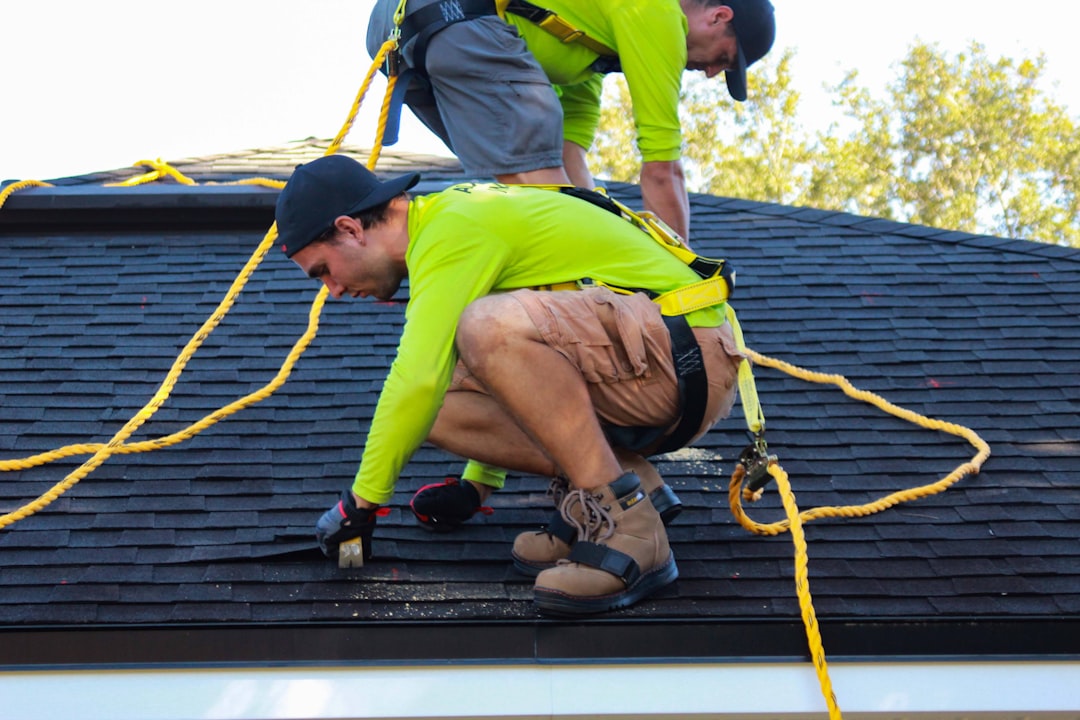
17 Jun Commercial Roof Repair and Maintenance: Protecting Your Business Investment
Commercial Roof Repair and Maintenance: Protecting Your Business Investment
Why Commercial Roof Repair Deserves Your Immediate Attention
Commercial roof repair is the process of identifying and fixing damage to a business building’s roofing system — before small problems become expensive disasters.
Quick answers for building owners:
- What it covers: Patching membranes, sealing leaks, fixing flashing, repairing drainage, and restoring worn roofing surfaces
- When you need it: Water stains on ceilings, pooling water, lifting seams, musty smells, or after any major storm
- How urgent is it: Very. Even a minor leak can cause insulation damage, mold growth, and structural deterioration within days
- Repair vs. replacement: Most roofs can be repaired or restored if caught early — full replacement is usually a last resort
- Cost impact: Early repairs cost a fraction of full replacement and can extend your roof’s life by 20 to 50+ years
Your commercial roof is one of the most expensive components of your building. Yet it’s also one of the most ignored — until water starts dripping onto equipment, inventory, or customers.
The reality is that most commercial roof failures don’t happen overnight. They build slowly through small cracks, clogged drains, and worn seams that go unnoticed until the damage is already widespread.
Twice-yearly inspections and prompt repairs are the single most effective way to protect that investment. A roof that might cost tens of thousands to repair could cost hundreds of thousands to replace — and the difference often comes down to how quickly problems were addressed.
This guide walks you through everything you need to know: what causes commercial roof damage, how to spot it early, when to repair versus replace, and what to expect from the repair process.
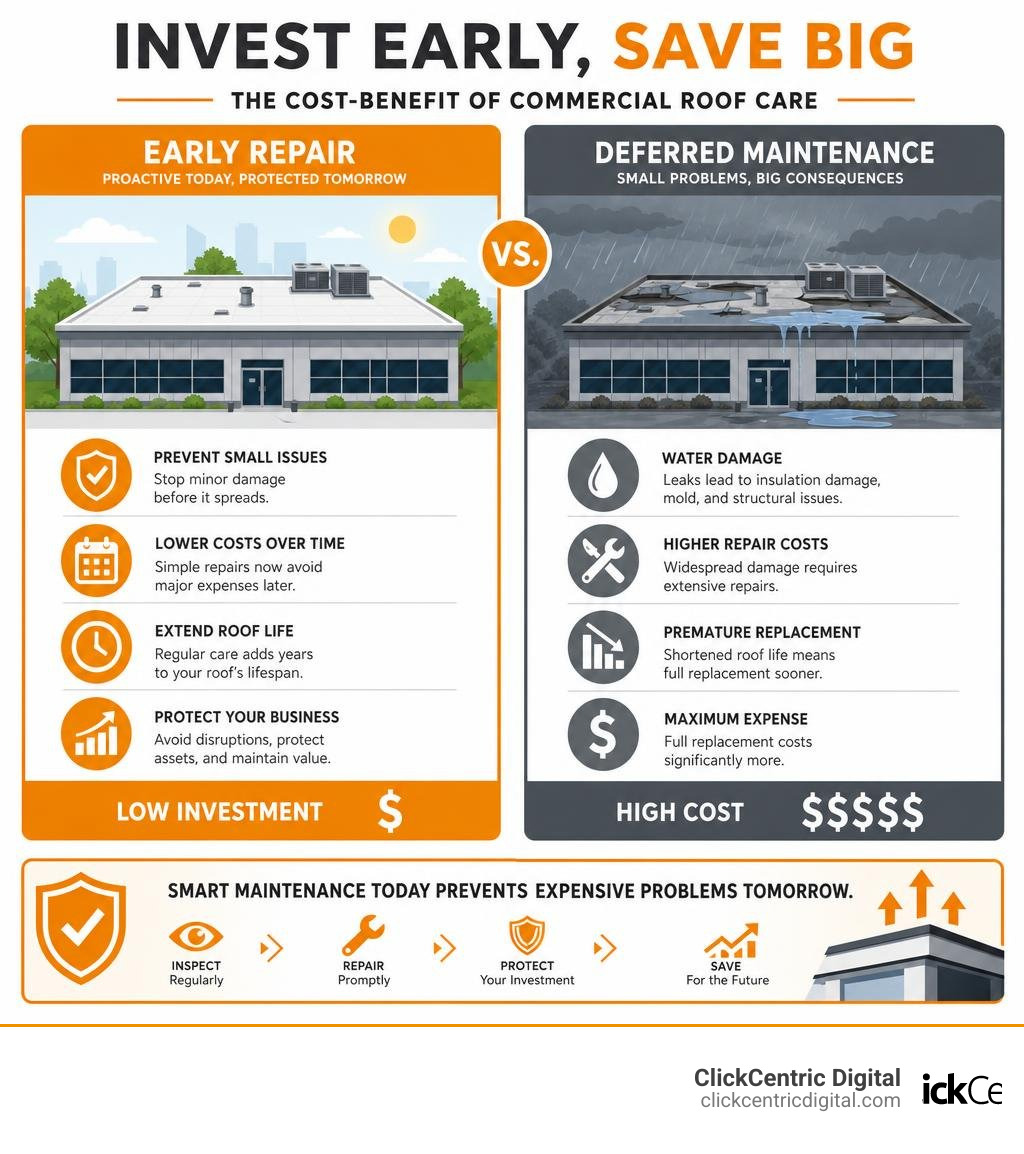
Simple guide to commercial roof repair terms:
Common Causes and Early Warning Signs of Commercial Roof Damage
Commercial roofing systems face a constant barrage of environmental stressors. In West Michigan—from the windy shores of Grand Haven MI and South Haven MI to the inland business hubs of Grand Rapids MI and Kalamazoo MI—our roofs endure intense seasonal shifts. Understanding what causes commercial roof deterioration is the first step toward preventing catastrophic structural failures.
- Ponding Water: Flat and low-slope roofs are uniquely vulnerable to standing water. If water remains on a roof surface for more than 48 hours without evaporating or draining, it is classified as “ponding.” This standing water exerts immense hydrostatic pressure on the membrane, accelerating the breakdown of adhesives and eventually finding its way through the tiniest seam imperfections.
- UV Degradation: Even on cloudy days, ultraviolet radiation breaks down the chemical bonds of roofing membranes. Over time, materials like TPO, EPDM, and modified bitumen lose their flexibility, becoming brittle and prone to cracking.
- Wind Damage: High winds can lift loose membrane edges, tear flashing away from parapet walls, and blow debris across the roof surface, causing punctures and abrasions.
- Membrane Punctures: HVAC technicians, window washers, and other maintenance personnel walking across the roof can accidentally drop tools, puncture membranes, or scrape protective coatings.
- Thermal Expansion and Contraction: West Michigan weather is famous for dramatic temperature swings. The rapid transition from freezing winter nights to sunny afternoons causes roofing materials to expand and contract. This “thermal shock” strains seams, fasteners, and flashing details.
- Clogged Drains: Fallen leaves, twigs, and windblown trash can easily block roof drains, scuppers, and gutters. When drainage is restricted, water backs up across the roof, transforming minor seam gaps into major entry points for active leaks.
Early Warning Signs Your Building Needs Commercial Roof Repair
You don’t have to wait for a indoor waterfall to realize your commercial roof is in trouble. By keeping an eye out for these subtle indicators, you can address issues when they only require a simple patch rather than a major overhaul.
- Water Stains: Discolored patches on ceiling tiles or along interior walls are the most obvious signs of water intrusion. Because water travels along roof decks and insulation before dripping down, the leak source on the roof is rarely directly above the interior stain.
- Musty Odors: If certain rooms or utility closets have a persistent, damp, musty smell, moisture is likely trapped within the roofing insulation or wall cavities, fostering mold growth.
- Bubbling Membrane: If you notice localized “balloons” or bubbles under your single-ply membrane, it means air or moisture has trapped itself beneath the system. This indicates the adhesive or mechanical fasteners have failed.
- Rusted Fasteners: Exposed screws or plates that show signs of rust indicate that moisture is lingering on or just beneath the surface, weakening the structural hold of the roof system.
- Accelerated Deterioration: Cracking, bald spots on mineral-surfaced roofs, or chalky residue on metal roofing are clear signs that the system’s protective layers are failing.
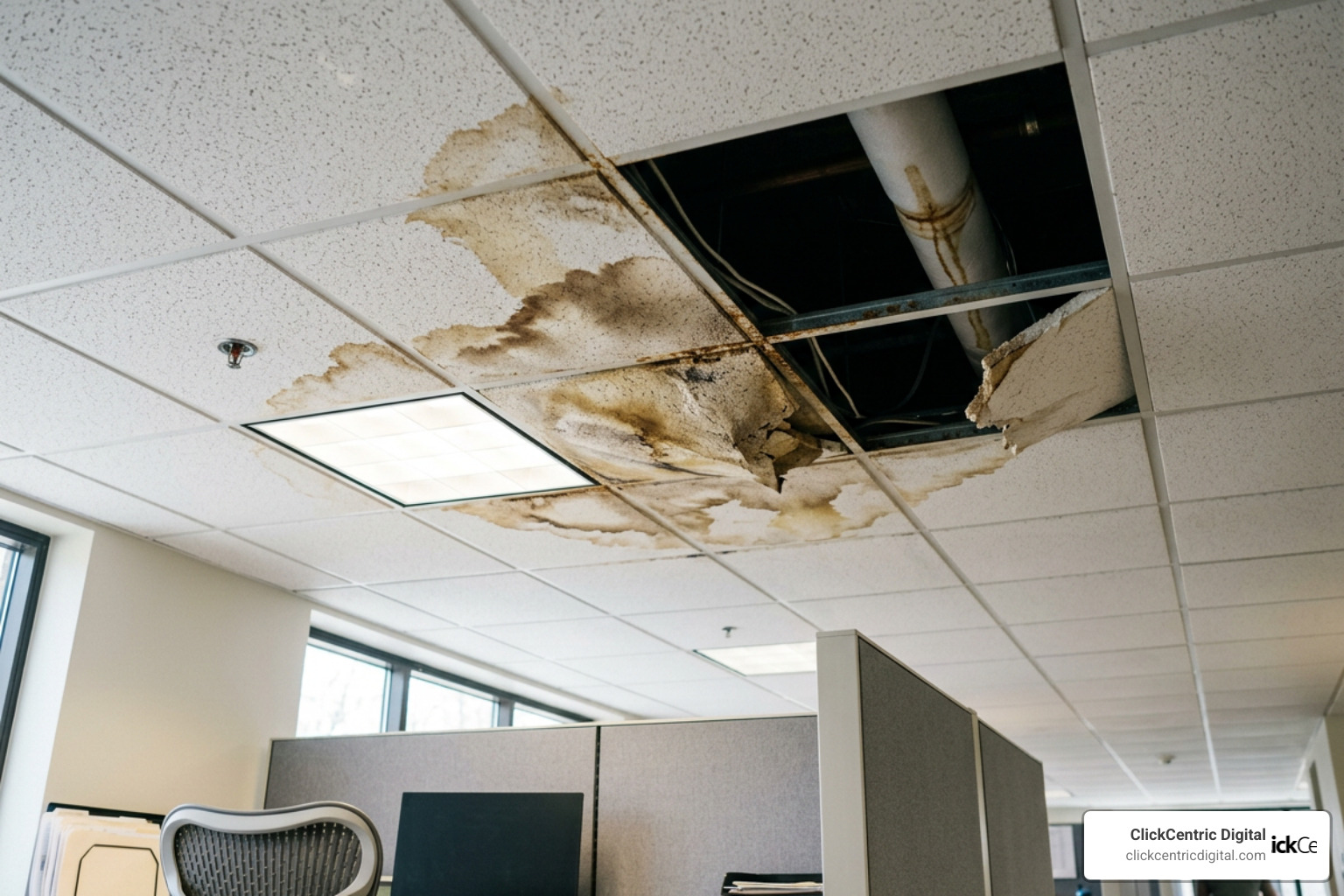
When these warning signs appear, acting quickly is paramount. Working with a dedicated specialist for Commercial Roof Leak Repair – Rapid Commercial Roofing ensures that the leak is traced to its true origin and repaired using industry-standard techniques before structural decking or interior assets are compromised.
Commercial Roof Repair vs. Full Replacement: Making the Right Decision
One of the most challenging decisions a building owner or facility manager faces is deciding whether to patch an aging roof or invest in a complete tear-off and replacement. Making the wrong choice can either waste capital on temporary fixes or force a massive capital expenditure before it is truly necessary.
To make an informed decision, several critical factors must be evaluated:
- Roof Age: Most commercial roofing systems are designed to last between 20 to 30 years. If your roof is only 10 years old and experiencing a localized leak, commercial roof repair is almost always the logical choice. However, if the system is approaching the end of its engineered lifespan, recurring repairs may simply be throwing good money after bad.
- Structural Integrity: If the underlying roof deck is structurally sound and dry, repairs or restoration are highly viable. If the deck is sagging, rusted, or rotting, replacement is mandatory for safety and code compliance.
- Moisture Mapping: Professional contractors use infrared scanning or nuclear moisture meters to map where wet insulation exists under the membrane. If less than 20–25% of the insulation is wet, those specific areas can be cut out, replaced, and patched. If moisture has saturated more than 25% of the roof footprint, a full replacement is typically required.
- Restoration Coatings: For roofs that are structurally sound but aging, reflective elastomeric or silicone coatings can be applied. This process—known as commercial roof restoration—seals minor leaks, restores UV protection, and can extend the roof’s lifespan by 10 to 20 years at a fraction of the cost of a full replacement.
- Capital Budget vs. Operational Expenses: Repairs are typically categorized as operational expenses (OpEx), which can be deducted in the year they occur. Full replacements are capitalized (CapEx) and depreciated over many years.
- Energy Efficiency: A new roof replacement allows you to install modern, high-R-value insulation, significantly lowering heating and cooling bills. However, reflective restoration coatings also improve energy efficiency by bouncing solar heat away from the building.
| Feature / Factor | Commercial Roof Repair | Commercial Roof Restoration | Full Roof Replacement |
|---|---|---|---|
| Typical Cost | Low (Localized pricing) | Moderate (30-50% of replacement) | High (Full capital expenditure) |
| Lifespan Added | 1 to 5 years | 10 to 20+ years | 20 to 30 years |
| Disruption Level | Very Low | Low (No tear-off noise/debris) | High (Tear-off, heavy equipment) |
| Insulation Replaced | Only in localized damp spots | None (Must be dry beforehand) | 100% replaced with new materials |
| Tax Treatment | Immediate OpEx deduction | Often immediate OpEx | Capitalized asset (CapEx) |
| Warranty | 1 to 2 years (repair site only) | 10 to 20-year NDL options | 20 to 30-year manufacturer warranty |
When to Choose Commercial Roof Repair Over Replacement
Opting for localized commercial roof repair makes the most sense when the damage is isolated to a specific area—such as a single punctured membrane section, a backed-up scupper, or damaged flashing around a newly installed HVAC unit. Membrane patching can easily restore the watertight integrity of single-ply systems like TPO and EPDM.
Choosing repair over replacement provides immediate cost savings, allowing you to preserve your capital budget for other facility improvements. By proactively sealing active leaks, you prevent moisture from spreading to dry insulation, effectively maximizing the remaining lifespan of the existing system.
For buildings with structurally sound but weathering surfaces, utilizing Commercial Roof Restoration Services represents an outstanding middle ground. It renews the entire roof surface without the immense waste, noise, and expense of a complete tear-off.
Before committing to any major project, it is vital to obtain an accurate, transparent estimate. Reviewing our Accurate Roof Bid Checklist: How to Avoid Costly Estimating Blunders will help you compare contractor proposals side-by-side, ensuring you don’t get caught off guard by hidden fees or incomplete scopes of work.
The Commercial Roof Repair Process and Material-Specific Solutions
When you hire a professional commercial roofing contractor, the repair process follows a systematic path to ensure long-term performance.
- Leak Detection & Diagnostics: Because water rarely travels in a straight line, finding the true entry point requires expertise. Contractors use visual inspections, moisture probes, and advanced infrared scanning (which detects temperature differences caused by trapped moisture under the membrane at night) to trace leaks back to their source.
- Surface Preparation: A patch will not stick to a dirty roof. The repair area must be power-washed, scrubbed to remove dirt, oils, and biological growth, and thoroughly dried.
- Seam Reinforcement & Patching: Depending on the material, the contractor will heat-weld a new patch, apply heavy-duty adhesive, or lay down a liquid-applied membrane reinforced with polyester fabric.
- Occupancy Coordination: Commercial repairs must be planned around the building’s daily operations. Contractors coordinate with facility managers to minimize noise, manage parking lot safety, and ensure zero disruption to tenants or manufacturing lines.
- Insurance Documentation: If the repair is due to wind, hail, or storm damage, the contractor provides comprehensive photographic documentation, moisture maps, and itemized estimates to support the commercial insurance claim.

Repairing Different Commercial Roofing Systems
Different roofing materials require vastly different repair methodologies. Using the wrong repair product can chemically destroy a membrane (for example, applying asphalt-based plastic cement to a TPO or EPDM roof will cause the membrane to dissolve and fail rapidly).
- TPO (Thermoplastic Polyolefin) Membrane: TPO is highly popular due to its reflective white surface and energy efficiency. Repairs involve cleaning the area and heat-welding a new TPO patch over the damaged section using a hot-air welder. If the roof is older and has lost its weldability, specialized primer and adhesive-backed tape are used.
- EPDM (Ethylene Propylene Diene Monomer) Rubber: EPDM is a durable synthetic rubber. Since it cannot be heat-welded, repairs require cleaning the rubber, applying a specialized primer, and adhering a self-adhering EPDM patch or seam tape.
- Metal Roofing: Metal roofs are prone to rust, loose fasteners, and seam separation. Repairs involve replacing backed-out structural fasteners with oversized screws, sealing seams with elastomeric acrylic coatings, and treating rusted areas with rust-inhibiting primers.
- Modified Bitumen & Built-Up Roofing (BUR): These traditional multi-ply asphalt systems are repaired by applying compatible cold-applied asphalt adhesives, modified utility membranes, or reinforcing fabrics to seal cracks, blisters, and splits.
- PVC (Polyvinyl Chloride) Systems: Similar to TPO, PVC is a thermoplastic membrane repaired by hot-air welding new PVC material directly to the existing sheet. PVC remains highly weldable even after years of weathering.
For businesses looking for reliable, high-quality craft, working with regional specialists who understand West Michigan’s intense lake-effect winters is crucial. Services like Commercial Roof Repairs | Moser Roofing Services offer the precision and material-specific expertise required to execute repairs that last.
If you are located in Grand Rapids, Holland, or the surrounding lakeshore areas, you can rely on trusted local specialists to handle flat and low-slope roofs:
- For comprehensive statewide commercial and residential support, check out Residential & Commercial Roofing Services in Michigan .
- If you need specialized flat roof care along the lakeshore, reach out to Holland Ready Roofing | West Michigan | Flat Roof Specialists or explore Holland Roofing: Commercial Roofing | Roofing Services .
- For reliable exterior remodeling and roofing services across the region, consult with West Michigan Roofing | West Michigan Exterior Remodeler .
- If your business is located further south, you can find local support through Lakeside Roofing Company: Local Residential & Commercial … , secure expert Roofing Services in South Haven, MI – Mighty Dog Roofing , or partner with national-scale experts at the Commercial Roofing Contractors in Kalamazoo, MI – CentiMark office.
Warranties and Preventative Maintenance Programs
When you invest in a commercial roof repair, you want reassurance that the fix is permanent.
- NDL (No Dollar Limit) Warranties: These are manufacturer-backed warranties that cover the full cost of labor and materials to resolve covered leaks, with no cap on the dollar amount. However, to keep an NDL warranty active, the manufacturer usually requires repairs to be performed by a certified contractor using their brand-approved products.
- Workmanship Guarantees: Provided directly by the roofing contractor, these cover the labor portion of the repair. Reputable local contractors typically offer a 1- to 5-year workmanship guarantee on their repair sites.
- Preventative Maintenance Programs: The best way to avoid costly emergency repairs is to enroll in a structured preventative maintenance program. This includes twice-yearly inspections (typically in spring and fall) to clear debris, clean drains and scuppers, inspect flashing seals, and perform minor “housekeeping” touch-ups. Regular maintenance not only catches leaks before they enter the building but also provides the detailed service history required to keep manufacturer warranties valid.
Frequently Asked Questions About Commercial Roof Repair
How quickly should a commercial roof leak be repaired?
A commercial roof leak should be repaired immediately. Water intrusion is progressive; once water gets past the membrane, it saturates the underlying insulation, destroying its R-value and creating a breeding ground for mold. Over time, trapped moisture rots wooden decking, rusts steel corrugated decks, and can cause interior ceiling collapses. What could have been a simple $500 seam patch can quickly balloon into a $10,000 deck restoration project if left unaddressed for even a few weeks.
Can a commercial roof repair be done without disrupting business operations?
Yes. Experienced commercial roofing contractors understand that your business cannot simply shut down. Repairs are closely coordinated with management to ensure minimal disruption. Contractors utilize off-peak scheduling (working early mornings, evenings, or weekends), use low-odor materials (especially important for schools, hospitals, and offices), and implement strict safety containment zones to protect employees, tenants, and customers.
What warranties are typically offered on commercial roof repairs?
Warranties vary based on the scope of the work. For localized repairs, contractors typically offer a 1- to 2-year workmanship warranty covering the specific repair site. If you undergo a comprehensive commercial roof restoration using reflective coatings, you can secure 10- to 20-year manufacturer warranties (including NDL options) that cover both labor and materials. Always clarify whether a warranty covers only the patch site or guarantees that the entire surrounding area remains leak-free.
Conclusion
Proactive commercial roof repair and consistent maintenance are not just operational chores—they are vital strategies for protecting your business’s physical assets, maintaining tenant safety, and preserving your capital budget. By identifying early warning signs, understanding your roofing material’s unique needs, and addressing leaks immediately, you can easily add decades of reliable service to your existing roof.
At ClickCentric Digital, we help commercial service providers, including roofing contractors throughout Grand Rapids, Holland, Kalamazoo, and West Michigan, grow their businesses. If you are a commercial roofer looking to secure more high-value repair, restoration, and replacement contracts, we specialize in improving your local search rankings, managing online reviews, and building high-performance advertising campaigns.
To learn how to scale your lead generation, check out our Step-by-Step Guide to Google Ads for Roofers.
Sorry, the comment form is closed at this time.