

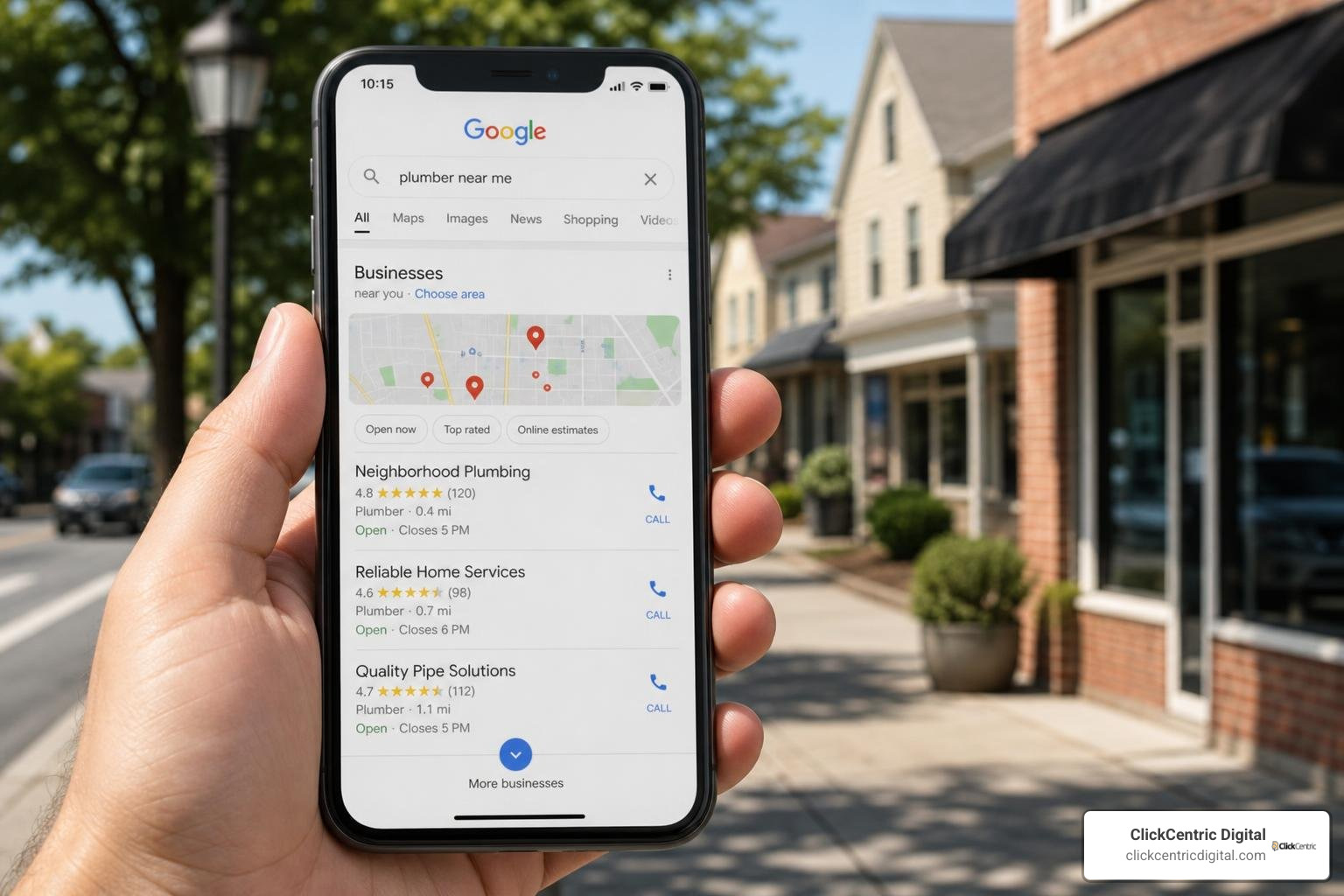
18 Sep How to Generate Local Business Leads in 5 Easy-to-Follow Steps
How to Generate Local Business Leads in 5 Easy-to-Follow Steps
Understanding Local Business Lead Generation vs General Marketing
Generating local business leads requires capturing nearby, high-intent prospects through five core steps: optimizing your Google Business Profile for map rankings, leveraging Google Local Services Ads for verified pay-per-lead visibility, running hyper-targeted local PPC and social media campaigns, automating customer review generation, and tracking closed-loop attribution to allocate budget effectively.
Local marketing operates under fundamentally different rules than broad national campaigns. When a company sells software nationwide or ships consumer products across the country, its marketing casts a wide net across millions of internet users. For a regional brick-and-mortar shop or home service contractor, casting a broad net is simply a quick way to burn through cash.
Local business lead generation focuses specifically on capturing high-intent prospects within a clearly defined service radius. These are people actively looking for a solution right around the corner. When a homeowner searches for emergency pipe repair or furnace maintenance, they are not browsing for entertainment. They have immediate geographic intent, tight decision windows, and a wallet ready to spend.
Because these prospects are geographically constrained, local campaigns enjoy significantly higher conversion rates than generic campaigns. Local search engine optimization (SEO) can deliver up to five times higher conversion rates than broad organic search. When your visibility aligns with someone’s immediate physical neighborhood, friction vanishes. Rather than chasing cold audiences across the internet, you can focus on gathering high-intent local leads on Google right when their need is most urgent.
Pay-Per-Click vs Pay-Per-Lead Models
Understanding how you pay for local traffic makes a huge difference in your bottom line. Two primary paid pricing models dominate digital marketing: Pay-Per-Click (PPC) and Pay-Per-Lead (PPL).
In standard Google Ads or local paid search, you operate on a Pay-Per-Click model. You bid on high-intent keywords, and every time someone clicks on your ad to visit your website or landing page, you pay Google a fee. Whether that visitor calls your business, fills out a form, or immediately bounces off the page, the click cost remains the same. PPC offers incredible control over ad copy, landing pages, and keyword targeting, but it requires diligent conversion rate optimization to keep costs profitable.
In contrast, the Pay-Per-Lead model charges you only when a prospect takes a verified action, such as placing a direct phone call or submitting an inquiry message. Google Local Services Ads (LSAs) operate on this exact mechanism. You set your budget and pay exclusively for qualified inquiries, providing unmatched transparency when calculating your return on ad spend (ROAS).
| Model | How You Pay | Lead Exclusivity | Cost Predictability | Setup & Control |
|---|---|---|---|---|
| Pay-Per-Click (PPC) | Per click on your ad | 100% Exclusive (traffic goes to your site) | Moderate (depends on conversion rate) | High (custom landing pages, granular bidding) |
| Pay-Per-Lead (PPL / LSAs) | Per qualified phone call or message | 100% Exclusive | High (fixed price per qualified lead) | Fast (turnkey profiles, verified badge requirements) |
| Shared Marketplaces | Per lead delivered (often subscription + fee) | Shared (sold to 3–5 competitors at once) | Low (hidden costs from lost bids & eroded margins) | Low (dependent on third-party marketplace algorithms) |
The Hidden Costs of Shared Lead Marketplaces
Many service businesses turn to shared lead platforms hoping for quick customer volume. While these aggregators deliver inquiries straight to your inbox, they introduce severe economic disadvantages that erode your profit margins over time.
Shared lead marketplaces operate by taking a single homeowner’s request and selling it simultaneously to four or five different contractors in the same town. Every contractor pays full price for the exact same contact details. What follows is a stressful, frantic race to the phone:
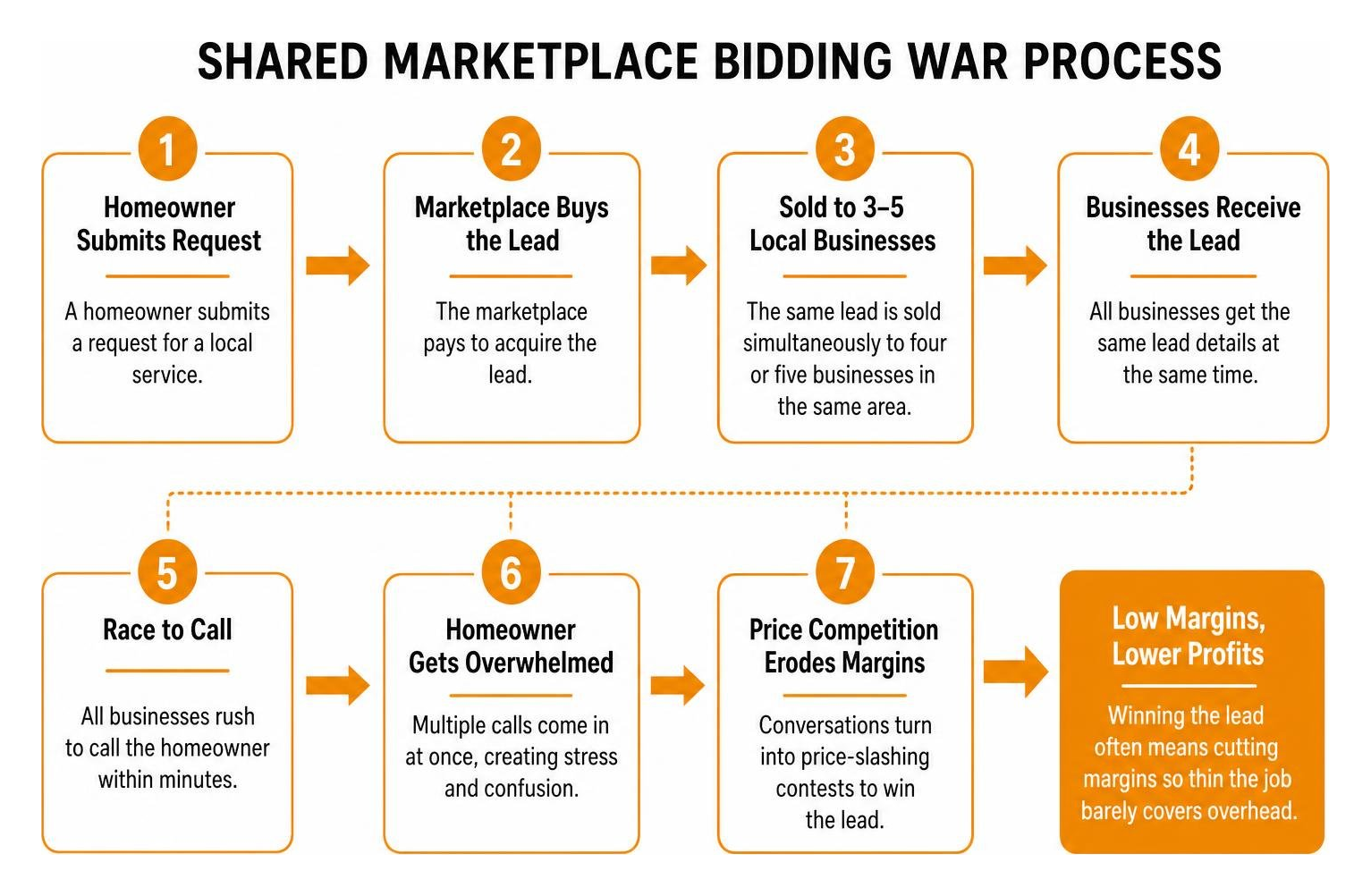
When five businesses call the same person within three minutes, the homeowner gets overwhelmed, and the conversation inevitably deteriorates into a price-slashing contest. Winning a shared lead often requires cutting your margins so thin that the job barely covers overhead.
Modern marketing demands better efficiency. Innovative discovery platforms and open-data business discovery engines highlight how direct market mapping and verified outreach outperform rented directory lists. Relying on shared aggregators means you never build independent brand equity. When you stop paying the middleman, your phone goes completely silent.
Step 1: Optimize Your Google Business Profile and Map Rankings
Your Google Business Profile (GBP) is the cornerstone of local search visibility. For most local queries, Google displays the “Map Pack” or “Local 3-Pack”—a dedicated block showing three top-rated local establishments directly below paid ads. Google Business Profile listings appear in approximately 46% of all local search results, making organic map optimization essential for consistent inbound calls.
To climb into the top three map positions, your business must demonstrate strong relevance, distance, and prominence:
- Verify and Complete Every Section: Claim your listing and fill out 100% of the profile details, including primary and secondary business categories, operational hours, special attributes, service menus, and high-resolution photos of your team and work.
- Maintain Strict NAP Consistency: Your Name, Address, and Phone number (NAP) must be identical across your website, Google profile, and external directories. Businesses maintaining consistent NAP data across citations see up to a 20% boost in local search rankings.
- Publish Regular Updates and Offers: Use Google Posts weekly to announce seasonal promotions, highlight recent projects, and share company updates to signal ongoing business activity to Google’s ranking algorithm.
Implementing proven local SEO strategies to stop being invisible ensures that your business stands out across Google Maps, attracting nearby customers right at the moment of intent.
Scaling City Pages with Programmatic Local Business Lead Generation
While your physical office anchors your primary Google Business Profile, your true service area likely extends across dozens of neighboring municipalities and suburbs. If a customer searches for your services from a town fifteen miles away, your central map pin might not rank at the top of their local results.
This is where programmatic SEO creates a massive competitive moat. Instead of relying on a single generic service page, you can build a structured network of geo-targeted, search-optimized landing pages—dedicating unique pages to specific service-city combinations across your territory.
Programmatic search assets work because they:
- Match Hyper-Local Intent: A page optimized for emergency furnace repair in Holland speaks directly to a homeowner’s local search query, dramatically improving conversion rates.
- Operate on High-Speed Architecture: Lightweight, static pages load almost instantaneously on mobile devices, satisfying Google’s Core Web Vitals and lowering bounce rates.
- Compound Value Over Time: Unlike paid ads that vanish the second you pause your spend, an owned network of city pages continues to rank, capture organic traffic, and route inbound phone calls month after month with near-zero marginal ongoing cost.
Step 2: Leverage Google Local Services Ads and Verification Badges
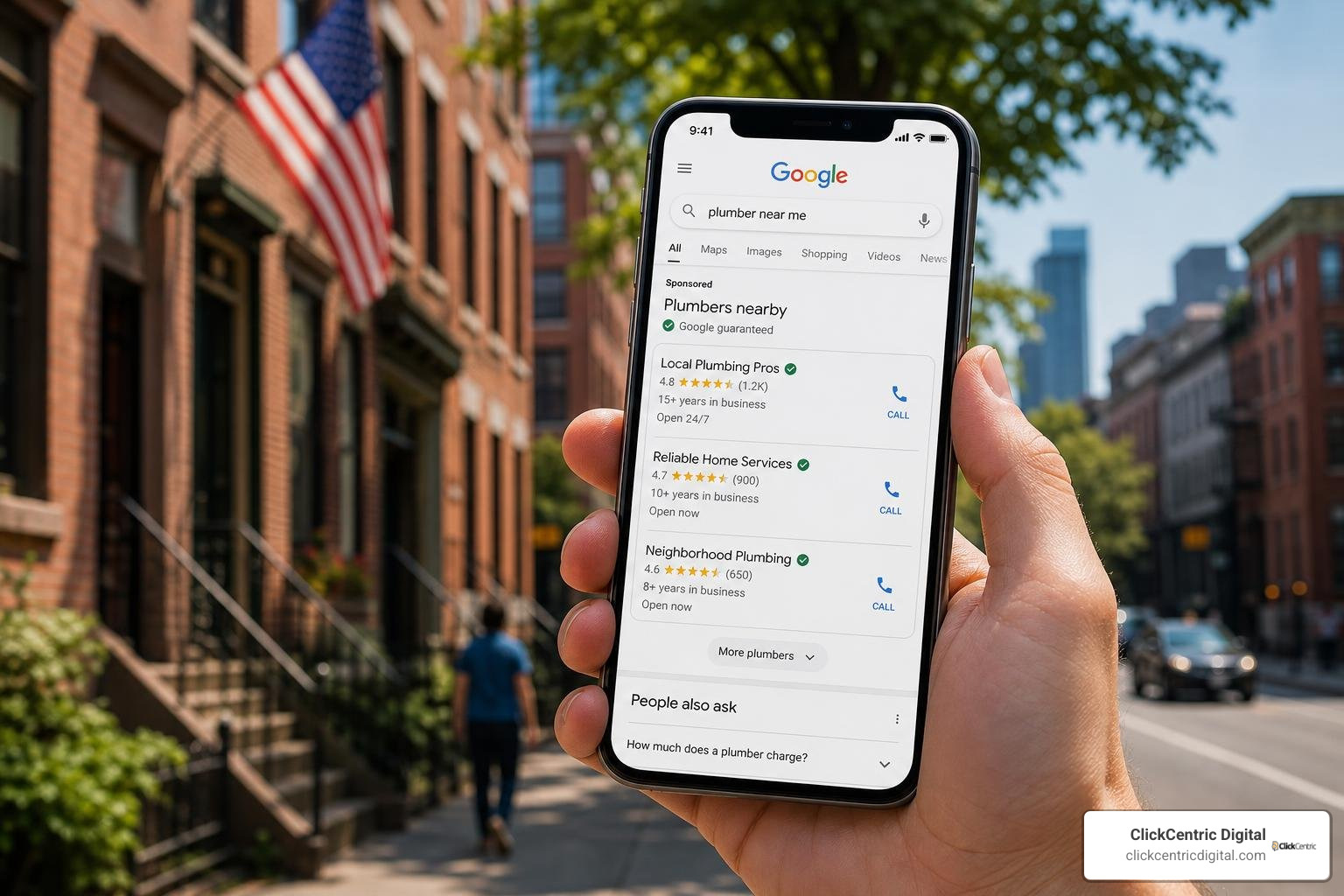
If you want to place your business at the absolute pinnacle of Google search results, Google Local Services Ads (LSAs) are the most direct path. Appearing above standard Pay-Per-Click ads and traditional organic map listings, LSAs sit in the VIP section of the search engine results page.
LSAs operate entirely on a pay-per-lead model. Homeowners searching for immediate assistance can view your business name, operating hours, review score, and verification badge, and then dial your phone number directly from the search result. You are only charged for valid customer inquiries related to your selected service categories.
Pairing Local Services Ads with affordable Google Ads management strategies ensures your business captures immediate paid search real estate while your organic SEO authority matures.
How Google Guarantee Drives Local Business Lead Generation
The defining feature of Google Local Services Ads is the verification badge displayed prominently next to your company name. For home service professionals, this is the coveted green Google Guarantee badge (or Google Screened / License Verified for professional services like lawyers, accountants, and healthcare providers).
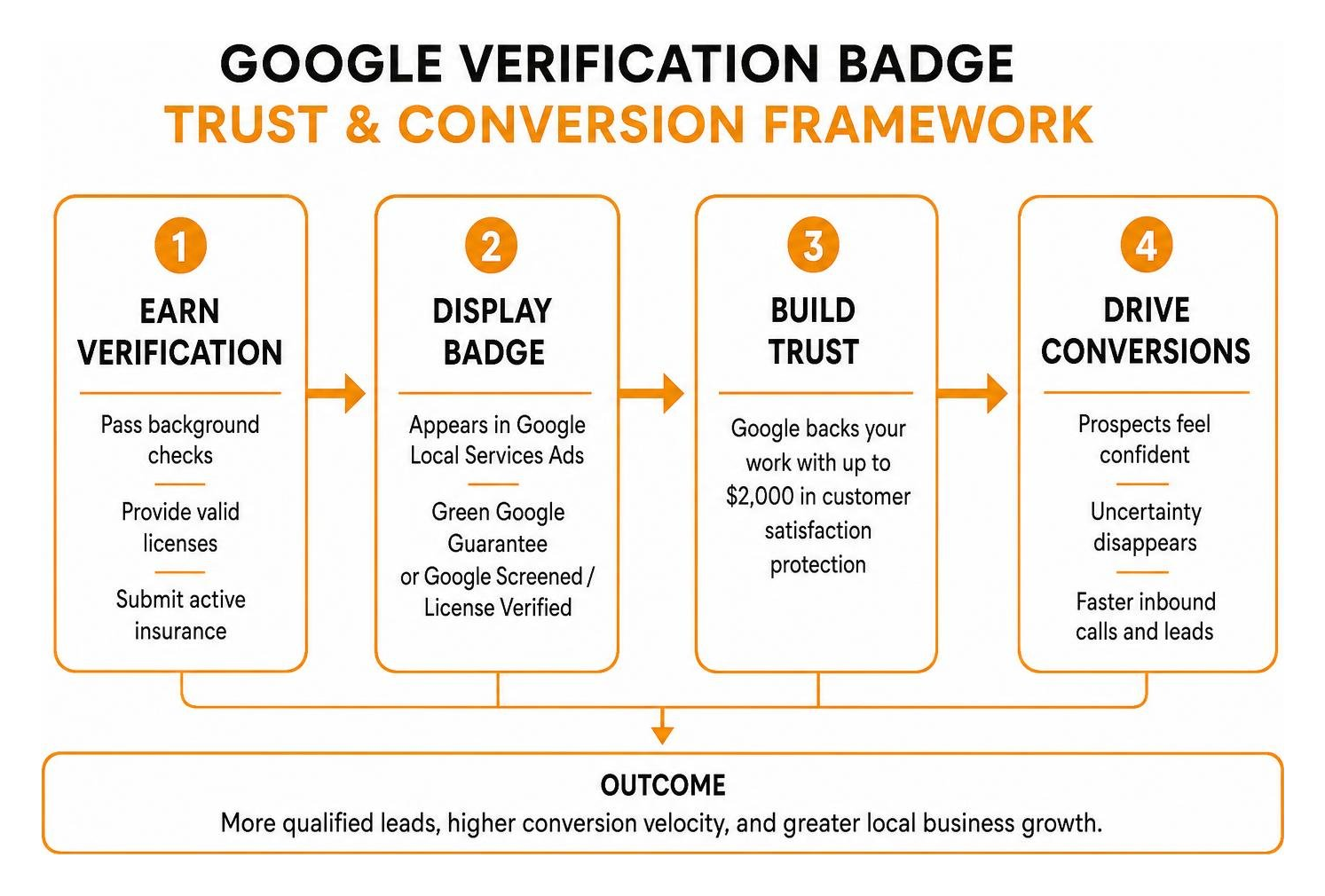
Earning the Google Guarantee requires passing background checks, providing proof of valid business licensing, and submitting active general liability insurance coverage. This badge tells hesitant prospects that Google backs your work with up to $2,000 in customer satisfaction protection.
That trust signal directly accelerates conversion velocity. When prospective customers see the green checkmark, their uncertainty disappears. They convert into inbound callers faster because third-party verification eliminates the fear of hiring an untrustworthy contractor.
Step 3: Run Targeted Local Social Media and PPC Campaigns
Search engine optimization and Local Services Ads capture active, existing demand from people looking for help right now. However, running hyper-targeted social media campaigns and Pay-Per-Click ads allows you to generate demand, build local brand awareness, and stay top-of-mind across your entire market.
By deploying local PPC campaigns that bring customers through the door, you can target precise keyword searches within specific postal codes or radius parameters. A paid local campaign can increase initial lead volume by up to 30% within the very first month of launch, providing an immediate influx of opportunities while your organic authority scales.
At the same time, running local Facebook ads without losing your shirt requires strict geographic fencing. Set your ad sets to target only people currently living within your service perimeter, filtering out passing commuters or out-of-state visitors.
Capturing Local Demand with Targeted Social Ads
Social platforms like Facebook and Instagram excel at visual storytelling, neighborhood brand building, and precise demographic targeting. Whether showcasing a completed kitchen remodel, a spotless commercial cleaning job, or an emergency AC installation on a hot summer afternoon, visual proof captures attention as neighbors scroll through their feeds.
To turn social engagement into qualified phone calls and appointments:
- Use Native On-Platform Lead Forms: Meta Lead Ads allow mobile users to submit contact inquiries with their pre-filled account information in just two taps, minimizing friction.
- Deploy Retargeting Pixels: Set up retargeting ads to display tailored offers to people who visited your website within the last 30 days but did not call or submit a form.
- Test Compelling Seasonal Offers: Rotate ad creative frequently, testing seasonal maintenance specials, diagnostic discounts, and local customer video testimonials.
Following the local service guide to high-converting Facebook ads helps you build ads that resonate with local homeowners, preventing ad fatigue and keeping your cost per lead affordable.
Step 4: Build Social Proof and Dominate Online Reviews
Online reviews are the digital equivalent of word-of-mouth recommendations over the backyard fence. You can run pristine ad campaigns and rank number one on Google Maps, but if your company displays a 3.2-star average with three-year-old reviews, prospects will skip your listing and call the 4.9-star competitor right below you.
Review velocity and review sentiment are major local search ranking factors. Google wants to recommend businesses that consistently satisfy customers today, not just five years ago.
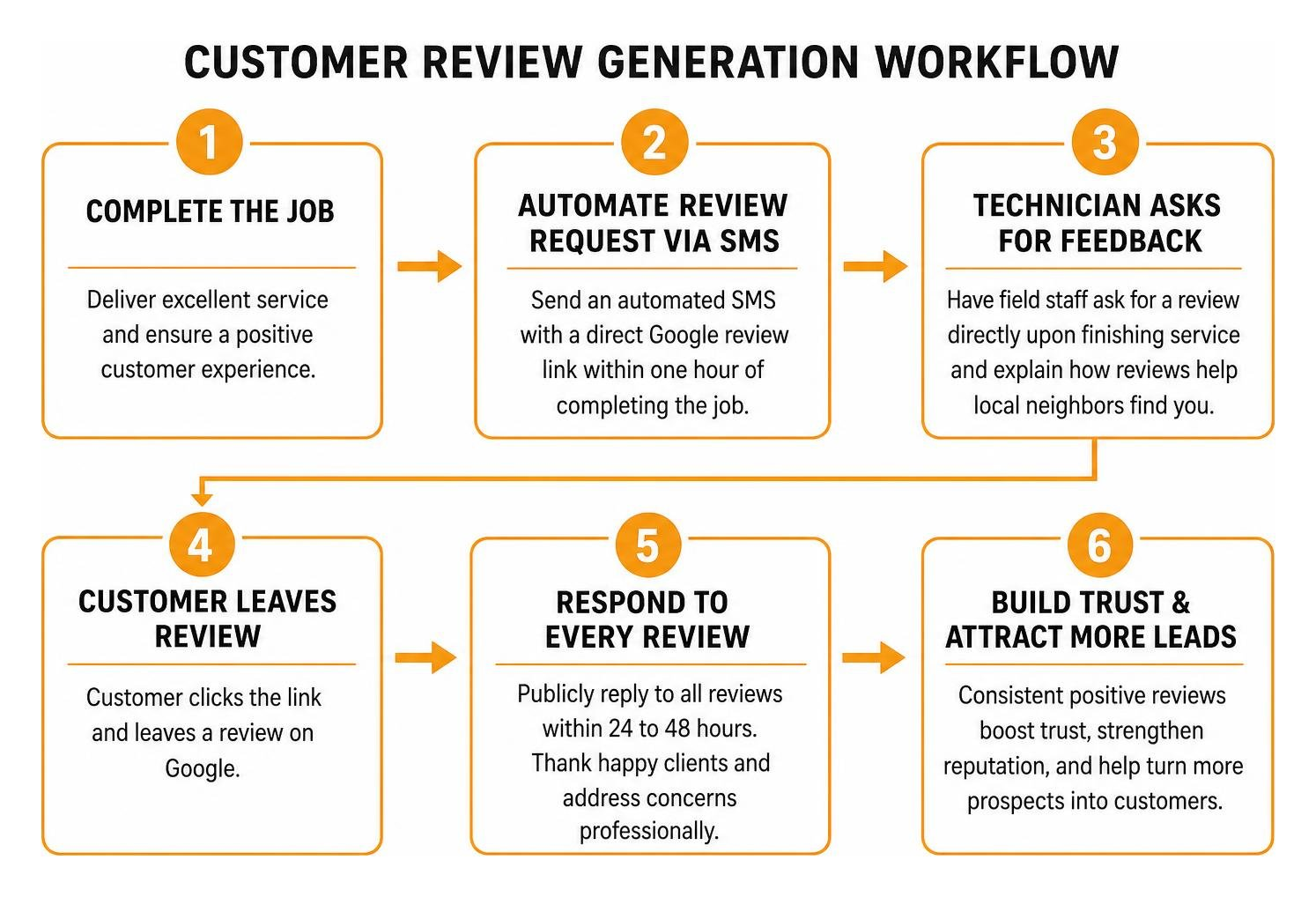
To build an unbeatable online reputation:
- Automate Review Requests via SMS: Text messages enjoy an open rate exceeding 90%. Send an automated SMS containing a direct Google review link within one hour of completing a job while the positive customer experience is fresh.
- Train Field Staff to Plant the Seed: Have your technicians ask for feedback directly upon finishing service: “We’re a local family business, and Google reviews help our neighbors find us. Would you mind leaving a quick note about your experience?”
- Respond to Every Single Review: Publicly reply to all reviews within 24 to 48 hours. Thank happy clients warmly, and address critical reviews professionally by acknowledging the issue and offering an offline phone number to resolve it.
Focusing on mastering local reviews to win more customers builds a moat of social proof that increases conversion rates across every other marketing channel you run.
Step 5: Track, Measure, and Budget for Predictable Lead Flow

You cannot manage what you do not measure. Scaling local customer acquisition requires connecting every dollar spent directly to booked revenue. Without closed-loop tracking, businesses often pour marketing dollars into channels that generate low-quality clicks while starving the channels that drive actual booked jobs.
Establishing a robust tracking infrastructure involves four essential components:
- Dynamic Call Tracking: Implement dynamic number insertion (DNI) on your website. This displays unique phone numbers to visitors based on their traffic source (Google Organic, Google Ads, Facebook Ads, Direct), recording the call and attributing it to the exact campaign and keyword that generated it.
- Standardized UTM Parameters: Tag every link in your paid ads, social profiles, and email campaigns with standardized UTM codes to monitor user behavior in Google Analytics.
- CRM Pipeline Integration: Connect your call tracking software and web forms directly to your Customer Relationship Management (CRM) system. This lets you track an inquiry from initial click to phone call, quote presentation, and final invoice payment.
- Community and Peer Benchmarking: Engaging with peer business groups and following regional digital marketing collaboration insights helps you benchmark acquisition metrics against local industry standards.
When allocating your marketing budget, evaluate both short-term search ads and long-term organic assets. Weighing your options between choosing between local SEO and paid Google Ads ensures your capital is split intelligently between instant lead generation and sustainable organic asset growth.
Frequently Asked Questions
What is the difference between local lead generation and national lead generation?
Local lead generation focuses strictly on attracting prospects within a specific, bounded geographic radius or service area. Because local consumers are looking for nearby businesses, local strategies rely heavily on Google Maps 3-Pack rankings, localized city content, Google Local Services Ads, and geographically fenced social campaigns. In contrast, national lead generation targets broad buyer personas across entire countries without geographic restrictions, relying more on top-of-funnel content marketing, broad organic SEO, webinars, and nationwide digital advertising. Local leads typically have much higher buying intent and shorter sales cycles.
How much should a small business budget for local customer acquisition?
Most established local service businesses allocate between 5% and 12% of gross revenue toward marketing and customer acquisition. If your business is looking to grow aggressively or break into competitive new territories, budgeting 10% to 15% is common. Your actual cost-per-lead will vary based on:
- Industry and Average Ticket Size: High-ticket services (like roof replacements or HVAC installations) naturally carry higher costs per lead ($60–$150+) than lower-ticket services (like lawn maintenance or house cleaning at $20–$50 per lead).
- Local Market Competition: Highly populated urban centers feature higher advertising bids than rural towns.
- Channel Distribution: Blending paid ads (immediate cash outlay) with organic SEO and owned city pages (which reduce acquisition costs over time) creates a sustainable, balanced blended cost-per-lead.
Why are exclusive search assets better than buying shared leads?
Buying leads from shared third-party aggregators forces your company into an immediate price war against three to five competitors for every prospect. You pay upfront for contact information that is simultaneously sold to your rivals, slashing profit margins and training customers to treat your services as an interchangeable commodity.
Building exclusive search assets—such as an optimized Google Business Profile, high-converting programmatic city pages, and dedicated PPC campaigns—ensures that 100% of incoming inquiries belong to you alone. You build long-term brand equity, preserve your pricing power, and create a sustainable inbound engine that continues producing calls year after year.
Conclusion
Building a predictable flow of new customer inquiries does not happen by accident. It requires a connected, multi-channel strategy where your map rankings, search ads, social campaigns, customer reviews, and analytics work together as a cohesive engine.
By optimizing your Google Business Profile, capturing high-intent searchers with Local Services Ads, scaling hyper-targeted city pages, dominating online reviews, and rigorously tracking your return on ad spend, you create a marketing ecosystem that drives consistent revenue.
At ClickCentric Digital, we specialize in helping local businesses take control of their growth. Whether you want to dominate map rankings, run high-converting ad campaigns, or build owned search assets that keep your phone ringing, explore our professional local SEO and customer acquisition services to start scaling your inbound pipeline today.
Sorry, the comment form is closed at this time.