

17 Mar Local SEO for Veterinarians: Fetching More Clients from Google
Local SEO for Veterinarians: Fetching More Clients from Google
What is Local SEO and Why is it Essential for Veterinary Clinics?
; high-intent local searches; proximity, relevance, and prominence; 46% of Google searches have local intent; the “digital handshake” for pet owners; outranking corporate hospitals with local focus
Local SEO for veterinarians is a specialized digital marketing strategy designed to help your practice appear in search results for geographically related queries. When a pet owner in Grand Rapids or Kalamazoo types “animal hospital” into their phone, Google doesn’t show them the best clinic in the country; it shows them the most relevant, prominent, and closest clinics to their current location.
For veterinarians, this is essential because your services are inherently local. Unlike an e-commerce store, you can’t treat a golden retriever from three states away. Statistics show that 93% of pet owners use search engines to find veterinary services, and 68% of those users click on one of the top three business listings in the “Local Pack” (the map section). If you aren’t in that top three, you are essentially invisible to the majority of your local market.
Furthermore, local searchers are ready to act. Most people who perform a local search visit a business within 24 hours. By mastering local SEO, you ensure that when a “ready-to-book” pet parent looks for help, your clinic is the one they find.
How Google Business Profile Optimization Impacts Veterinary Local Search Rankings
; the most powerful free local marketing tool; Google’s local search algorithm; proximity, relevance, and prominence; digital storefront vs. set-and-forget; impact on the “Local Pack”
Your Google Business Profile (GBP) is the single most important factor in local search. It functions as your clinic’s “digital storefront.” When optimized, it tells Google exactly what you do, where you are, and how well you do it. Google’s algorithm uses three main pillars to rank your profile:
- Proximity: How close is your clinic to the person searching?
- Relevance: Does your profile match the specific keywords the user typed (e.g., “avian vet” or “emergency pet surgery”)?
- Prominence: How well-known is your business? This is determined by your reviews, backlinks, and overall web presence.
A fully optimized GBP doesn’t just list your phone number; it showcases your team, your facilities, and your expertise. Practices that treat their GBP as a living asset—regularly posting updates and responding to questions—consistently outrank those that simply “set it and forget it.”
What are the Most Effective Keywords for Veterinary Local SEO?
; high-intent phrases; “vet near me” and “animal hospital [city]”; service-specific terms; emergency veterinary keywords; species-specific searches; long-tail keywords for niche services
Keywords are the bridge between what pet owners are thinking and the results Google provides. For a veterinary practice, you need a mix of broad and specific terms.
- Broad/High-Intent: “veterinarian near me,” “animal hospital in Holland MI,” and “best vet in Grand Haven.”
- Emergency: “emergency vet near me,” “24 hour animal hospital,” and “urgent pet care.” These have the highest conversion rates because the need is immediate.
- Service-Specific: “dog dental cleaning,” “cat vaccinations,” “pet microchipping,” and “spay and neuter clinic.”
- Species-Specific: “exotic animal vet,” “feline-only veterinarian,” or “avian specialist.”
Focusing on these high-value terms ensures you attract the right kind of traffic—people looking for the specific care you provide in the specific area you serve.
How Veterinary Practices Can Conduct Proper Keyword Research for Local Searches
; using Google Keyword Planner and Search Console; analyzing competitor keywords; identifying local modifiers; balancing high-volume and long-tail terms; keyword mapping to service pages
Keyword research isn’t about guessing; it’s about data. We recommend starting with Google Search Console to see which terms are already bringing people to your site. You can also use Google Keyword Planner to find the search volume for specific phrases in your Michigan service area.
A “local modifier” is simply adding your city name to a service. Instead of just “pet vaccinations,” you should target “pet vaccinations in South Haven.” Check your competitors’ websites as well—what services are they highlighting? If they are ranking for “affordable dog dentistry” and you offer that service but don’t mention it on your site, you’re leaving money on the table.
Steps Needed to Fully Optimize a Google Business Profile for a Vet Clinic
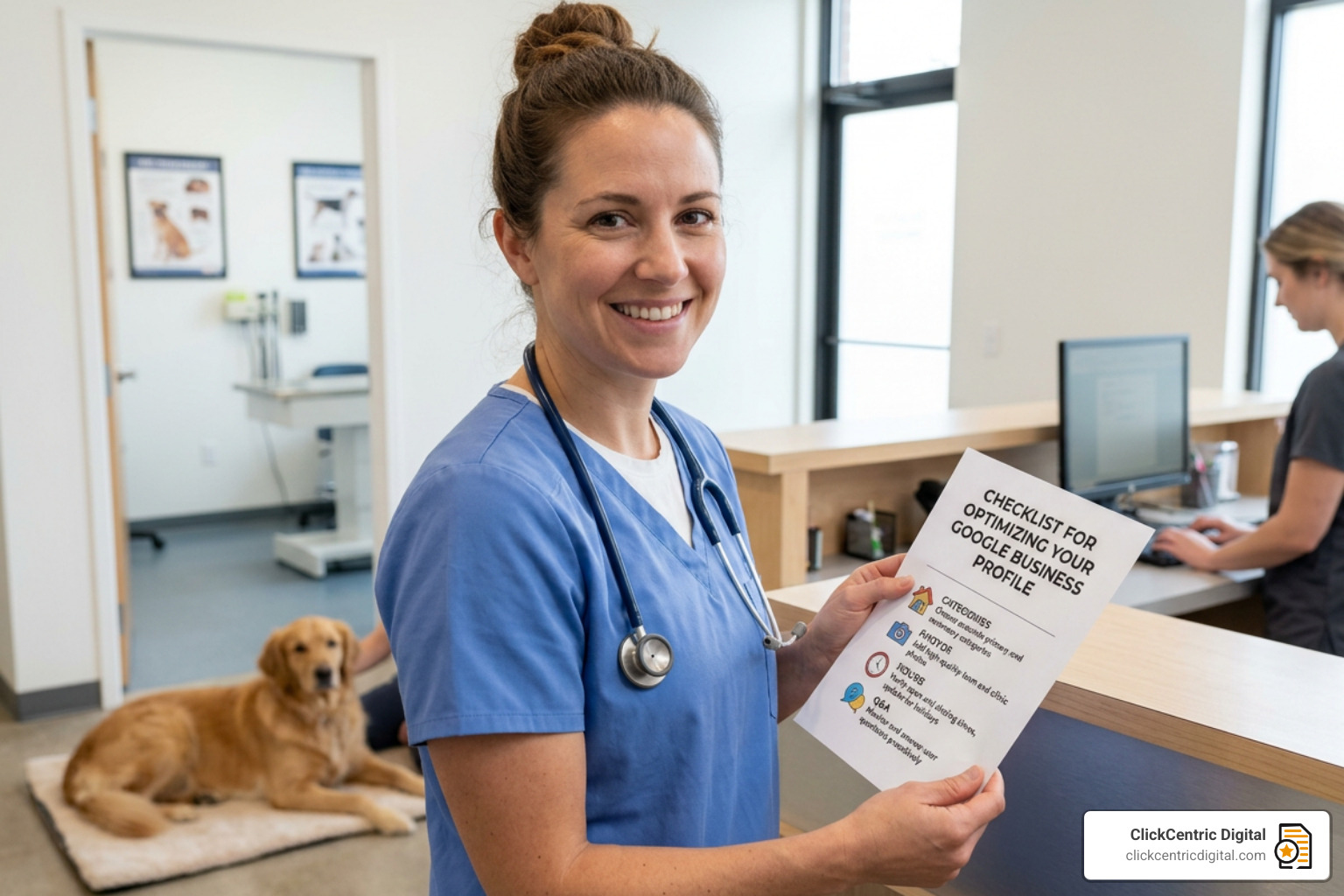
; claiming and verifying your listing; selecting the correct primary and secondary categories; uploading real (not stock) photos; setting accurate emergency hours; utilizing the Q&A feature; weekly GBP posts
To dominate the local map, follow these steps:
- Claim and Verify: Ensure you own the listing so no one else can change your data.
- Primary Category: Choose “Veterinarian” or “Animal Hospital.” If you specialize, use “Emergency Veterinarian Service.”
- Real Photos: Upload at least 4 photos each of your exterior, interior, friendly staff, and equipment. Avoid stock photos; pet owners want to see where their “fur babies” will be treated.
- Emergency Info: If you offer after-hours care, make sure your hours are 100% accurate. Nothing kills trust faster than a “24/7” listing that doesn’t answer the phone at midnight.
- Q&A: You can actually post your own frequently asked questions and answer them yourself. For example: “Do you offer payment plans?” “Yes, we accept CareCredit.”
Why NAP Consistency is Critical for Local SEO Success
; Name, Address, Phone number; building trust with Google’s “crawler”; avoiding “confused Google” syndrome; impact on local citations; scheduling quarterly citation checkups
NAP stands for Name, Address, and Phone number. Google’s “crawlers” scan the entire internet to verify that your business is legitimate. If your Facebook page says “Grand Rapids Vet Clinic,” but your Yelp profile says “GR Veterinary Hospital,” Google gets confused.
A confused Google is a Google that won’t rank you. Inconsistency signals that your business data might be unreliable, which hurts your rankings. Ensure your NAP is identical across your website, social media, and every directory you join. We recommend a quarterly “citation checkup” to find and fix any stray variations of your business name or old phone numbers.
How Online Reviews Influence Local Search Rankings and Client Trust
; 88% trust online reviews as much as personal recommendations; review quantity, frequency, and recency; responding to every review; keyword-rich reviews; impact on click-through rates (CTR)
Reviews are the lifeblood of local seo for veterinarians. Google looks at three things: how many reviews you have (quantity), how often you get them (frequency), and how recent they are (recency).
Beyond rankings, reviews build massive trust. 88% of people trust online reviews as much as a recommendation from a friend. When a client leaves a review saying, “The best emergency vet in Kalamazoo saved my dog’s life,” they are giving you a double win: they are providing social proof to other owners and giving Google keyword-rich content that helps you rank higher for “emergency vet.”
Website Optimization Techniques to Improve Local SEO for Veterinary Practices
; title tags and meta descriptions; local landing pages; embedding Google Maps; site speed and image compression; internal linking between service and blog pages
Your website needs to be more than just a digital brochure; it needs to be optimized for search. This starts with your “Meta Tags.” Your Title Tag should look like this: Veterinarian in Holland MI | [Clinic Name] | Full Service Pet Care.
Every major service you offer should have its own page. Don’t just list “Services” on one page. Create a dedicated page for “Pet Dental Care” and another for “Senior Pet Wellness.” This allows Google to index each page for specific searches. Also, ensure you embed a Google Map on your contact page to reinforce your location to the algorithm.
Why Mobile-Friendliness is Crucial for Veterinary Local SEO
; 60% of emergency searches happen on mobile; Google’s mobile-first indexing; responsive design; click-to-call buttons; user experience and bounce rates
Most local searches for vets happen on the go. If a pet owner is at the park and their dog gets injured, they aren’t going home to their desktop; they are using their phone. If your website is slow, hard to navigate, or requires “pinching and zooming” to read the phone number, the user will leave. This is called a “bounce,” and it tells Google your site isn’t helpful, which lowers your ranking. A mobile-friendly site with a prominent “Click-to-Call” button is non-negotiable for modern practices.
How Veterinary Clinics Should Create Location-Specific Content to Rank Higher
; “City Pages” with local landmarks; blogging about local pet events; seasonal pet safety tips for Michigan; “Educate before you sell” philosophy; building community relevance
Google loves content that proves you are an active part of your community. Instead of generic articles, write about “The 5 Best Dog Parks in Grand Rapids” or “Common Winter Pet Hazards in West Michigan.” This “City Page” strategy, as noted by The Drake Center, ties your clinic to local landmarks and businesses, making you the most relevant result for local searches.
What Role Does Social Media Play in Supporting Local SEO Efforts for Vets?
; driving traffic to the website; increasing brand “signals”; engaging with local followers; biweekly Q&A sessions; sharing reviews and pet success stories
While social media isn’t a direct ranking factor, it supports SEO by driving traffic and engagement. When you share a blog post on Facebook and 50 people click it, that “signal” tells Google your content is valuable. Use social media to humanize your practice. Post “Pet of the Week” photos or go live for a quick Q&A about flea and tick season. This builds a loyal local following that is more likely to search for you by name.
How Veterinary Practices Can Build High-Quality Backlinks and Local Citations
; niche directories (Rover, Pets Welcome); local Chamber of Commerce links; guest blogging for local pet shelters; the impact of Domain Authority (DA); avoiding spammy link tactics
A backlink is a “vote of confidence” from another website. For a vet, the best links come from local or industry-related sources. Getting listed on high-DA sites like Rover or Pets Welcome is a great start.
However, local links are gold. A link from your local Grand Haven Chamber of Commerce or a sponsorship link from a local animal shelter carries massive weight in local SEO. Focus on quality over quantity; one link from a reputable local news site is worth more than a hundred links from random “link farms.”
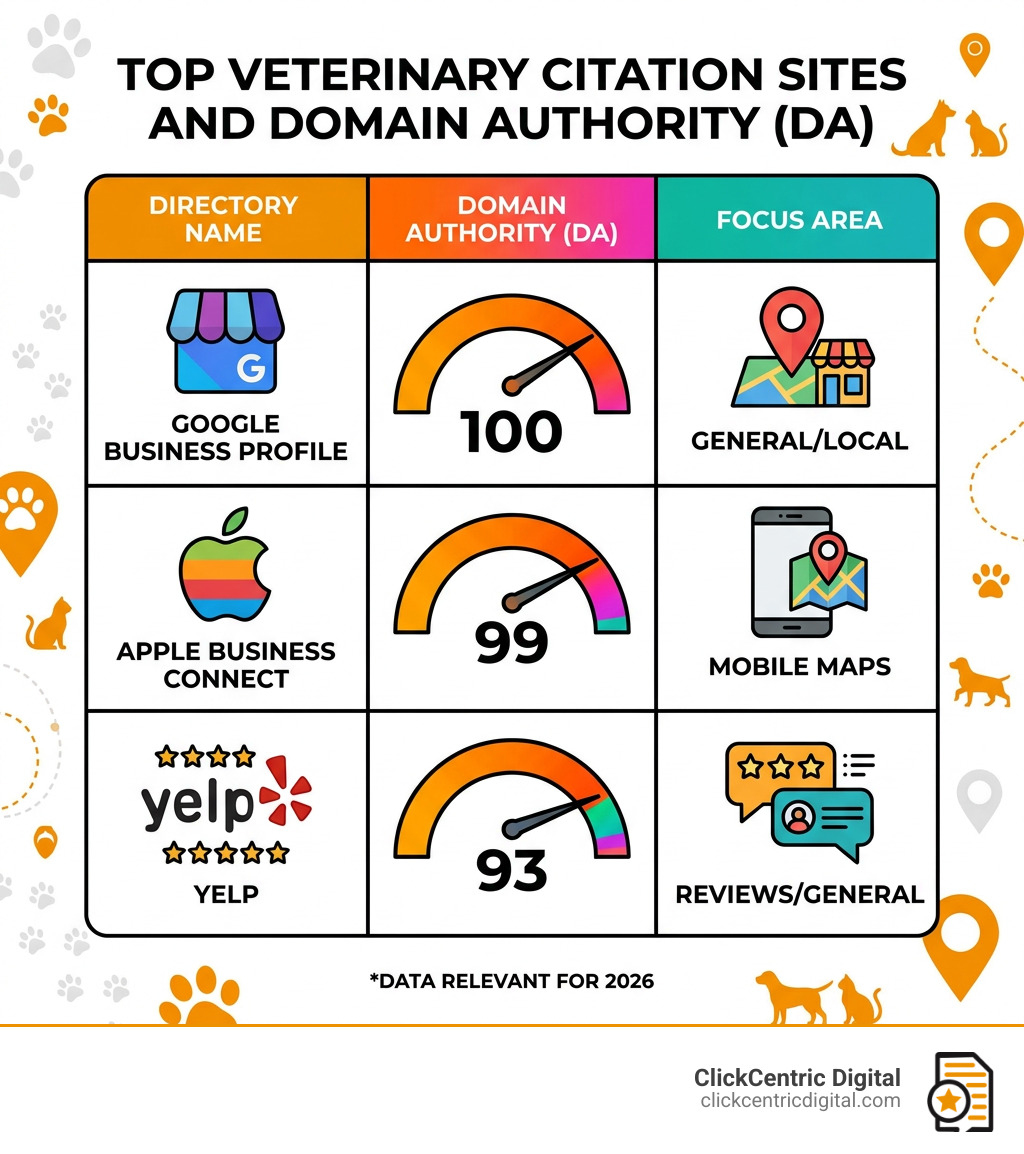
| Directory Name | Domain Authority (DA) | Focus Area |
|---|---|---|
| Google Business Profile | 100 | General/Local |
| Apple Business Connect | 99 | Mobile Maps |
| Yelp | 93 | Reviews/General |
| Rover | 81 | Pet Services |
| USA Veterinarians | 18 | Niche/Vet Specific |
Best Tools for Monitoring and Tracking Local SEO Performance
; Google Analytics 4 (GA4); Google Search Console; GBP Insights; tracking “Driving Directions” and “Phone Calls”; rank tracking software
You can’t improve what you don’t measure. Use Google Analytics 4 to see how much of your traffic is coming from “organic search” versus social media. Pay close attention to your GBP Insights—this will show you exactly how many people clicked to call you or asked for driving directions directly from the Google map. These are “high-intent” actions that lead directly to appointments.
Common Mistakes Veterinary Practices Make with Local SEO
; neglecting the GBP after setup; using stock photos; ignoring negative reviews; keyword stuffing; having a slow, non-mobile website; inconsistent NAP across directories
The biggest mistake is thinking SEO is a one-time task. It’s a marathon, not a sprint. Many clinics set up their profile and then never post an update or respond to a review. Others try to “cheat” by stuffing their description with keywords like “best vet best vet best vet,” which actually gets you penalized by Google. Authenticity and consistency are what win the long game.
How Long Does It Typically Take to See Results from Local SEO for a Vet Clinic?
; the 3-6 month window for initial shifts; 6-12 months for significant ROI; factors affecting timeline (competition, starting point); SEO as a long-term compound interest
SEO is not an overnight fix. Most clinics start seeing movement in their rankings within 3 to 4 months. However, to see a significant increase in new client appointments—the kind that changes your bottom line—you should expect a 6 to 12-month window. Think of SEO like pet health: preventative care and consistency lead to the best long-term results.
Strategies for Encouraging and Managing Google Reviews
; asking in-clinic at checkout; QR codes on discharge papers; automated email and text follow-ups; incentivizing the team (not the clients); professional responses to negative feedback
The best time to ask for a review is when a happy pet owner is standing at your checkout counter. Make it easy for them by having a QR code they can scan right there. We also suggest an automated follow-up system. Send a “How did we do?” text or email 24 hours after their visit.
If you get a negative review, don’t panic. Respond professionally, apologize for their experience, and ask to take the conversation offline. This shows potential clients that you care about customer service even when things don’t go perfectly.
How Veterinary Clinics Can Measure the ROI of Their Local SEO Efforts
; cost per new client acquisition; tracking new appointment sources; comparing organic growth vs. paid ad spend; lifetime value of a pet owner; using ClickCentric Digital’s strategies for growth
To calculate ROI, look at your total investment in SEO and divide it by the number of new clients who found you via Google. At ClickCentric Digital, we focus on targeted strategies for local customer acquisition. A new client isn’t just one visit; it’s potentially 10-15 years of wellness exams, vaccinations, and dental cleanings. The “Lifetime Value” of a client brought in by local seo for veterinarians is often in the thousands of dollars, making the initial SEO investment highly profitable.
Proven Step-by-Step Local SEO Strategies Specifically for Veterinarians
; the “Fetch More Clients” blueprint; audit, optimize, content, and review; building local authority; staying ahead of the algorithm
- Audit: Check your current rankings and NAP consistency.
- Optimize: Claim your GBP and fix your website’s technical issues.
- Content: Create service-specific and location-specific pages.
- Review: Implement a system to get 2-3 new reviews every week.
- Engage: Post weekly on your GBP and social media.
By following this blueprint, you move from being just another clinic to being the “go-to” veterinary authority in your Michigan community.
Ready to dominate your local market? ClickCentric Digital helps West Michigan businesses improve local search rankings and manage online reviews to turn searchers into long-term clients. Whether you are in Grand Rapids, Holland, or Kalamazoo, we are here to help your practice grow.
Sorry, the comment form is closed at this time.