

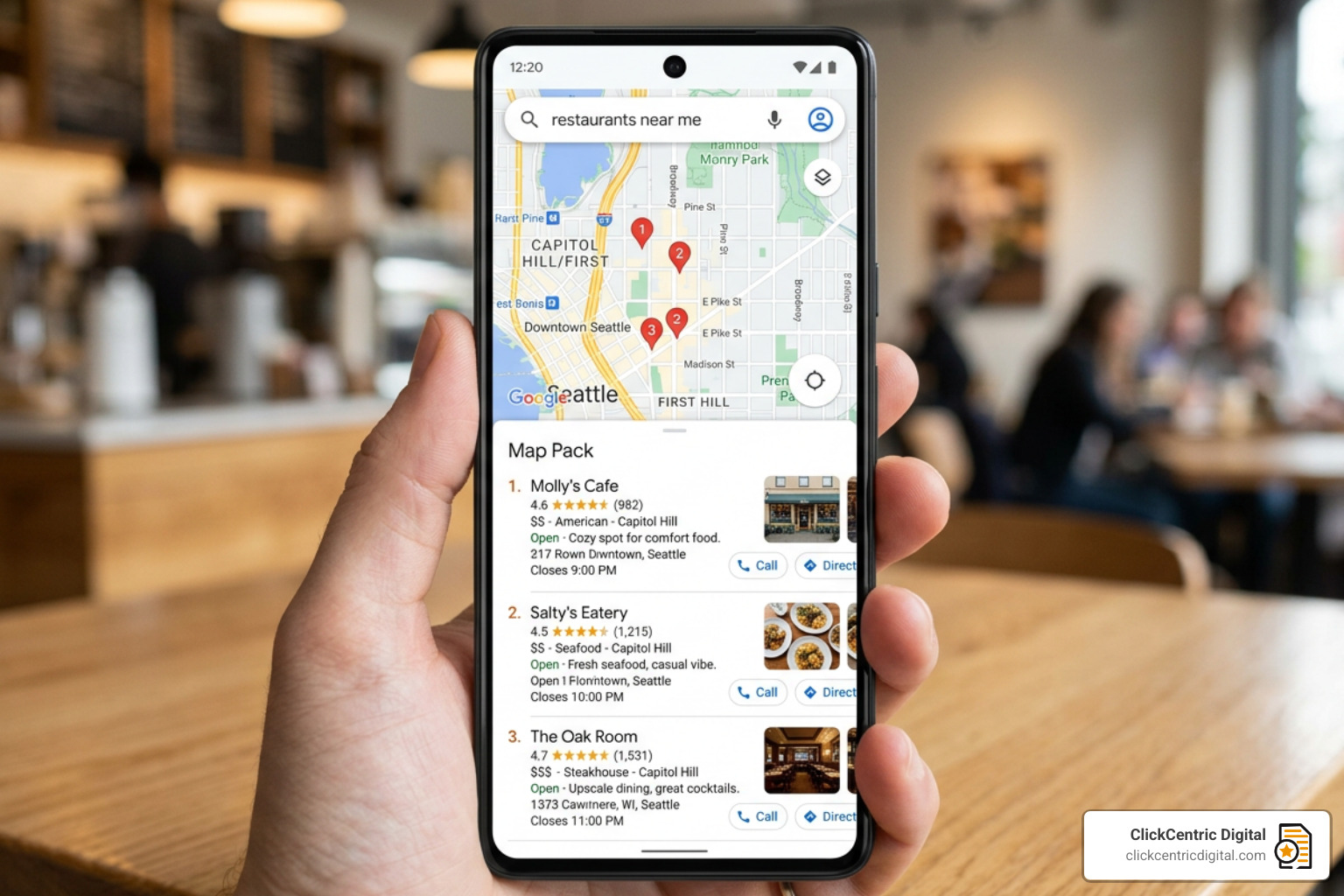
21 Mar Google Maps Ranking Factors for 2025
Google Maps Ranking Factors for 2025
Why Google Map Pack Ranking Factors Determine Who Gets Found Locally
The google map pack ranking factors that decide which businesses appear in Google’s top 3 local results come down to three core pillars:
| Ranking Pillar | What It Means | Key Signals |
|---|---|---|
| Relevance | How well your business matches the search query | GBP category, services, keywords |
| Distance | How close your business is to the searcher | Physical address, GPS proximity |
| Prominence | How well-known and trusted your business is | Reviews, backlinks, citations |
These three factors work together — but not equally. Proximity alone can override a better-optimized competitor. Reviews can tip the scales when distance is similar. And without relevance, nothing else matters.
Here’s why this matters for your business:
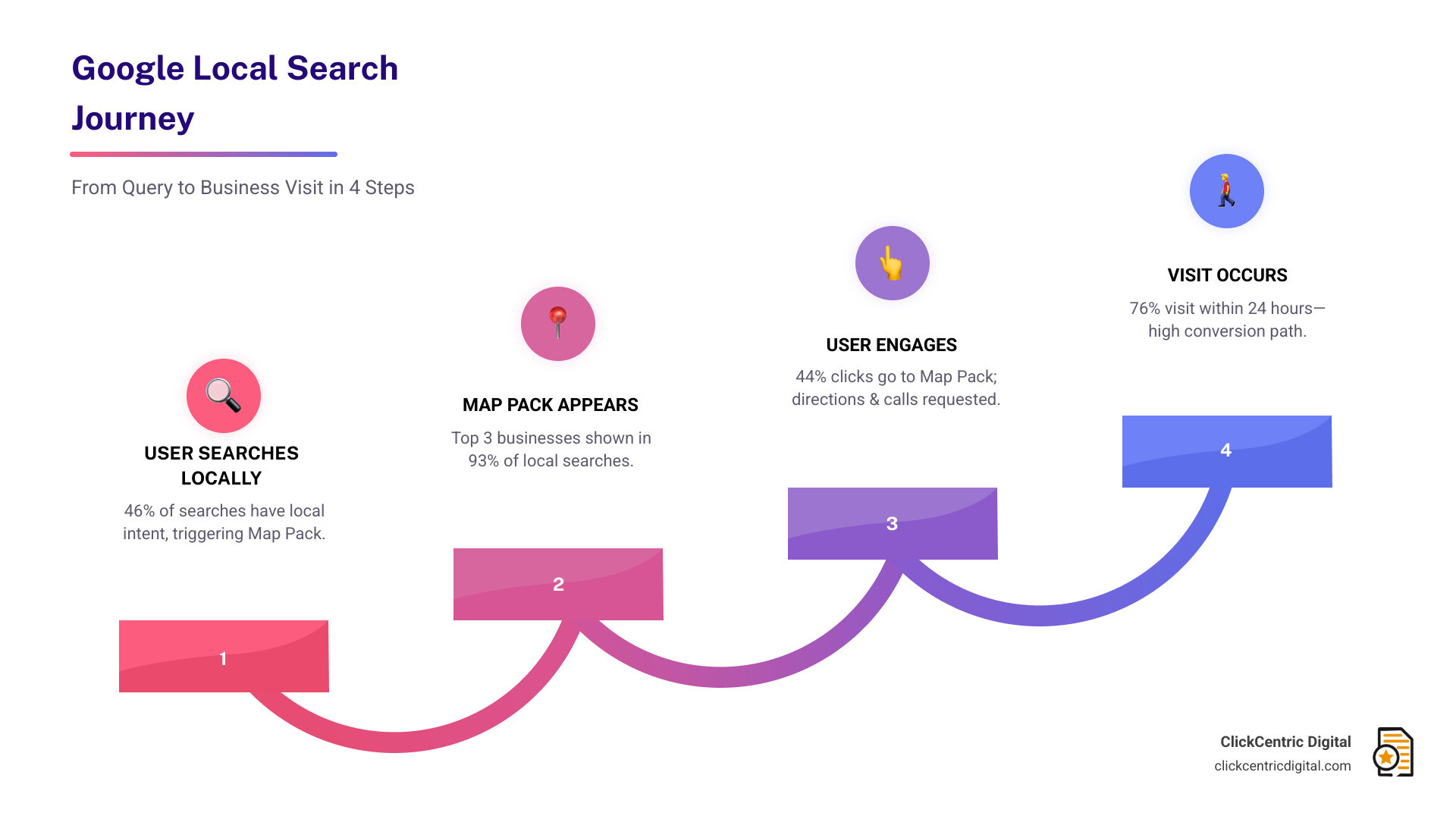
- 46% of all Google searches have local intent
- The Google Local Pack appears in 93% of those searches
- Businesses in the Map Pack receive nearly 44% of all clicks
- 76% of people who search locally visit a business within 24 hours
That’s a huge amount of high-intent traffic going to just three businesses per search. If you’re not one of them, you’re largely invisible to local customers who are ready to buy.
The hard truth? You can do a lot of things right — complete your Google Business Profile, collect hundreds of great reviews, build a solid website — and still not appear in the Map Pack. Location, competition, and behavioral signals all play a role that many business owners don’t fully understand.
This guide breaks down exactly how Google’s local algorithm works and what you can do about each factor.
The Three Pillars of Google Map Pack Ranking Factors
Understanding the google map pack ranking factors requires a deep dive into the “three pillars” Google uses to determine which businesses deserve those coveted top spots. Think of these pillars as a weighted scale. If you are weak in one area, you must be exceptionally strong in the others to compensate.

Relevance: The “What” Factor
Relevance is how well a local business profile matches what someone is searching for. If a user searches for “emergency plumber in Grand Rapids,” Google isn’t going to show them a general handyman unless that handyman has specifically signaled they handle plumbing emergencies. According to Google’s local pack algorithm selects businesses based on three weighted factors: proximity, review signals, and relevance, relevance matching between your business category and the search query is a primary driver of visibility.
Distance: The “Where” Factor
Distance (or proximity) considers how far each potential search result is from the location terms used in a query. If a user doesn’t specify a location, Google calculates distance based on what it knows about their current GPS or IP location. This is often the most frustrating factor because you can’t “optimize” your physical address once you’ve signed a lease. A study in the Journal of Business Research found that proximity bias can override other ranking factors by up to 40% on mobile devices. This explains why a smaller shop two blocks away might outrank a massive, well-reviewed competitor five miles away.
Prominence: The “Who” Factor
Prominence refers to how well-known a business is. This is based on information that Google has about a business from across the web, like links, articles, and directories. Some places are more prominent in the offline world, and Google tries to reflect this in local ranking. For example, famous museums or iconic local landmarks in West Michigan are likely to be prominent in search results. Review count and score are factored into local search ranking; more reviews and positive ratings can improve a business’s local ranking.
Proximity and the City Center Edge
One of the most significant “hidden” google map pack ranking factors is the concept of city boundaries and the “centroid” or city center. Google’s local results heavily favor businesses located within the official city limits of the search. If your business is located just one block outside the official Grand Haven or Holland city line, you may find it incredibly difficult to rank for searches that include the city name.
Proximity is determined by several data points:
- Searcher Location: The exact GPS coordinates of the mobile device.
- Official Center: Google identifies a specific “center” for every city (like the downtown area of Kalamazoo). Businesses closer to this center often get a slight ranking boost for broad city-wide searches.
- IP Address: For desktop users, Google uses the IP address to estimate location, which is generally less precise than mobile GPS but still highly influential.
If you find yourself struggling to rank despite having a great profile, it might be a “proximity ceiling.” In high-competition areas, the “local” radius might only be 1 or 2 miles. This is why local search results can vary by as much as 47% between locations only one mile apart.
Optimizing Google Business Profile for Relevance and Engagement
Your Google Business Profile (GBP) is the foundation of your local SEO. It is essentially your digital storefront. If this isn’t 100% complete, you are leaving money on the table.
Choosing Your Categories Wisely
The single most important relevance signal is your Primary Category. You must choose the one that most accurately describes your core business. However, don’t ignore secondary categories. Secondary categories broaden relevance without diluting primary category strength. For instance, if we are helping a client in Holland MI who runs a spa, their primary category might be “Day Spa,” but secondary categories could include “Massage Therapist” or “Facial Spa” to capture more specific searches.
For more tailored help, you can explore our local SEO services to see how we fine-tune these settings.
Maximizing Relevance as a Google Map Pack Ranking Factor
To truly dominate the relevance pillar, you need to go beyond the basics. Google crawls your entire profile to find “justification” signals—those little snippets of text that say “Their website mentions…” or “A reviewer said…”
- Keyword Integration: Naturally include your service areas (like South Haven or West Michigan) and core services in your business description. Avoid keyword stuffing, which can lead to suspensions.
- Service Menus and Product Lists: Fill these out completely. If you’re a contractor in Grand Rapids, list every specific service from “roof leak repair” to “shingle replacement.”
- Attribute Selection: Use attributes like “Black-owned,” “Women-led,” or “Wheelchair accessible.” These help Google match you with users using specific filters.
- LSI Keywords: Use Latent Semantic Indexing keywords—terms related to your main service. For a “dentist,” this includes “teeth whitening,” “cavity,” or “oral hygiene.”
Behavioral Signals and User Engagement
Google doesn’t just look at what you say about your business; it looks at how users interact with you. These are known as behavioral signals, and they account for roughly 10-12% of the ranking weight.
- Click-Through Rate (CTR): If people see your listing and click it more often than your competitors, Google sees you as more relevant.
- Direction Requests: High volumes of people asking for directions to your Grand Haven office signal that you are a popular, real-world destination.
- Call Volume: Frequent clicks on the “Call” button tell Google your business is active and helpful.
- Dwell Time: How long a user stays on your profile or clicks through to your website matters.
- Branded Searches: If people specifically search for “ClickCentric Digital” rather than just “marketing agency,” it tells Google we have high prominence.
Building Prominence via Reviews and Local Authority
Prominence is where you prove to Google that you are the best choice in the area. While you can’t change your distance from a searcher, you can build so much prominence that Google decides to show your business even if it’s a little further away.
How Reviews Act as Google Map Pack Ranking Factors
Reviews are the lifeblood of the Map Pack. They account for approximately 16% of the algorithm’s decision-making process. But it’s not just about having a 5-star rating.
| Signal | Why It Matters |
|---|---|
| Review Volume | Having 100+ reviews makes you look established. |
| Review Velocity | Google likes to see a steady stream of new reviews, not just a bunch from three years ago. |
| Sentiment | Google’s AI reads the text. “Best pizza in Holland MI” is a massive relevance boost. |
| Response Speed | Research from Harvard Business School found that responding to customer reviews resulted in better ratings, with businesses seeing an average improvement of 0.12 stars. |
We always recommend our clients in Kalamazoo or Grand Rapids respond to every single review—positive or negative—within 24 to 48 hours. It shows both Google and potential customers that you are engaged.
Strategies for Service Area Businesses (SABs)
What if you don’t have a storefront? Many plumbers, cleaners, and landscapers work at the customer’s location. These are Service Area Businesses (SABs).
Ranking as an SAB is harder because you lack a physical “pin” that searchers can see on the map at all times. However, you can still win:
- Verified Markers: You still need a physical address to verify the account (usually a home office), but you can hide it from the public.
- Service Zones: Don’t just set a 50-mile radius. Be specific about the cities you serve, like “Holland, Zeeland, and Saugatuck.”
- Local Landing Pages: Create pages on your website specifically for “Plumbing Services in Grand Haven MI.” This builds on-page relevance that Google links back to your Map Pack listing.
- NAP Consistency: Ensure your Name, Address, and Phone number are identical across the web. Even a small difference like “Street” vs. “St.” can slightly confuse the algorithm.
Frequently Asked Questions about Local SEO
How long does it take to rank in the Google Map Pack?
Typically, you can see movement in 2 to 4 months with an aggressive strategy. However, building long-term authority and outranking established competitors in cities like Grand Rapids or Kalamazoo usually takes 6 to 12 months of consistent effort.
Can I rank in the Map Pack without a physical office?
Yes, as a Service Area Business (SAB). You must verify your business using a physical address (like your home), but you can choose to hide that address from the public. Your ranking will then be based on the service area you define, though you may still face a slight proximity disadvantage compared to storefronts.
Do Google Ads help improve my Map Pack ranking?
Directly? No. Paying for ads won’t change your organic rank. However, ads can increase brand awareness and “branded searches.” When more people search for your business by name after seeing an ad, your prominence increases, which does help your organic ranking over time.
Conclusion
Mastering the google map pack ranking factors is an ongoing process, not a “one-and-done” task. As we’ve seen, the combination of relevance, distance, and prominence creates a complex landscape where local businesses must stay active to survive. Whether you are a boutique in Holland or a law firm in Grand Rapids, your visibility depends on how well you feed Google’s algorithm with fresh photos, consistent NAP data, and high-quality customer reviews.
At ClickCentric Digital, we specialize in helping West Michigan businesses navigate these complexities. From managing your online reputation to building targeted local authority, our goal is to ensure that when a customer searches for your services, your name is one of the three they see.
Improve your local visibility with ClickCentric Digital and let’s start growing your local footprint today.
Sorry, the comment form is closed at this time.