

10 Jun Stop Begging for Feedback with This Review Request Software
Stop Begging for Feedback with This Review Request Software
Why Most Businesses Are Losing Customers Before They Even Make Contact
The best customer review management tools in 2026 are:
| Tool | Best For | Starting Price |
|---|---|---|
| Birdeye | Multi-location businesses | $299/mo |
| BrightLocal | Local SEO + reviews | $44/mo |
| Yotpo | eCommerce brands | Custom |
| Podium | SMB lead generation | Custom |
| ReviewTrackers | Enterprise monitoring | $89/mo |
| Uberall | AI-powered automation | Custom |
| GatherUp | Review generation | $99/mo |
| Grade.us | Agencies | $110/mo |
Here’s an uncomfortable truth: 98% of consumers read online reviews before making a purchase. And if you have fewer than 20 reviews, nearly half of potential customers will skip your business entirely.
That’s not a small problem. That’s a leaking bucket.
Most local business owners know reviews matter. But keeping up with review requests, monitoring feedback across Google, Yelp, Facebook, and a dozen other platforms, and actually responding to every review? That’s a full-time job on its own.
Review management software exists to fix exactly that. It automates the tedious parts, centralizes everything in one place, and helps you turn customer feedback into a real competitive advantage — not just a chore you keep putting off.
In this roundup, we compare the top customer review management tools available in 2026 so you can find the right fit for your business without testing all of them yourself.
Why Your Business Needs Customer Review Management Tools in 2026
If you’re running a business in Grand Rapids or Kalamazoo, you aren’t just competing with the shop down the street; you’re competing with their star rating. In 2026, Google has become the undisputed king of feedback, accounting for 81% of all online reviews. If your digital “front door” is covered in dust—or worse, unanswered complaints—customers will simply keep walking.
The importance of customer review management tools goes beyond just “looking good.” It’s about being found. Google’s local search algorithm treats review frequency, recency, and your response rate as major ranking signals. If you aren’t active, you’re invisible. Research shows that even a tiny 0.1 improvement in your star rating can lead to a measurable increase in foot traffic.
Furthermore, consumers have short memories. About 74% of shoppers only care about reviews written in the last three months. This means you can’t rest on your laurels from a great year in 2024. You need a consistent “review engine” that keeps fresh feedback rolling in. By Mastering Local Reviews to Win More Customers, you ensure that when someone in West Michigan searches for your services, they see a vibrant, trusted, and highly-rated business.

The AI Revolution in Customer Review Management Tools
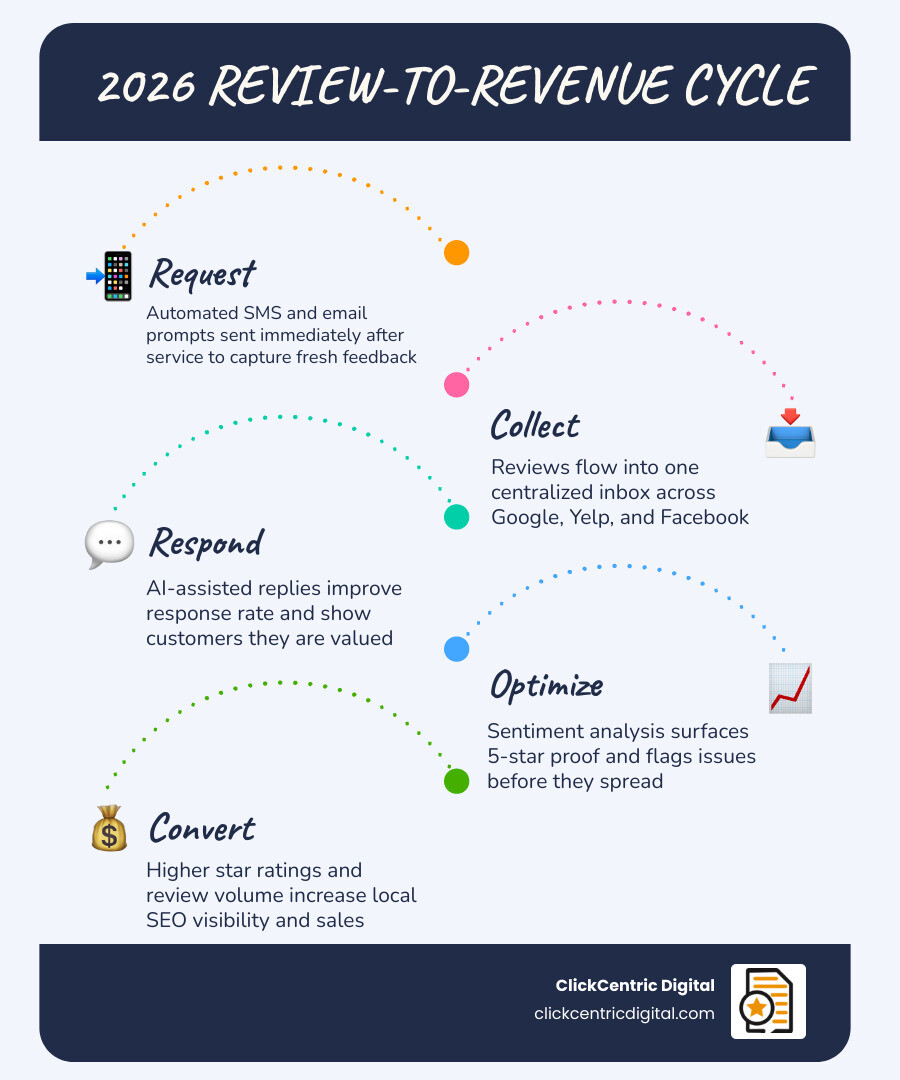
The biggest shift we’ve seen leading into May 2026 is the integration of high-level AI. Traditional tools used to just send an email and notify you when a review arrived. Modern customer review management tools are much smarter.
- Sentiment Analysis: AI now reads every review to score the sentiment. It can tell the difference between a “fine” three-star review and a “frustrated” three-star review by analyzing the language used.
- Semantic Tagging: Tools can automatically group reviews into themes like “Pricing,” “Customer Service,” or “Wait Times.” This allows us to see exactly where a business is winning or losing without reading 500 individual comments.
- Context-Aware Replies: AI agents can now draft personalized, human-sounding responses that address specific points mentioned by the customer. This isn’t just a “Thanks for the visit!” template; it’s a response that acknowledges the specific dish they ate or the technician who helped them.
- Automated Moderation: AI can flag suspicious or spammy reviews—like those planted by competitors—before they even hit your public profile, protecting your reputation 24/7.
Maximizing ROI with Customer Review Management Tools
Investing in these tools isn’t just an expense; it’s a revenue driver. When you display those gold stars next to your Google Ads, your click-through rate (CTR) can jump by as much as 17%. People trust their peers more than they trust your marketing copy. In fact, shoppers are four times more likely to buy when they see social proof like verified purchase badges.
The numbers don’t lie: businesses that actively manage their reviews see an average revenue increase of 18%. On the flip side, the cost of neglect is high. Since 57% of consumers won’t even consider a business with fewer than 4 stars, a poor rating is effectively a “closed” sign for over half your potential market. If you want to stop the bleeding, you need to Stop Settling for Four Stars and Generate More 5-Star Reviews Today.
Essential Features of Modern Review Platforms
When we help businesses in Grand Haven or South Haven choose a platform, we look for features that actually save time. A tool is only useful if it makes your life easier.
- Centralized Inbox: You shouldn’t have to log into Yelp, Facebook, Google, and TripAdvisor separately. The best customer review management tools pull every mention into one dashboard.
- SMS Automation: Email is great, but SMS has a 66% higher conversion rate for review requests. Sending a text the moment a job is finished is the most effective way to capture a 5-star rating.
- QR Codes and Physical Triggers: For brick-and-mortar stores in Holland, MI, having a “Review Tap Stand” or a QR code at the register allows customers to leave feedback before they even leave the building.
- Drip Campaigns: Sometimes customers forget. Automated reminders at the 3-day or 7-day mark can increase your review collection by 3x compared to a single manual request.

Choosing the right platform depends on your specific needs. Are you an eCommerce brand needing photo reviews? Or a local plumber needing Google Maps visibility? Knowing How to Pick a Review Generation Platform for Local Businesses is the first step toward a bulletproof reputation.
Integrating Feedback into Your Marketing Ecosystem
Review management shouldn’t exist in a vacuum. To get the most out of your data, your review platform needs to talk to your other systems.
- CRM Synchronization: When a customer leaves a review, that data should automatically sync with your CRM (like Salesforce or HubSpot). If a loyal customer leaves a 5-star review, your sales team should know. If they leave a 1-star review, a support ticket should be created immediately.
- API Connectivity: Modern tools offer “Model Context Protocol” (MCP) and REST APIs, allowing you to feed review data into your internal reporting tools or even your Slack channel for real-time alerts.
- User-Generated Content (UGC): Reviews are a goldmine for content. Top-tier tools allow you to “socially share” your best reviews, turning a text-based Google review into a beautiful Instagram post or a website widget with one click.
Manual vs. Automated Review Workflows
| Feature | Manual Workflow | Automated (AI-Powered) |
|---|---|---|
| Requesting Reviews | Handing out business cards | Triggered SMS/Email post-purchase |
| Monitoring | Checking 5+ sites daily | Real-time alerts in one dashboard |
| Responding | Typing unique replies for hours | AI-drafted responses for approval |
| Analysis | Guessing what customers want | AI theme clustering and SWOT reports |
| Reporting | Manual Excel spreadsheets | Weekly automated intelligence briefs |
Frequently Asked Questions about Review Management
Can I remove negative reviews from Google?
This is the question we get most often in West Michigan. The short answer: You cannot simply delete a review because you don’t like it. However, you can flag reviews that violate Google’s policies (such as spam, fake content, or harassment). For a deep dive into what is actually possible, check out our Review Removal Reality Check: Can You Really Delete Google Feedback?. Generally, the best “removal” strategy is to bury a negative review under a mountain of fresh, positive ones.
How do pricing models vary for review software?
Pricing is usually based on the number of locations or the volume of review requests.
- Starter Plans ($29 – $49/mo): Usually for single-location businesses with basic monitoring and email requests.
- Growth/Standard Plans ($99 – $199/mo): Often include SMS requests, AI reply assistance, and website widgets.
- Enterprise/Multi-Location: These are usually custom-quoted but offer deep discounts for businesses with 10+ locations.
What are the main benefits of using review management software?
The three “big wins” are:
- Time Savings: Automating the “ask” and the “reply” saves roughly 10-15 hours of manual work per month.
- Brand Consistency: Ensuring every customer gets a professional response, regardless of which location they visited.
- Improved Search Rankings: More reviews and higher ratings directly correlate to better placement in the Google Local Pack.
Conclusion
In 2026, your online reputation is your most valuable asset. Whether you’re a boutique in Grand Haven or a law firm in Kalamazoo, people are talking about you online. Customer review management tools give you the power to join that conversation, steer it in a positive direction, and turn silent browsers into vocal advocates.
At ClickCentric Digital, we specialize in helping businesses across West Michigan navigate these tools to improve their local search rankings and dominate their market. Don’t let your hard-earned reputation be defined by a few loud voices or a stale profile.
Ready to take control of your digital word-of-mouth? Let us help you build a strategy that works while you sleep. Manage your online reputation with ClickCentric Digital and start turning those five stars into a growing bottom line.
Sorry, the comment form is closed at this time.