

28 Apr Stop Guessing Your Local Map Ranking
Stop Guessing Your Local Map Ranking
Why Your Local Map Ranking Is Costing You Customers Right Now
Local map ranking refers to where your business appears in Google’s Map Pack and Google Maps when nearby customers search for your services. Here’s what you need to know at a glance:
How local map rankings work:
- Relevance – Does your business category and profile match what the customer searched for?
- Proximity – How close is your business to the person searching?
- Prominence – How well-known and trusted is your business (reviews, links, citations)?
What the numbers mean:
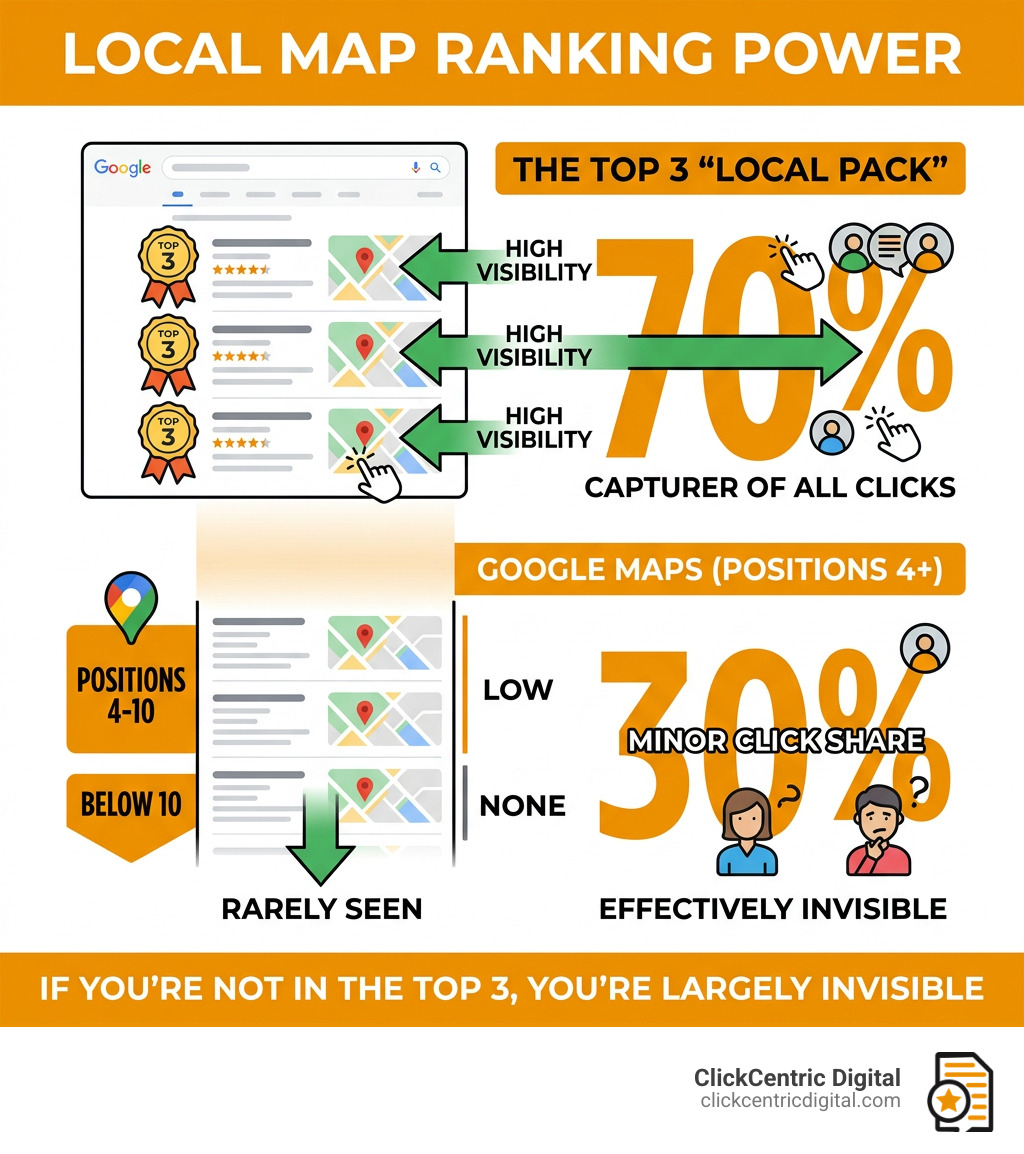
| Ranking Position | Visibility | Result |
|---|---|---|
| Top 3 (Map Pack) | High | ~70% of all clicks |
| Position 4-10 | Low | Rarely seen |
| Below 10 | None | Effectively invisible |
Think about this for a second. A customer in your neighborhood opens Google and types “plumber near me.” Your business is three blocks away. But you’re not showing up. A competitor two miles further wins the job.
That’s the reality of how local rankings work today. Proximity matters, but it’s not the whole story.
The frustrating part? Most business owners have no idea where they actually rank. A single-point rank check — the kind most basic SEO tools provide — only tells you how you rank from one spot, usually the center of your city. It tells you nothing about how you appear to someone searching from their home, their car, or their office a mile away.
The Google Map Pack captures 70% of all clicks in local searches. If you’re not in those top three spots, you’re largely invisible to potential customers who are ready to buy right now.
The good news: there are tools and strategies that show you exactly where you rank across your entire service area — and what to do about the gaps.
The Evolution of Local Map Ranking: Beyond Single-Point Tracking
In the early days of SEO, we used to check rankings by sitting in our office in Grand Rapids or Holland, typing a keyword into Google, and seeing where we landed. If we were #1, we celebrated. But that’s a dangerous way to measure success in 2026.
Modern local map ranking is hyper-fluid. Google uses what we call “proximity bias.” This means your ranking can change literally street by street. You might be the king of the hill when someone searches from Heritage Hill in Grand Rapids, but by the time they drive over to East Grand Rapids, you’ve vanished from the top three results.
Traditional trackers fail because they provide a one-dimensional view. They simulate a search from a single latitude and longitude coordinate. In reality, your customers are searching from their driveways, their office desks, and while waiting in line at a coffee shop in Kalamazoo.
Understanding the Search Engine Optimization & Google Maps Ranking relationship is vital because the Local Pack drives 93% of new business. If you rely on outdated reporting, you are essentially flying blind. Google’s official documentation on distance and proximity confirms that distance is a core pillar of the algorithm. However, prominence (your reputation) and relevance (how well you answer the query) can actually “stretch” your reach, allowing you to outrank closer competitors if your profile is superior.
We often see a “localized reshuffling” where the Map Pack results change based on the density of competitors in a specific neighborhood. For example, in a high-traffic area like downtown Holland MI, the competition is so fierce that your “ranking radius” might only be a few blocks. In a more spread-out area like South Haven or Grand Haven, you might maintain a top spot for several miles.
Understanding the Local Search Grid: A Visual X-Ray of Your Business
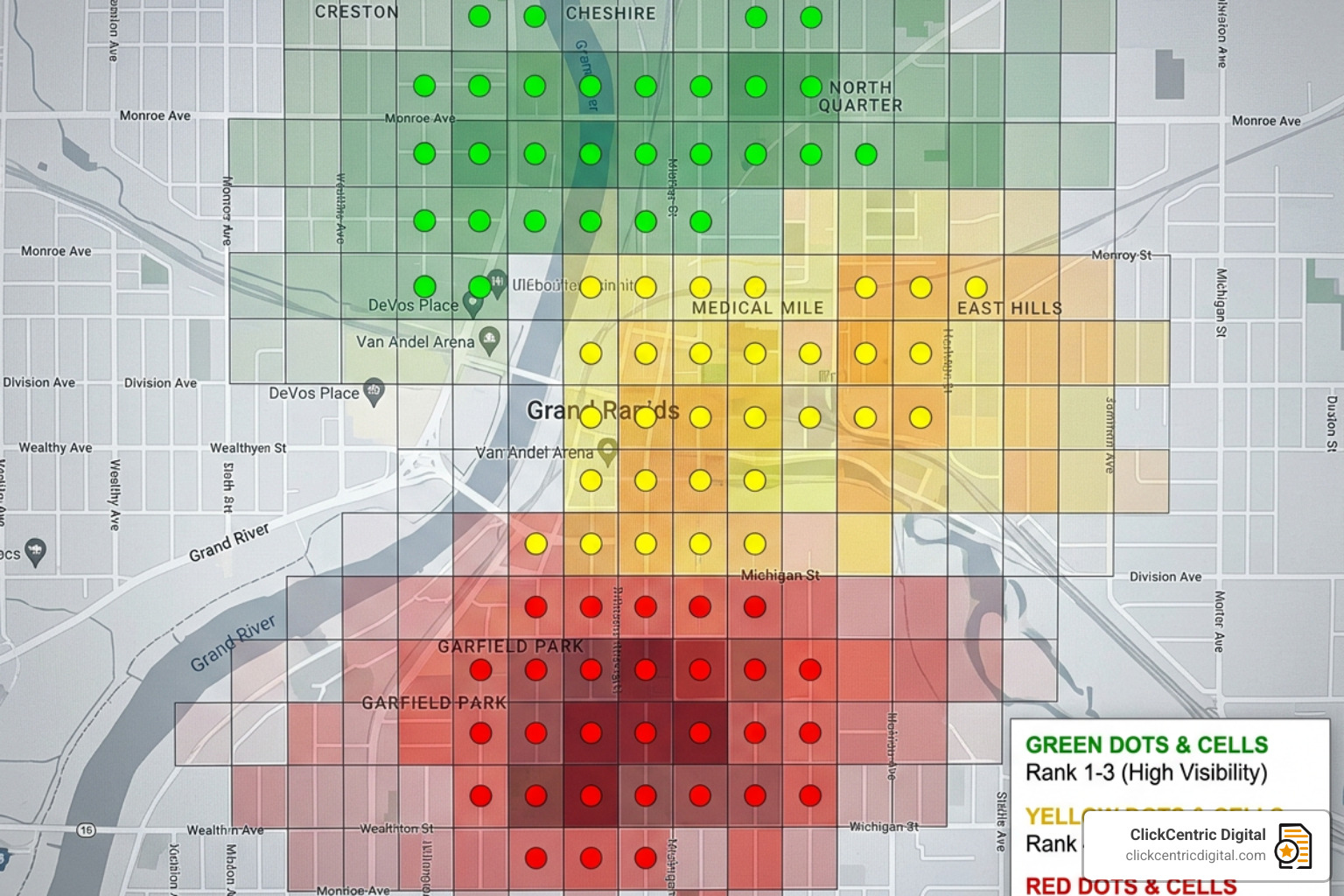
To solve the “blind spot” problem, we use what is known as a Local Search Grid. Think of this as a visual X-ray of your business’s health across West Michigan. Instead of one data point, a grid scan places dozens (or hundreds) of virtual searchers across a map to see exactly where you rank at each spot.
How the Grid Works
We typically set up grids ranging from a 3×3 (9 points) for a very tight local focus, up to a 15×15 (225 points) for a bird’s-eye view of an entire region like Kalamazoo or Grand Rapids. Each point on the grid represents a real-world search.
The results are color-coded, making it incredibly easy to interpret:
- Green (1, 2, 3): You are in the Map Pack. You are winning the clicks.
- Yellow (4-10): You are on the “front page” of maps but not in the top three. You’re a runner-up.
- Red (11-20): You are buried deep in the results. Customers have to scroll and hunt to find you.
- Gray (20+ or “Not Found”): You are effectively invisible in this area.
You can View a sample report to see how these heatmaps tell a story that a spreadsheet never could. By using precise latitude and longitude coordinates, we can identify exactly where your “visibility wall” is. If you’re green in the north but red in the south, we know exactly where our next marketing campaign needs to focus.
How to Improve Your Local Map Ranking in Red Zones
When we see a sea of red or gray on your grid, we don’t panic. We diagnose. There are three common patterns we look for:
- The Swiss Cheese Pattern: This is when you have random green dots mixed with red and yellow. This usually signals inconsistent data. Perhaps your citations (mentions of your name, address, and phone number) are messy, or your Google Business Profile (GBP) is missing key information.
- The Donut Pattern: You rank #1 at your actual office location, but the moment you move half a mile away, you disappear. This is a classic “weak authority” signal. Google trusts you’re there, but it doesn’t think you’re important enough to show to people further away.
- The Competitor Wall: You rank great in one direction but hit a hard “red zone” in another. This usually means a strong competitor is physically located in that area and is dominating the proximity factor.
To fix these, we use an “inside-out” strategy. We first secure the area immediately around your business. Once that’s solid green, we push the boundaries. This involves creating hyper-local content. For instance, if you’re a service provider in West Michigan, we might suggest creating pages specifically for neighborhoods like Ada, Cascade, or Wyoming.
We’ve seen this work exceptionally well in specialized fields. For example, our guide on Local SEO for Veterinarians: Fetching More Clients from Google highlights how neighborhood-specific reviews and localized project photos can break through a “Competitor Wall.”
Top Local Map Ranking Factors for 2026
The local algorithm is constantly evolving. What worked in 2022 won’t cut it in 2026. Here are the heavy hitters we are focusing on this year:
1. The 10-Review Trust Threshold
It’s no longer just about having “more” reviews; it’s about hitting specific algorithmic triggers. Research on the 10-review trust threshold shows a massive jump in visibility once a business moves from 9 reviews to 10. It’s as if Google finally “verifies” you as a legitimate local entity. If you have 8 reviews, you are leaving money on the table. Sprint to 10.
2. The “Openness” Signal
Since late 2023, Google has significantly boosted the weight of business hours. Google’s confirmation of business hours as a ranking factor means that if your business is marked as “Closed” at the time of the search, you are likely to be filtered out of the results entirely for “near me” queries. While it’s tempting to say you’re open 24/7, don’t lie—Google tracks user behavior and “directions requested” to see if people are actually visiting.
3. Primary Categories and “Review Justifications”
Your primary category is the single most important piece of text on your GBP. If you’re a “Personal Injury Lawyer” but your category is just “Lawyer,” you’re losing to more specific competitors. Furthermore, Google now looks for “justifications”—snippets of text from your reviews that match the search query. If a customer in Kalamazoo searches for “emergency furnace repair,” and a review on your profile says “they did a great job with my emergency furnace repair,” Google is much more likely to rank you higher for that specific search.
4. Service Area Businesses (SABs) and Address Hiding
Many of our clients in West Michigan are plumbers, roofers, or cleaners who work at the customer’s location. A common question is: “Does hiding my address hurt my ranking?” The answer is no. Google’s guidelines are clear: if you don’t serve customers at your physical location, you must hide your address. Following these rules prevents “spam flags” and keeps your local map ranking stable.
Measuring Success: Share of Local Voice and AI Visibility
In the past, we just looked at “Average Rank.” Today, we use a much more sophisticated metric: Share of Local Voice (SoLV).
SoLV measures how often your business is the dominant choice across a specific search radius. If there are 100 search points in a grid and you are in the top three for 60 of them, your SoLV is 60%. This is the ultimate proof of ROI for our clients. It shows that your “territory” is actually expanding.
But the search landscape is fracturing. We are no longer just fighting for Google Maps. We are fighting for AI visibility. With ChatGPT boasting over 200 million weekly users and Perplexity query growth statistics showing 780 million queries processed in a single month, your business needs to be “AI-ready.”
| Feature | Traditional Map SEO | AI Visibility (GEO) |
|---|---|---|
| Primary Goal | Rank #1-3 in Google Maps | Be the “Recommended” AI answer |
| Data Source | Google Business Profile | Bing, Yelp, Apple, Brand Mentions |
| User Intent | “Find a business near me” | “Who is the best plumber for X?” |
| Measurement | Local Search Grid / Heatmaps | Share of AI Voice (SAIV) |
Tracking AI Visibility and Local Map Ranking
How do you rank in a world where people ask Siri or ChatGPT for recommendations instead of typing into a search bar? This is called Generative Engine Optimization (GEO).
- Bing Places Synchronization: ChatGPT uses Bing for much of its local data. If your Bing Places profile is outdated, ChatGPT might recommend a competitor who hasn’t even updated their website since 2015 just because their Bing data is “cleaner.”
- Apple Business Connect: For the millions of iPhone users in Grand Rapids and Kalamazoo, Apple Maps is the default. Apple Business Connect now powers Siri, Apple Wallet, and even how your business name appears in a text message.
- Google AI Overviews: Google is now placing AI-generated answers at the very top of the search results, often above the Map Pack. To show up here, your website needs high “entity authority”—meaning you are mentioned on local news sites, chamber of commerce pages, and local blogs.
- Visual Search (Google Lens): People are now taking photos of storefronts or products to find information. Ensuring your GBP has high-quality, branded photos helps Google’s AI identify your business in the real world.
Frequently Asked Questions about Local Map Ranking
Which tool is most accurate for tracking local map ranking?
The most accurate tools are those that offer “dual-source” tracking. This means they track the Local Pack (the 3-pack on the main search results) and Google Maps (the results inside the Maps app) separately. These two algorithms are actually different! The Local Pack values prominence and reviews more, while Google Maps values proximity and distance. A good tool will show you both so you can diagnose if your problem is your location or your reputation.
Does hiding my address hurt my local map ranking?
No. As long as you have defined your service areas correctly in your Google Business Profile, hiding your address (as required for Service Area Businesses) does not inherently lower your rank. In fact, trying to “cheat” by showing a residential address can lead to a suspension, which is the ultimate ranking killer.
How many reviews do I need to see a ranking boost?
As mentioned earlier, the “magic number” is 10. Once you hit 10 verified reviews, you typically see a noticeable lift in your local map ranking. Beyond that, focus on “review velocity”—the consistency of getting new reviews—and ensuring those reviews contain keywords related to your services and your West Michigan location.
Conclusion
At ClickCentric Digital, we know that local map ranking isn’t just about vanity metrics or “feeling good” because you see your name on a screen. It’s about local customer acquisition. It’s about being the first choice for a family in Holland looking for a dentist or a business in Grand Rapids needing an IT consultant.
Stop guessing where you rank. By using visual grid tracking and modern GEO strategies, we turn those red zones into green zones, providing you with visual proof that your marketing budget is actually working.
Ready to dominate the West Michigan market? Improve your local search rankings today and let us help you turn your business into a local landmark.
Sorry, the comment form is closed at this time.