


22 Apr Automated Review Response System Pros and Cons
Automated Review Response System Pros and Cons
Why an Automated Review Response System Can Make or Break Your Online Reputation
An automated review response system is software that monitors, analyzes, and replies to customer reviews across platforms like Google, Yelp, and Facebook — automatically, at scale, and in your brand’s voice.
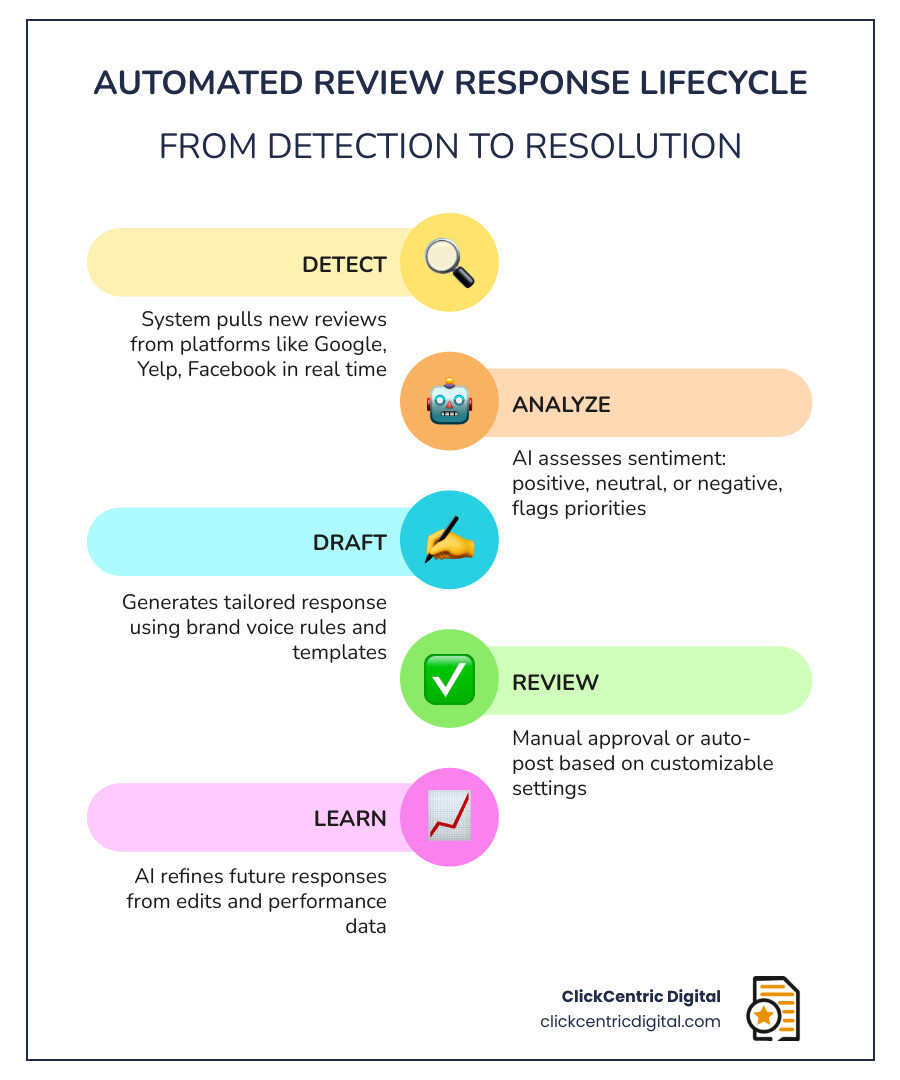
Here’s how it works at a glance:
- Detect — The system pulls in new reviews from connected platforms in real time
- Analyze — AI reads sentiment (positive, neutral, or negative) and flags priority cases
- Draft — A tailored response is generated based on your brand voice rules
- Review — You approve manually, or the system posts automatically based on your settings
- Learn — The AI refines future responses based on edits and performance data
Managing customer reviews by hand might feel like the right approach — personal, attentive, on-brand. But the reality for most local business owners is different.
Reviews come in at all hours. They pile up across multiple platforms. A negative post on a Saturday night sits unanswered until Monday morning, quietly shaping the opinion of every potential customer who reads it before you even see it.
That delay has real consequences.
Over 50% of US consumers expect a response to their review within three days — and that expectation is tightening. According to 2023 Pew Research, Americans increasingly expect near-real-time digital engagement from the businesses they interact with.
The gap between what customers expect and what most small businesses can realistically deliver manually is where reputation damage quietly happens.
This guide breaks down the pros and cons of automated review response systems — so you can decide whether automation is right for your business, and how to implement it effectively if it is.
The Hidden Costs and Challenges of Manual Review Management

Many business owners in Grand Rapids or Kalamazoo start with the best intentions, personally replying to every Google review. However, as a business grows, manual management quickly becomes a “hidden” drain on resources. The most obvious cost is time. If you are spending five hours a week toggling between browser tabs, that is time taken away from serving customers or improving your operations.
Beyond the clock, there is the cost of inconsistency. When you’re tired or stressed, your brand voice might slip. A manual response written on a busy Friday afternoon might sound short or defensive compared to one written on a quiet Tuesday morning. Human error is inevitable; we miss typos, forget to include keywords, or—worst of all—miss reviews entirely.
For multi-location businesses, such as a franchise with spots in Holland and South Haven, manual management leads to fragmentation. One location might be great at responding, while another ignores feedback for weeks. This inconsistency erodes the TrustPilot study on the value of brand reputation, which highlights that a positive online reputation is the single biggest factor affecting consumer trust.
Furthermore, manual management often misses the SEO boat. Google rewards businesses that respond frequently and quickly. If your response rate is low, your local search ranking suffers.
| Feature | Manual Review Management | Automated Review Response System |
|---|---|---|
| Response Time | 24–72+ hours | Near real-time (3-4 hours avg) |
| Labor Cost | High (Hours of staff time) | Low (Fixed monthly subscription) |
| Consistency | Variable (Depends on mood/staff) | 100% Brand-aligned |
| SEO Impact | Minimal/Slow | High (Increased velocity/frequency) |
| Scalability | Difficult | Seamless across 100+ locations |
How an Automated Review Response System Preserves Quality and Brand Voice
A common fear is that an automated review response system will make a business sound like a cold, unfeeling robot. In reality, modern systems use advanced Natural Language Processing (NLP) and machine learning to understand the nuance of a customer’s comment.
By implementing Reputation Management software, we can ensure that every response is contextually relevant. These systems don’t just “blast” a message; they detect sentiment. If a customer mentions “great service” at your West Michigan storefront, the AI identifies that positive sentiment and drafts a warm thank-you. If someone mentions a “long wait,” the system recognizes the frustration and prepares an empathetic apology.
This level of responsiveness is a massive signal for Search Engine Optimization Google Maps Ranking. Google looks for “signals of life.” When a business responds to every review within hours, it signals to search engines that the business is active and reliable, often leading to a 140% increase in non-branded impressions.
Maintaining Authenticity with an Automated Review Response System
To keep things “human,” we use personalization tags and dynamic templates. An effective automated review response system will automatically insert the reviewer’s name and mention specific details from their review.
We can also set custom vocabulary rules. For example, if your brand is “laid back and beachy” for a South Haven location, we can program the AI to use friendly, casual language. If you are a law firm in Grand Rapids, we set the tone to professional and authoritative. By using historical data learning, the AI actually gets better over time, mimicking the edits you make to its drafts until it sounds exactly like you.
Core Components of an Effective Automated Review Response System
An effective system is more than just a “reply bot.” It needs a centralized inbox that aggregates data from every corner of the web. This includes:
- Google Business Profile
- Yelp
- TripAdvisor
- Industry-specific sites like BBB or Yellow Pages
The core components should also include sentiment triggers (to alert you immediately to 1-star reviews) and automated escalation paths. If a review contains words like “legal,” “sue,” or “poisoning,” the system should bypass the auto-reply and ping a manager immediately.
Strategic Implementation and Workflow Optimization
Success with an automated review response system requires a strategy. We don’t recommend turning on “full auto” for everything on day one. Instead, we use a hybrid human-AI workflow.
For 4 and 5-star reviews with no text, the system can handle those automatically. For reviews with detailed text or negative sentiment, the AI drafts a response that stays in a “queue” for a human to give a final “thumbs up.” This ensures you maintain control while still reaping the 6x decrease in response time that automation provides.
It is also vital to have a crisis communications guide for businesses. If a local event causes a sudden spike in negative feedback—like a power outage at your Holland MI facility—you need the ability to pause automation and switch to a manual, crisis-specific response.
Step-by-Step Deployment of an Automated Review Response System
- Connect Platforms: Securely link your Google, Facebook, and Yelp profiles to the centralized dashboard.
- Configure Brand Voice: Define your “Do’s and Don’ts.” (e.g., “Always thank them by name,” “Never use emojis”).
- Set Alert Sensitivity: Decide who gets notified for what. Maybe a 3-star review goes to the marketing lead, but a 1-star review goes to the owner.
- Auto-Reply Queueing: Set up rules for which reviews get an instant reply and which require a manual check.
- Low-Risk Testing: Run the system for two weeks in “draft mode” only to see how the AI performs before letting it post live.
- Staff Oversight Training: Ensure your team knows how to use the dashboard to step in when the AI flags a complex issue.
Monitoring and Measuring Automation Performance
Once the system is live, we track specific KPIs to ensure it’s working. We look for a 4900% increase in the overall review response rate, which is common when moving from manual to automated tools.
We also monitor “Review Velocity”—how many new reviews you are getting per month. Automation often includes “review requests” via SMS or email, which can significantly boost your star rating. Even a 0.1 improvement in your star rating can lead to a measurable increase in foot traffic to your West Michigan locations.
Frequently Asked Questions about Automated Review Response Systems
How do automated systems handle negative or toxic reviews?
Most systems use sentiment analysis to “triage” these. Instead of a generic reply, the system flags the review as “High Priority” and sends an instant alert to your team. It can also detect spam or fake reviews and help you file a dispute with the platform (like Google or Yelp) to have them removed.
Can I approve AI-generated drafts before they are published?
Absolutely. This is called “Hybrid Mode.” The AI does the heavy lifting of writing the response, but it sits in your inbox waiting for a “click to publish.” This gives you the speed of AI with the safety of human oversight.
Does using automation impact my local SEO and search rankings?
Yes, positively! Google’s algorithm favors businesses that have a high response rate and a high “freshness” of reviews. By responding to every review within hours, you are sending strong signals that your business is prominent and trustworthy, which helps you climb the Map Pack rankings.
Conclusion
The automated review response system is no longer a luxury for big corporations; it is a necessity for any local business in Grand Rapids, Holland, or Kalamazoo that wants to stay competitive. While the “pro” is massive time savings and improved SEO, the “con” is the risk of sounding generic if you don’t take the time to configure your brand voice properly.
At ClickCentric Digital, we help you find that perfect balance. We implement targeted strategies for local customer acquisition, ensuring your reputation works for you 24/7, even while you sleep.
Sorry, the comment form is closed at this time.