


15 Apr Don’t Get Lost in the Crowd with a Better Local Search Marketing Strategy
Don’t Get Lost in the Crowd with a Better Local Search Marketing Strategy
Why Your Business Is Invisible Without a Local Search Marketing Strategy
A solid local search marketing strategy is no longer optional for local businesses — it’s the difference between thriving and being completely invisible to customers who are ready to buy right now.
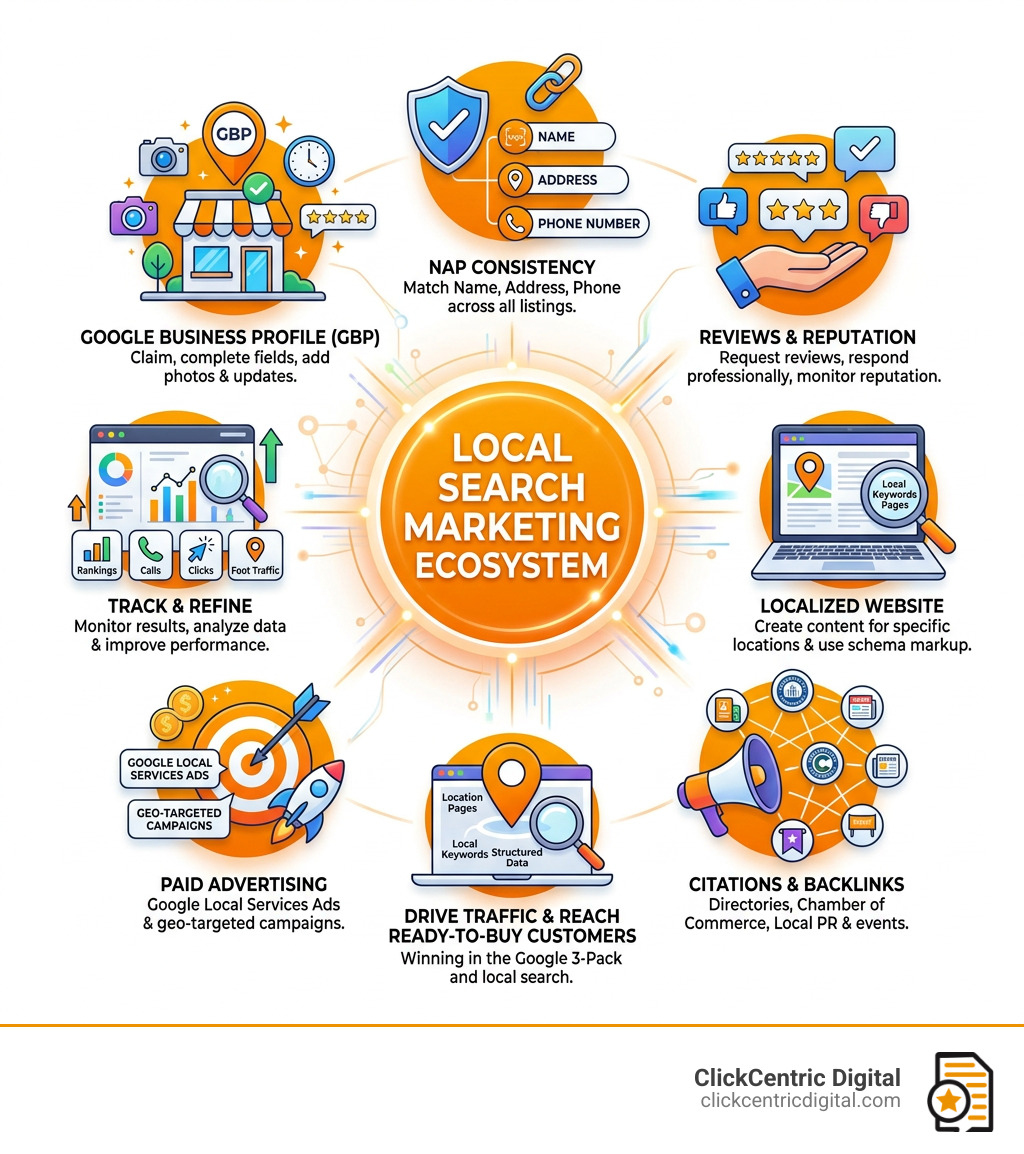
Here’s a quick overview of what an effective local search marketing strategy includes:
- Claim and optimize your Google Business Profile (GBP) — complete every field, choose the right categories, add photos, and keep it updated
- Build NAP consistency — your Name, Address, and Phone number must match across every directory and listing
- Earn and manage reviews — actively request reviews, respond to all of them, and monitor your reputation
- Create localized website content — location pages, hyper-local keywords, and structured data (schema markup)
- Build local citations and backlinks — directories, Chamber of Commerce, local PR, and event sponsorships
- Layer on paid advertising — Google Local Services Ads and geo-targeted campaigns once your organic foundation is solid
- Track and refine — monitor rankings, calls, clicks, and foot traffic to improve over time
Think about your own search behavior for a moment. When you need something nearby — a plumber, a great lunch spot, a dentist — you grab your phone and search. You click one of the first three results on the map. You probably never scroll further.
Your customers do the exact same thing.
In April 2025, analysts counted 1.5 billion “near me” searches every single month — a 500% jump in just a few years. And 46% of all Google searches have local intent. That’s an enormous pool of high-intent buyers searching for businesses like yours.
Here’s the hard truth: 42% of searchers click a result inside the Google 3-Pack and never look further. If you’re not in those top three spots, most of that traffic goes to your competitors — not you.
And it’s getting more competitive, not less. AI-generated search results, voice assistants, and zero-click answers are reshaping how people find local businesses. The old playbook of just “having a website” isn’t enough anymore.
The good news? Small businesses can absolutely compete — and win — against larger brands with the right strategy in place.
Defining Your Local Search Marketing Strategy for 2025
To win in the modern landscape, we first need to understand what we are actually building. A local search marketing strategy is a comprehensive plan to promote your business to customers in a specific geographic area. While many people use the terms interchangeably, there is a slight nuance between local search marketing and local SEO.
Local SEO is the technical and organic process of ranking in the “Map Pack” and local organic results. Local search marketing is the broader umbrella that includes SEO, paid advertising (like Google Ads), reputation management, and social media engagement. In 2025, this strategy must account for driving more “zero-click” traffic. A “zero-click” search is when a user gets all the information they need—like your phone number, hours, or address—directly from the search results page without ever clicking through to your website.
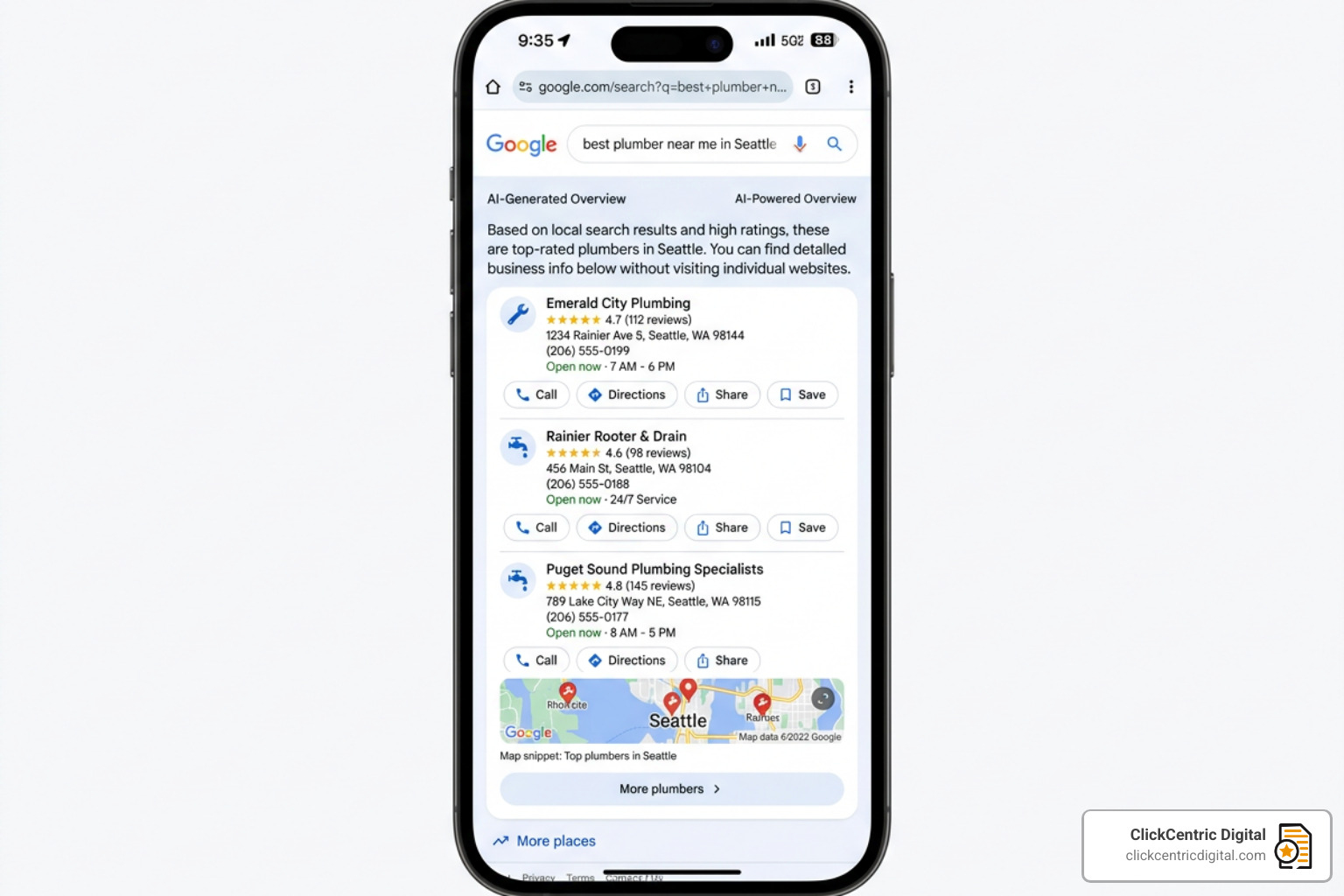
Google determines these results based on three core pillars:
- Proximity: How close is your business to the person searching?
- Relevance: How well does your business profile match what the user is looking for?
- Prominence: How well-known is your business? This is measured by your reviews, backlinks, and overall web presence.
At ClickCentric Digital, we specialize in Search Engine Optimization & Google Maps Ranking to ensure your business hits all three of these marks, especially across West Michigan, from Grand Rapids to Kalamazoo.
Why a Local Search Marketing Strategy is Essential in 2025
The way people shop has fundamentally shifted. We are living in a mobile-first world where 84% of “near me” searches happen on a smartphone. Even more striking is the intent behind these searches: 88% of mobile local searches lead to a store visit, a phone call, or a purchase within a week.
Furthermore, half of all Google searches now feature AI-generated overviews. This means if your business isn’t optimized for these new surfaces, you are missing out on half the potential visibility. Whether someone is asking Siri for a “dentist in Holland MI” or typing “best coffee in Grand Haven” into Google, your local search marketing strategy determines if you are the answer they receive.
The Shift Toward AI-Driven Local Discovery
We are entering the era of “Share of AI Voice.” Large Language Models (LLMs) like ChatGPT and Google’s Gemini are trained on the data they find across the web. To show up in an AI summary, your business needs strong “entity signals.”
This is where Structured data becomes your best friend. By using Schema markup, you provide search engines with a clear, coded map of your business details. AI models use this structured data to understand your geographic coverage and service offerings. If the AI knows you serve “South Haven MI” specifically because of your code, you’re much more likely to be mentioned in a personalized AI recommendation.
The Core Pillars of Local Search Dominance
The foundation of any successful local search marketing strategy starts with your Google Business Profile (GBP). It is the single most important asset you own in the local ecosystem.
To stay on Google’s good side, you must follow Google’s Business Profile guidelines. This means providing accurate, truthful information.
- Category Selection: Be specific. If you deliver pizza in Kalamazoo, choose “Pizza Delivery” rather than just “Restaurant.”
- Service Areas: Clearly define where you work. Don’t claim an entire state if you only service West Michigan.
- Verification: Ensure you complete the verification process immediately to prove your business is legitimate.
Consistency is the glue that holds this together. Your NAP (Name, Address, Phone number) must be identical across the web. If your GBP says “Street” but your website says “St.”, it can create enough friction to lower your rankings.
Mastering Reviews and Reputation Management
In 2025, your reputation is your most powerful marketing tool. Statistics show that 71 percent of people read online reviews when researching a business. Even more importantly, 98% of people place some degree of trust in these reviews.
Effective Reputation Management involves more than just getting stars; it’s about engagement.
- Response Time: A GatherUp study shows that 60% of review writers expect a response within two days.
- Sentiment Analysis: Pay attention to what people are saying. Are they complaining about the wait time in your Holland office? Use that feedback to improve.
- Social Proof: High-quality reviews act as a “purchase trigger.” 6 in 10 consumers won’t even consider a business with less than a 4-star rating.
We recommend a proactive approach: ask every happy customer for a review within 24 hours of their visit. A simple reminder can double your response rate.
Building Authority Through Citations and Local Backlinks
Think of citations and backlinks as “votes of confidence” from the local community. The Guidelines to Representing Your Business on Google emphasize that prominence is built through these external signals.
- Structured Citations: These are listings in major directories like Yelp, Bing Places, and Apple Maps.
- Unstructured Citations: These are mentions of your business on neighborhood blogs, local news sites, or event pages.
- Local PR: Getting a shout-out from a local Grand Rapids news outlet or sponsoring a Little League team in Grand Haven provides high-authority local backlinks that are incredibly hard for national competitors to replicate.
Technical and Content Optimization for Local Reach
Your website is your “home base.” While GBP drives the calls, your website provides the authority that helps you rank. We focus heavily on Website Design & Development that is built specifically for local conversion.
| Feature | On-Page SEO | Technical Local SEO |
|---|---|---|
| Focus | Content and Keywords | Site Infrastructure |
| Local Element | City/Neighborhood names | LocalBusiness Schema |
| Goal | Relevance to the user | Crawlability for engines |
| Key Metric | Keyword rankings | Core Web Vitals |
Google’s Quality Raters look for E-E-A-T (Experience, Expertise, Authoritativeness, and Trustworthiness). For a local business, this means showing you are a real part of the community.
Executing a High-Converting Local Search Marketing Strategy
Creating “Location Pages” is a game-changer for businesses serving multiple areas like Holland, MI and Grand Haven. Each page should have unique content—never just swap out the city name.
- Hyper-local Keywords: Use landmarks or neighborhood names. Instead of just “Plumber in Grand Rapids,” try “Plumber near Heritage Hill.”
- Dynamic Content: You can use dynamic content blocks in your marketing to show different offers to customers in Kalamazoo versus Holland.
- Local FAQs: Answer questions specific to your area. “What are the local building codes for decks in South Haven?” creates massive local authority.
Visual Content and Engagement Signals
Photos and videos aren’t just for decoration; they are data points. Birdeye’s 2025 report found that businesses posting weekly to their GBP see 41% higher engagement rates.
We encourage businesses to upload geotagged photos of their actual work. If you’re a landscaper in West Michigan, show off that patio you just finished in Holland. User-generated content (UGC), like photos uploaded by your customers, is even more powerful because it provides authentic social proof that AI models and human customers both love.
Scaling with Paid Advertising and Emerging Tech
Once your organic foundation is solid, it’s time to “leapfrog” the competition. Paid Traffic Management allows you to appear at the very top of the search results instantly.
Google Local Services Ads (LSAs) are particularly effective because they operate on a pay-per-lead basis rather than pay-per-click. However, be aware that Google may reuse your LSA content across other products, so keep your profile professional.
Don’t ignore Apple! With 60 percent of all smartphone owners relying on Google Maps, Apple Maps is a close second for iOS users. Optimizing your Apple Business Connect profile ensures you are visible to the millions of iPhone users in West Michigan.
As you scale, we use AI visibility tracking to see how often your brand is mentioned in AI Overviews compared to your competitors. For multi-location businesses, we utilize API management to ensure all 10 or 20 of your locations stay updated simultaneously without manual errors.
Frequently Asked Questions about Local Marketing
What is the difference between local SEO and local search marketing?
Local SEO focuses on organic rankings in the Map Pack and search results. Local search marketing strategy is broader, encompassing paid ads, social media, email marketing, and reputation management alongside SEO to drive customer acquisition.
How long does it take to see results from a local search marketing strategy?
You can see initial wins (like a verified listing or fixed NAP) in as little as 30 days. However, for competitive markets like Grand Rapids, it typically takes 3 to 6 months of consistent effort to see significant, sustainable ranking improvements.
Do I need a website if I already have a Google Business Profile?
Yes! Your website and GBP form a unified system. Statistics show that businesses with an optimized website outperform those with only a GBP. Your website is where you control the narrative, house your long-form content, and implement the schema markup that feeds AI models.
Conclusion: Your Action Plan for Local Success
Implementing a local search marketing strategy is an iterative process. It’s not a “set it and forget it” task; it’s a system of small, consistent patterns that build trust with Google and your customers.
At ClickCentric Digital, we help West Michigan businesses dominate their local markets by focusing on the metrics that matter: branded search volume, direction requests, and actual foot traffic.
Ready to stop being invisible? Download the Template for our local SEO checklist and see where you stand. Whether you need help with Search Engine Optimization & Google Maps Ranking or a full-scale digital overhaul, we are here to help you turn every “near me” search into a “right now” customer.
Sorry, the comment form is closed at this time.