

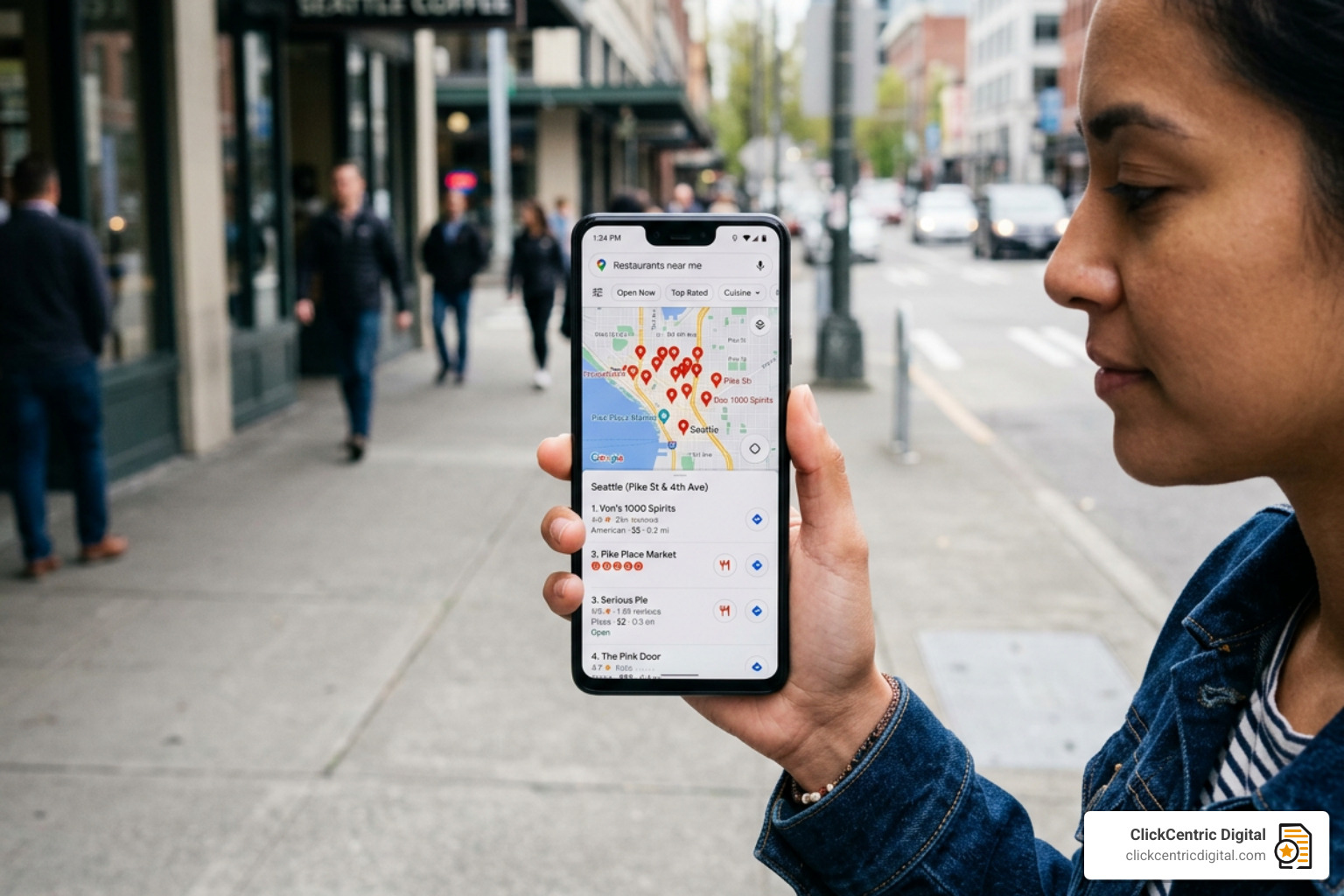
28 Mar The Math Behind a Better Local Search Strategy
The Math Behind a Better Local Search Strategy
Why Your Local Search Strategy Is a Math Problem (And How to Solve It)
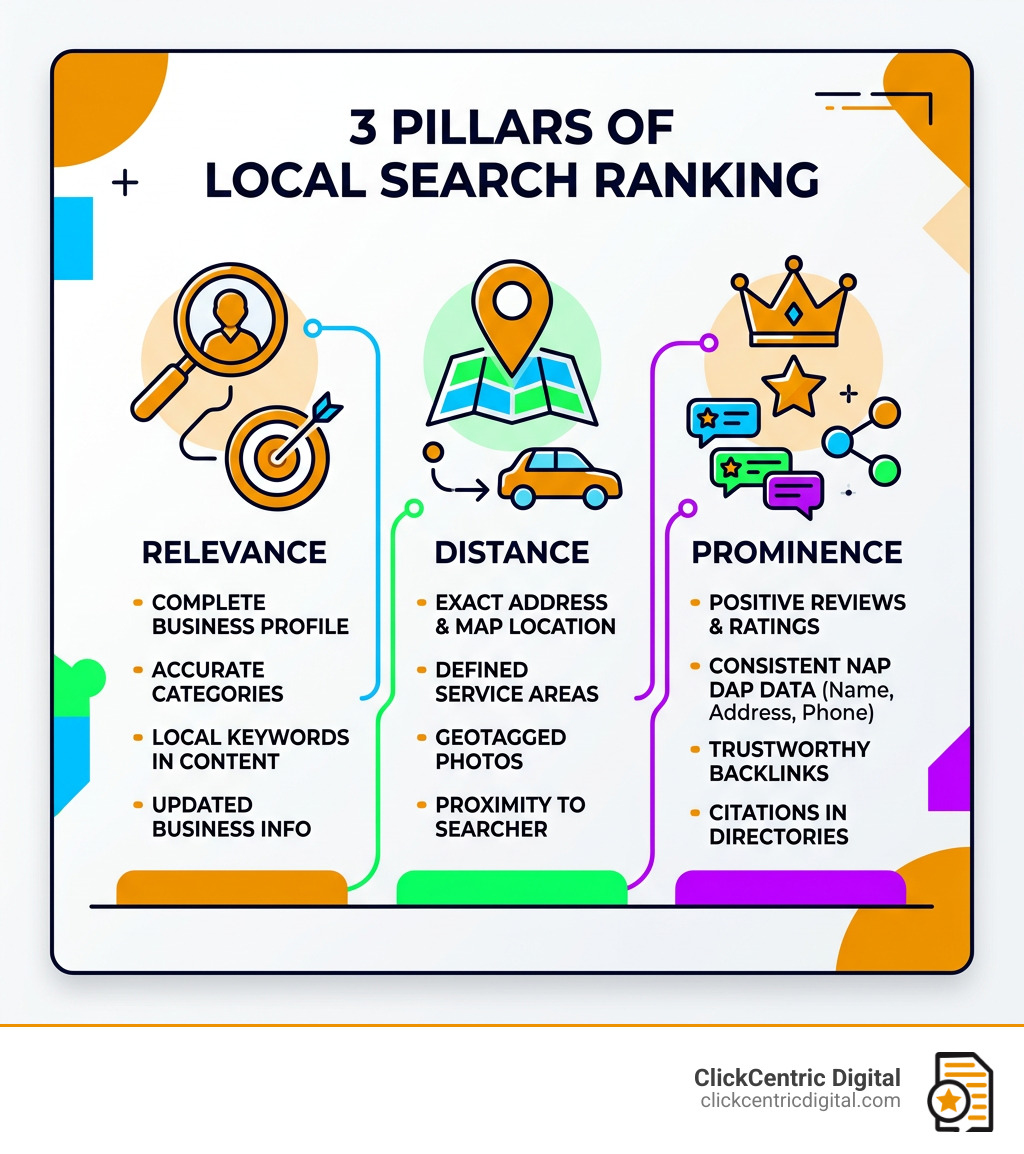
A strong local search strategy comes down to three things Google measures for every local result: Relevance, Distance, and Prominence. Here is a quick breakdown:
| Factor | What It Means | How to Influence It |
|---|---|---|
| Relevance | Does your profile match what the searcher wants? | Complete your Google Business Profile, choose the right category, use local keywords |
| Distance | How close is your business to the searcher? | Accurate address, defined service areas, geo-tagged content |
| Prominence | How well-known and trusted is your business? | Reviews, backlinks, citations, consistent NAP data |
Nearly half of all Google searches have local intent. And 18% of those local searches on a smartphone result in a purchase within the same day. That is not a small window of opportunity — it is a daily pipeline of ready-to-buy customers.
But here is what most business owners miss: Google does not rank local businesses randomly. It runs something close to a weighted probability model — constantly evaluating signals across your profile, website, reviews, and citations to decide who shows up and who gets buried.
The good news? Those signals are measurable. And if you can measure them, you can improve them.
This guide walks you through the exact variables Google weighs, so you can stop guessing and start making smarter decisions about where to focus your time and budget.
The Variables of a Winning Local Search Strategy

When we look at a local search strategy, we aren’t just looking at a checklist; we are looking at a system of variables. Google’s algorithm functions much like a Bayesian model, where it constantly updates the probability that your business is the “best” answer based on new data points (like a fresh 5-star review or a new photo upload).
To dominate the local landscape in West Michigan—from the lakeshore in Grand Haven to the bustling streets of Kalamazoo—you need to master three primary variables: Relevance, Distance, and Prominence. These aren’t just abstract concepts; they are the gears that drive Search Engine Optimization Google Maps Ranking.
Google’s own documentation on how to improve your local ranking emphasizes that these factors combine to find the best match for a user’s query. If a business is further away but more likely to have what the user is looking for, Google might rank it higher than a closer, less relevant option.
Probability and Relevance in Local Ranking
Relevance is the measure of how well a local business profile matches what someone is searching for. In “entity signals,” Google treats your business as a distinct object with specific attributes.
The most critical step here is following the Official Google Business Profile guidelines. This means choosing the correct primary category. If you are a “Plumber” in Holland, MI, don’t just settle for “Contractor.” Precision outperforms generalization every time. According to industry surveys, the primary category remains the #1 ranking factor for the Local Pack.
Keyword matching also plays a role, but it’s not about “stuffing.” It’s about ensuring your business description, services, and even the “from the business” section naturally reflect the terms your customers use. When we align your profile with these entity signals, we increase the mathematical probability that Google views you as the most relevant answer.
The Proximity Factor and User Centroid
Distance is the one variable that is hardest to “hack,” but it is vital to understand. Google calculates the distance between the searcher (the “user centroid”) and the business location.
For Service Area Businesses (SABs) in places like South Haven or Kalamazoo that don’t have a storefront, there is often a debate about hiding addresses for SABs. While Google guidelines require SABs to hide their physical address if they don’t serve customers there, some studies suggest this can impact the “ranking radius.”
We focus on defining your service areas precisely. Instead of just selecting “West Michigan,” we help you list specific cities like Holland, Zeeland, and Grand Rapids. This tells Google exactly where your “radius of relevance” should extend.
Solving for Authority: Profile and Citation Optimization
If Relevance and Distance are about “who” and “where,” Prominence is about “how important.” Prominence is Google’s way of measuring your business’s authority. This is where your digital footprint comes into play.
NAP consistency (Name, Address, Phone number) is the bedrock of your local search strategy. If your business is listed as “ClickCentric Digital” on Google but “Click Centric Marketing” on Yelp, search engines get confused. Confusion equals lower rankings.
We also can’t ignore the growing importance of claiming your Apple Maps listing. With 58% of businesses still neglecting their Apple Business Connect profiles, claiming yours is an easy way to capture the mobile audience that Google might miss.
To understand how Google views your authority, look at your citations:
| Feature | Structured Citations | Unstructured Citations |
|---|---|---|
| Definition | Business listings on formal directories (Yelp, Yellow Pages, Bing). | Mentions on blogs, news sites, or social media. |
| Value | Builds a foundational “trust” signal for your NAP data. | Acts as a “vote of confidence” for your local prominence. |
| Control | Highly controllable via manual or automated tools. | Earned through PR, events, and high-quality content. |
Hyper-Local Keywords in Your Local Search Strategy
In 2025, generic keywords like “dentist” are too competitive. The real wins happen with hyper-local, long-tail queries. People don’t just search for “coffee shop”; they search for “best espresso near downtown Grand Rapids” or “quiet cafe with Wi-Fi in Kalamazoo.”
By researching keywords with Google Keyword Planner, we can identify conversational phrases that match how people actually speak into their phones. Voice search is now a massive part of the equation, with over 55% of consumers using voice assistants to find local businesses. Your content should answer specific questions: “Where is the nearest 24-hour emergency plumber in Holland MI?”
Mentioning local landmarks—like being “just down the street from Western Michigan University” or “near the Windmill Island Gardens”—helps Google anchor your business to a specific geographic context.
Visual Content as an Engagement Multiplier
Photos aren’t just for show; they are data points. Businesses with recent photos receive 42% more requests for driving directions and 35% more click-throughs to their websites.
When you upload geotagged photos, you are providing a “verified” signal of your location. We recommend a high-frequency posting schedule. According to engagement stats for GBP photos, businesses that post weekly see 41% higher engagement than those that post monthly.
Encourage user-generated content (UGC) as well. When a customer posts a photo of your storefront or a completed project, it carries more weight than your own professional photography. It is an authentic signal of “Prominence.”
The Reputation Equation: Reviews and Social Proof
Reviews are the “Entrée” of your local search strategy, not a side dish. They influence both your ranking and your conversion rate. A staggering 98% of consumers read reviews for local businesses, and 90% say those reviews influence their buying decisions.
At ClickCentric Digital, we view Reputation Management as a core pillar of growth. It isn’t just about having a high star rating; it’s about the “Reputation Equation”:
Rating + Volume + Velocity + Diversity = Authority.
The impact of reviews on buying decisions is undeniable, but their impact on Google’s algorithm is just as significant. Reviews provide fresh, keyword-rich content that helps Google understand what you do.
Calculating Review Velocity and Impact
“Review Velocity” refers to how often you get new reviews. If you have 500 reviews but the last one was from 2022, Google (and your customers) might assume you’ve closed shop or your quality has slipped.
According to Moz local search ranking factors, review signals make up about 15% of how Google decides to rank your page in the Local Pack. High velocity signals that your business is active and popular. We help you set up automated systems to request reviews within 24 hours of service, ensuring a steady stream of fresh social proof.
Strategic Response Frameworks
Responding to reviews is no longer optional. Businesses that respond to reviews see a 12% increase in customer retention and a 15% boost in local search visibility.
An Uberall study on review response visibility found that the simple act of replying signals to Google that you are an engaged, trustworthy entity. When responding, follow these rules:
- Be Professional: Even if the review is unfair, stay calm.
- Be Prompt: Aim for a 24-48 hour window.
- Include Keywords: Naturally mention the service and location. (e.g., “We’re so glad you enjoyed our HVAC repair service here in Grand Haven!”)
- Take it Offline: For negative reviews, provide a phone number or email to resolve the issue privately.
Technical Variables: Schema and Mobile Performance
Your website is the “landing page” for your Google Business Profile. If your site is slow, clunky, or not mobile-friendly, your local search strategy will fail. Google uses mobile-first indexing, meaning it looks at your mobile site to determine your rankings.
One of the most powerful technical levers you can pull is Implementing LocalBusiness Schema. Schema markup is a specific code you add to your HTML that tells Google exactly what your content means. It confirms your NAP, your hours, your price range, and even your specific services in a language the search engine understands perfectly.
We also focus on Core Web Vitals—metrics that measure loading speed, interactivity, and visual stability. If your site takes longer than 3 seconds to load on a smartphone, you are likely losing half of your potential local leads before they even see your name.
Optimizing for Zero-Click Searches
A “zero-click” search is when a user gets the information they need (like your phone number or hours) directly from the search results page without ever clicking through to your website.
With the rise of AI Overviews and Knowledge Panels, appearing in these “featured snippets” is crucial. We optimize your content to provide direct answers to common questions. By using Google Search Console for local monitoring, we can see which queries are driving visibility and ensure your “Entity” is strong enough to be the source of truth for Google’s AI.
Measuring Your Local Search Strategy Success
You cannot manage what you do not measure. We don’t just look at “rankings”; we look at “intent completion.” This includes:
- Direction Requests: How many people are asking how to get to you?
- Click-to-Call: How many leads are calling you directly from the map?
- Website Visits: How much local traffic is hitting your service pages?
Using Google Business Profile Performance Insights, we track these interactions monthly. We also implement UTM codes on your GBP website link to differentiate “organic” website traffic from “local” traffic. This allows for a much more accurate ROI calculation, helping you see exactly how many dollars in revenue were generated by your local presence.
Frequently Asked Questions about Local SEO
What is the most important local ranking factor in 2025?
While there is no single “magic” factor, your Google Business Profile primary category and review quality/velocity are currently the strongest signals for the Local Pack. Following these with a mobile-optimized website and consistent NAP data creates a winning foundation.
How long does it take to see results from a local search strategy?
Typically, you will see initial improvements in visibility and engagement within 30 to 60 days of optimizing your profile and fixing NAP inconsistencies. However, dominating a competitive market like Kalamazoo or Grand Rapids usually takes 3 to 6 months of consistent effort.
Do I need a physical address to rank in the Local Pack?
You need a physical address to verify your business with Google, but you do not have to show it publicly. Service Area Businesses (SABs) can hide their address and still rank in the Local Pack for the specific areas they serve.
Conclusion
At ClickCentric Digital, we know that a successful local search strategy is more than just a “set it and forget it” task. It is a dynamic, mathematical approach to building trust with both Google and your local community. Whether you are managing a single shop in Holland or a multi-location enterprise across West Michigan, the principles of Relevance, Distance, and Prominence remain the same.
We specialize in helping businesses navigate these variables, integrating organic SEO with targeted Google and Facebook ads to achieve total market dominance. Ready to turn your local presence into a lead-generation machine? Optimize your local presence with ClickCentric Digital and let’s start solving the math of your growth today.
Sorry, the comment form is closed at this time.