

24 Mar How to Win the Local Pack in 2026 and Beyond
How to Win the Local Pack in 2026 and Beyond
What Are the GMB Ranking Factors Businesses Still Need to Know? (And Why They Still Matter)
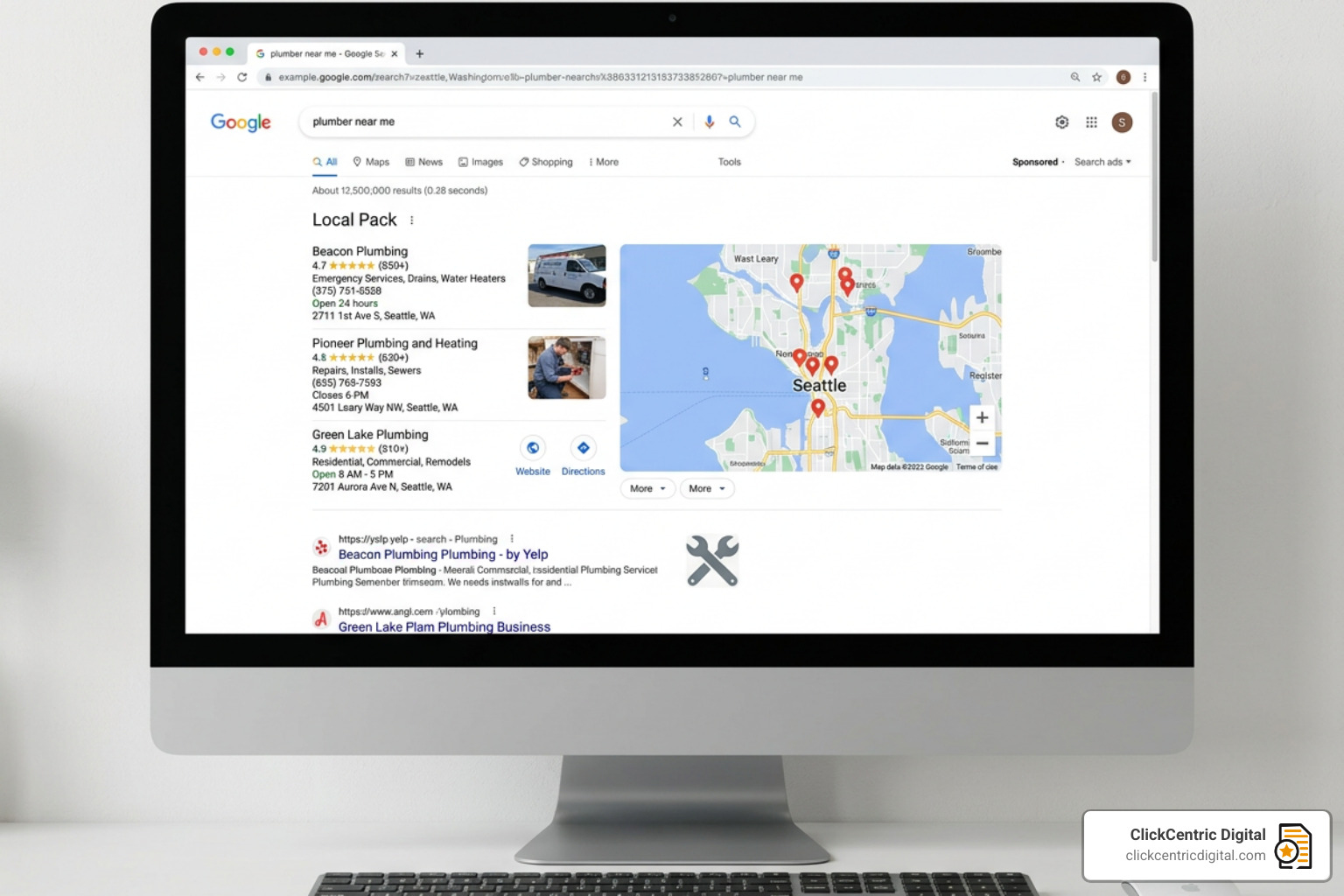
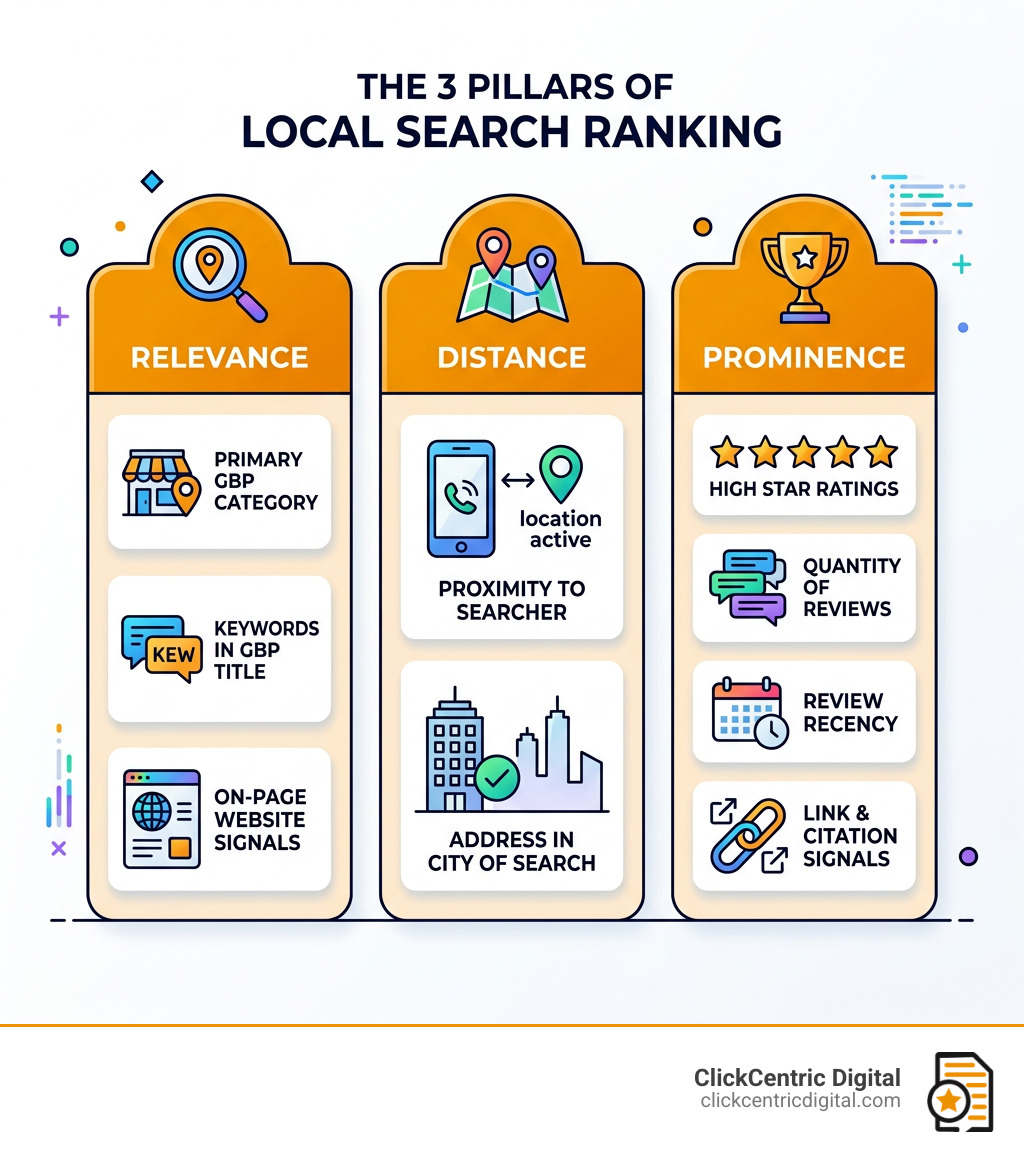
The keyword gmb ranking factors 2023 may refer to an earlier snapshot of local SEO, but the underlying signals are still highly relevant for businesses that want to rank in Google Maps today. These are the signals Google uses to decide which local businesses show up in the Local Pack – that map-based box of three results that appears at the top of search pages. Here are the most important ones, based on long-standing industry consensus:
- Primary Google Business Profile (GBP) Category – the single most influential signal
- Proximity to the searcher – how close your business is to the person searching
- Keywords in your GBP business title – your real business name, not stuffed keywords
- Physical address in the city of search – being located where people are searching
- High Google star ratings – average rating across all your reviews
- Additional GBP categories – secondary categories that expand your relevance
- Quantity of native Google reviews – total number of reviews on your profile
- Review recency – how fresh your most recent reviews are
- On-page website signals – keyword relevance, title tags, and content on your site
- Link and citation signals – mentions and links from other trusted websites
Local search has never been a set-and-forget game. Google’s algorithm keeps evolving – and the gap between what worked a few years ago and what works now is bigger than most business owners realize.
According to Whitespark’s Local Search Ranking Factors survey, Google Business Profile signals alone account for 32% of Local Pack ranking weight. That’s more than any other single category of factors.
But here’s the thing: knowing the list is just the start. How these factors interact – and which ones have quietly gotten more powerful – is where most businesses leave rankings on the table.
This guide breaks it all down: what mattered in the 2023 ranking-factor snapshot, what has shifted since, and exactly what you should be doing now.
The Core GMB Ranking Factors 2023: What Still Matters Today
When we look at the dashboard of a Google Business Profile, it’s easy to get overwhelmed by the options. However, the foundational gmb ranking factors 2023 established a blueprint that remains the gold standard for local visibility in West Michigan. Whether you are operating out of Grand Rapids MI or Kalamazoo MI, the “Big Three” pillars—Relevance, Distance, and Prominence—still dictate who wins the map pack.
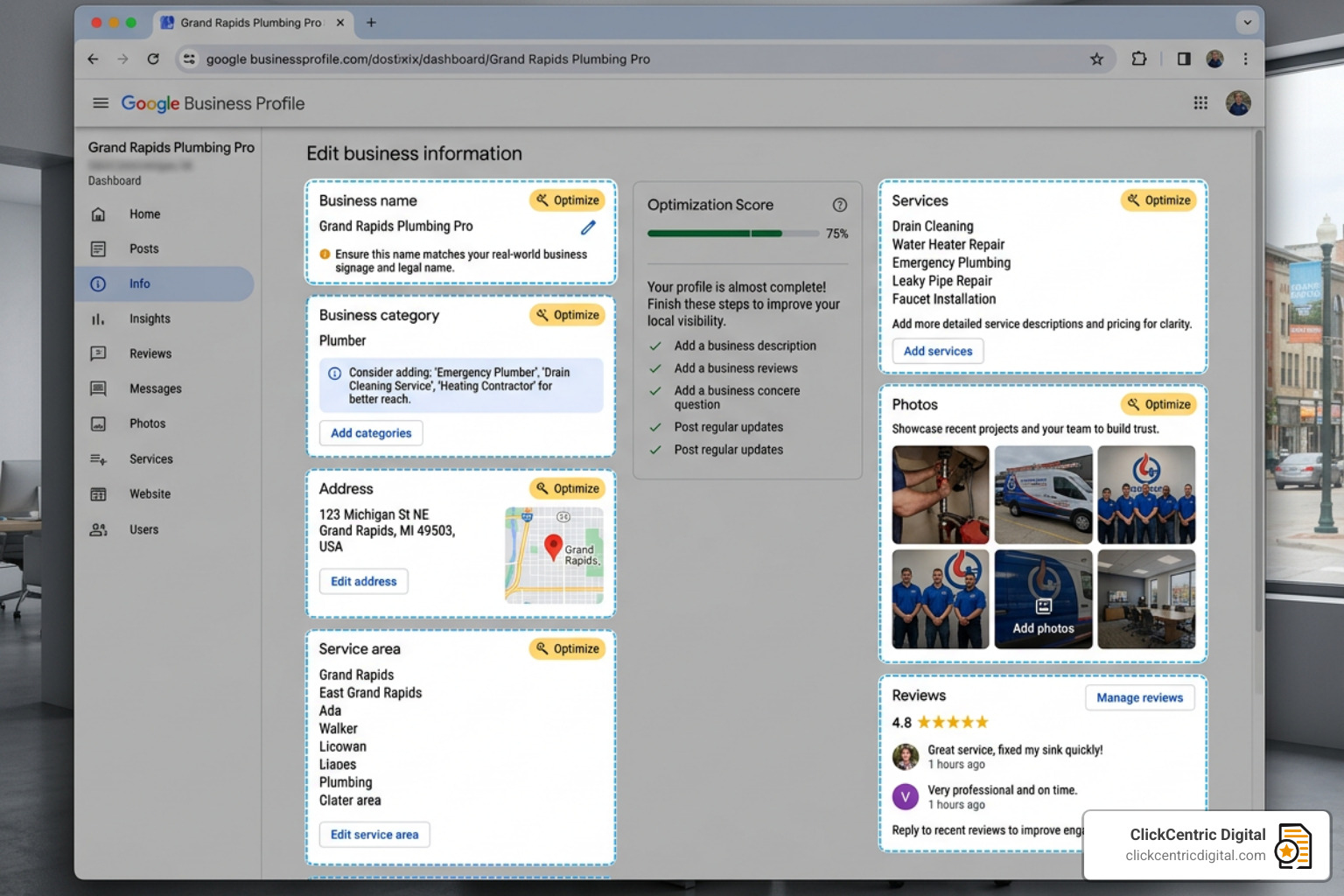
The Primary Category remains the undisputed heavyweight champion of ranking factors. In 2023, it held a massive influence score, and industry data suggests its importance is only growing as Google seeks to categorize businesses with surgical precision. If you’re a “Personal Injury Lawyer” but only categorized as a “Lawyer,” you’re missing out on the specific relevance Google needs to rank you for high-intent searches.
Proximity is the factor we have the least control over, yet it remains a top-two signal. Google prioritizes businesses closest to the searcher’s physical location. While you can’t move your office every time someone searches from a different street in Holland, you can influence your “Prominence” to help Google justify showing your business even if you aren’t the absolute closest option.
One of the most debated gmb ranking factors 2023 is the use of keywords in the business title. While having keywords like “Plumber” or “Dentist” in your name provides a massive ranking boost, Google’s Guidelines for Representing Your Business on Google are very clear: your title must match your real-world business name. Keyword stuffing is the fastest way to get flagged by competitors or suspended by Google’s increasingly aggressive spam filters.
2023 vs. 2026: The Shifting Landscape
To understand where we are going, we have to look at how the weights of these signals are moving.
| Ranking Factor | 2023 Importance Score | 2026 Projected Score | Trend |
|---|---|---|---|
| Primary GBP Category | 193 | 227 | Up |
| Proximity to Searcher | 176 | 225 | Up |
| Keywords in Title | 181 | 223 | Up |
| Review Recency | #93 rank | #11 rank | Skyrocketing |
| Spam Fighting | #5 rank | #19 rank | Down |
Maximizing GMB Ranking Factors 2023 Through Review Recency
If there is one metric that has absolutely exploded in importance since 2023, it is Review Recency. In the 2023 surveys, recency was a mid-tier factor. Fast forward to today, and it has jumped nearly 80 spots in the priority list. Why? Because Google wants to know that your business is active right now.
A business in Grand Haven MI with 500 reviews from three years ago is often outranked by a business with 50 reviews, five of which came in this week. We recommend aiming for a steady “review velocity”—getting at least one or two new reviews every week—rather than a massive burst once a year.
There is also a documented “trust threshold.” Research shows a significant ranking boost when a business moves from 9 reviews to 10. This tenth review seems to signal to Google that you are a verified, established entity. Beyond quantity, customer sentiment and keywords within the reviews themselves act as “keywords you don’t have to write.” When a customer mentions your “emergency furnace repair in Holland MI,” Google uses that unstructured data to boost your relevance for those specific terms.
Impact of Business Categories and Keywords
Choosing your categories is a strategic exercise, not a guessing game. Your Primary Category does about 80% of the heavy lifting. We often see businesses in West Michigan struggle because they’ve chosen a category that is too broad.
To get this right, we suggest a quick competitor audit:
- Search for your #1 desired keyword (e.g., “roofing contractor Grand Rapids”).
- Look at the top 3 results in the Local Pack.
- Use a tool like the GMBSpy Chrome extension to see which primary and secondary categories they are using.
While you can add up to ten categories, more isn’t always better. Adding unrelated categories can dilute your relevance. However, adding relevant secondary categories is a core part of our Google Maps ranking services, as it helps you appear for a wider “net” of related searches.
Remember: Real-world names matter. If your legal name is “Smith & Sons,” don’t change your GBP to “Smith & Sons Best Plumbers Grand Rapids” unless you’ve legally changed your business name. Google is less forgiving than ever, and the penalty for an “Incorrect Primary Category” or a stuffed title has actually increased in severity since 2023.
The Evolution of Behavioral Signals and “Openness”
Google is getting better at watching how humans interact with your business. These are called Behavioral Signals, and they are becoming a dominant force in local rankings.
Think about it: if 100 people search for “coffee shop,” and 80 of them click on the second result to “Get Directions,” Google realizes that the second result is likely the better choice. Other critical behavioral signals include:
- Branded Searches: People searching for your specific business name.
- Click-Through Rate (CTR): How many people click your listing versus others.
- Calls and Bookings: High-intent actions taken directly from the profile.
A rising factor that caught many by surprise in late 2023 is the “Open Now” signal. Google has started heavily favoring businesses that are actually open at the time of the search. If someone searches for an “emergency plumber” at 2 AM, Google may completely hide businesses that aren’t listed as open 24/7. This makes maintaining accurate, real-time hours a mission-critical task. If you say you’re open but don’t answer the phone, users will leave frustrated reviews, creating a negative feedback loop that tanks your rankings.
Technical Hygiene and GMB Ranking Factors 2023
“The boring bits are the important bits again.” That is the mantra for technical hygiene. In 2023, having a verified profile was enough. Today, Google looks for “technical perfection.”
- Proper Map Pin Placement: Is your pin exactly over your front door? If it’s in the middle of the street or the back of the building, it can negatively impact your proximity score.
- Address Visibility: For storefronts in Kalamazoo or South Haven, showing your address is a positive signal. If you are a Service Area Business (SAB), hiding your address according to Google’s policy is necessary to avoid suspension, but storefronts generally have a slight ranking edge in dense urban areas.
- Profile Completeness: A profile that is 100% complete—including products, services, and a detailed description—sends a signal of professionalism and authority.
If you find a competitor who is clearly cheating—perhaps using a PO Box or a fake address to rank in a city they aren’t in—you can use the business redressal form to report them. Google has become slightly less proactive about fighting spam themselves, meaning “community policing” by honest business owners has become more effective.
On-Page SEO and the Rise of AI Search Visibility
Your website and your Google Business Profile are two sides of the same coin. In 2023, On-Page Signals accounted for roughly 19% of Local Pack rankings and a massive 36% of local organic rankings.
To win today, you need Topical Authority. This means your website shouldn’t just have one “Services” page. Instead, you should have dedicated landing pages for every specific service you offer in every city you serve. For example, a “Water Damage Restoration in Holland MI” page will perform significantly better than a generic “Restoration” page.
Key elements for your On-Page SEO Checklist include:
- LocalBusiness Schema: Code that tells Google exactly what your NAP (Name, Address, Phone) is.
- Keywords in H1/H2 Headings: Ensuring your primary service and city are in the main headers.
- Internal Linking: Linking from your blog posts to your service pages to show Google which pages are most important.
We are also seeing the rise of AI Search Visibility. Platforms like Perplexity and ChatGPT (via Bing) are now being used for local discovery. These AI engines don’t just look at your GBP; they look for mentions of your business on “Best Of” lists, local news sites, and unstructured citations (blogs and community forums). Being featured as one of the “Best Dentists in West Michigan” on a local blog is now a powerful ranking signal for both Google and AI search engines.
Avoiding Negative Signals and Suspension Risks
As Google’s algorithm becomes more sophisticated, it is also becoming less forgiving. The “Wild West” days of local SEO are over, and the penalties for cutting corners are severe.
The biggest negative factor in 2023—and still today—is an Incorrect Primary Category. If Google thinks you are misrepresenting what you do, they will bury your listing. Other high-risk activities include:
- PO Boxes and Virtual Offices: Google wants to see a physical location where customers can actually visit (or where you truly operate from). Using a UPS Store address is a one-way ticket to suspension.
- Fake Reviews: Google’s AI is now incredibly good at spotting patterns of fake reviews. If you get 20 reviews in one day from accounts that have never left a review before, expect a “permanently closed” flag or a total profile wipe.
- Review Gating: This is the practice of only asking happy customers for reviews while sending unhappy ones to a private feedback form. This violates Google’s terms of service.
The goal is to build a profile that is “suspension-proof” by being honest, consistent, and active. If your reputation falls below 4 stars, it’s not just a conversion problem; it’s a ranking problem. 51% of consumers won’t even consider a business with less than 4 stars, and Google knows it.
Frequently Asked Questions about Local SEO
What is the #1 ranking factor for the Local Pack?
The Primary GBP Category remains the #1 factor. It tells Google what you are at the most fundamental level. If this is wrong, no amount of reviews or backlinks will help you rank for the right terms.
How does proximity to the searcher impact rankings?
Proximity is a “gatekeeper” factor. Google identifies all businesses within a certain radius of the searcher that meet the relevance criteria. While you can’t change your location, you can expand your “ranking radius” by improving your Prominence (reviews and links) and Relevance (on-page SEO).
Are citations and backlinks still important for GMB?
Yes, but the focus has shifted from quantity to quality. In 2021, you might have wanted 200 directory listings. In 2026, you want 20 high-quality, industry-relevant links and “unstructured citations” from local West Michigan news sites or “Best Of” lists. These prove to Google that you are a real, authoritative entity in your community.
Conclusion
Winning the Local Pack in 2026 requires a shift in mindset. It’s no longer just about the gmb ranking factors 2023; it’s about building a multi-platform search ecosystem.
Google wants to reward businesses that are prominent, relevant, and—most importantly—trustworthy. By nailing the “boring” technical basics, maintaining a fresh stream of reviews, and optimizing your website for topical authority, you can future-proof your rankings against whatever algorithm update comes next.
At ClickCentric Digital, we specialize in these targeted strategies for local customer acquisition. Whether you’re looking to dominate the map pack in Kalamazoo or scale your leads in Grand Rapids, we help you manage the complexity so you can focus on running your business.
Ready to put your business on the map? Explore our specialized Search Engine Optimization & Google Maps Ranking services and let’s start growing your local presence together.
Sorry, the comment form is closed at this time.