

20 Mar Mastering Google PPC Management Without Losing Your Mind
Mastering Google PPC Management Without Losing Your Mind
Why Google PPC Management Determines Whether Your Ad Budget Grows or Disappears
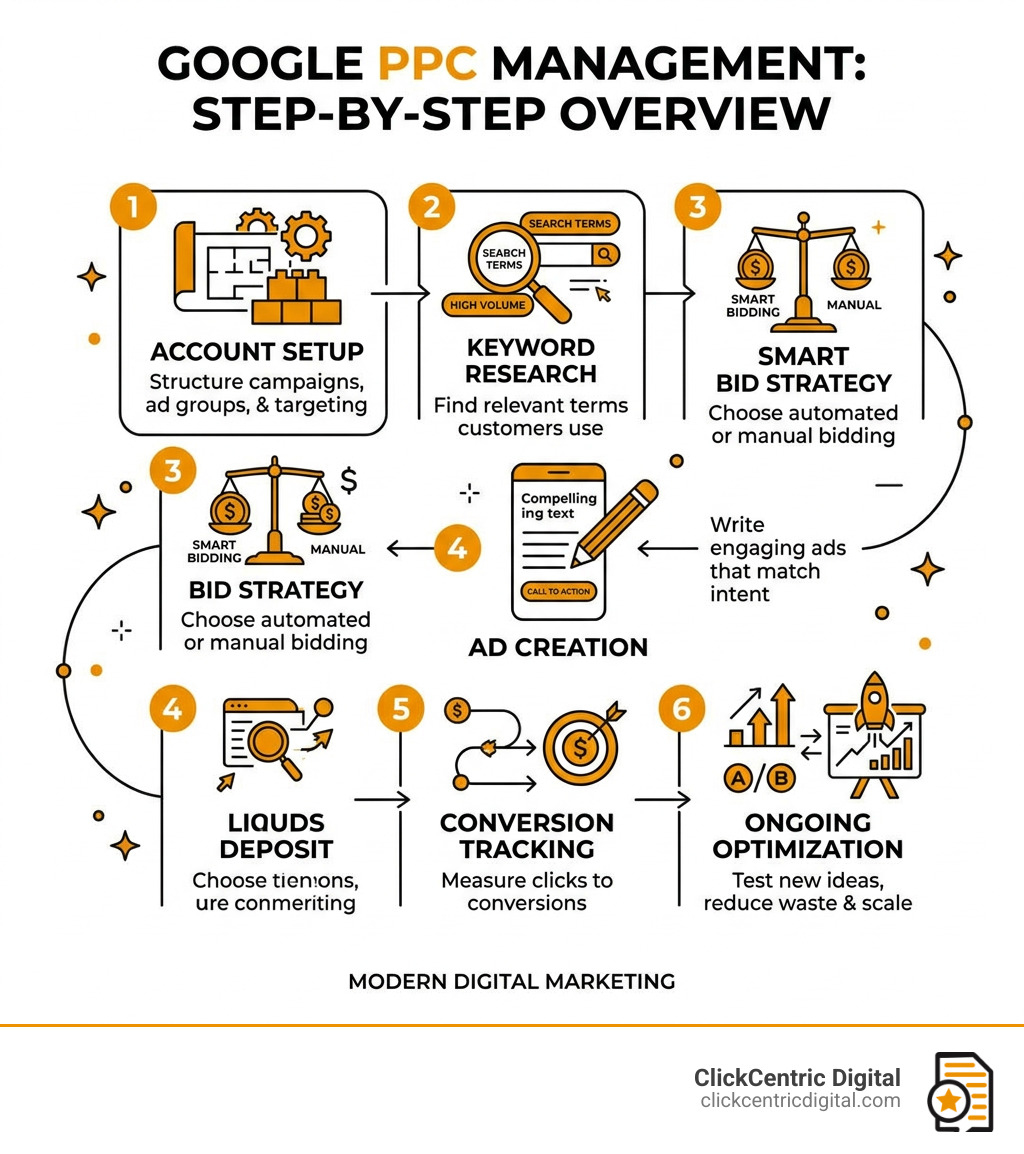
Google PPC management is the ongoing process of setting up, optimizing, and maintaining paid ad campaigns on Google Ads to drive profitable traffic to your business.
Here’s what effective Google PPC management involves:
- Account setup – Structuring campaigns, ad groups, and targeting correctly from the start
- Keyword research – Finding the search terms your customers actually use
- Bid strategy – Choosing between Smart Bidding automation or manual control
- Ad creation – Writing compelling ads that match what searchers want
- Conversion tracking – Measuring which clicks turn into real customers
- Ongoing optimization – Cutting waste, scaling what works, testing new ideas
If you run a local business, you already know the frustration. You spend money on Google Ads, the clicks come in, but the phone doesn’t ring. Something is wrong, but it’s hard to know what.
That feeling is more common than you’d think. And it’s almost always a management problem, not a Google problem.
The numbers tell a clear story about what’s possible when campaigns are run well. 93% of marketers consider PPC an effective channel. Businesses typically earn around $2 for every $1 spent on ads – and the best-managed campaigns push that to an 8:1 return.
The gap between average and excellent comes down almost entirely to how the campaigns are managed.
Google’s platform has changed dramatically in recent years. AI-powered bidding, Performance Max campaigns, and automated targeting have made things both more powerful and more complex. Getting the most out of these tools requires real expertise – not just a login and a budget.
This guide walks you through everything: account setup, campaign types, bidding strategies, costs, and the mistakes that quietly drain budgets. Whether you’re managing ads yourself or evaluating an agency, you’ll know exactly what good looks like.
Building a Foundation: Account Setup and Google PPC Management Essentials
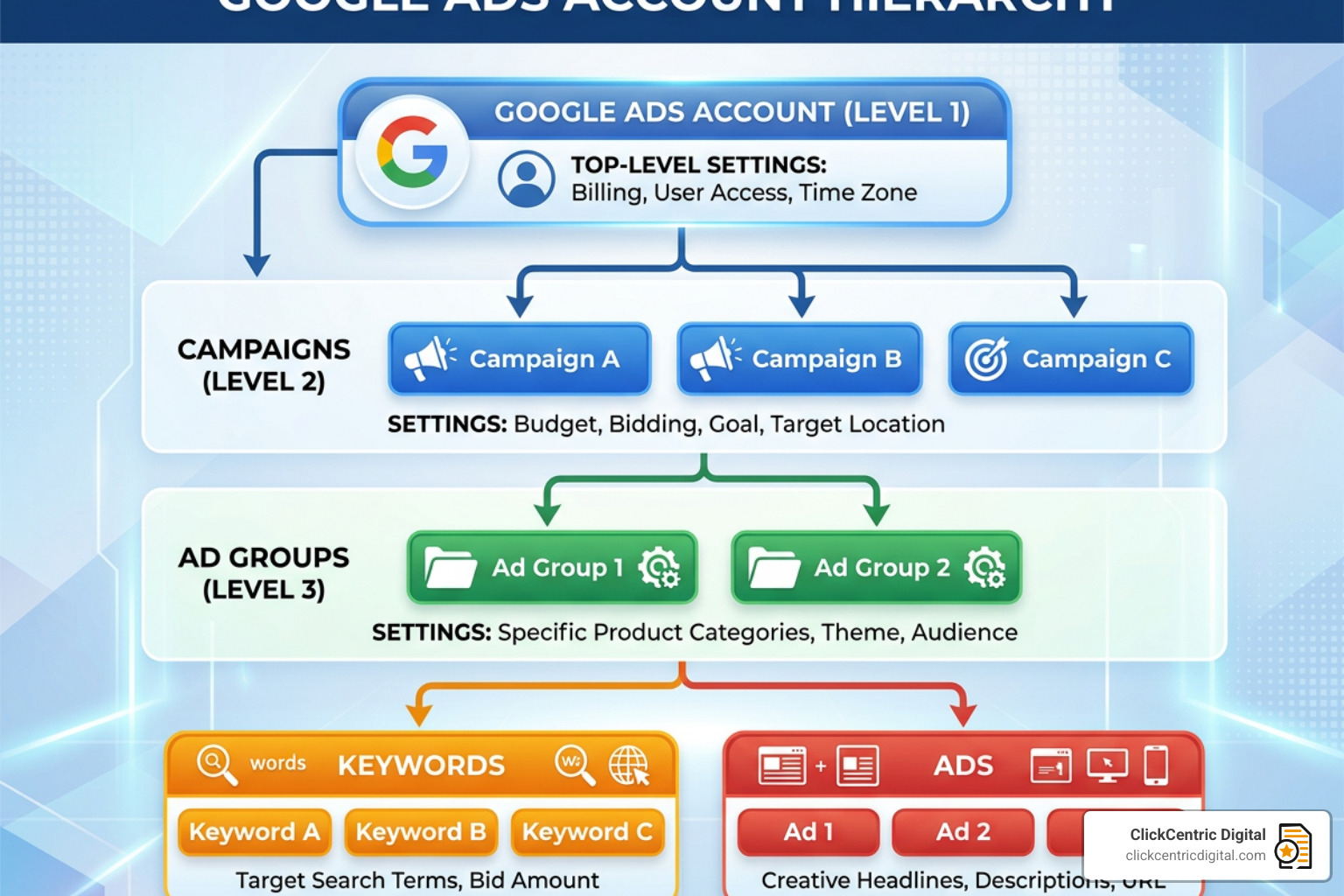
Before we ever write a single line of ad copy, we have to build the house. In google ppc management, your account structure is the foundation. If the foundation is cracked, the most beautiful ad in the world won’t save your ROI.
A proper Google Ads account follows a specific hierarchy: Account > Campaigns > Ad Groups > Keywords and Ads. For businesses in West Michigan, whether you are in Grand Rapids, Holland, or Kalamazoo, this structure allows you to control your budget geographically and topically.
One of the first things we do is set up conversion tracking for your website. Without this, you are essentially flying a plane in a fog bank without an altimeter. You might be at 10,000 feet, or you might be ten feet from the ground—you simply don’t know.
Data integration is the next step. We don’t just want to see that someone clicked; we want to see if that person became a lead in your CRM. Syncing your CRM (like Salesforce or HubSpot) with Google Ads allows the system to understand “Value-Based Bidding.” This means we tell Google to go find more people who actually buy, not just people who like to click on buttons.
Finally, we configure billing and set clear goals. Are we looking for phone calls, form fills, or direct e-commerce sales? Each requires a different campaign setup.
Professional Google PPC Management: Why Expertise Matters
You might be wondering, “Can’t I just do this myself?” Technically, yes. Google makes it very easy to “Start Now” and spend money. However, there is a massive difference between spending money and investing it.
Professional google ppc management provides strategic oversight that software alone cannot match. We’ve seen clients come to us missing 30-40% of their conversions because of tracking issues. That is a massive amount of data that Google’s AI needs to work correctly. When you start now with a Google Ads expert, you aren’t just paying for someone to “push buttons.” You are paying for:
- Time Efficiency: You focus on running your business in Grand Haven or South Haven while we handle the daily bid adjustments.
- Wasted Spend Prevention: We identify “negative keywords” that prevent your ads from showing up for irrelevant searches (like someone looking for a “free” version of your paid service).
- Advanced Optimization: Moving beyond basic Search ads into the complex world of Performance Max and Demand Gen.
The Role of Conversion Tracking and Data Integrity
If you don’t understand your conversion tracking data, you cannot optimize. Period.
Modern PPC management relies heavily on “signals.” When a conversion happens, we send a signal back to Google. But what about “offline conversions”? If a customer calls your office in Holland, MI, and closes a deal three weeks later, Google doesn’t naturally know that. We use tools like Google Tag Manager (GTM) and offline conversion imports to close that loop.
We also look at attribution models. The “Last Click” model is a bit old-fashioned—it gives all the credit to the last thing someone touched. In reality, a customer might see a YouTube ad, then a Display ad, and then search for you. Data-driven attribution uses AI to understand the entire journey, ensuring we don’t accidentally turn off the YouTube ad that actually started the sale.
Navigating the Google Ads Ecosystem: From Search to Performance Max
Google Ads is no longer just “the ads at the top of the search page.” It is a massive ecosystem.
| Ad Type | Best For | Key Advantage |
|---|---|---|
| Search Ads | High-intent leads | Shows up exactly when someone searches for you. |
| Display Ads | Brand awareness | Reaches people while they browse 2M+ websites. |
| YouTube Ads | Engagement/Storytelling | Great for visual products or services. |
| Shopping Ads | E-commerce | Shows the product image and price immediately. |
| Performance Max | Cross-channel ROI | Uses AI to find customers across all Google properties. |
The Search Network remains the bread and butter for most local service businesses. It captures “high-intent” prospects—people actively looking for a solution. However, we often use Display and YouTube to stay “top of mind” for those who aren’t ready to buy today (remember, 92% of first-time visitors aren’t ready to purchase yet!).
Mastering Performance Max and AI-Driven Campaigns
Performance Max (or PMax) is the “new kid on the block,” and it’s incredibly powerful. It’s a goal-based campaign type that allows us to access all Google Ads inventory (Search, YouTube, Display, Discover, Gmail, and Maps) from a single campaign.
To succeed here, you need to follow a best practices guide for Performance Max. It’s not about keywords; it’s about “Asset Groups.” You give us the images, videos, and headlines, and Google’s AI tests millions of combinations to see what works.
We also use “Audience Signals.” This is where we tell the AI, “Hey, here is a list of our current customers—go find more people who look like them.” This helps the machine learning phase ramp up much faster.
Integrating Local Services Ads (LSAs) into Your Strategy
For our local service providers in West Michigan—plumbers, lawyers, HVAC techs—Local Services Ads are a game-changer. These are the ads that appear at the very top of Google with the “Google Guaranteed” or “Google Screened” badge.
The best part? You pay per lead, not per click. If the phone doesn’t ring, you don’t pay. You can check the LSA eligibility list to see if your industry qualifies.
LSAs rely heavily on proximity targeting and professional verification. Google puts its own reputation on the line with a $2,000 lifetime reimbursement cap for customers if the job isn’t done right. This builds massive trust before the customer even clicks.
A Proven Step-by-Step Process for High-Performance Campaigns
We don’t guess; we follow a process. Successful google ppc management is about repeatable steps that lead to predictable results.
- Account Audit: We look for “waste”—geographic areas that don’t convert or keywords that spend money but never lead to a phone call.
- Quality Score Improvement: Google rewards relevance. If your ad matches the searcher’s intent and leads to a great landing page, Google lowers your cost per click. Learning how to improve your quality score is like getting a discount on every ad you buy.
- Landing Page Optimization: You can’t send specialized traffic to a generic homepage. We ensure the landing page has “message match”—if the ad promises a “Free Consultation,” the landing page better say “Free Consultation” in big letters at the top.
- SEO Integration: We often use data from our Search Engine Optimization & Google Maps Ranking efforts to inform our PPC. If a keyword is too hard to rank for organically, we buy our way to the top with PPC.
- Audience Mapping: We align ads with where the customer is in their journey. A “How to fix a leaky faucet” search gets an educational ad; a “Plumber near me” search gets a “Call Now” ad.
Advanced Bidding Strategies and Smart Bidding
Gone are the days of manually changing bids by five cents every Tuesday. More than 80% of advertisers now use automated bidding. When we talk about finding success with Smart Bidding, we are talking about using Google’s AI to bid in “real-time.”
Google’s AI looks at millions of signals for every single auction:
- What device is the user on?
- What time of day is it?
- What is their past search history?
- Are they physically located in Grand Rapids or just visiting?
We typically use Target CPA (Cost Per Acquisition) if we have a set budget for a lead, or Target ROAS (Return on Ad Spend) if we want to maximize revenue. Advertisers switching from Target CPA to Target ROAS often see a 14% increase in conversion value!
Effective Keyword Research for Google PPC Management
Keyword research is the heart of the “Search” side of Google Ads. But it’s not just about finding high-volume words. It’s about finding profitable words.
According to the About Keywords in Search Network campaigns page, relevance is king. We use the Google Keyword Planner to see what people in West Michigan are searching for.
We also heavily utilize Negative Keywords. If you are a high-end kitchen remodeler, we want to make sure you don’t show up for “cheap kitchen cabinets” or “DIY kitchen repair.” This one step alone can save businesses thousands of dollars in wasted spend every month.
Understanding Costs, Pricing Models, and Common Pitfalls
How much does Google Ads cost? It’s the million-dollar question. The answer is: it depends on your industry and your goals.
In google ppc management, there are three main costs:
- Ad Spend: This goes directly to Google. You only pay when someone clicks (CPC) or when your ad is shown (CPM).
- Management Fees: This is what you pay an agency like us to make sure your ad spend isn’t wasted.
- Creative/Landing Page Costs: The cost to build the pages and ads that actually convert the traffic.
Agencies typically use one of three pricing models:
- Percentage of Spend: Usually 10-20% of your ad budget.
- Flat Fee: A set monthly price regardless of spend (great for smaller budgets).
- Hybrid: A lower flat fee plus a small percentage of spend.
We recommend checking the measure your results page frequently to ensure your Cost Per Lead (CPL) makes sense for your business margins.
Avoiding Common Google Ads Mistakes
We’ve seen it all. The most common mistake is using “Broad Match” keywords without any negative keywords or Smart Bidding. This is how you end up paying for clicks that have nothing to do with your business.
Another big one is neglecting Responsive Search Ads. Google wants you to provide multiple headlines and descriptions so it can mix and match them. If you only provide one headline, your “Ad Strength” will be low, and you’ll pay more for every click.
Other pitfalls include:
- Missing Ad Extensions: Not including your phone number or location in the ad.
- Poor Mobile Optimization: 60%+ of searches happen on mobile. If your site is slow on a phone, you’re throwing money away.
- No Clear Goal: Running ads just to “get your name out there” without tracking a specific action.
Choosing the Right Agency and Measuring ROI
When choosing a partner for Paid Traffic Management, look for transparency. You should always own your Google Ads account. If an agency won’t let you see the data, run away!
A good agency will focus on the metrics that matter:
- CTR (Click-Through Rate): Are people interested in the ad?
- Conversion Rate: Are they taking action on the website?
- ROAS (Return on Ad Spend): For every dollar we give Google, how many do we get back?
Remember the 8:1 benchmark? That’s our North Star. We want to turn your marketing from a “cost center” into a “profit engine.”
Frequently Asked Questions about Google Ads
How much does Google Ads management typically cost?
Most professional management starts between $500 and $1,500 per month for small to mid-sized businesses, or 10-20% of ad spend for larger accounts. This covers the strategy, optimization, and reporting that keeps your CPL low.
How do I choose the right PPC agency for my business?
Look for an agency that understands your specific local market. If you are in Grand Rapids or Kalamazoo, you want someone who knows the local search landscape. Ask for case studies and ensure they are “data-driven” rather than just “creative.”
What results can I expect in the first 90 days of a campaign?
The first 30 days are the “Learning Phase” where Google’s AI gathers data. By day 60, we are usually trimming the waste and seeing the CPL stabilize. By day 90, we are typically in full optimization mode, scaling the winners and hitting our ROAS targets.
Conclusion
Mastering google ppc management doesn’t have to be a nightmare. It requires a blend of technical setup, creative messaging, and constant data analysis. At ClickCentric Digital, we specialize in helping businesses across West Michigan—from the lakeshore in Holland to the bustling streets of Grand Rapids—capture local customers through targeted search and ads.
Whether you need to dominate the “snack pack” with LSAs or scale your e-commerce brand with Performance Max, we have the expertise to make it happen. Don’t let your ad budget disappear into the “broad match” void.
Ready to see what professional management can do for your bottom line? Explore our Paid Traffic Management services today and let’s start building your profit engine.
Sorry, the comment form is closed at this time.